How SaaS startups show subscription pricing on their business model slide: price points, tiers, what the price is charged on, and why customers pay.
SaaS Business Model Slide: Pricing Examples
Seven SaaS business model slides, shown in full, compare how companies present subscription pricing: whether a price is shown, what it is charged per, and whether the slide explains why a customer would pay it.
TL;DR
A SaaS business model slide should state a price, the unit it is charged on (per month, per user, per usage level) and why the customer earns it back. In the examples below, Nicereply shows four tiers tied to usage (500, 2,500 and 5,000 ratings a month); Akmazio gives a starting price ($300/month) and says customers need only 2–3 leads a month to justify it; ReCheck lists three models with exact prices. The weakest say "subscription" with no number (CourtCorrect, Buzzient) or promise "disruptive pricing" without showing it (Makematic). Show a price, the unit and the payback in one line; leave revenue totals to the traction and financials slides.
SaaS business model slides from real pitch decks
Each example shows the exact stored slide above its analysis and links to the full teardown. Prices are as shown on the slides at the time of the deck, not current prices. Stage and year are given only where the slide or deck states them.
Nicereply business model slide — slide 6
Customer satisfaction survey software. Stage and year are not stated on the slide.
Nicereply deck, slide 6. Exact stored slide matched to this analysis.
Our analysis: Every tier has a price and a usage limit, so an investor can see how revenue rises with customer size.
Evidence and limitation: It's a copy of the pricing page. Add the share of customers on each tier or the average revenue per account.
What a founder can adapt: Tie each tier to the usage measure that grows with your customer.
Supporting analysis
What the deck claims: "Business model — Monthly subscription plans": Starter $87 (500 ratings/month), Pro $197 (2,500 ratings/month), Business $329 (5,000 ratings/month), Enterprise ("Do you need more?", contact us).
Presentation choice: Every tier has a price and a usage limit, so an investor can see how revenue rises with customer size.
When it does not fit: It's a copy of the pricing page. Add the share of customers on each tier or the average revenue per account.
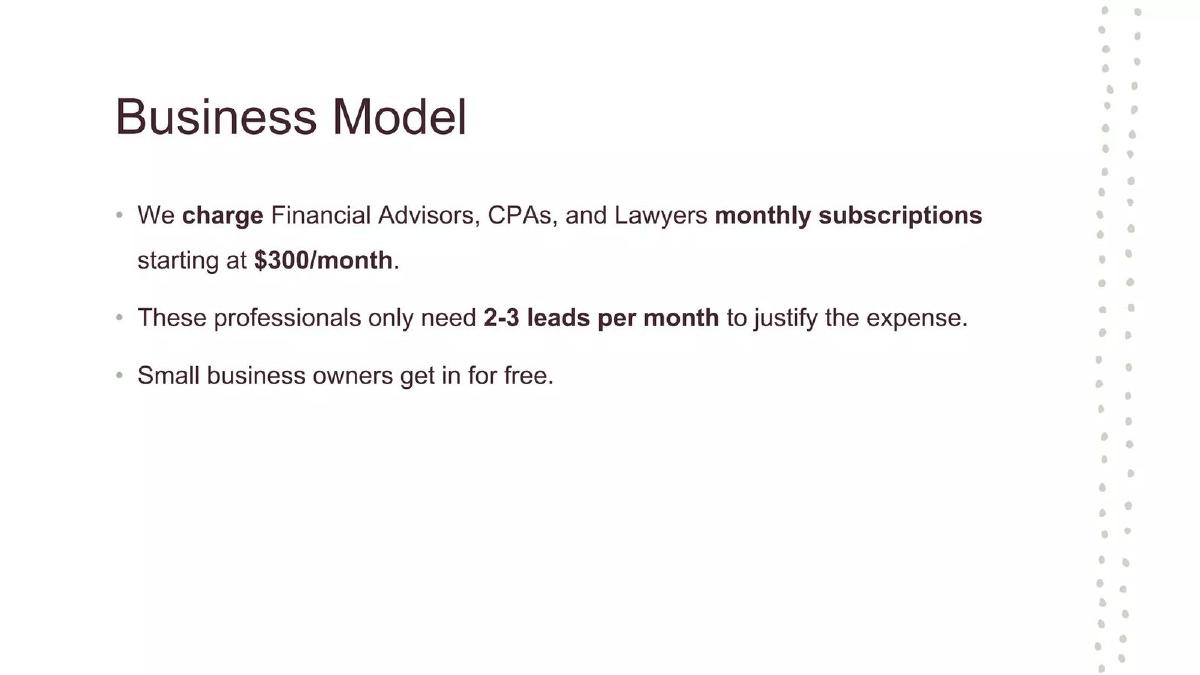
Platform connecting small business owners with financial advisers, accountants and lawyers. Stage and year are not stated on the slide.
Akmazio deck, slide 6. Exact stored slide matched to this analysis.
Our analysis: In three lines it states who pays, the price and why paying makes sense for them.
Evidence and limitation: "2–3 leads" is a claim, not a result. Add how many leads paying members actually get.
What a founder can adapt: Add one line explaining how quickly the customer earns the subscription back.
Supporting analysis
What the deck claims: "We charge Financial Advisors, CPAs, and Lawyers monthly subscriptions starting at $300/month." "These professionals only need 2-3 leads per month to justify the expense." "Small business owners get in for free."
Presentation choice: In three lines it states who pays, the price and why paying makes sense for them.
When it does not fit: "2–3 leads" is a claim, not a result. Add how many leads paying members actually get.
Blockchain document timestamping. The slide states the raise: €590K for 11% equity.
ReCheck deck, slide 6. Exact stored slide matched to this analysis.
Our analysis: Every model has an exact price, covering pay-per-use, subscription and licence.
Evidence and limitation: Three models with very different sizes and no sign of which matters most. Say which brings most revenue, and keep the raise on the ask slide.
What a founder can adapt: If you have more than one model, give the exact price for each.
Supporting analysis
What the deck claims: "Business model & investment — Raising € 590K investment for 11% equity". "SaaS: 0,98 € for a document timestamped or 29 €/month subscription fee." "Hosted solution: annual license fee 9 400 € and/or transaction fee per file/product - 0,07 €." "Pluggable component: license fee + integration services (120 €/hour) + 5% equity."
Presentation choice: Every model has an exact price, covering pay-per-use, subscription and licence.
When it does not fit: Three models with very different sizes and no sign of which matters most. Say which brings most revenue, and keep the raise on the ask slide.
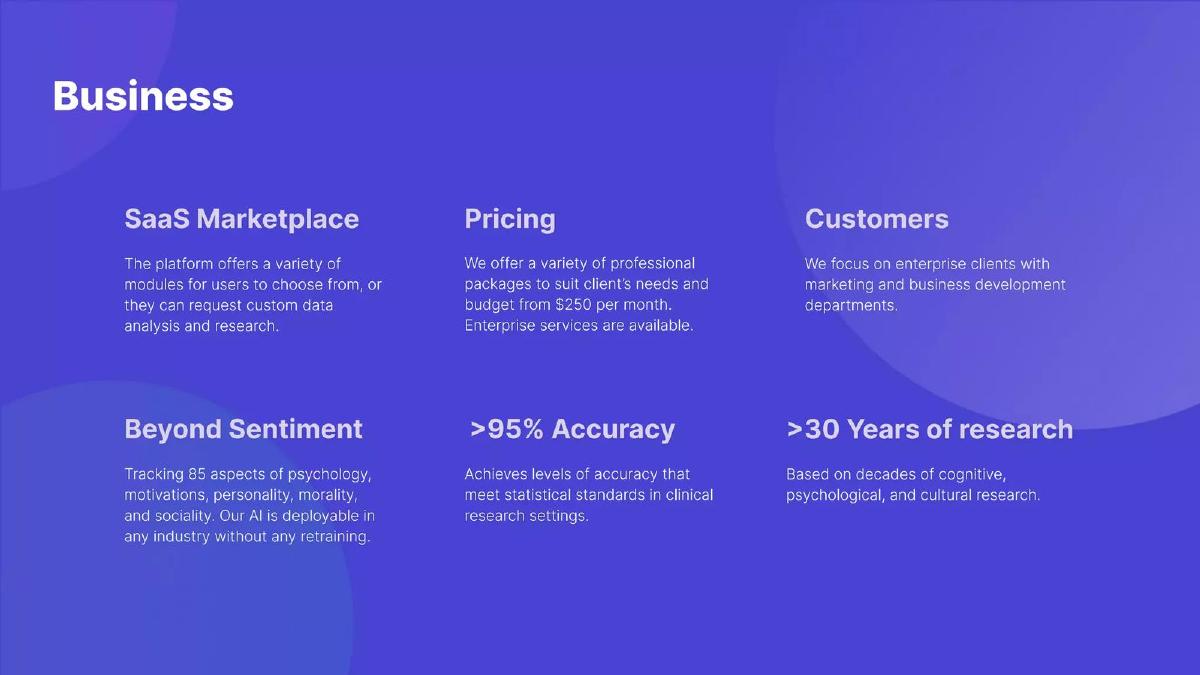
AI cultural analysis platform. The roadmap guide uses a different slide from a CulturePulse deck.
CulturePulse deck, slide 4. Exact stored slide matched to this analysis.
Our analysis: It gives an entry price and names the target buyer, so investors can relate price to customer.
Evidence and limitation: A $250 entry price sits oddly with an enterprise focus. Show the typical enterprise contract size, and move accuracy claims to the product slide.
What a founder can adapt: State a starting price and who it's for.
Supporting analysis
What the deck claims: "Business": "SaaS Marketplace — The platform offers a variety of modules for users to choose from, or they can request custom data analysis and research." "Pricing — We offer a variety of professional packages to suit client's needs and budget from $250 per month. Enterprise services are available." "Customers — We focus on enterprise clients with marketing and business development departments." Plus "Beyond Sentiment", ">95% Accuracy", ">30 Years of research".
Presentation choice: It gives an entry price and names the target buyer, so investors can relate price to customer.
When it does not fit: A $250 entry price sits oddly with an enterprise focus. Show the typical enterprise contract size, and move accuracy claims to the product slide.
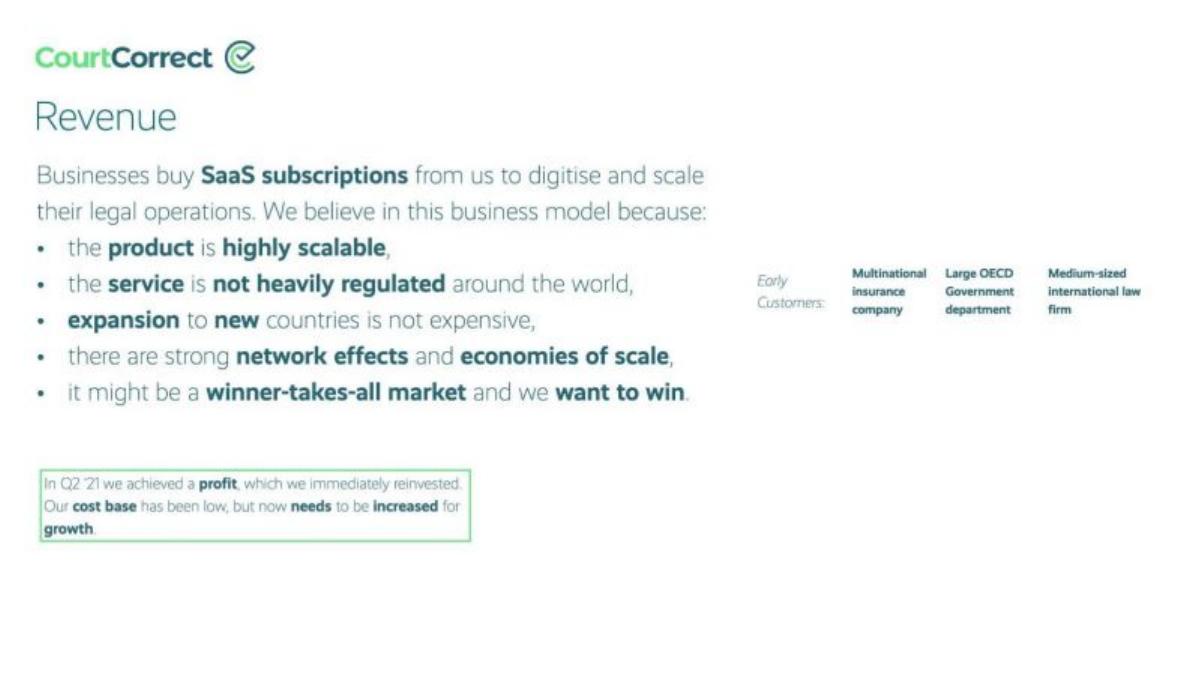
Legal operations software. The slide mentions Q2 '21.
CourtCorrect deck, slide 5. Exact stored slide matched to this analysis.
Our analysis: The early customer types and the note about profitability give useful context.
Evidence and limitation: No price, contract size or billing unit. Replace the list of beliefs with what a typical customer pays per year.
What a founder can adapt: Treat this as a slide to improve on. Keep the customer types.
Supporting analysis
What the deck claims: "Revenue — Businesses buy SaaS subscriptions from us to digitise and scale their legal operations." Reasons: highly scalable product, service not heavily regulated, cheap expansion to new countries, network effects and economies of scale, possibly winner-takes-all. Early customers: multinational insurance company, large OECD government department, medium-sized international law firm. Box: "In Q2 '21 we achieved a profit, which we immediately reinvested. Our cost base has been low, but now needs to be increased for growth."
Presentation choice: The early customer types and the note about profitability give useful context.
When it does not fit: No price, contract size or billing unit. Replace the list of beliefs with what a typical customer pays per year.
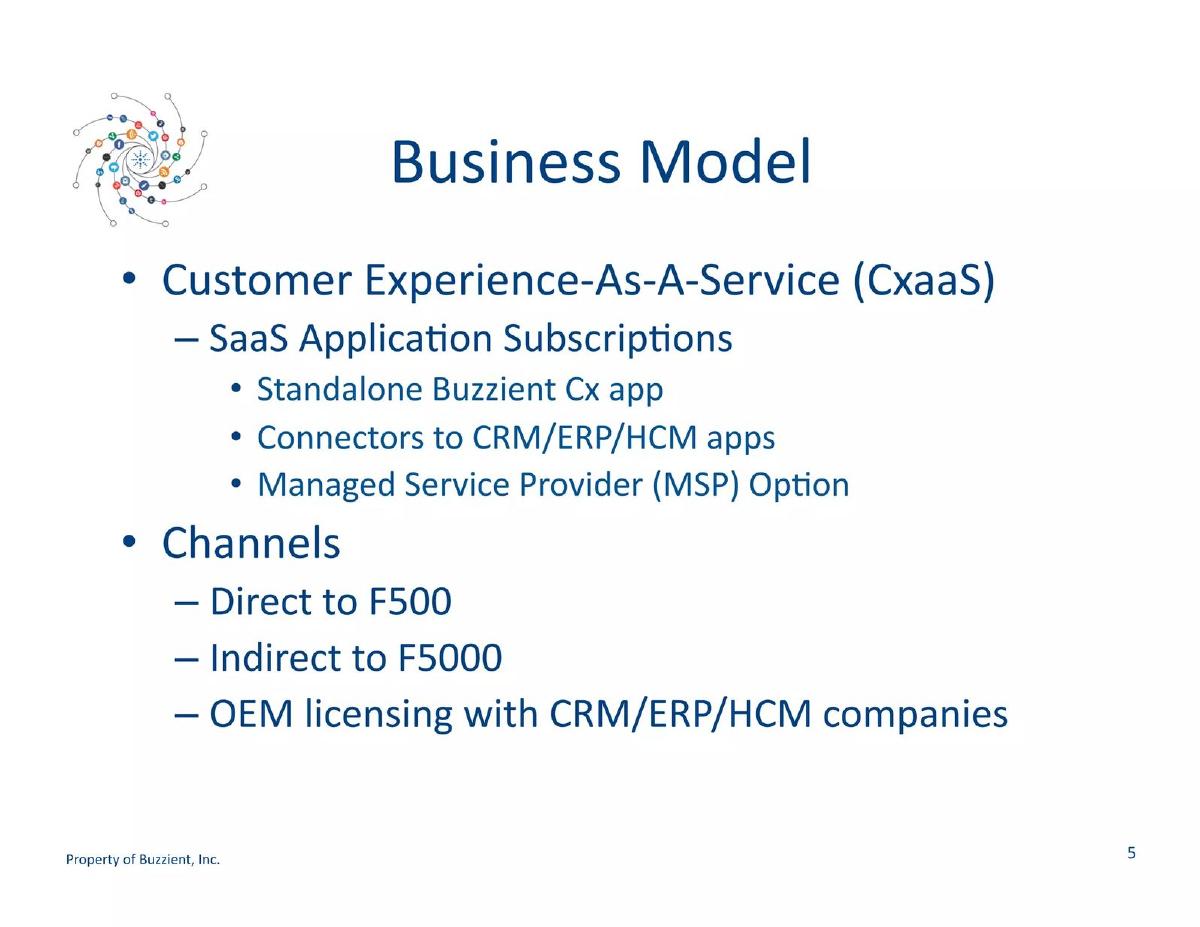
Customer experience software for large companies. Stage and year are not stated on the slide.
Buzzient deck, slide 6. Exact stored slide matched to this analysis.
Our analysis: It separates what is sold from how it is sold, and names target customer sizes.
Evidence and limitation: No prices at all. Add a typical annual contract for a Fortune 500 customer and what the connectors cost.
What a founder can adapt: Treat this as a slide to improve on. Keep the channel split.
Supporting analysis
What the deck claims: "Business Model": "Customer Experience-As-A-Service (CxaaS) — SaaS Application Subscriptions: standalone Buzzient Cx app; connectors to CRM/ERP/HCM apps; Managed Service Provider (MSP) option." "Channels: direct to F500; indirect to F5000; OEM licensing with CRM/ERP/HCM companies."
Presentation choice: It separates what is sold from how it is sold, and names target customer sizes.
When it does not fit: No prices at all. Add a typical annual contract for a Fortune 500 customer and what the connectors cost.
What each slide tells an investor about revenue per customer
Price, unit and payback together let an investor estimate revenue per customer.
Example
Price shown
Charged on
Payback explained
Who pays
Nicereply
$87–$329/month + enterprise
Ratings per month
No
Implied
Akmazio
From $300/month
Month
Yes (2–3 leads)
Professionals; SMBs free
ReCheck
€0.98/doc, €29/month, €9,400/year
Document, month, year
No
Not stated
CulturePulse
From $250/month
Package
No
Enterprise teams
CourtCorrect
No
Not stated
No
Businesses
Buzzient
No
Not stated
No
F500/F5000
Makematic
No
Not stated
No
Teachers
Key Takeaways
Show a real price. Five of seven examples do; the two that don't leave investors unable to estimate revenue per customer.
Tie tiers to a usage measure. Nicereply's tiers scale with ratings per month, so revenue grows as customers grow.
Explain the payback. Akmazio's "2–3 leads per month to justify the expense" answers why customers will keep paying.
Keep models few. ReCheck lists three; say which one brings most revenue.
Name who pays and who doesn't. Akmazio charges professionals and lets small business owners in free.
Build your SaaS business model slide
Fill in each line before designing the slide.
Who pays. Which customer pays, and does anyone use it free?
Price. What does a typical customer pay per month or year?
Unit. What is it charged per: user, usage level, location, flat fee?
Growth. How does a customer's bill grow as they grow?
Payback. How quickly does the customer earn the price back?
Copyable framework: [Customer type] pays [price] per [unit]; typical account [$ per year]. Bills grow with [usage measure]. Customers earn it back in [time] through [saving or revenue].
Illustrative example 1 — written by us
Before: Simple subscription. Disruptive pricing.
After: Schools pay $6 per teacher per month (typical school: $2,200/year), about a third of the cost of the training videos they buy today.
What improved: Our illustrative rewrite, not Makematic's text; the figures are invented for the example. It adds price, unit, typical account and the comparison.
What this guide adds to the business model guide
The main business model guide covers every way startups make money. This guide covers only subscription software, where investors want to estimate revenue per customer and how it grows. The marketplace facet covers commissions; the SaaS traction guide covers recurring revenue growth.
Common mistakes
No price. Show at least a typical price.
Vague pricing claims. Replace "disruptive" with a number.
Too many models. Say which one matters most.
Price doesn't match buyer. Show enterprise contract sizes for enterprise buyers.
No payback. Explain why customers keep paying.
Diagnostic checklist
A price or typical contract value is shown.
The billing unit is stated.
The payer is clear, including any free users.
It shows how a customer's bill grows.
Payback for the customer is explained.
Frequently asked questions
How we chose these examples
Corpus: published pitch deck teardowns on StartupFundraising.com. Founder-uploaded private decks are excluded.
Selection (2026-09-24): we searched extracted text of slides 2–6 for subscription and pricing language on business model or revenue slides (about 50 matches) and inspected nine candidates. We excluded slides already used in the main business model guide (Circles, Cereus), a competition slide quoting competitors' prices (Gridle) and a slide about Salesforce's history (Replicated). Seven remain.
Overlap check: the main business model guide covers all revenue models; the marketplace facet covers commissions; the SaaS traction guide covers recurring revenue growth. This guide covers only how subscription pricing is shown.
Review: all seven stored slide images were inspected on 2026-09-24 and matched to company, deck and slide number (editorial model review). No person has yet completed an editorial review of this page.
Prices are as shown on the slides. We make no claim that any slide caused a fundraising outcome.