CourtCorrect’s 2021 Seed deck presents a bold vision to replace traditional, slow-moving legal systems with a fair, fast, and affordable AI-driven platform. The company identifies a massive gap in access to justice, citing UN estimates that 5.1 billion people face justice issues. By offering a SaaS subscription model to businesses for handling cases efficiently, CourtCorrect aims to scale legal operations globally. The deck is notable for its transparency regarding its cap table—showing 80% founder equity—and its early profitability in Q2 2021. While the product description remains high-level…
Key takeaways
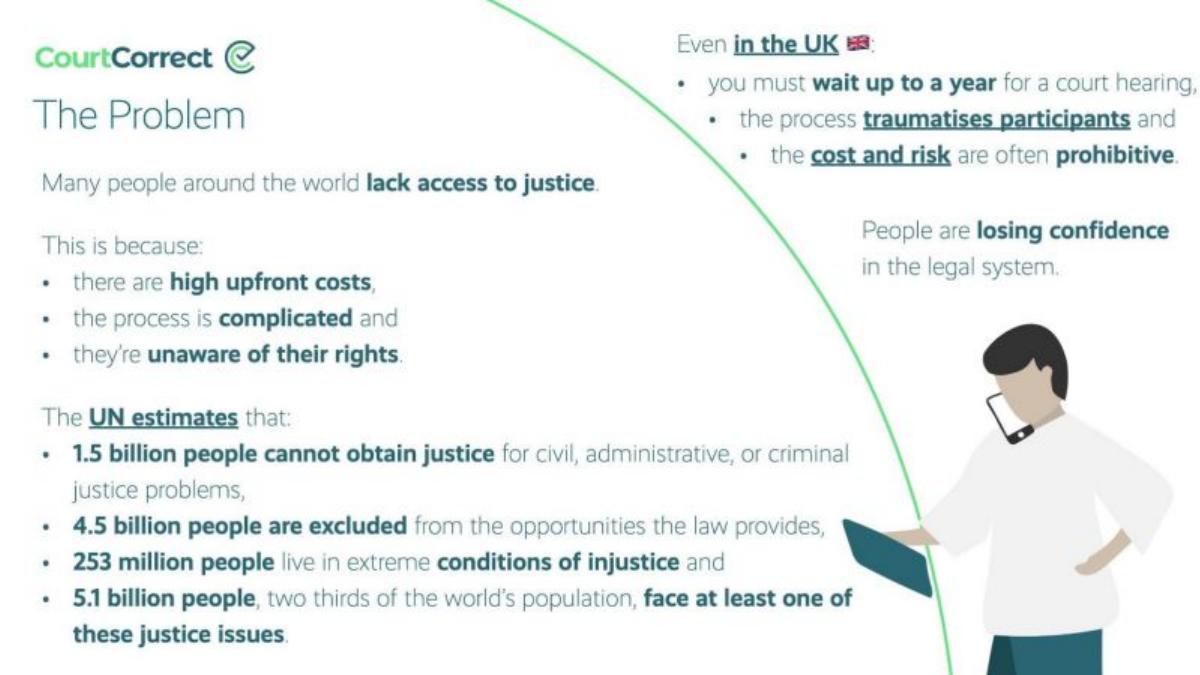
- The company identifies a global crisis in legal access, noting that 5.1 billion people lack adequate justice (Slide 2).
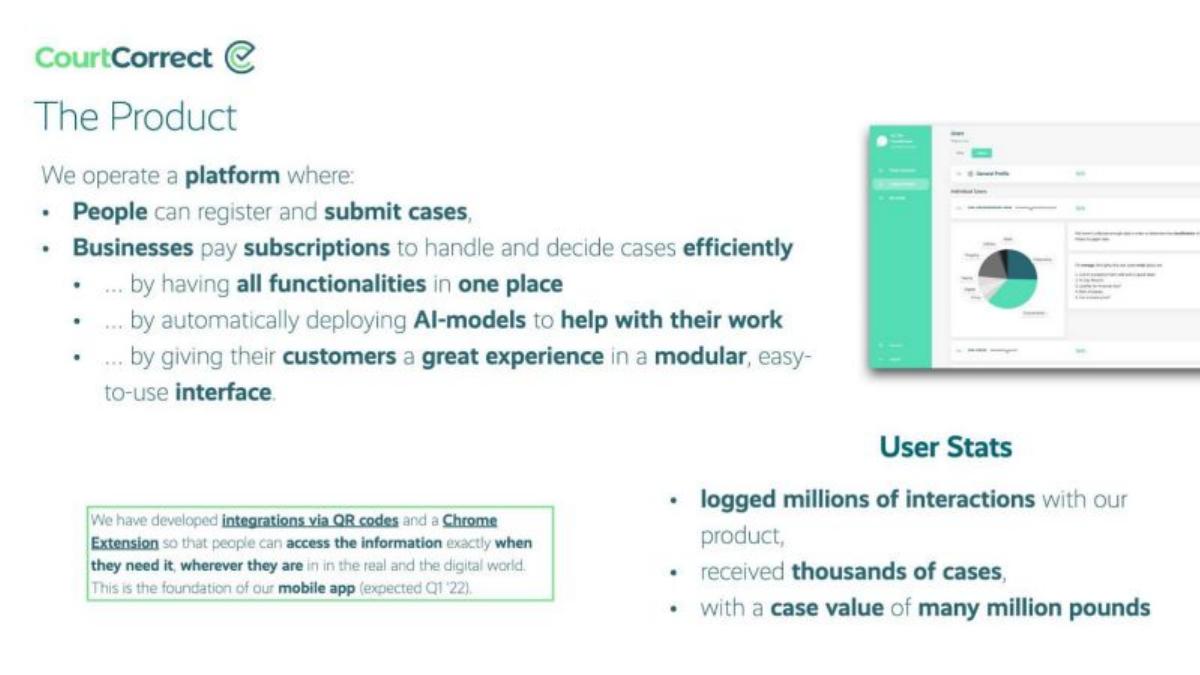
- CourtCorrect operates a SaaS model where businesses pay subscriptions to manage and decide cases using AI models (Slide 4).
- The platform has already logged millions of interactions and received thousands of cases with 'many million pounds' in value (Slide 4).
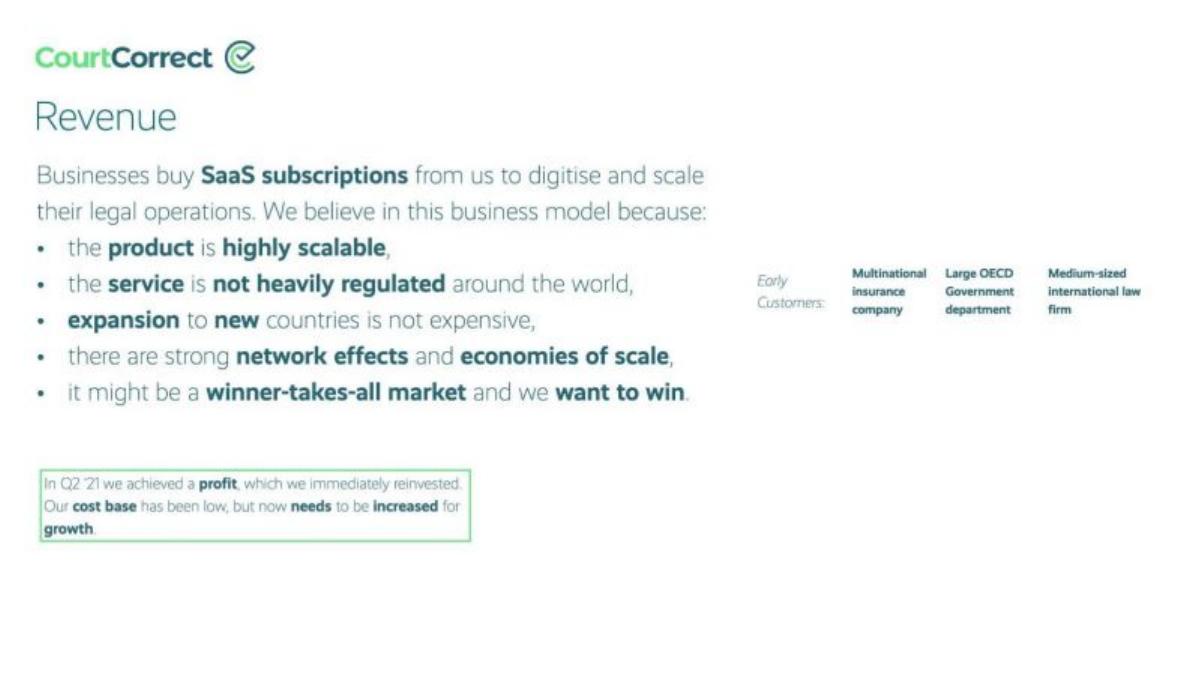
- The startup achieved a profit in Q2 2021, which was immediately reinvested into growth (Slide 5).
- The UK Lawtech market alone is estimated at GBP 22bn, with the global legal services market reaching GBP 550.5bn in 2021 (Slide 7).
- The management team features strong academic credentials from Cambridge and Harvard, including a CEO who previously exited a startup (Slide 9).
- The pre-raise cap table is highly concentrated, with 80% held by founders and 11% by pre-seed investors (Slide 10).
- The funding ask was specifically for £2m to expand the engineering and sales teams and enter the US market (Slide 11).
The Vision: Justice That 'Feels Good'
CourtCorrect enters the market with a high-concept pitch: building an alternative global legal system. The deck, used for their 2021 Seed round, balances a massive social mission with a pragmatic SaaS business model. By positioning themselves as a 'Lawtech' solution rather than a traditional law firm, they aim to capture a slice of a multi-billion dollar market through automation and AI.
Slide 1: Title Slide
The opening slide establishes the brand identity with the tagline "Justice Feels Good." The imagery—a person on an e-scooter in front of Big Ben—firmly roots the company in its London origins while suggesting a modern, mobile-first approach to a traditionally stagnant industry. It clearly states the stage as a "Seed Round."
Slide 2: The Problem
CourtCorrect uses a macro-to-micro approach to define the problem. They cite UN estimates that 5.1 billion people face justice issues and 1.5 billion cannot obtain justice for civil or criminal problems. They then narrow the focus to the UK, noting that even there, people wait up to a year for hearings. The slide identifies three core barriers: high upfront costs, complexity, and lack of awareness. This slide successfully creates a sense of urgency and scale.
Slide 3: The Solution and Vision
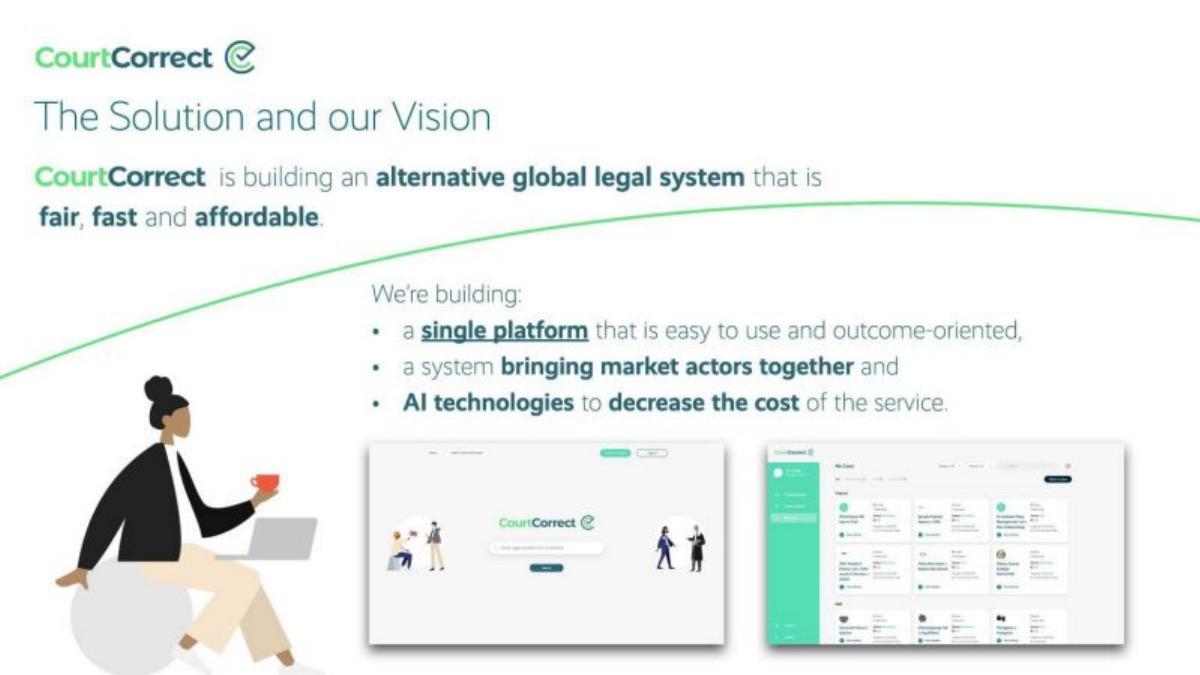
The solution is described as an "alternative global legal system" that is fair, fast, and affordable. The slide highlights three pillars: a single platform, a system bringing market actors together, and AI technologies to decrease costs. Two small screenshots provide a first glimpse of a clean, dashboard-style interface, though they lack deep detail.
Slide 4: The Product
This slide explains the mechanics of the platform. People register and submit cases, while businesses pay subscriptions to handle those cases. Key features mentioned include AI-model deployment and a modular interface. The "User Stats" section provides early validation: millions of interactions, thousands of cases, and a case value of "many million pounds." It also mentions a Chrome Extension and QR code integrations, with a mobile app expected in Q1 '22.
Slide 5: Revenue Model
CourtCorrect defines itself as a SaaS business. They list five reasons for this model, including scalability, low regulation, and the potential for a "winner-takes-all market." Crucially, they disclose that they achieved a profit in Q2 '21, which is rare for a Seed-stage startup. They list early customers as a multinational insurance company, a large OECD government department, and a medium-sized international law firm, though specific names are omitted.
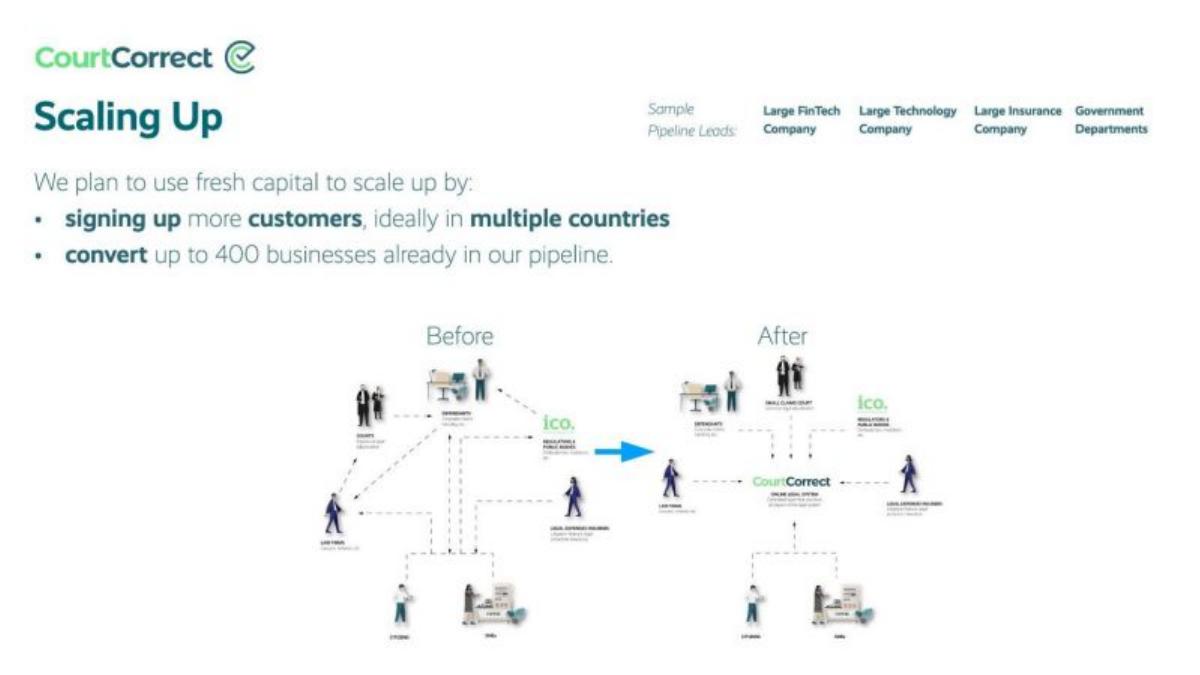
Slide 6: Scaling Up
This slide outlines the growth strategy: signing more customers in multiple countries and converting a pipeline of 400 businesses. It includes a "Before and After" diagram showing how CourtCorrect centralizes communication between citizens, SMEs, law firms, and regulators. Sample pipeline leads include large FinTech, Technology, and Insurance companies.
Slide 7: The Market Opportunity
The deck leans on research from LawtechUK to quantify the opportunity. They cite an annual demand for Lawtech in the UK of GBP 22bn and a global legal services market worth GBP 550.5bn in 2021. The slide also notes a 101% average annual growth rate of investment in Lawtechs between 2017 and 2020, positioning the sector as faster-growing than FinTech or Healthtech.
Slide 8: Competitors and Differentiation
Instead of a standard 2x2 grid, CourtCorrect lists three categories of competitors: Claims Management Systems, Consumer-Facing Legal Apps, and Governments. Their differentiation points include a focus on higher claim values, faster implementation than government systems, and a more adaptable platform for multiple verticals. They reiterate that their vision of a "single platform" is their unique edge.
Slide 9: Management
The team slide is a strong point, emphasizing academic and professional pedigree. CEO Ludwig Bull is a Cambridge LLB with a previous exit. The board and advisors bring experience from Harvard, the IMF, Credit Suisse, and the OECD. This level of institutional backing is likely what gave investors confidence in a platform tackling such a complex, regulated space.
Slide 10: Round Details
The company seeks £2m to expand growth. This slide is exceptionally transparent, featuring a pie chart of the pre-raise cap table: 80% Founder Equity, 11% Pre-Seed Investor Equity, and 9% Share Option Pool. This shows a clean, founder-led structure which is highly attractive to Seed investors.
Slide 11: Use of Funds
The ask is split between hiring and capital. Hiring needs include Data Scientists, Backend Engineers, and Account Managers. Capital is earmarked for entering the US market and amplifying traffic. The slide notes that the engineering team is currently run by the CEO/CTO, indicating a need to professionalize the technical leadership.
Slide 12: Contact and Culture
The final slide provides contact info and a collage of team photos, including "Workshops with Customers" and "Strategy Session in Cambridge." It also mentions "Going viral on TikTok," suggesting a modern marketing sensibility that contrasts with the traditional legal world.
What Works in This Deck
Strong Macro Data: By using UN and LawtechUK statistics, the founders successfully frame a niche software product as a solution to a global humanitarian and economic crisis. This elevates the pitch from a simple tool to a mission-driven enterprise.
Financial Transparency: Mentioning profitability in Q2 2021 and showing the exact cap table percentages removes significant friction during the due diligence process. It signals that the founders are organized and business-minded.
Academic Credibility: In the legal sector, pedigree matters. The heavy emphasis on Cambridge and Harvard affiliations, along with advisors from the IMF and OECD, provides the necessary "social proof" to disrupt a conservative industry.
What Is Missing
Specific Case Studies: While the deck mentions "thousands of cases," it doesn't walk through a single specific example of how a case was resolved on the platform. Investors often want to see the "magic"—exactly how the AI helps a business decide a case faster than a human lawyer.
Unit Economics: The deck mentions a SaaS model and profitability, but it lacks data on Customer Acquisition Cost (CAC) or Lifetime Value (LTV). For a Seed round, showing the efficiency of their sales funnel is usually expected.
Regulatory Detail: The deck claims the service is "not heavily regulated around the world." This is a bold claim for a legal platform. A slide addressing how they navigate unauthorized practice of law (UPL) or specific jurisdictional regulations would have added weight to their expansion plans.
Founder Takeaways
The 'Before and After' Visual: Slide 6 is a great example of how to visualize a complex ecosystem. If your startup sits in the middle of multiple stakeholders (citizens, businesses, regulators), use a diagram to show how you simplify the existing web of communication.
Leverage Industry Bodies: CourtCorrect didn't just make up their market size; they used data from a government-sponsored body (LawtechUK). Using third-party, authoritative sources for your TAM/SAM/SOM makes your numbers much more believable.
Tagline Alignment: The tagline "Justice Feels Good" is consistently supported throughout the deck by the clean UI and the focus on "fair, fast, and affordable" outcomes. Ensure your brand promise is reflected in the product features you choose to highlight.
Frequently asked questions
- What problem is CourtCorrect solving?
- CourtCorrect addresses the global lack of access to justice, which they attribute to high upfront costs, complicated processes, and a lack of rights awareness. They specifically highlight that even in developed markets like the UK, participants can wait up to a year for a court hearing, leading to a loss of confidence in the legal system.
- How does CourtCorrect make money?
- The company utilizes a SaaS subscription model. Businesses pay to use the platform to digitize and scale their legal operations. The deck argues that this model is highly scalable, less regulated than traditional legal services, and benefits from strong network effects.
- What is the current traction of the platform?
- As of the 2021 deck, CourtCorrect had logged millions of interactions and processed thousands of cases. They mentioned early customers including a multinational insurance company, a large OECD government department, and a medium-sized international law firm.
- Who are the key people behind CourtCorrect?
- The team is led by CEO Ludwig Bull, a Cambridge LLB graduate who previously exited a startup. The board and advisory team include individuals with backgrounds at McKinsey, Credit Suisse, the IMF, and Clifford Chance, as well as academic expertise from Cambridge and Harvard.
- What are the primary uses for the raised funds?
- The company intended to use the £2m raise to hire data scientists and backend engineers, expand their sales team with account managers, and provide the capital necessary to enter the US market and amplify web traffic.