The 0x Labs Series B deck is a masterclass in explaining complex Web3 infrastructure through a layered product narrative. By segmenting their business into three distinct brands—Matcha (consumer), 0x API (developer), and 0x Protocol (settlement)—the company demonstrates how it captures value across the entire 'exchange stack.' The deck relies heavily on massive growth multiples from 2021, such as a 14.6x increase in Matcha volume and a 50.5x increase in API transactions. While it lacks traditional financial projections or a specific 'ask' slide, the sheer scale of their ecosystem—integrating…
Key takeaways
- The company frames its mission as building 'exchange infrastructure for the internet' (Slide 1).
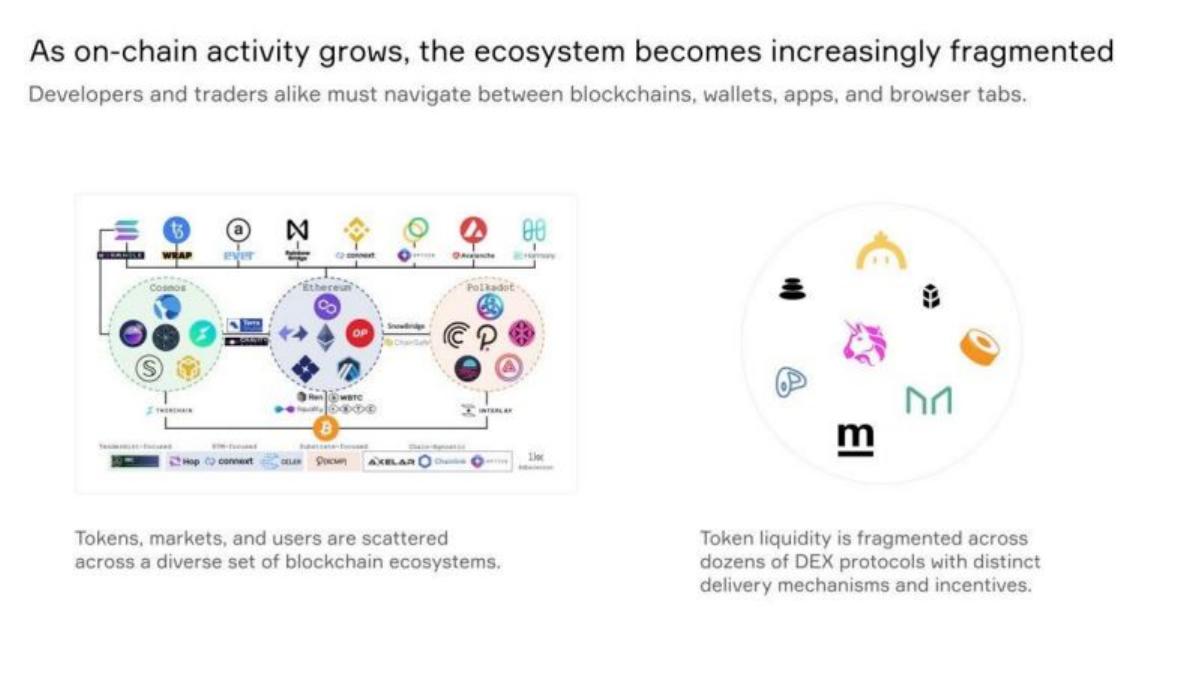
- 0x Labs identifies 'fragmentation' across blockchains and DEX protocols as the primary market friction (Slide 3).
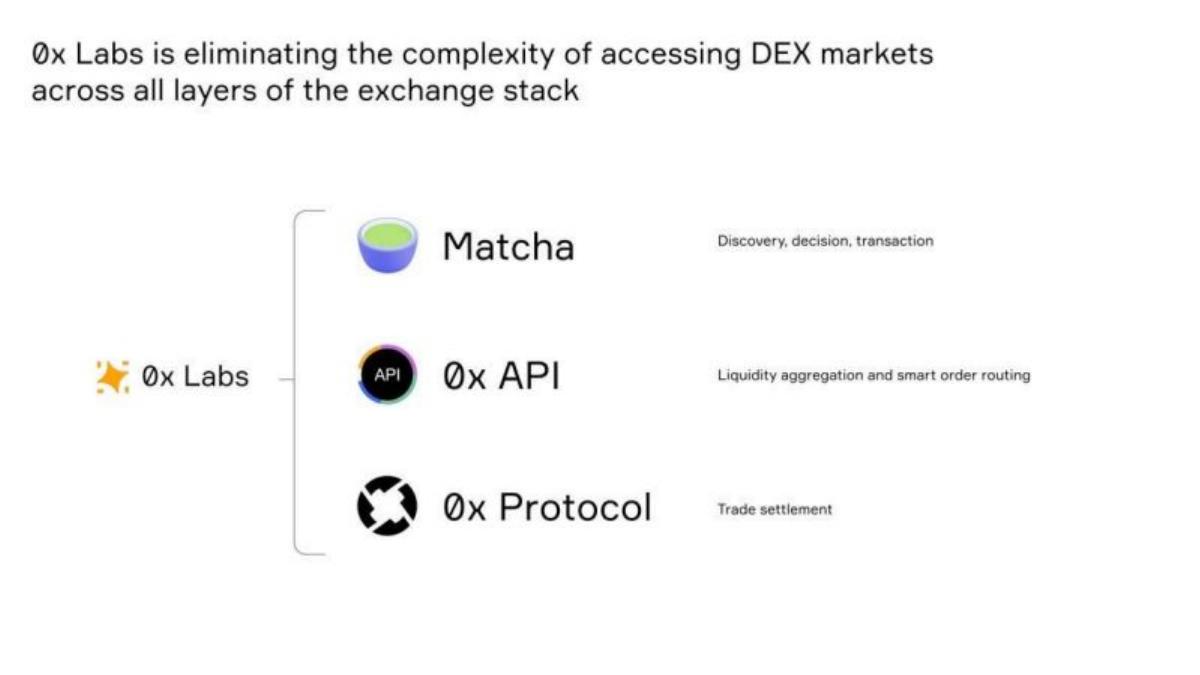
- The business model is divided into three layers: Matcha for discovery, 0x API for aggregation, and 0x Protocol for settlement (Slide 4).
- Matcha's trade volume grew 14.6x in 2021, reaching $34 billion in total volume since its March 2020 launch (Slides 7-8).
- The 0x API serves over 50 integrators, including high-profile wallets like MetaMask and Coinbase Wallet (Slides 10-11).
- API transaction volume saw a massive 50.5x growth spike in 2021 (Slide 12).
- The 0x Protocol is presented as a self-governing ecosystem with a $14.38M community treasury (Slide 17).
- The team slide emphasizes technical contributions, noting they helped establish the NFT token standard (ERC721) (Slide 18).
Executive Summary: The Infrastructure Play for Tokenized Value
0x Labs' Series B pitch deck is a clinical look at how to pitch a 'toll-bridge' business model in the decentralized finance (DeFi) space. Rather than pitching a single app, 0x Labs pitches an entire stack. By 2022, the company had moved beyond its origins as a simple protocol to become a multi-product powerhouse. This deck successfully argues that as the world tokenizes, the most valuable position is the infrastructure that connects fragmented liquidity. With $34 billion in volume and a 50x growth in transactions, the data provided a compelling case for their $70M round.
Slides 1-4: The Macro Vision and the Three-Layer Stack
Slide 1 opens with the company's core thesis: 'Building exchange infrastructure for the internet.' This is a high-level positioning statement that moves the company away from being 'just a crypto project' and into the realm of essential internet utility.
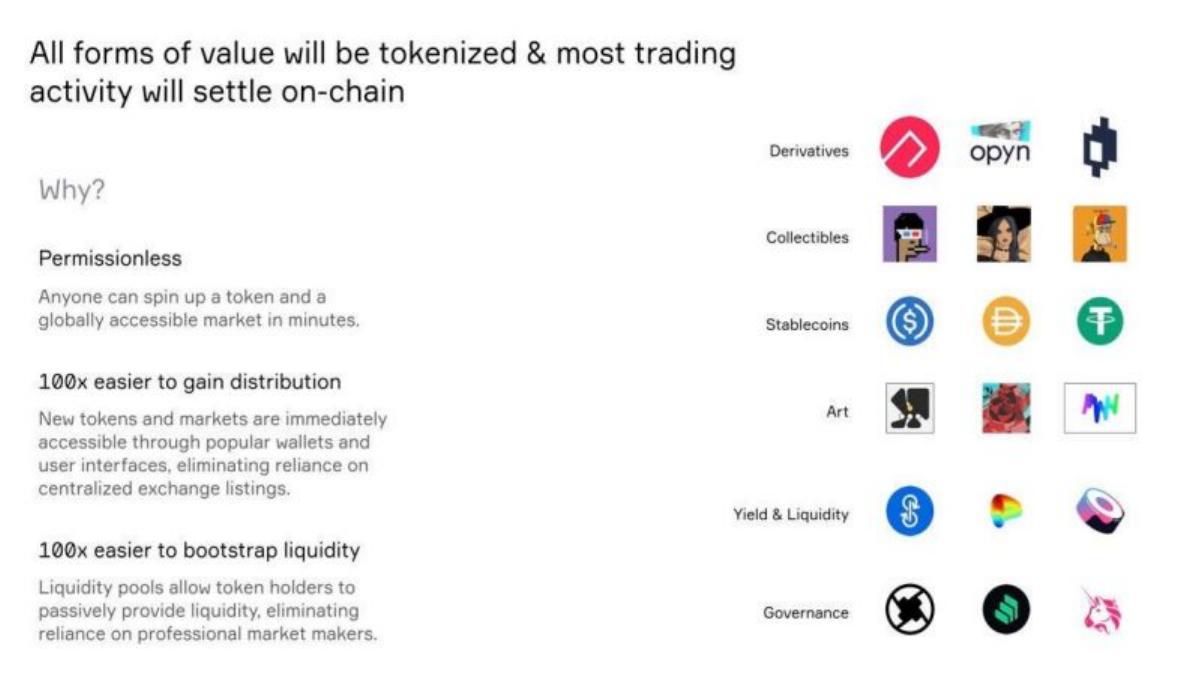
Slide 2 establishes the 'Why.' It posits that 'All forms of value will be tokenized & most trading activity will settle on-chain.' It lists derivatives, collectibles, stablecoins, art, yield, and governance as the key categories. The slide claims that on-chain trading is '100x easier to gain distribution' and '100x easier to bootstrap liquidity' compared to traditional centralized systems.
Slide 3 identifies the 'Problem.' As the ecosystem grows, it becomes 'increasingly fragmented.' The slide uses a complex ecosystem map to show tokens scattered across various blockchains (Ethereum, Cosmos, Polkadot) and liquidity fragmented across dozens of DEX protocols. This fragmentation is the friction that 0x Labs intends to solve.
Slide 4 introduces the solution by breaking 0x Labs into three distinct layers: Matcha (Discovery/Consumer), 0x API (Aggregation/Developer), and 0x Protocol (Settlement/Infrastructure). This slide is the most important in the deck because it explains how the company captures value at every level of the user journey.
Slides 5-8: Matcha – The Consumer Gateway
Slide 5 is a simple transition slide for Matcha, described as 'Discovery, decision, transaction.'
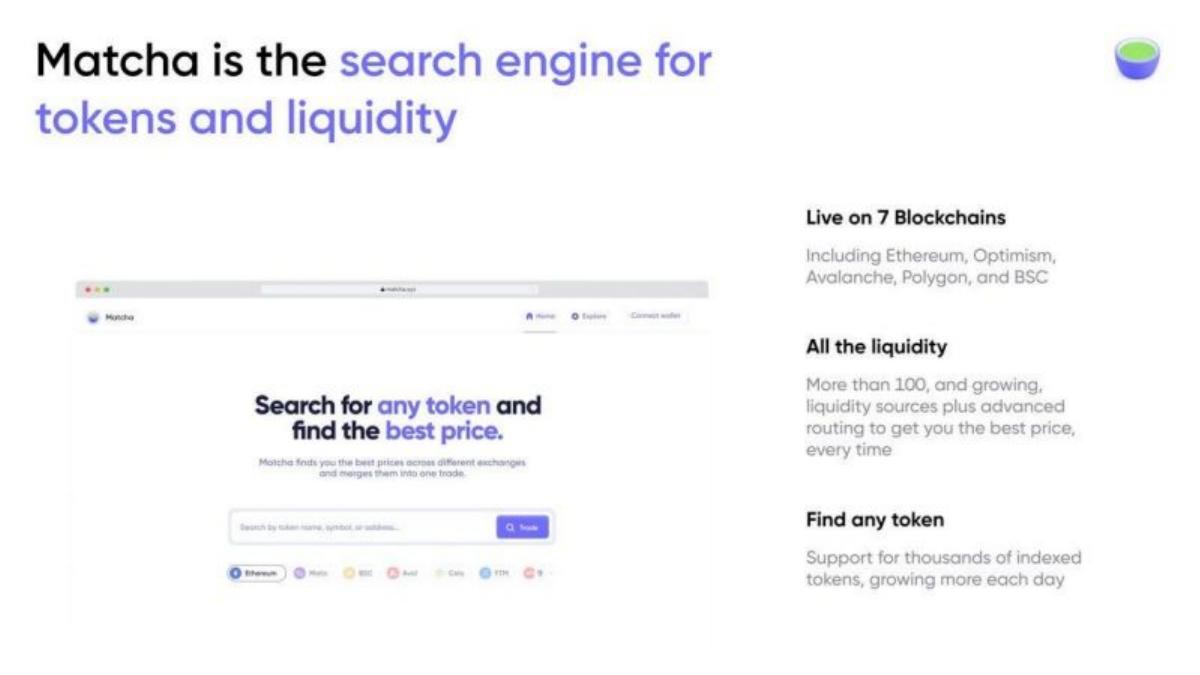
Slide 6 positions Matcha as the 'search engine for tokens and liquidity.' It highlights that the product is live on 7 blockchains (including Ethereum, Optimism, Avalanche, Polygon, and BSC) and aggregates over 100 liquidity sources to find the best price for thousands of indexed tokens.
Slide 7 presents the growth data for Matcha. In 2021, the number of traders grew 3.5x, transactions grew 7.9x, and most impressively, dollar volume grew 14.6x. Using multiples rather than raw numbers is a common tactic to show momentum, though the raw numbers follow on the next slide.
Slide 8 provides the scale: '$34 Billion in trade volume since launch in March 2020.' It includes two bar charts showing monthly volume and monthly users. A key takeaway here is the diversification of chains; while Ethereum remains the largest by volume, the 'Monthly Users' chart shows a massive spike in August 2021 driven by Polygon and BSC, proving the product's multi-chain appeal.
Slides 9-13: 0x API – The Developer Engine
Slide 9 transitions to the 0x API, defined by 'Liquidity aggregation and smart order routing.'
Slide 10 explains the mechanics of the API. It shows how it pulls from 'Professional Market Makers' (via an RFQ system) and '95+ Liquidity sources across 7+ Blockchain Networks.' It then funnels this through the 0x API to '50+ integrators.' It highlights technical features like multi-hop routing, multi-source routing, and gas cost optimization.
Slide 11 is a 'logo wall' of social proof. It lists 'top wallets and crypto apps' that trust the API, including MetaMask, Coinbase Wallet, Brave, and Zapper . For a Series B infrastructure company, this slide is the ultimate validator; if the biggest names in the industry use your API, you have effectively become the industry standard.
Slide 12 shows the API's growth metrics. In 2021, monthly traders grew 15.3x, volume grew 20x, and transactions grew a staggering 50.5x. This suggests that the API is not just growing, but its usage is becoming more high-frequency.
Slide 13 provides a breakdown of unique addresses and monthly volume for the API. Similar to the Matcha slide, it shows that while Ethereum dominates volume, chains like Polygon and BSC are responsible for a massive portion of the unique address growth, reaching over 800,000 unique addresses in late 2021.
Slides 14-17: 0x Protocol – The Settlement Layer
Slide 14 introduces the 0x Protocol, the base layer for 'Trade settlement.'
Slide 15 defines it as an 'open protocol for peer-to-peer exchange.' It notes that the protocol handles ERC20, ERC721 (NFTs), and ERC1155 tokens. It also mentions its ability to tap into on-chain liquidity pools.
Slide 16 highlights the 'vibrant ecosystem' built on the protocol. It specifically calls out Coinbase NFT and OpenSea as users of the protocol for NFT marketplaces. It also mentions data infrastructure partners like Dune Analytics and The Graph.
Slide 17 focuses on the 'self-governing' nature of the protocol. It shows a screenshot of a governance portal and a 'Community Treasury' worth $14.38M. This slide is intended to show that the protocol is decentralized and sustainable, governed by ZRX token holders.
Slides 18-20: Team and Conclusion
Slide 18 introduces the team. Co-founders Will Warren and Amir Bandeali are featured with their previous experience (Los Alamos and DRW). The slide notes a team of 52 members with experience from Coinbase, Google, Meta, and Microsoft. Crucially, it highlights their technical contributions to the wider crypto space, such as helping establish the ERC721 (NFT) standard and the WETH implementation. This establishes them as 'builders' of the ecosystem, not just participants.
Slide 19 is a concluding summary slide, repeating the logos of the three core products under the 0x Labs banner.
What Works in This Deck
The Layered Narrative: By splitting the business into Matcha, API, and Protocol, 0x Labs avoids the confusion of being 'too many things.' They show they have a product for users, a product for developers, and a product for the entire ecosystem. · Explosive Multiples: The use of '50.5x growth' and '14.6x volume growth' creates a sense of unstoppable momentum. In a Series B, investors are looking for signs of product-market fit that has already scaled, and these numbers provide that. · Dominant Social Proof: Listing MetaMask and Coinbase as integrators (Slide 11) and Coinbase NFT as an ecosystem project (Slide 16) makes the company appear as a 'must-own' infrastructure play. · Technical Authority: Highlighting their role in creating the NFT standard (Slide 18) gives the team immense credibility that goes beyond their own product's success.
What Is Missing
Revenue and Unit Economics: The deck is entirely focused on 'Volume' and 'Transactions.' It does not explain how 0x Labs actually makes money. While many crypto infrastructure projects focus on token appreciation or future monetization, a $70M Series B usually requires some discussion of the business model's sustainability. · Competitive Landscape: There is no mention of competitors like Uniswap, 1inch, or other aggregators. The deck assumes 0x Labs is the default choice, which may be true for some integrators, but a competitive analysis is a standard omission here. · The 'Ask': There is no slide detailing how much they are raising, the valuation, or the intended use of funds. This information is often removed from public versions of decks, but its absence makes it a 'pure' vision and traction deck. · Future Roadmap: The deck is very focused on what happened in 2021. It offers very little on what the next 2-3 years look like or what new products are in development.
What Other Founders Should Copy
The 'Why Now' Slide: Slide 3's focus on 'fragmentation' is a perfect example of identifying a market pain point that grows as the market grows. It suggests that the more successful crypto becomes, the more necessary 0x Labs becomes. · Visualizing the Stack: If your company has multiple products, use a diagram like Slide 4 to show how they relate to one another. It helps investors categorize your different revenue or growth streams. · Logo Grouping: Slide 11 groups logos by 'Wallets' and 'Apps.' This is much more effective than a random jumble of logos because it tells a story about where your product fits in the user's workflow. · Multi-Chain Proof: If you are in Web3, showing that your growth isn't just tied to one ecosystem (like Ethereum) is vital. The charts on Slide 8 and 13 do an excellent job of showing 'cross-chain' resilience.
Frequently asked questions
- What is the core problem 0x Labs is solving?
- According to Slide 3, the core problem is fragmentation. As on-chain activity grows, tokens and liquidity are scattered across dozens of different blockchains and decentralized exchange (DEX) protocols. This makes it difficult for developers and traders to find the best prices and navigate the ecosystem efficiently.
- How does 0x Labs differentiate its products?
- Slide 4 breaks the company into three layers: Matcha is a consumer-facing search engine for tokens; 0x API is a developer-facing service for liquidity aggregation and smart order routing; and 0x Protocol is the underlying open-source infrastructure for trade settlement.
- What were the key growth metrics for the Series B?
- The deck highlights explosive growth in 2021. Matcha volume grew 14.6x (Slide 7), and 0x API transactions grew 50.5x (Slide 12). By the time of the deck, Matcha had processed $34 billion in total trade volume since its 2020 launch (Slide 8).
- Who are 0x Labs' major partners?
- Slide 11 lists several 'top wallets and crypto apps' that integrate 0x API, including MetaMask, Coinbase Wallet, Brave, Polygon Wallet, and Rainbow. It also mentions integrations with apps like Zapper, dYdX, and ShapeShift.
- What is the background of the 0x Labs team?
- Slide 18 features co-founders Will Warren (formerly Los Alamos National Laboratory) and Amir Bandeali (formerly DRW). The 52-person team includes alumni from Google, Coinbase, Meta, and Microsoft. They are credited with helping establish the ERC721 (NFT) and EIP712 standards.