10Six positions itself as a software-driven orchestrator of energy storage, aiming to solve the grid's 'balancing problem' exacerbated by renewables. By networking existing, underutilized battery assets—which they claim sit idle 98% of the time—10Six creates a virtual power plant capable of providing high-value grid services like frequency regulation. The deck leans heavily on regulatory tailwinds, specifically FERC Order 755, which incentivizes fast-responding storage. Their 'Backup-as-a-Service' model removes upfront CAPEX for commercial customers while allowing 10Six to monetize the asset…
Key takeaways
- The company defines itself as a software entity that networks energy storage to optimize 'each stored electron' (Slide 2).
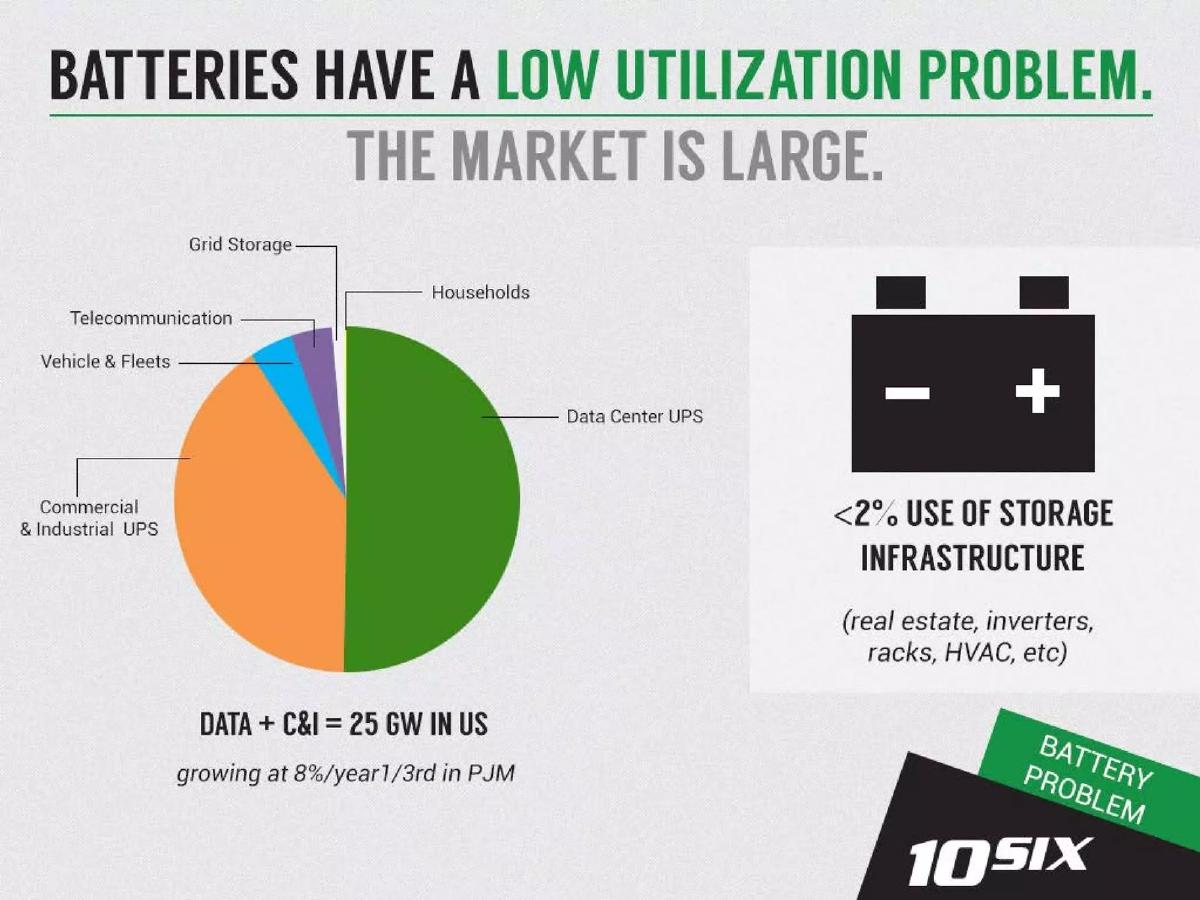
- 10Six identifies a massive inefficiency where storage infrastructure is utilized less than 2% of the time (Slide 4).
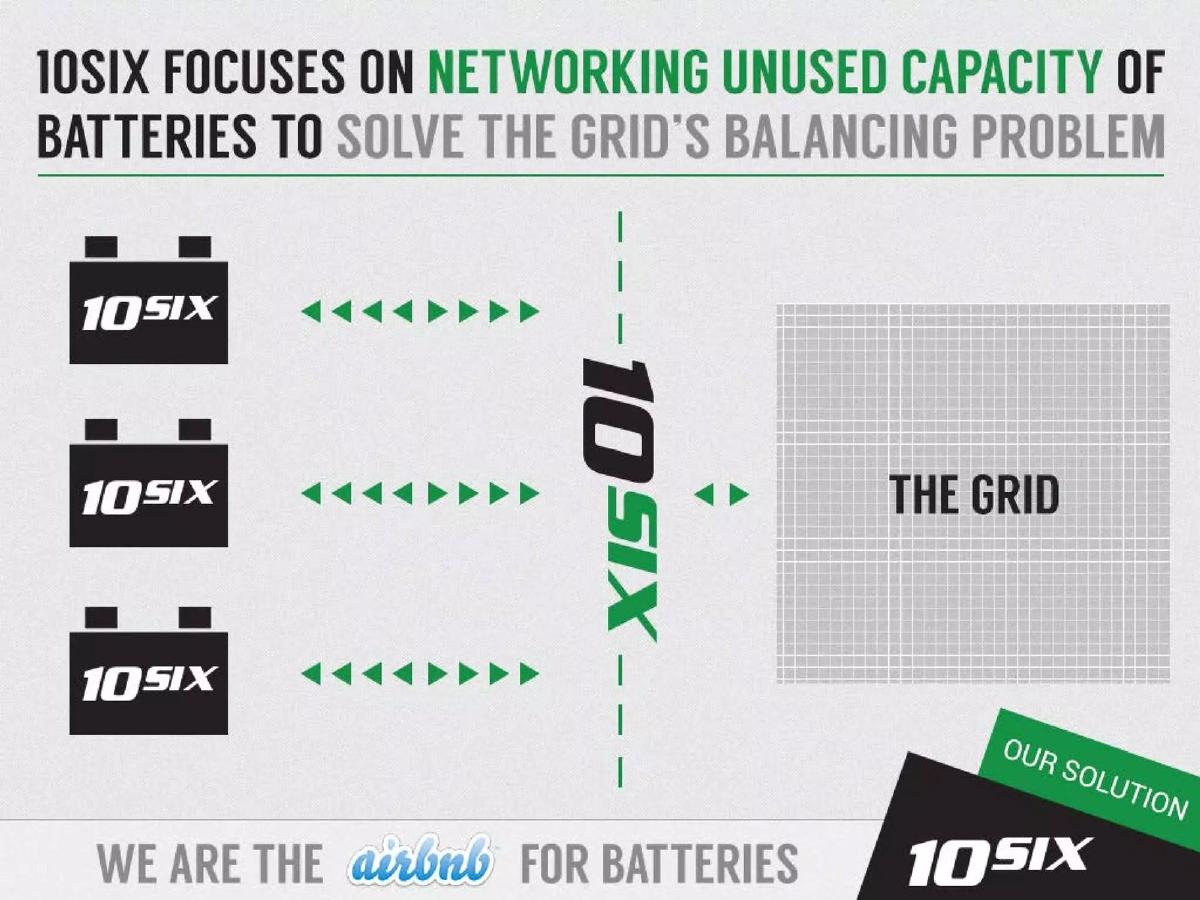
- The core value proposition is described using the 'Airbnb for Batteries' analogy, networking unused capacity to the grid (Slide 5).
- Regulatory tailwinds are central to the pitch, citing FERC Order 755/784 which provides a 3X preference for battery-like capacity (Slide 7).
- The PJM grid market is highlighted as paying $300,000/year per MW installed, significantly higher than non-FERC markets (Slide 7).
- 10Six differentiates itself by being 'asset agnostic' and focusing on business model innovation rather than selling hardware (Slide 8).
- The 'Backup-as-a-Service' model guarantees over 15 minutes of critical power with zero CAPEX for the customer (Slide 9).
- The deck claims to increase asset utilization from <1% to ~100% by managing degradation and generating revenue (Slide 10).
10Six Pitch Deck Teardown: The Software Layer for a Strained Grid
The 2014 overview deck for 10Six is a masterclass in identifying a specific regulatory and market inefficiency and positioning a software solution to bridge the gap. At its core, 10Six is pitching the transition from static, siloed hardware (backup batteries) to a dynamic, networked utility. By leveraging the 'Airbnb' analogy, they simplify a complex energy-tech concept into a recognizable business model.
Slide 1: Title Slide
The cover is minimalist, featuring the 10Six logo and the text 'OVERVIEW PRESENTATION | 2014'. It establishes a clean, professional brand identity using a black, white, and green color palette, which is standard for the 'cleantech' or energy sector.
Slide 2: The Mission Statement
'10SIX IS A SOFTWARE COMPANY THAT NETWORKS ENERGY STORAGE TO OPTIMIZE EACH STORED ELECTRON'
This slide is highly effective because it immediately defines the company's category. By calling themselves a 'software company' rather than a battery company, they signal higher margins and scalability to investors. The phrase 'optimize each stored electron' is a strong, punchy value proposition that suggests efficiency and technical depth.
Slide 3: The Grid Problem
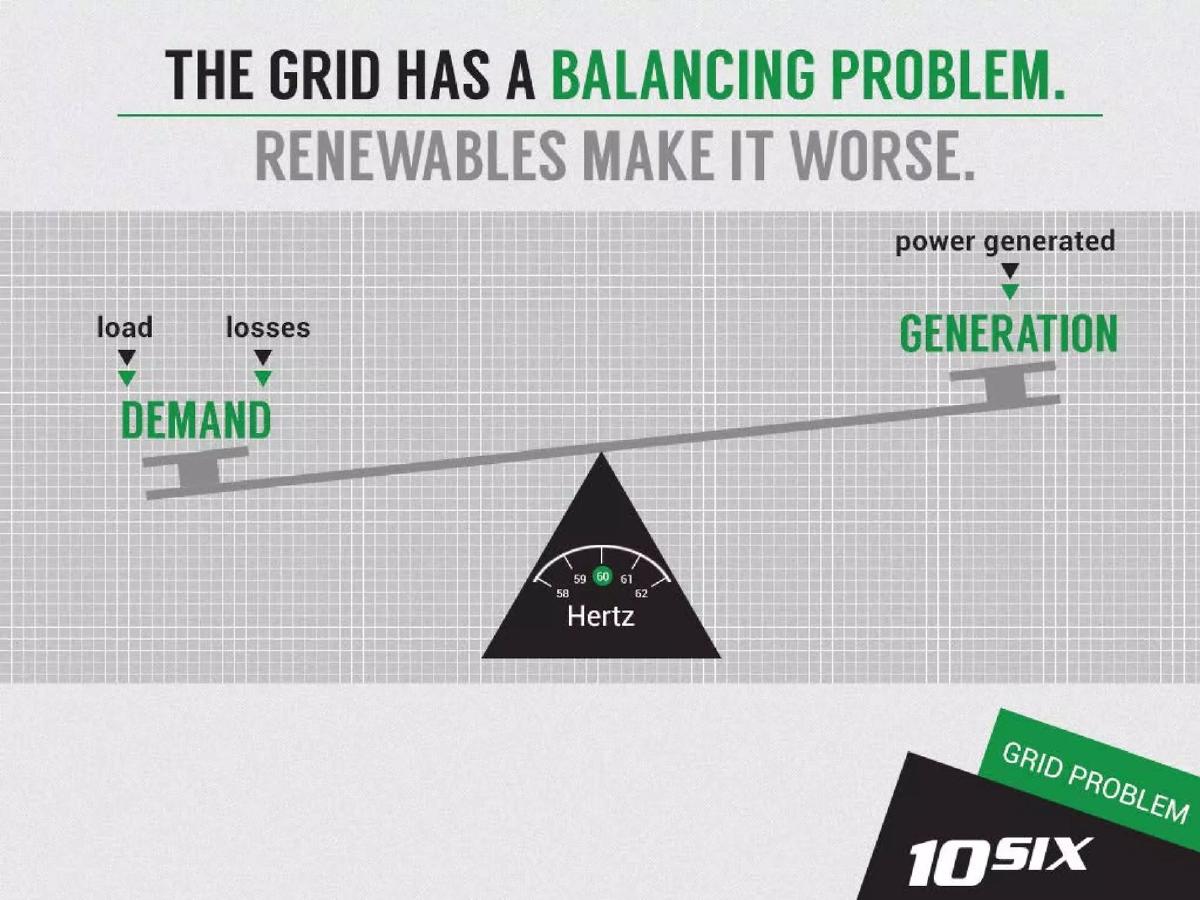
This slide uses a simple seesaw graphic to illustrate the 'balancing problem' of the grid. It shows 'Demand' (load and losses) on one side and 'Generation' on the other, with a 'Hertz' meter at the fulcrum. The text states, 'RENEWABLES MAKE IT WORSE.' This is a crucial point for 2014; as wind and solar grew, the grid's need for fast-acting stabilization increased, creating a market for 10Six.
Slide 4: The Battery Problem
10Six identifies a massive market inefficiency here. They provide a pie chart showing the distribution of storage assets, with 'Data Center UPS' (Uninterruptible Power Supply) and 'Commercial & Industrial UPS' making up the vast majority of the 25 GW market in the US. The key metric is '<2% USE OF STORAGE INFRASTRUCTURE.' This highlights that billions of dollars in hardware are sitting idle, providing a clear opportunity for a 'sharing economy' model for energy.
Slide 5: The Solution - 'Airbnb for Batteries'
This slide introduces the core business model. It shows a diagram of multiple batteries connected through the 10Six software layer to 'THE GRID.' The tagline 'WE ARE THE Airbnb FOR BATTERIES' is the 'aha' moment of the deck. It tells the investor exactly how they make money: by taking an underutilized asset owned by someone else and renting its capacity to a third party (the grid).
Slide 6: Technical Implementation (M2M Networking)
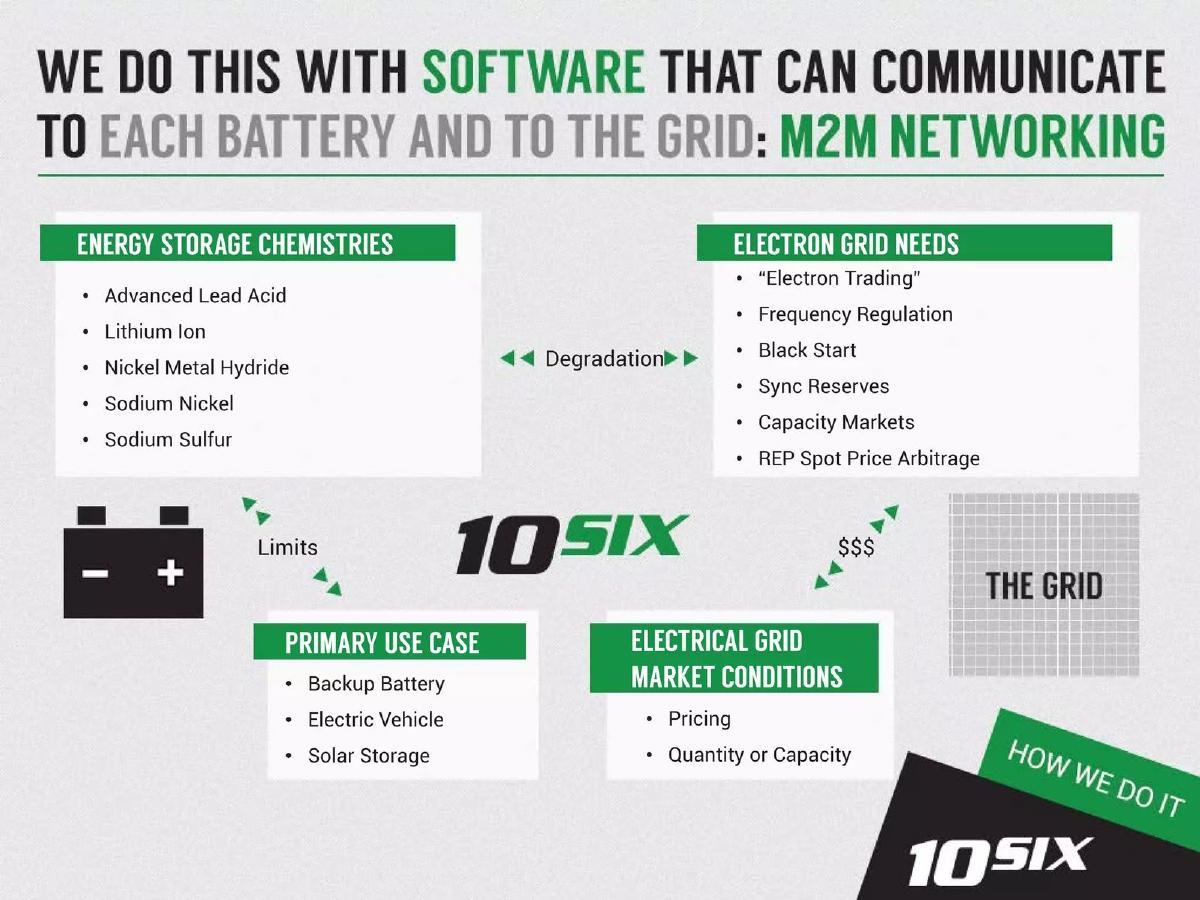
This slide gets into the 'How.' It lists various energy storage chemistries (Lead Acid, Lithium Ion, etc.) and grid needs (Frequency Regulation, Black Start, etc.). It explains that their software manages the 'Degradation' of the battery against the '$$$' generated from the grid. This shows they understand the technical trade-offs of using a backup battery for grid services, which can wear out the hardware faster.
Slide 7: The Regulatory Catalyst (FERC Mandate)
This is perhaps the most important slide for a 2014 energy pitch. It cites 'FERC ORDER 755 / 784,' which mandated that battery-like capacity receive a '3X relative preference' for grid stability services. They quantify this by stating PJM (a regional transmission organization) pays '$300,000/YEAR PER MW INSTALLED' versus only $100,000 in non-FERC markets. This proves there is a high-margin, regulated revenue stream waiting to be captured.
Slide 8: Competitive Landscape
10Six uses a standard 2x2 matrix, plotting 'Product vs. Service' on the Y-axis and 'Grid Scale vs. Consumer Scale' on the X-axis. They place themselves in the 'Service / Grid Scale' quadrant alongside Enbala and Geli. They emphasize being 'ASSET AGNOSTIC,' noting that while Tesla and Stem sell hardware, 10Six builds the network. This positioning is designed to appeal to investors who want to avoid the heavy CAPEX of manufacturing.
Slide 9: Backup-as-a-Service
This slide explains the customer-facing side of the business. 10Six offers 'NO CAPITAL EXPENSE BY THE CUSTOMER.' They finance, install, and maintain the batteries, providing the customer with guaranteed backup power while 10Six keeps the grid revenue. It’s a classic 'no-brainer' sales pitch for a commercial facility manager.
Slide 10: Before & After Comparison
The final slide compares the traditional model to the 10Six model. The traditional model is a 'Sunk Cost' utilized <1% of the time with a $1 million/MW upfront cost. The 10Six model is a 'Fully Managed Solution' utilized ~100% of the time, generating revenue, and costing the customer nothing upfront. It’s a strong closing argument for the economic viability of the business.
What 10Six Does Well
Clear Analogy: The 'Airbnb for Batteries' comparison instantly makes a complex utility-scale software play understandable. · Market Timing: By anchoring the pitch in FERC Order 755, they show that the 'Why Now?' is driven by federal law, not just a trend. · Economic Contrast: Slide 10 provides a very clear 'Before and After' that demonstrates the value to the end customer (C&I facilities). · Category Positioning: They are very disciplined about calling themselves a 'software company' and 'asset agnostic,' which is a more venture-backable narrative than being a hardware distributor.
What is Missing from the 10Six Deck
The Team: There is no mention of who is building this. In a highly regulated and technical field like energy storage, the founders' backgrounds in grid management or software engineering are critical. · Traction: The deck is purely conceptual. There are no mentions of pilot programs, signed LOIs from data centers, or partnerships with utilities. · Financials: While they mention the $300k/MW revenue potential, they don't show a pro-forma or a path to profitability. · The Ask: This deck functions as a 'teaser' or 'overview' but fails as a fundraising deck because it doesn't ask for a specific amount of money or explain what the milestones for the next round will be. · Unit Economics: They mention financing the batteries for the customer. This implies 10Six needs significant capital to buy the hardware. The deck doesn't explain how they fund that hardware (e.g., a separate credit facility) without diluting equity investors.
Founder Takeaways: Copy the Logic, Not the Omissions
Founders should study how 10Six identifies a regulatory arbitrage opportunity. If a new law or mandate (like the Inflation Reduction Act today) creates a 3X price premium for a specific service, that should be the center of your pitch. It provides an external validation that your market isn't just growing, but is being actively subsidized or protected.
Additionally, the 'Asset Agnostic' positioning is a smart way for hardware-adjacent startups to pitch to VCs. By focusing on the 'orchestration layer' or the 'network,' you can claim the scalability of a SaaS company while operating in a physical industry. However, never leave out your team slide. In the energy sector, your ability to navigate the 'alphabet soup' of regulators (FERC, PJM, DOE) is your most valuable asset, and investors need to see that expertise on the slide.
Frequently asked questions
- What is the primary problem 10Six is trying to solve?
- 10Six addresses the 'balancing problem' of the electrical grid, where demand and generation must be perfectly matched to maintain frequency (Slide 3). This problem is worsening due to the intermittent nature of renewable energy. They specifically target the 'low utilization problem' of existing batteries, noting that most backup systems sit idle for more than 98% of their lifespan.
- How does the 'Airbnb for Batteries' model actually work?
- Similar to how Airbnb networks unused rooms, 10Six uses M2M (machine-to-machine) networking software to connect various energy storage assets—like backup batteries, EV batteries, and solar storage—into a single network (Slide 5). This network communicates with the grid to provide services like frequency regulation and capacity, monetizing the 'unused' capacity of those batteries when they aren't needed for their primary backup function.
- What is the significance of FERC Order 755 in this pitch?
- FERC Order 755 is the economic engine of the pitch. It mandates that fast-responding assets like batteries receive higher compensation for grid stability services compared to slower incumbents like diesel generators (Slide 7). 10Six notes that in the PJM market, this results in payments of $300,000 per MW per year, creating a lucrative revenue stream for their networked assets.
- Who are 10Six's main competitors and how do they differ?
- The deck lists competitors like Enbala, Geli, Stem, Tesla, and A123 Systems (Slide 8). 10Six differentiates itself by being 'asset agnostic'—they don't want to sell the hardware. While Tesla and A123 focus on the product (the battery itself), 10Six focuses on the service and business model innovation, acting as an add-on to existing monetization models.
- What is missing from this deck that an investor would need?
- This is an 'Overview Presentation' and lacks several critical fundraising components. There is no team slide to establish credibility, no financial projections to show scalability, no mention of existing customers or pilot projects (traction), and no 'Ask' slide detailing how much capital they are raising or how it will be used.