How energy and battery startups present the problem in a pitch deck: name the asset or user wasting power, measure the waste.
Energy Startup Problem Slide: Real Pitch Deck Examples
Eight problem slides from energy startups (grid storage, batteries, motor efficiency, portable power, EV data and energy infrastructure), shown in full, compare whether each slide names where energy is wasted or missing, measures it, and says why today's technology falls short.
TL;DR
An energy problem slide works when it points at one asset or user and measures the waste. 10SIX does this in two numbers: "<2% use of storage infrastructure" in batteries that already sit in data centres and commercial buildings, a base of "25 GW in US" "growing at 8%/year". FluxDrive names the cause — design engineers "oversize ALL systems for future demand" — and says existing couplings "DON'T address the Major Problem". Galatica's four icon tiles ("Smarter Infrastructure", "Efficient Logistics") name no user, no waste and no number, the weaker pattern.
Energy problem slides from real pitch decks
Each example shows the exact stored slide above its analysis and links to the full teardown. Claims are as shown on the slides; we have not verified them.
10SIX problem slide — slide 4
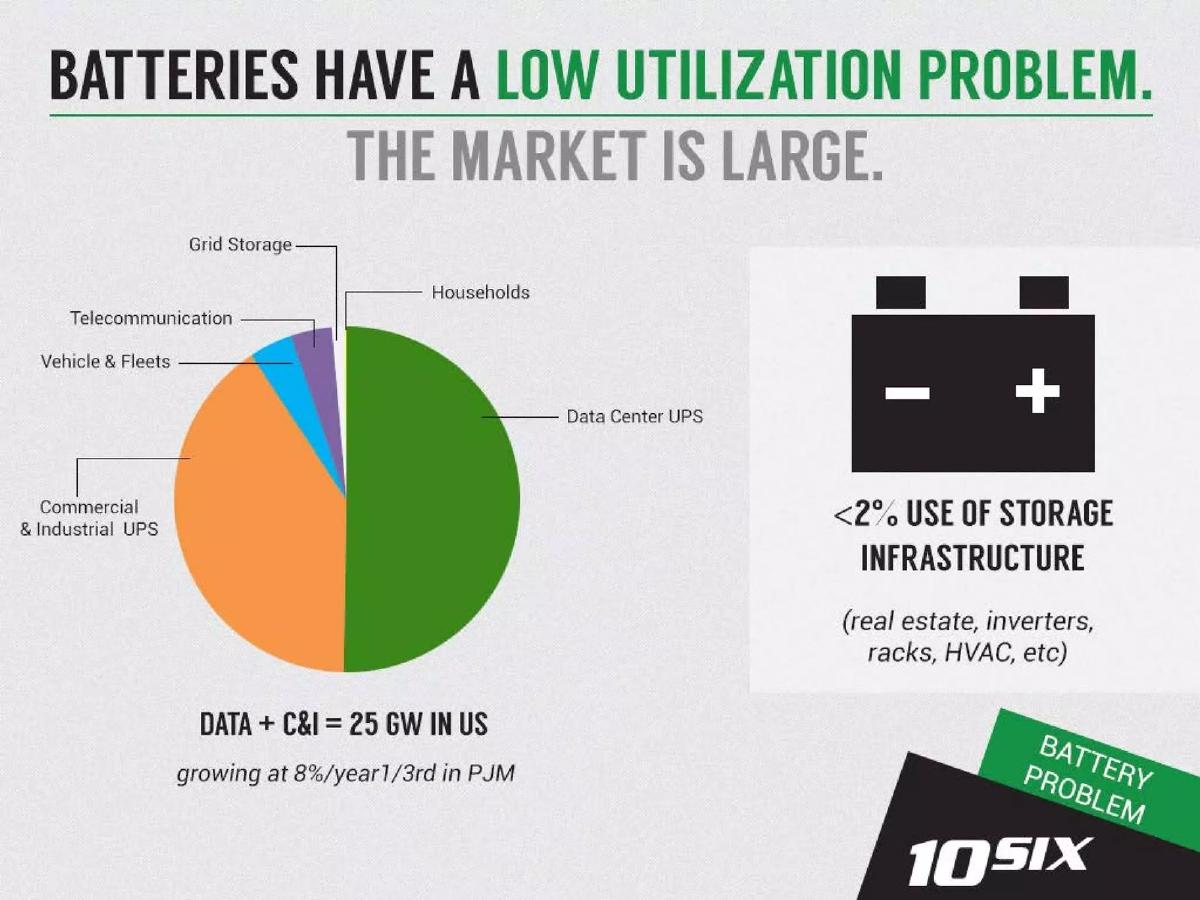
Networking idle battery capacity for the grid. A pie chart of where batteries sit and one large figure.
10SIX deck, slide 4. Exact stored slide matched to this analysis.
Our analysis: The strongest example here: it names the asset (backup batteries), measures the waste (<2% use) and sizes it (25 GW).
Evidence and limitation: Utilisation and installed-base figures; no source shown.
What a founder can adapt: If your problem is unused capacity, give the utilisation rate and the size of the idle base.
Supporting analysis
What the deck claims: "Batteries have a low utilization problem. The market is large." Pie chart: Data Center UPS, Commercial & Industrial UPS, Vehicle & Fleets, Telecommunication, Grid Storage, Households. "<2% use of storage infrastructure (real estate, inverters, racks, HVAC, etc)". "Data + C&I = 25 GW in US growing at 8%/year 1/3rd in PJM".
Presentation choice: An idle asset that is already paid for is an easy problem to grasp, and the number makes it concrete.
When it does not fit: Add a source for the <2% figure; it carries the slide.
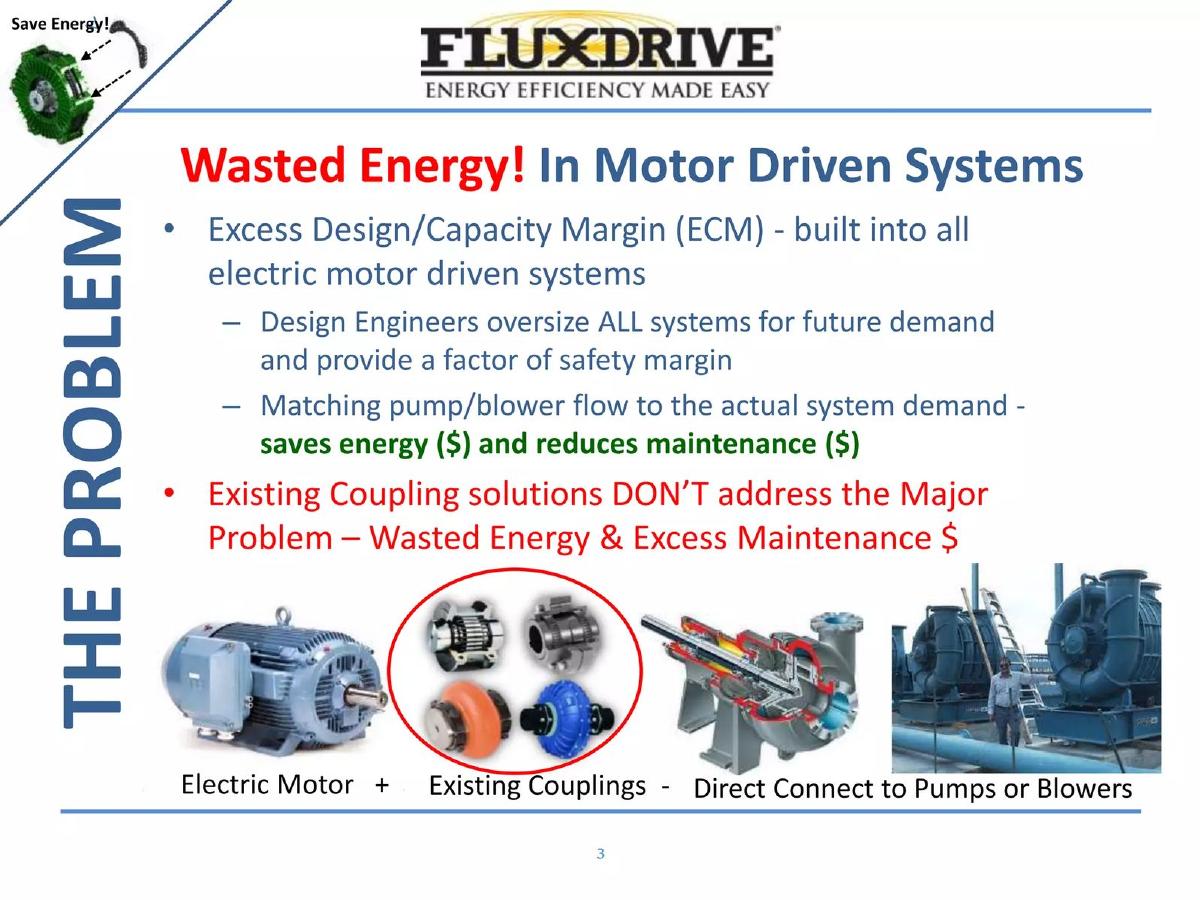
Magnetic couplings for industrial motors. Bullets above a row of equipment photos.
FluxDrive deck, slide 3. Exact stored slide matched to this analysis.
Our analysis: It explains why the waste exists (oversizing for safety) and why current parts don't fix it.
Evidence and limitation: No figures.
What a founder can adapt: Explain the everyday practice that creates the waste.
Supporting analysis
What the deck claims: "Wasted Energy! In Motor Driven Systems." "Excess Design/Capacity Margin (ECM) - built into all electric motor driven systems": "Design Engineers oversize ALL systems for future demand and provide a factor of safety margin"; "Matching pump/blower flow to the actual system demand - saves energy ($) and reduces maintenance ($)". "Existing Coupling solutions DON'T address the Major Problem – Wasted Energy & Excess Maintenance $". Photos: electric motor, existing couplings, pumps and blowers.
Presentation choice: The cause is a normal engineering habit, so the investor believes the waste is widespread.
When it does not fit: No number; add typical oversizing or energy lost per motor.
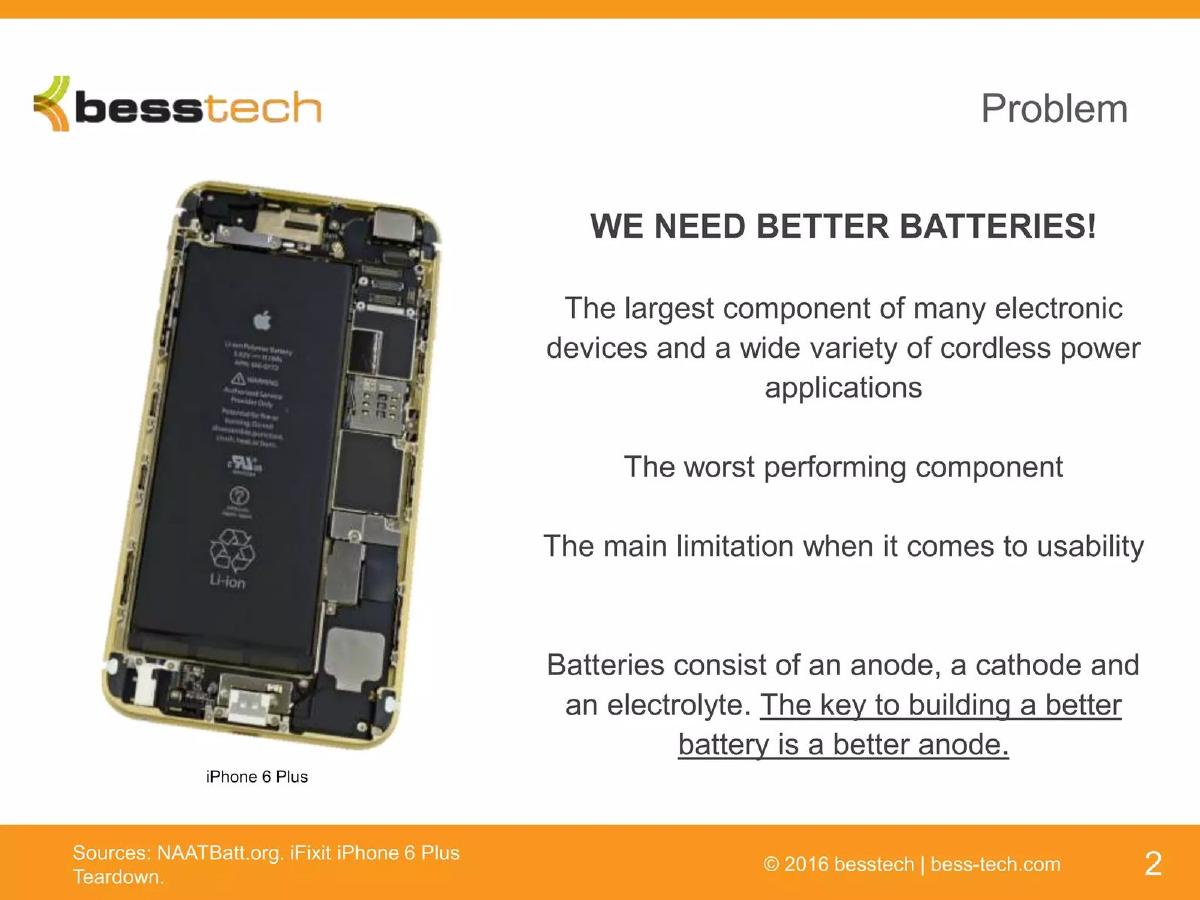
Battery anode materials. A phone teardown photo and four statements with a source line.
Besstech deck, slide 2. Exact stored slide matched to this analysis.
Our analysis: It narrows a broad problem (batteries) to the part the company works on (the anode).
Evidence and limitation: Sources named; no figures.
What a founder can adapt: Move from the everyday problem to the component you fix in one step.
Supporting analysis
What the deck claims: "We need better batteries!" "The largest component of many electronic devices and a wide variety of cordless power applications." "The worst performing component." "The main limitation when it comes to usability." "Batteries consist of an anode, a cathode and an electrolyte. The key to building a better battery is a better anode." Sources: "NAATBatt.org, iFixit iPhone 6 Plus Teardown".
Presentation choice: The photo shows the battery filling the phone, which makes "largest component" visible.
When it does not fit: Add one performance number, such as energy density against what devices need.
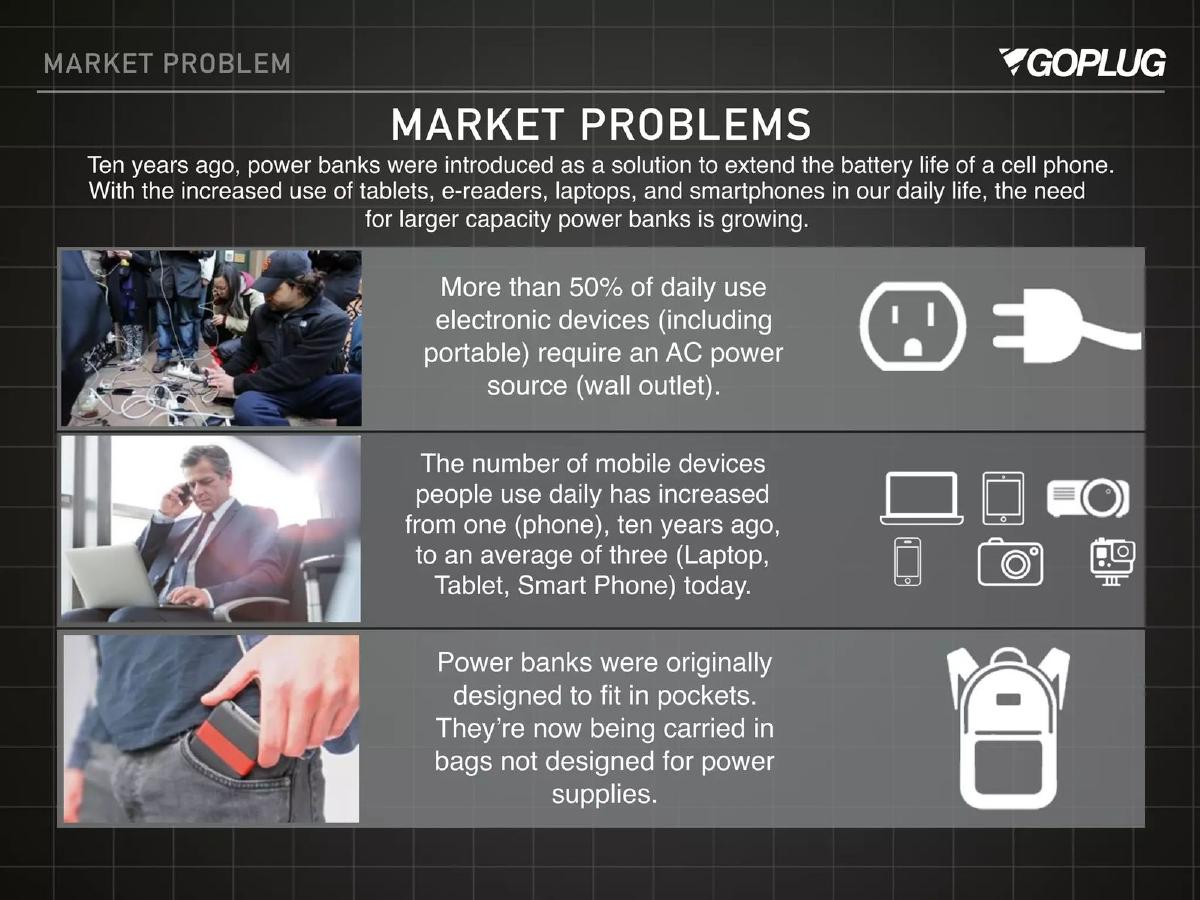
High-capacity portable power. Three photo rows, each with one point.
GoPlug deck, slide 3. Exact stored slide matched to this analysis.
Our analysis: It shows how the user's needs grew while the product stayed the same.
Evidence and limitation: Two figures; no sources.
What a founder can adapt: Show what changed for your user since today's product was designed.
Supporting analysis
What the deck claims: "Ten years ago, power banks were introduced as a solution to extend the battery life of a cell phone." "More than 50% of daily use electronic devices (including portable) require an AC power source (wall outlet)." "The number of mobile devices people use daily has increased from one (phone), ten years ago, to an average of three (Laptop, Tablet, Smart Phone) today." "Power banks were originally designed to fit in pockets. They're now being carried in bags not designed for power supplies."
Presentation choice: "From one device to three" is a change anyone recognises.
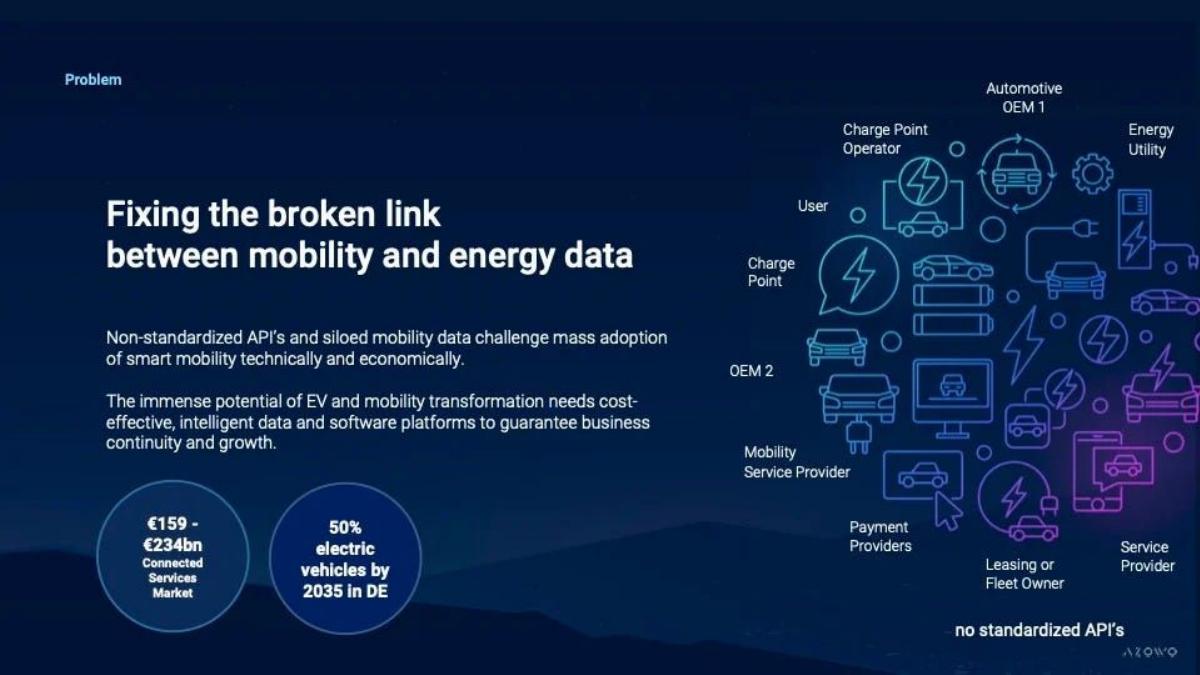
Data platform linking EVs, chargers and utilities. Text beside a web of connected parties.
Azowo deck, slide 2. Exact stored slide matched to this analysis.
Our analysis: The diagram shows the problem well: many parties, no common connection.
Evidence and limitation: Market and adoption figures; no sources.
What a founder can adapt: Draw who has to talk to whom and where the link breaks.
Supporting analysis
What the deck claims: "Fixing the broken link between mobility and energy data." "Non-standardized API's and siloed mobility data challenge mass adoption of smart mobility technically and economically." "The immense potential of EV and mobility transformation needs cost-effective, intelligent data and software platforms." "€159 - €234bn Connected Services Market." "50% electric vehicles by 2035 in DE." Diagram: carmakers, charge point operators, energy utility, fleet owners — "no standardized API's".
Presentation choice: A web of parties with no shared API makes the integration pain visible.
When it does not fit: The figures are market size, not the cost of the problem; say what the missing link costs one operator.
Fuel cells for portable devices. Bullets beside a photo of a burning laptop.
Neah Power deck, slide 5. Exact stored slide matched to this analysis.
Our analysis: It names why the current technology falls short, but not for whom.
Evidence and limitation: No figures; a photo.
What a founder can adapt: Put numbers on the gap: hours needed against hours delivered.
Supporting analysis
What the deck claims: "Battery Technology Challenges." "Demand for longer runtime." "Lithium-ion batteries": "Heavy", "Safety concerns", "Inefficient performance". "Power gap, demand vs. available energy": "Power hungry features", "Increased use in mobile environments", "Limited battery technology".
Presentation choice: "Power gap, demand vs. available energy" is a clear way to frame the problem.
When it does not fit: A dramatic photo standing in for evidence.
Waste-to-energy resort development in Indonesia. Four bullets.
The Elysium Project deck, slide 4. Exact stored slide matched to this analysis.
Our analysis: Partial: an energy shortage is named, but beside three unrelated problems, including luxury resorts.
Evidence and limitation: No figures.
What a founder can adapt: Keep the electricity point and say who lacks power and how much.
Supporting analysis
What the deck claims: "Whats wrong?" "Indonesia has a problem with waste disposal & plastic." "Indonesia has limited amounts of electricity & clean water." "Indonesia has very few resorts catering to UHNWI & HNWI, and no international standard marinas." "The air we are breathing & the water we drink is becoming more and more polluted."
Presentation choice: Kept to show how mixing problems weakens each one.
When it does not fit: Four problems for four different customers.
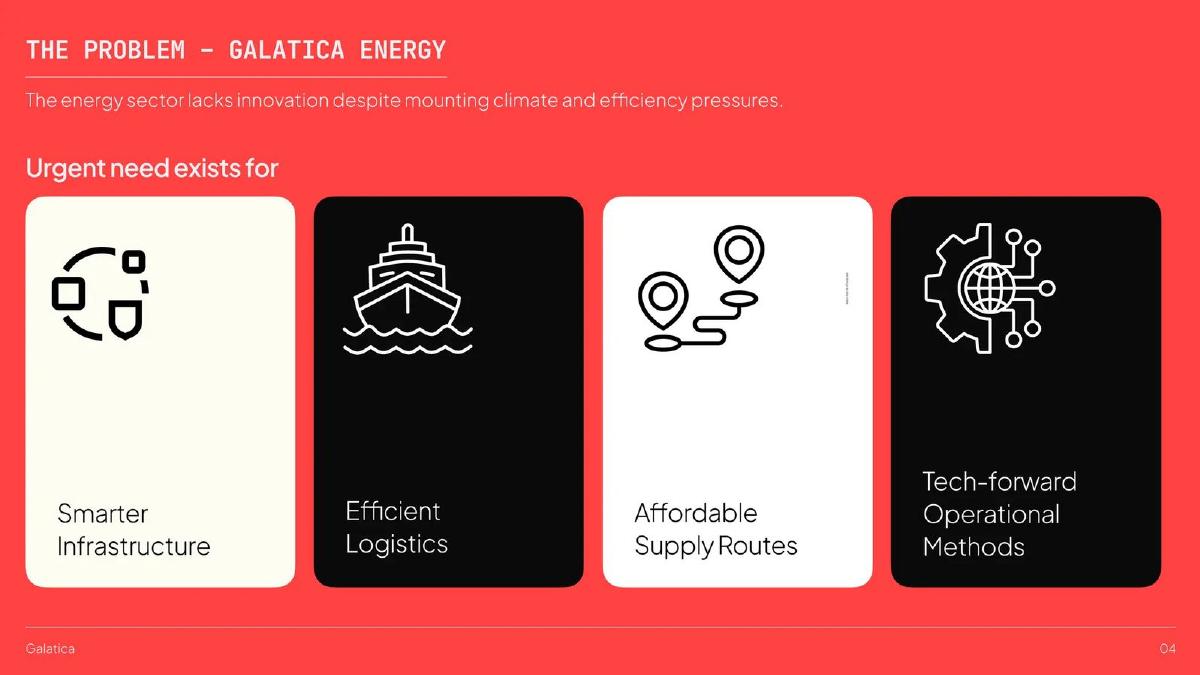
Energy infrastructure. A subtitle and four icon tiles on red.
Galatica deck, slide 4. Exact stored slide matched to this analysis.
Our analysis: Weak on purpose: four needs written as solutions, no user, no waste and no number.
Evidence and limitation: No figures.
What a founder can adapt: Pick one tile and say who suffers and what it costs them.
Supporting analysis
What the deck claims: "The problem - Galatica Energy." "The energy sector lacks innovation despite mounting climate and efficiency pressures." "Urgent need exists for": "Smarter Infrastructure", "Efficient Logistics", "Affordable Supply Routes", "Tech-forward Operational Methods".
Presentation choice: Kept as a contrast; compare 10SIX, which names the asset and measures the waste.
When it does not fit: Listing what you'll build in place of the problem.
Say why current technology can't fix it — that is where a deep-tech product earns its place.
Source technical figures; energy data is widely published.
"The energy sector lacks innovation" is a claim, not a problem.
Build your energy problem slide
One asset or user, how much energy is wasted or missing, why today's technology can't fix it.
Where. Which asset, site or user is wasting or short of energy?
How much. Utilisation, kWh, runtime or cost, with a source.
Why. Why can't current technology or practice fix it?
Who pays. Who bears the cost today?
Copyable framework: [Asset or user] wastes / lacks [amount] because [cause]. Current [technology] can't fix it because [reason]. [Source].
Illustrative example 1 — written by us
Before: The energy sector lacks innovation despite growing efficiency pressures.
After: A mid-size cold-storage warehouse spends about $40,000 a year running compressors at full speed even when half empty; existing controls only switch them on and off. (Figures from our audits of 12 sites.)
What improved: Our illustrative rewrite; the figures are invented for the example. It names the site, the waste and why current controls fall short.
What this guide adds
The climate problem guide covers emissions, carbon removal and materials. This guide covers energy itself: storage, batteries, efficiency and supply. None of the eight slides here appears in another guide; Better NRG's problem slide was left out because it is already in the marketplace problem guide.
Energy problems usually fall into three kinds: capacity sitting unused, energy wasted in use, or technology that can't store or deliver enough.
Three things an energy problem slide proves
Where the energy goes wrong: unused storage (10SIX), oversized motors (FluxDrive), batteries that are "The worst performing component" (Besstech).
How much: "<2% use of storage infrastructure" (10SIX); "More than 50% of daily use electronic devices... require an AC power source" (GoPlug).
Why today's technology fails: "Existing Coupling solutions DON'T address the Major Problem" (FluxDrive); lithium-ion is "Heavy" with "Safety concerns" (Neah Power).
Common mistakes
"The energy sector lacks innovation". Say where energy is lost, and how much.
Needs written as solutions. "Smarter infrastructure" is what you'll build, not the problem.
Market size in place of the problem. A €200bn market isn't what one customer loses.
No reason current technology fails. Investors will ask why incumbents can't fix it.
Mixing unrelated problems. One energy problem per slide.
Diagnostic checklist
It names one asset, site or user.
It measures the waste or shortfall.
It says why current technology can't fix it.
Figures have a source.
It focuses on one problem.
Frequently asked questions
How we chose these examples
Corpus: published pitch deck teardowns on StartupFundraising.com. Founder-uploaded private decks are excluded.
Selection (2026-09-25): we searched slides 2–5 for problem slides mentioning energy, electricity, solar, the grid, utilities or batteries. Nine stored images were inspected. Better NRG slide 2 is already in the marketplace problem guide and was left out; Amogy, ComBio and Ecolocked are in the climate guides and were not re-inspected. The Elysium Project is marked partial; Galatica is kept as a weaker contrast.
Overlap check: none of these eight slides appears in another guide. The technology slide guide uses Azowo slide 5, not its problem slide.
Review: all eight stored slide images were inspected on 2026-09-25 and matched to company, deck and slide number (editorial model review). No person has yet completed an editorial review of this page.
Claims are as shown on the slides; we have not verified them. We make no claim that any slide caused a fundraising outcome.