Flux Drive’s pitch deck focuses on the 'SmartCOUPLING,' a permanent magnet-based hardware solution designed to improve the efficiency of industrial motor-driven systems. The company addresses the problem of 'Excess Design/Capacity Margin' in engineering, which leads to energy waste and high maintenance costs. By using an adjustable air gap to transfer torque without physical contact, Flux Drive claims to eliminate wear and reduce vibration. The deck leans heavily on technical validation, citing 11 patents across 35 countries and showcasing a traction list that includes Boeing, Veolia, and the…
Key takeaways
- The core value proposition is a 'drop-in' solution for energy and maintenance savings in motor-driven systems (Slide 1).
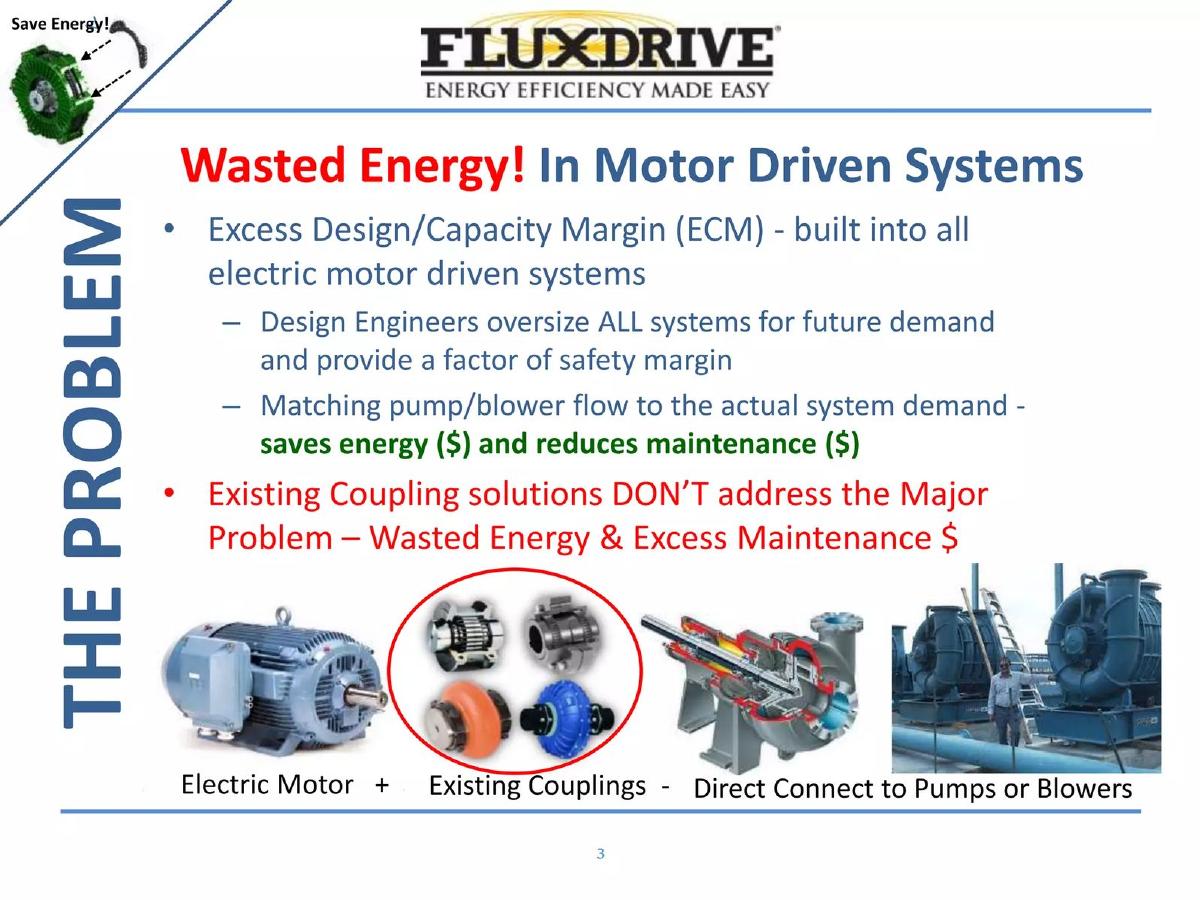
- The problem identified is that engineers typically oversize systems for future demand, creating wasted energy and excess maintenance (Slide 3).
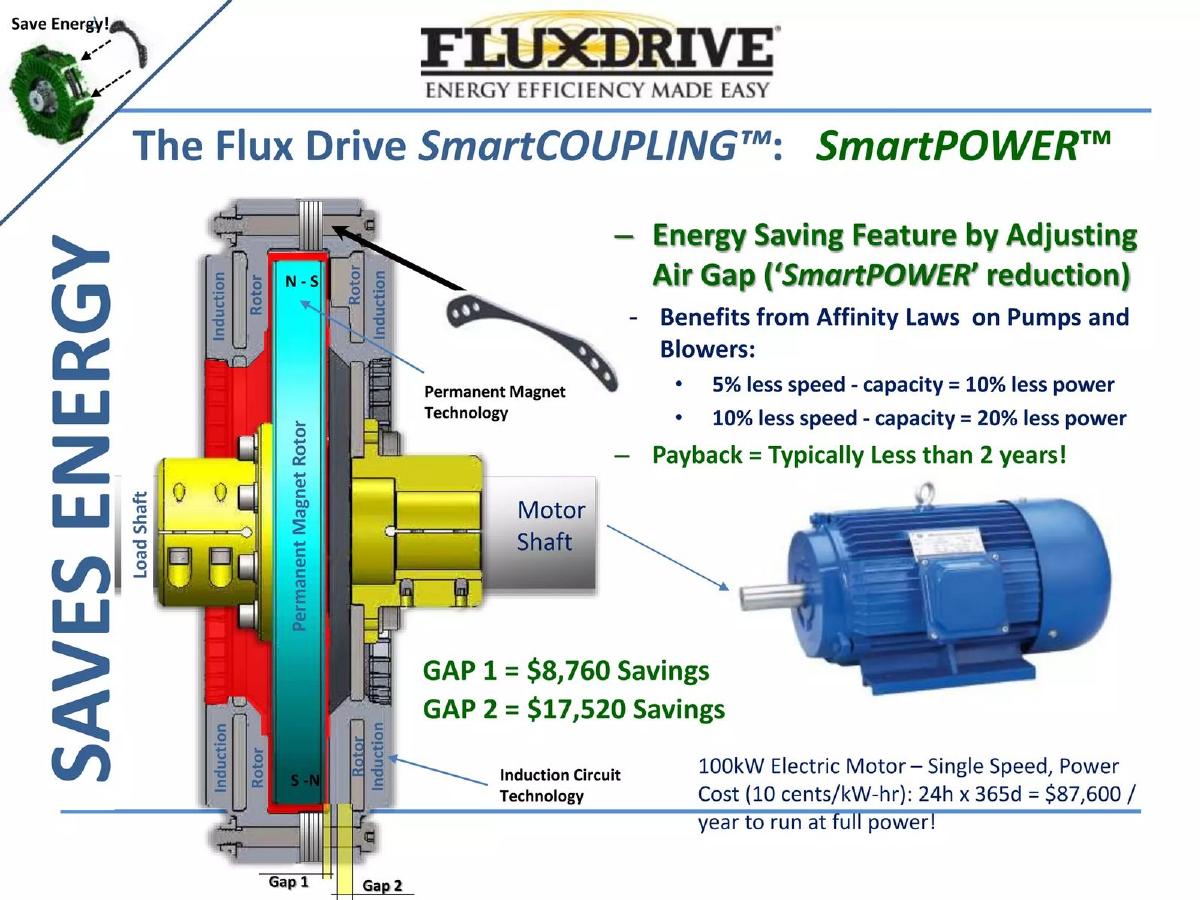
- The technology uses permanent magnet rotors and an adjustable air gap to transfer torque without touching parts, theoretically preventing wear (Slide 7).
- Flux Drive attained American Bureau of Shipping certification in 2012 and scaled its SmartCOUPLING technology to 500hp by 2014 (Slide 9).
- Intellectual property is a major focus, with 11 patents in the portfolio and issued patents in the USA, Canada, Mexico, and several Asian and Oceanic countries (Slide 9).
- Marketing efforts included 100,000+ impressions in trade publications like Modern Pumping Today and Upstream Pumping (Slide 11).
- Traction is demonstrated through a logo wall featuring major entities such as Boeing, Pemex, and the U.S. Navy (Slide 13).
- Actual installation photos show the hardware applied to 50hp, 100hp, and 200hp pumps and fans (Slide 15).
Flux Drive: Industrial Efficiency Through Magnetic Coupling
The Flux Drive pitch deck, specifically version 1.3 from 2014, is a technical, hardware-focused presentation aimed at industrial investors. The company positions itself as a solution to a specific engineering inefficiency: the tendency to oversize motor-driven systems. By providing a mechanical alternative to electronic variable frequency drives (VFDs), Flux Drive attempts to capture a niche in the massive industrial maintenance and energy efficiency market. The deck relies heavily on technical diagrams and a strong list of existing customers to build credibility.
Slide 1: Title and Value Proposition
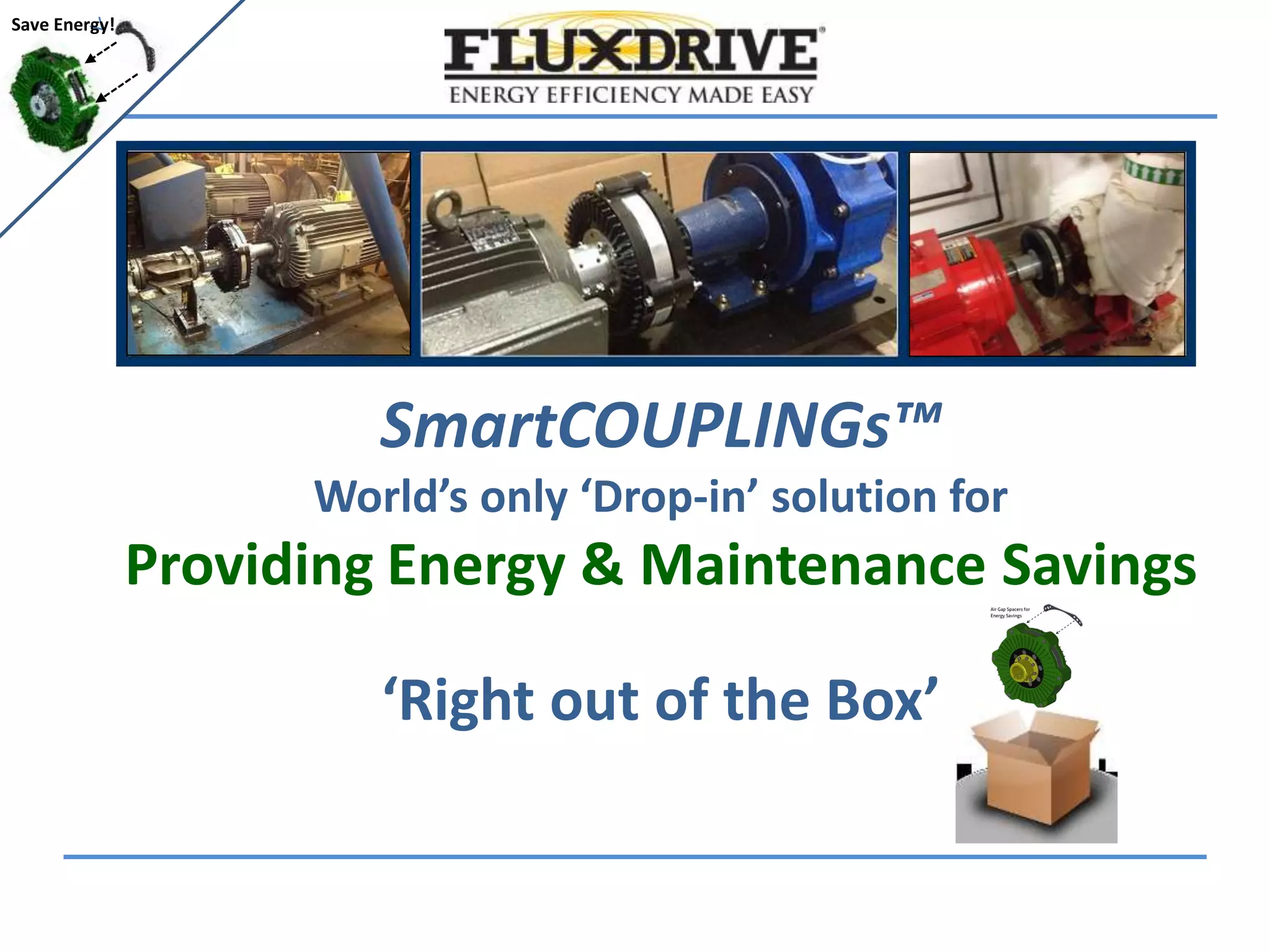
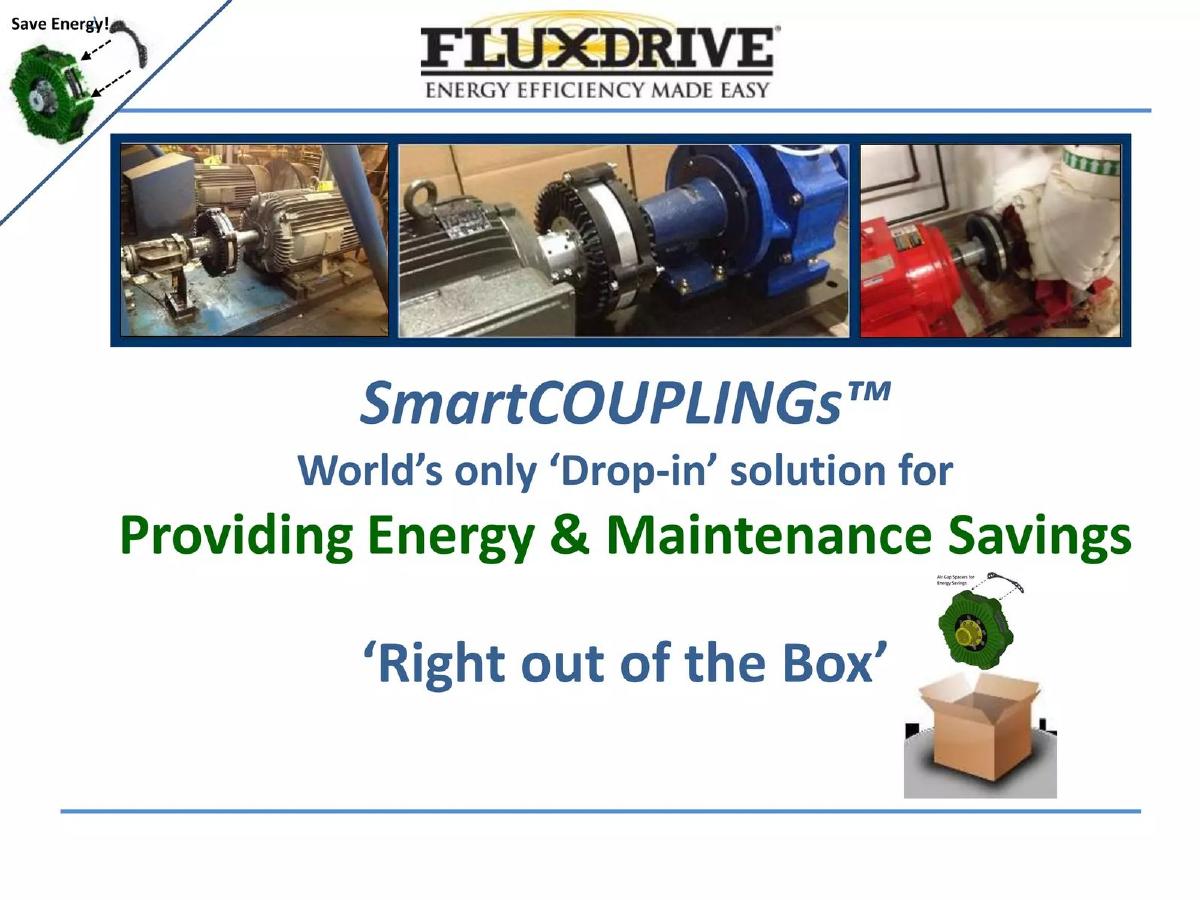
The opening slide introduces the 'SmartCOUPLINGS' brand and the company's core mission: 'Energy Efficiency Made Easy.' The slide features three photos of the hardware installed in industrial settings, emphasizing that this is a physical, 'drop-in' solution. The phrase 'World’s only ‘Drop-in’ solution' suggests a competitive advantage based on ease of installation, while 'Right out of the Box' reinforces the low-friction adoption path for industrial plant managers.
Slide 3: The Problem of Wasted Energy
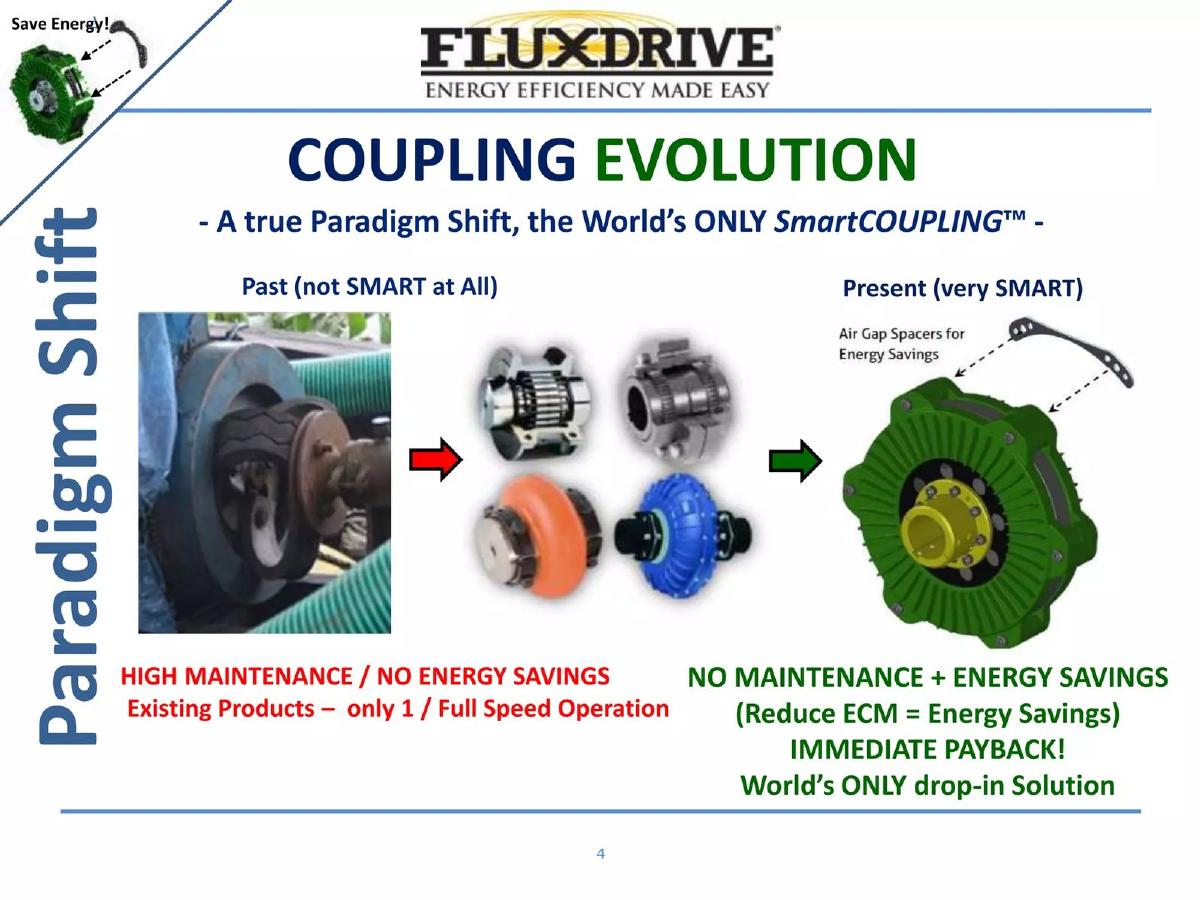
Slide 3 defines the problem as 'Wasted Energy! In Motor Driven Systems.' It identifies a specific cause: Excess Design/Capacity Margin (ECM). The deck argues that design engineers intentionally oversize systems for future demand, leading to inefficiency. It points out that existing coupling solutions do not address this waste. The visual aid shows a standard electric motor connected to existing couplings and then to pumps or blowers, highlighting the specific point in the mechanical chain where Flux Drive intervenes.
Slide 5: The Solution and Benefits
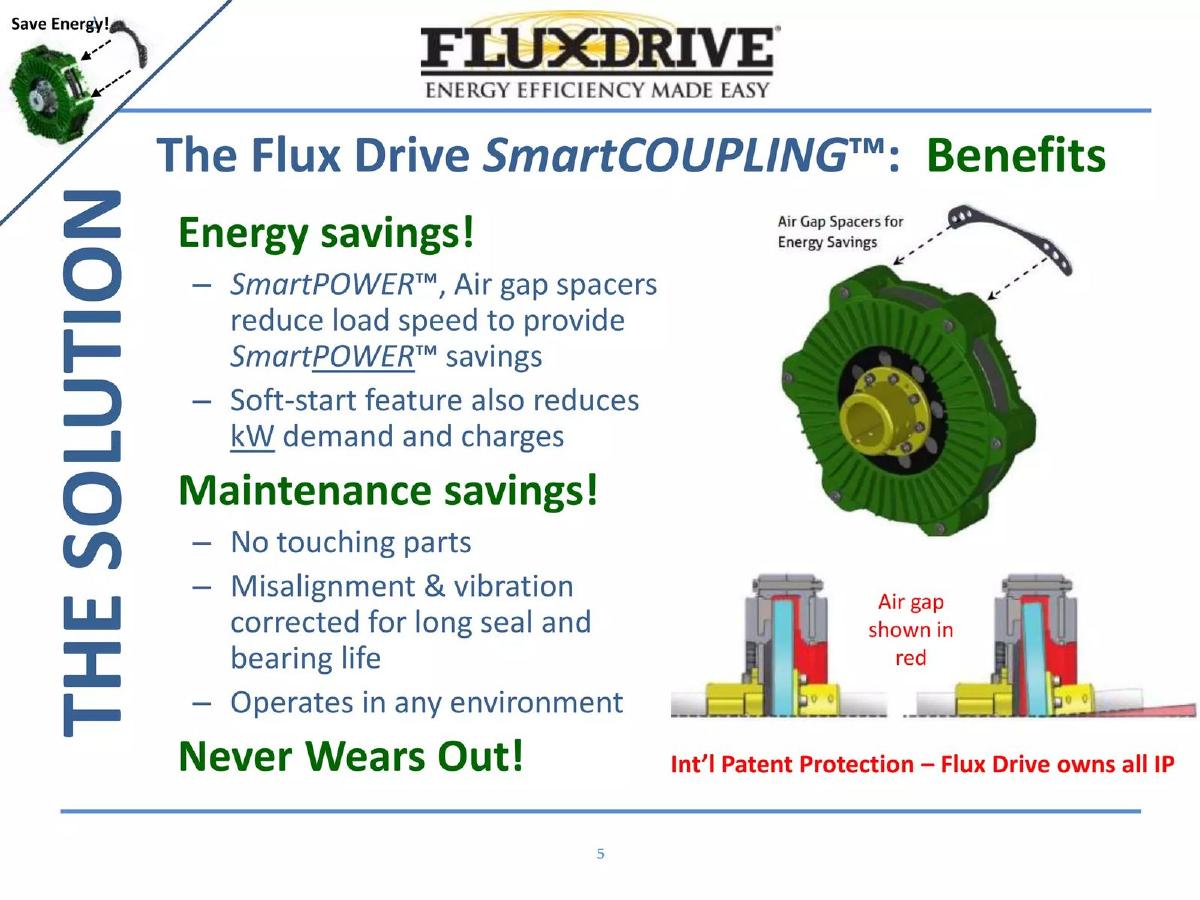
The solution is presented as the 'Flux Drive SmartCOUPLING.' The benefits are split into two categories: energy savings and maintenance savings. On the energy side, the deck introduces 'SmartPOWER' air gap spacers and a 'soft-start' feature to reduce demand charges. On the maintenance side, the slide claims there are 'no touching parts,' which eliminates wear from misalignment and vibration. A crucial note at the bottom states that the company has 'Int’l Patent Protection' and 'owns all IP,' a key point for hardware investors.
Slide 7: Technical Mechanics of the Air Gap
Slide 7 provides a detailed cross-section diagram of the technology. It shows a 'Load Shaft' and a 'Motor Shaft' separated by an 'Air Gap.' The diagram labels the induction rotor and the permanent magnet rotor. The text highlights that the system accepts compound shaft misalignment and accommodates thermal growth. The central claim, 'NEVER wears out!', is repeated here, supported by the visual evidence that the two halves of the coupling never physically touch.
Slide 9: Company Milestones and IP Portfolio
This slide provides a timeline of the company's progress. It notes that the product was ready and the first patent was issued in 2007. Between 2008 and 2012, the company cultivated initial markets and attained American Bureau of Shipping certification. By 2013, the technology was scaled to 300hp, and by 2014, the SmartCOUPLING was scaled to 500hp. The slide also details the patent portfolio, citing 11 patents and coverage in over 35 countries, including the USA, Canada, and South Korea.
Slide 11: Marketing and Media Reach
Slide 11 focuses on the company's efforts to build brand awareness. It mentions a Veolia case study published in 'Pumps & Systems' magazine in May 2014. The company claims over 100,000 advertising impressions in industry publications like 'Modern Pumping Today' and 'Upstream Pumping.' It also lists trade show participation in sectors including the Navy, Oil & Gas, and Forest Products. This slide serves to demonstrate that the company is active in the professional industrial community.
Slide 13: Customer Traction Logo Wall
The traction slide is a dense collection of logos from major industrial and government entities. Notable names include Boeing, Veolia Water, Pemex, the U.S. Navy, and Weyerhaeuser. The inclusion of diverse sectors—from aerospace and water treatment to forestry and oil—suggests that the technology has broad horizontal application across any industry using large electric motors.
Slide 15: Real-World Installations
To move beyond logos, Slide 15 shows photos of the 'SmartCOUPLING' and 'IntelligentCOUPLING' (ASD) in use. The photos are labeled with specific applications: a 100hp hot oil pump, a 50hp water pump, a 50hp dye pump, a 50hp cooling tower fan, a 200hp water pump, and a 200hp induced draft fan. This slide is critical for proving that the technology is not just a prototype but a functional industrial component capable of handling high-horsepower loads.
Slide 17: Financial Projections and Gated Data
Slide 17 is the most restrictive in the deck. It mentions that business development is underway for units in China, Singapore, and India. However, it does not provide any actual numbers. Instead, it directs the viewer to 'login to Crowdfunder using your accredited investor account' for financial details. This indicates the deck was likely used as a top-of-funnel marketing tool for a crowdfunding campaign rather than a comprehensive document for a private VC meeting.
Slide 19: Contact Information
The final slide provides contact details for Chip Corbin, the CEO. It includes an email address and a phone number with an extension. The slide also features a final rendering of the SmartCOUPLING hardware, reinforcing the product-centric nature of the pitch.
What Flux Drive Does Well
The deck excels at technical communication. For an industrial product, the 'how it works' is often as important as the 'how much it makes,' and Flux Drive uses clear diagrams to explain the permanent magnet coupling. The emphasis on the 'Air Gap' as a solution for both energy waste and mechanical wear is a strong, dual-purpose value proposition. Furthermore, the traction slides (13 and 15) are excellent. Seeing the product installed on a 200hp fan provides a level of 'social proof' that a simple logo wall cannot achieve alone. The focus on intellectual property also suggests a company that has spent time and capital building a defensive moat around its hardware.
Omissions and Weaknesses
The most glaring omission is the lack of a team slide. While the CEO is named on the final slide, there is no information about his background or the expertise of the engineering team. In hardware startups, the ability to manufacture and scale is a significant risk, and investors need to see a team capable of navigating those challenges. Additionally, the deck lacks a 'Market Size' slide. While the customer list is impressive, the deck doesn't quantify the Total Addressable Market (TAM) for motor couplings, leaving the investor to guess the scale of the opportunity. Finally, the decision to gate the financials (Slide 17) makes the deck feel incomplete as a standalone fundraising tool. Without revenue figures, growth rates, or a specific ask, the deck functions more like a product brochure than a business case.
Founder Takeaways
Founders in the industrial tech space should take note of how Flux Drive uses specific application photos to prove their technology. Showing the hardware in a 'hot oil pump' or a 'cooling tower' is much more persuasive than generic claims of 'industrial use.' Another takeaway is the importance of highlighting certifications and patents early; in sectors like shipping (ABS certification) and heavy industry, these are not just 'nice-to-haves' but requirements for entry. However, founders should avoid the 'gated financials' approach if they are pitching directly to VCs. While it may work for a public crowdfunding portal, a traditional pitch deck should include at least a high-level summary of the business model, current revenue, and the specific funding amount being sought.
Frequently asked questions
- What is the primary technology behind Flux Drive?
- Flux Drive utilizes permanent magnet technology to create a non-contact coupling for industrial motors. As shown on Slide 7, the 'SmartCOUPLING' transfers torque across an air gap between an induction rotor and a permanent magnet rotor. This design allows for the accommodation of shaft misalignment and thermal growth without the transfer of vibration, which the company claims results in a product that 'never wears out.'
- How does Flux Drive save energy for industrial users?
- The energy savings are achieved through 'SmartPOWER' air gap spacers. According to Slide 5, these spacers allow operators to reduce load speed to match actual demand rather than the maximum capacity of an oversized motor. Additionally, the system features a 'soft-start' capability that reduces peak kilowatt demand and associated utility charges during motor startup.
- What evidence of market traction does the company provide?
- The company provides three forms of traction: a logo wall of customers, specific installation photos, and marketing reach. Slide 13 lists high-profile clients like Boeing, Veolia, and the U.S. Navy. Slide 15 provides photographic evidence of the hardware installed on various industrial machines, ranging from 50hp dye pumps to 200hp draft fans, proving the technology is operational in the field.
- Is the technology protected by intellectual property?
- Yes, intellectual property is a pillar of the deck. Slide 9 states that Flux Drive has a portfolio of 11 patents with applications in over 35 countries. They have successfully secured issued patents in major markets including the USA, Canada, Mexico, South Korea, Singapore, Australia, and New Zealand. The deck explicitly notes on Slide 5 that 'Flux Drive owns all IP.'
- What is missing from this pitch deck?
- The deck is notably missing a team slide, a detailed financial breakdown, and a specific funding ask. While it mentions a CEO (Chip Corbin) on the final slide, there is no background on the leadership team. Furthermore, Slide 17 acts as a gatekeeper, stating that financial details are only available to accredited investors via the Crowdfunder platform, leaving the viewer without knowledge of the company's revenue or valuation.