Fluid AI’s pitch deck is an exercise in enterprise credibility. Rather than getting bogged down in the technical architecture of their artificial intelligence, the founders focus almost entirely on 'Fluid AI in Action.' The deck highlights a nationwide rollout with RBL Bank and high-visibility deployments for Toyota and Rolls Royce. With a team featuring Oxford PhDs and dropouts from India’s top-ranked business schools, the narrative is built on the pedigree of the founders and the scale of their existing clients. While the deck is light on specific unit economics and market sizing, it succes…
Key takeaways
- The company positions itself as technology to 'revolutionize the in-store experience' on slide 1.
- Fluid AI emphasizes a 'Nation Wide Rollout' with RBL Bank, showcasing physical branch and ATM integration on slide 3.
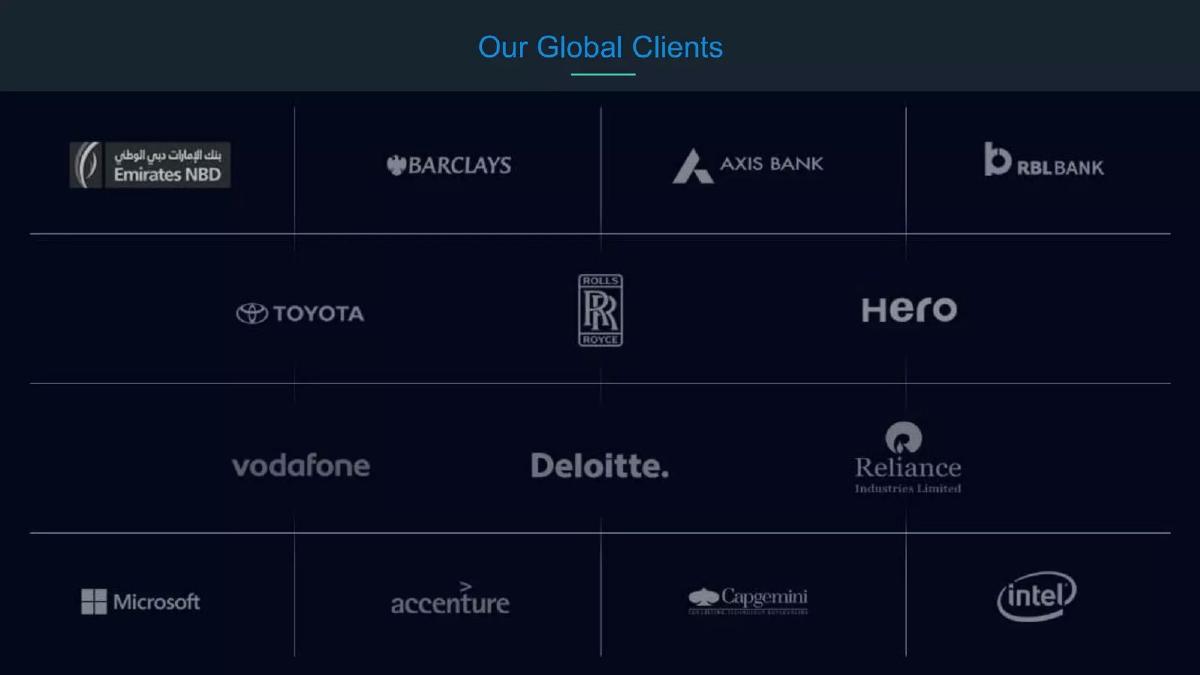
- The deck lists five major enterprise clients—RBL Bank, Vodafone, Toyota, Rolls Royce, and Emirates NBD—as active deployments on slide 4.
- A single metric is provided for baseline engagement: '5% Engagement with Digital' before Fluid AI implementation on slide 5.
- The team is described as a '40 Person Team' including AR and AI experts with a PhD from Oxford on slide 6.
- Founders Raghav and Abhinav are highlighted for dropping out of IIM A (Rank 1) and ISB (Rank 2) respectively on slide 6.
- The business model is stated simply as 'A per installation annual license fee' on slide 7.
- The deck lacks a specific funding ask, use of proceeds, or detailed financial projections across the provided slides.
Fluid AI: The Power of the Enterprise Logo
Fluid AI’s pitch deck is a study in minimalist enterprise sales. In a sector often cluttered with technical jargon about neural networks and computer vision, this deck chooses to show rather than tell. The core thesis is simple: high-value physical spaces (banks, car showrooms) are failing to engage customers digitally, and Fluid AI has already solved this for some of the world’s largest brands.
Slide 1: The Vision Statement
The cover slide establishes a clean, professional brand identity. The subtitle, "TECHNOLOGY TO REVOLUTIONIZE THE IN-STORE EXPERIENCE," immediately anchors the company in the 'Phygital' space—the intersection of physical retail and digital interaction. The use of a New York City skyline image suggests global ambition, despite the heavy concentration of Indian clients later in the deck.
Slides 2-3: The Proof of Scale
Slide 2 acts as a simple transition: "OUR DEPLOYMENTS." This leads directly into slide 3, which focuses on "RBL Bank – Nation Wide Rollout." This is a critical strategic move. By leading with a 'Nation Wide Rollout' rather than a 'Pilot,' Fluid AI signals that their technology is stable, scalable, and trusted by a regulated financial institution. The photos show the technology integrated into ATMs and branch windows, proving the hardware-software integration is battle-tested.
Slide 4: The Logo Wall in Action
Slide 4, titled "Fluid AI in Action," is the strongest slide in the deck. It breaks down five distinct use cases:
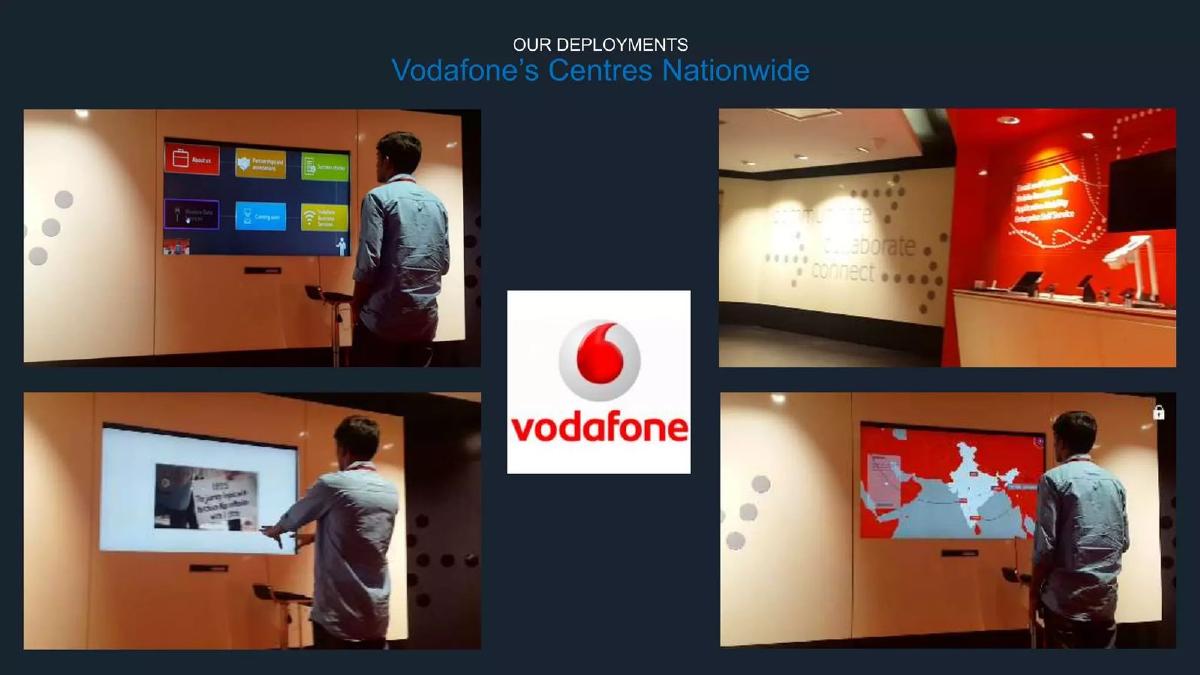
RBL Bank: Branches and ATM networks. · Vodafone: Customer Experience Centers across India. · Toyota: Showcasing car models at Auto Expo. · Rolls Royce: Events for new car model launches. · Emirates NBD: The 'Branch of the Future' network.
This slide does three things simultaneously: it proves sector versatility (Finance, Auto, Telco), it establishes luxury credentials (Rolls Royce), and it demonstrates international reach (Emirates NBD).
Slide 5: The Engagement Gap
Slide 5 introduces the "Impact" section, though it only shows the baseline: "Before Fluid AI: 5% Engagement with Digital." This is a classic 'gap analysis' setup. By highlighting how low traditional digital engagement is in physical stores, they prepare the investor for a (presumably) much higher number in the following slides. It identifies the specific pain point: the 'dead' digital signage that most retailers currently use.
Slide 6: The Pedigree of the 'A-Team'
The team slide focuses on 'The Break' and 'The A-Team.' It highlights that the founders dropped out of IIM A and ISB , the two highest-ranked business schools in India. This 'dropout' narrative is a common trope in startup fundraising to signal conviction. Furthermore, mentioning "AR and AI experts (PhD from Oxford)" provides the technical 'heft' needed to back up the 'AI' in their name, suggesting the 40-person team has deep academic roots.
Slide 7: The Revenue Engine
The business model is refreshingly simple: "A per installation annual license fee." For an investor, this is the ideal model for a company targeting large enterprises. It suggests predictable, recurring revenue that scales linearly with the client's physical footprint. If a bank has 1,000 branches, the revenue potential is clearly defined and easy to model.
Slide 8: Contact and Continuity
The final slide provides direct contact information for the founders, Abhinav and Raghav. The consistency of the branding—clean white and dark blue—remains intact throughout, projecting a level of corporate readiness that matches their Fortune 500 client list.
What Works in This Deck
1. Social Proof as a Shield: By the time an investor reaches the team slide, they have already seen Rolls Royce and Toyota logos. This makes the technical claims of the 'AI' much more believable because these massive corporations have already performed their own due diligence.
2. Visual Evidence: The deck uses actual photos of the product in the wild. In the world of AI and AR, where 'vaporware' is common, seeing a person standing in front of a branded Rolls Royce screen (Slide 4) is worth more than ten slides of architectural diagrams.
3. Focus on 'Phygital': The deck stays strictly focused on the in-store experience. It doesn't claim to solve online e-commerce or general AI problems; it owns the 'branch' and 'showroom' niche.
What Is Missing
1. The 'After' Metric: Slide 5 shows the 5% engagement baseline but the provided slides do not show the improvement Fluid AI delivered. Without the 'After' number, the 'Impact' section is incomplete.
2. Market Sizing (TAM): There is no mention of how many bank branches or car showrooms exist globally. Investors need to know if this is a $100M opportunity or a $10B opportunity.
3. Competitive Landscape: The deck assumes Fluid AI is the only player in this space. A slide addressing how they differ from traditional digital signage companies or other AR startups would be beneficial.
4. The Ask: There is no slide indicating how much money is being raised or what the milestones for the next 18 months will be. This may be due to the deck being an 'overview' rather than a formal 'fundraising' deck, but for a teardown, it is a notable omission.
Founder's Playbook: What to Copy
Use the 'Dropout' Narrative Wisely: If you have left a prestigious institution or a high-ranking job to start a company, frame it as 'The Break' as Fluid AI did. It frames the departure as a proactive choice driven by the scale of the opportunity.
Logo Hierarchy: If you have one massive client and four small ones, make the massive client the hero of its own slide (like RBL Bank on Slide 3) and group the others later. It creates a sense of 'anchor' credibility.
Simplify the Business Model: Don't overcomplicate your pricing in a pitch deck. 'Per installation annual license fee' is a phrase every VC understands. Save the tiered pricing and implementation fees for the data room.
Final Verdict: Fluid AI’s deck is a high-signal, low-noise presentation. It relies on the prestige of its founders and the scale of its clients to do the heavy lifting. While it lacks the granular data required for a final investment decision, as a 'hook' deck to secure a first meeting, it is exceptionally effective.
Frequently asked questions
- What exactly does Fluid AI's technology do?
- Based on the visual evidence in the deck, Fluid AI provides interactive digital displays and AI-driven interfaces for physical locations. Slide 4 shows these in use for 'showcasing car models' at Toyota and creating a 'Branch of the Future' for Emirates NBD. The technology appears to involve gesture control or interactive touch-points that replace or augment traditional static displays in retail and banking environments.
- Who are the key customers mentioned in the deck?
- The deck leans heavily on blue-chip enterprise logos. Specifically, slide 4 names RBL Bank (nationwide rollout), Vodafone (customer experience centers in India), Toyota (Auto Expo showcases), Rolls Royce (new car model launches), and Emirates NBD (branch network). This suggests a focus on high-value retail sectors like banking, telecommunications, and luxury automotive.
- What is the background of the Fluid AI founding team?
- The team is positioned as highly academic and elite. Slide 6 notes that the 40-person staff includes experts with PhDs from Oxford. The founders, Raghav and Abhinav, are highlighted for their 'break' from top-tier Indian institutions, having dropped out of IIM Ahmedabad and the Indian School of Business (ISB) to pursue the venture.
- How does Fluid AI generate revenue?
- Fluid AI utilizes a standard enterprise software-as-a-service (SaaS) or licensed hardware model. Slide 7 explicitly defines the business model as 'A per installation annual license fee.' This implies recurring revenue tied to the physical footprint of their deployments, which aligns with their strategy of targeting large branch networks like RBL Bank.
- What metrics does the deck use to prove success?
- The deck is surprisingly sparse on quantitative data. The primary metric shown on slide 5 is a 'Before Fluid AI' baseline of '5% Engagement with Digital.' While the slide implies an 'Impact' section, the provided slides do not show the 'After' metric, relying instead on the visual proof of 'Nation Wide Rollouts' to signal success.