Flowhaven’s Series A deck is a focused, professional presentation that leans heavily on founder pedigree and industry-specific pain points. Founded in 2016, the company addresses the $280B brand licensing market, which is plagued by fragmented data and manual processes. The deck excels at visualizing the 'before and after' state of a licensing department, moving from a mess of spreadsheets and emails to a unified suite. With a team boasting over 50 years of combined experience—including the creator of Rovio’s licensing framework—Flowhaven establishes immediate credibility. While the deck lack…
Key takeaways
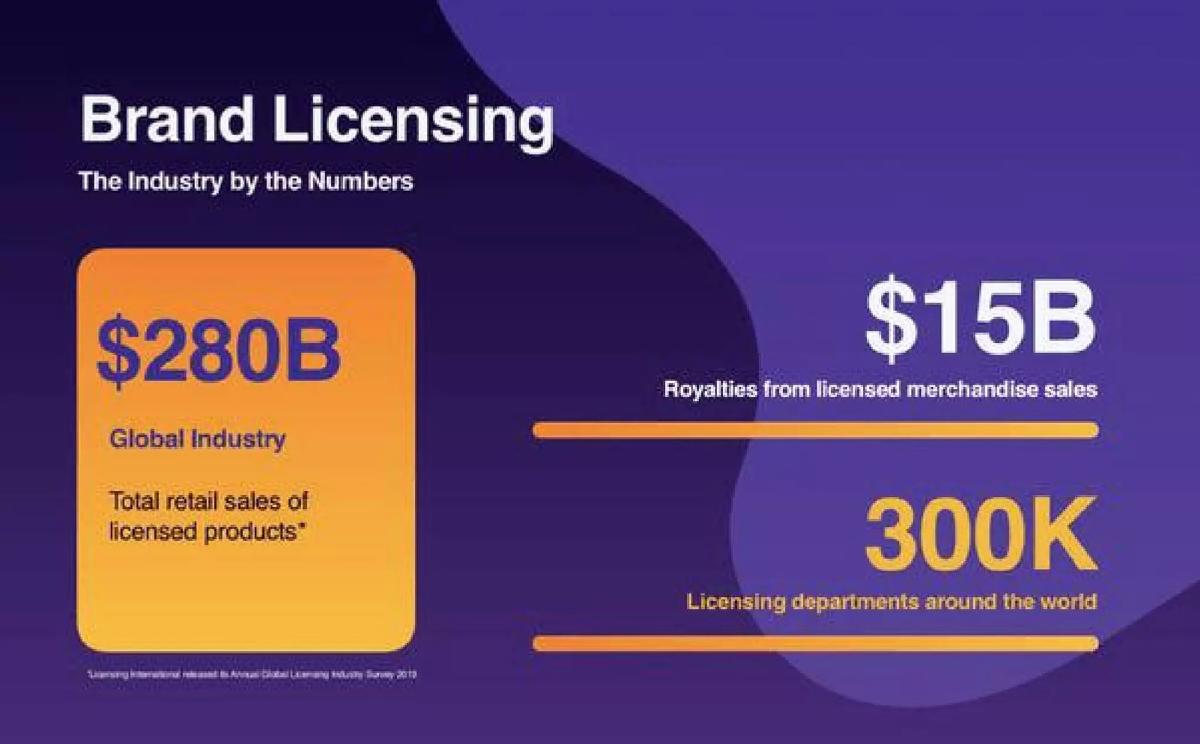
- The company targets a massive but niche global industry with $280B in total retail sales of licensed products (Slide 4).
- Founder Kalle Törmä brings high-tier domain expertise as the creator of Rovio Entertainment's (Angry Birds) licensing framework (Slide 3).
- The deck identifies a specific volume of 300,000 licensing departments globally that suffer from information flow problems (Slide 5).
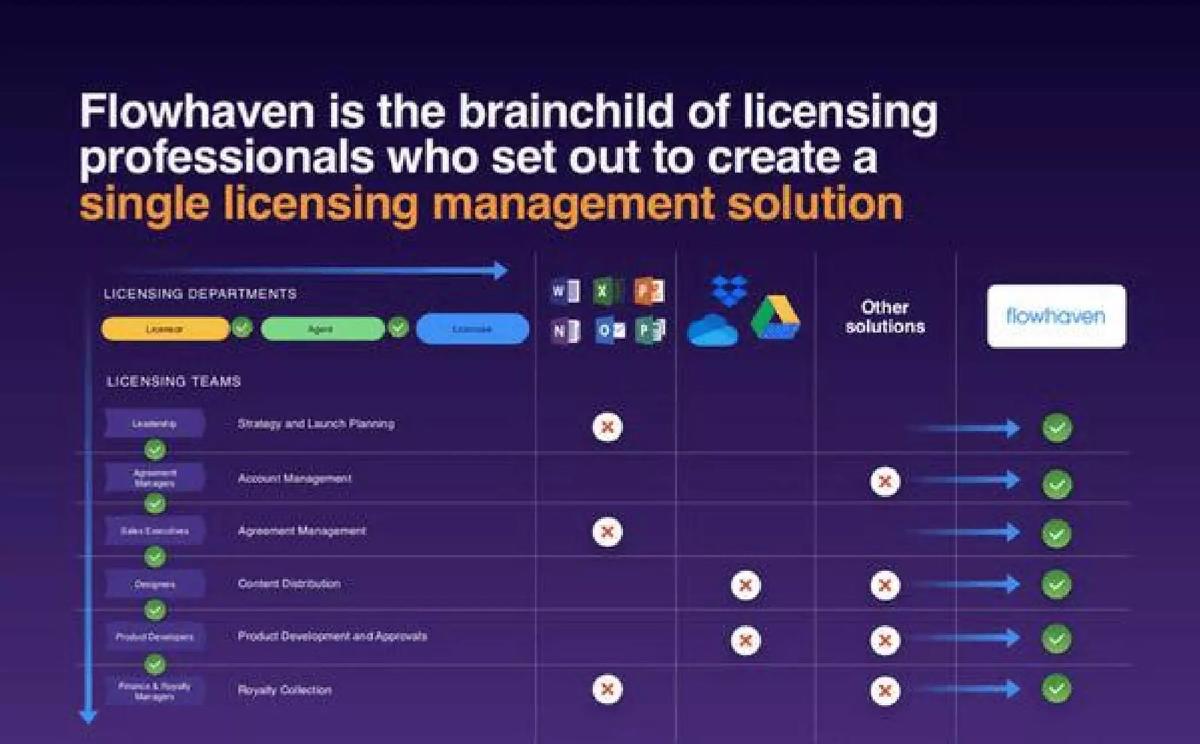
- Flowhaven positions itself as a replacement for fragmented tools like Excel, Dropbox, and generic CRMs (Slide 6).
- Product functionality is broken down into five core pillars: Account Management, Content Management, Design Approvals, Royalties Reporting, and Analytics (Slide 7).
- Traction is demonstrated through significant user growth, including a +300% user login trend and +200% activity increase (Slide 11).
- Customer satisfaction is exceptionally high, with a reported Net Promoter Score (NPS) of greater than 90 (Slide 12).
- The deck utilizes high-profile social proof by featuring logos from Nintendo, Crunchyroll, and Laika (Slide 11).
Introduction: The Vertical SaaS Play for Brand Licensing
Flowhaven’s Series A pitch deck is a clinical example of how to present a vertical SaaS solution to investors. Founded in 2016 and raising $21.2 million, the company doesn't try to be everything to everyone. Instead, it focuses intensely on the brand licensing niche. The deck is structured to first establish the massive scale of this 'hidden' industry and then immediately validate the team’s right to win based on their previous experience at companies like Rovio and Fox.
Slides 1-3: The Team and the Pedigree
Slide 1: Title The cover slide is minimalist, featuring the Flowhaven logo and the subtitle 'Licensing Suite.' The background uses a dark purple gradient with faint UI elements, signaling a modern software product.
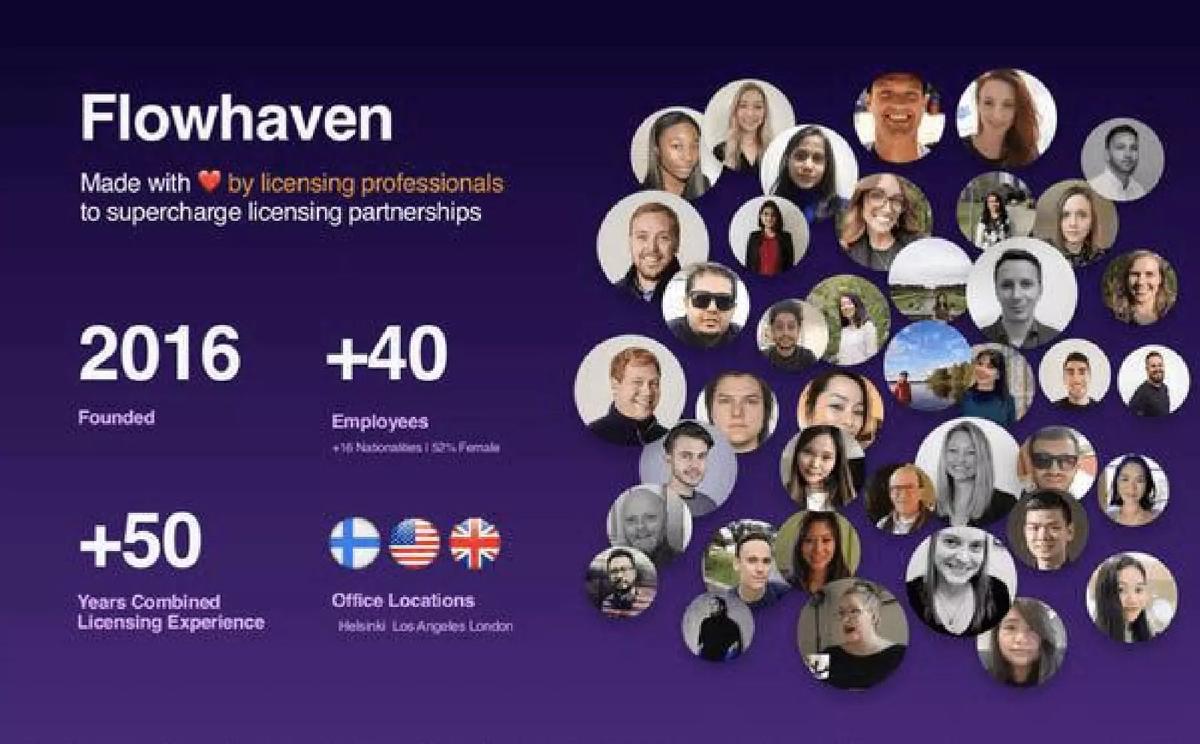
Slide 2: Company Overview This slide serves as a 'traction at a glance' page. It notes the company was founded in 2016 and has grown to over 40 employees representing 15+ nationalities. Crucially, it highlights '+50 Years Combined Licensing Experience.' By placing the office locations (Helsinki, Los Angeles, London) alongside a collage of team photos, Flowhaven establishes itself as a global, mature organization rather than a small local startup.
Slide 3: The Founders This is one of the strongest slides in the deck. Founder-market fit is the central theme here. CEO Kalle Törmä is credited as the 'Creator of Rovio Entertainment’s (Angry Birds) full licensing operations framework.' This is a massive credibility marker in the licensing world. The rest of the leadership team, including CCO Timo Olkkola and GM Jess Trinca, bring backgrounds from Neste, Fox, and FremantleMedia. The CTO, Leonid Zadorozhnykh, is positioned as a 'wizard' leading a 10+ person engineering team. This slide tells investors that these people aren't just building software; they are building the tool they wished they had when they were running licensing for the world's biggest brands.
Slides 4-6: Market Opportunity and Problem Definition
Slide 4: Brand Licensing by the Numbers Flowhaven defines the market size with three key figures: a $280B global industry (total retail sales of licensed products), $15B in royalties from licensed merchandise sales, and 300,000 licensing departments around the world. By citing the 'Annual Global Licensing Industry Survey 2019,' they ground their TAM (Total Addressable Market) in third-party data.
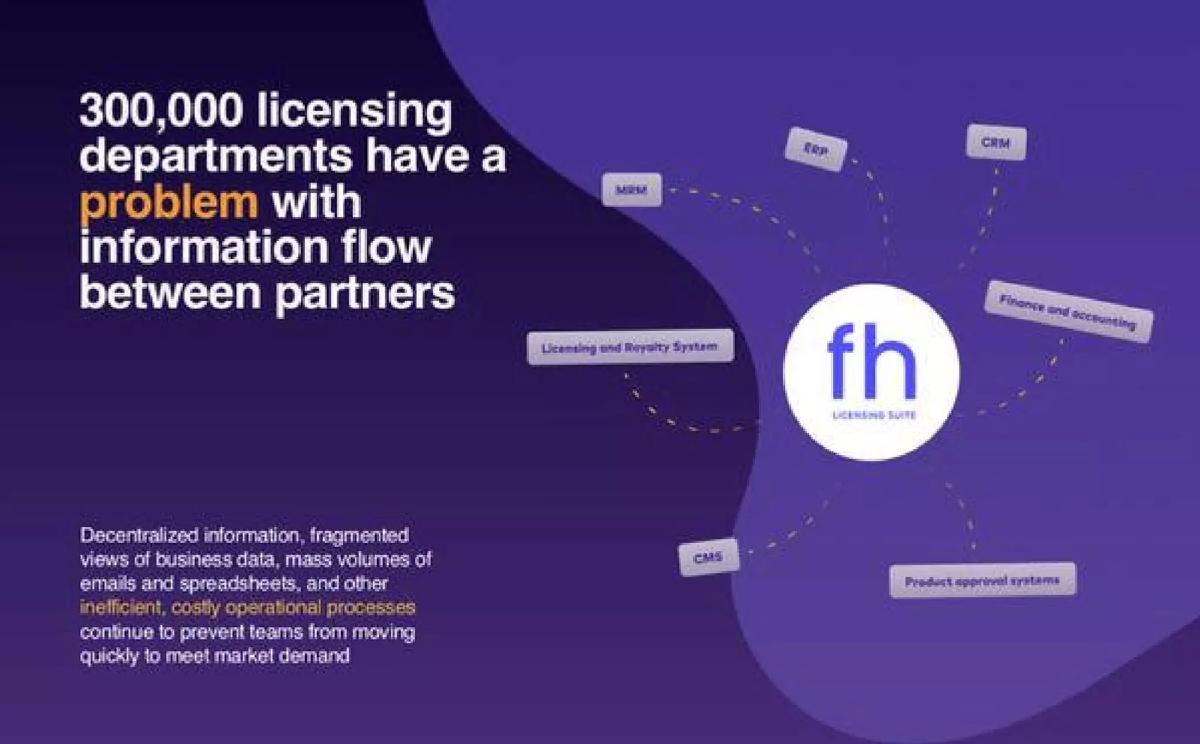
Slide 5: The Problem The deck identifies the core pain point: 'information flow between partners.' It lists the symptoms of this problem: decentralized information, fragmented views of data, and 'mass volumes of emails and spreadsheets.' A hub-and-spoke diagram shows how Flowhaven (fh) sits at the center of various systems like ERP, CRM, and Finance, which are currently disconnected.
Slide 6: The Solution (Comparison) This slide uses a checklist format to compare Flowhaven against the status quo. It shows that while 'Licensing Teams' (Leadership, Agreement Managers, Sales, Designers, etc.) currently use a mix of Microsoft Office, Dropbox, and 'Other solutions,' none of those tools cover the entire workflow. Flowhaven is shown with a column of green checkmarks, indicating it is the only 'single licensing management solution' that covers everything from strategy to royalty collection.
Slides 7-10: Product Deep Dive
Slide 7: All Licensing Work in One Place This slide visualizes the product as a circular workflow. It breaks the platform into five modules: Account Management, Commercial and Sales Management, Content Management, Design & Marketing Approvals, and Royalty and Forecast Reporting. Analytics sits at the center of the loop.
Slide 8: Account and Content Management Flowhaven begins to show the UI. The slide explains that users can 'trigger or create tasks' and that 'all licensing communication is organized in one suite.' For content management, it highlights 'Automatic content sharing to rights holders based on agreement details,' which addresses a specific manual labor pain point in the industry.
Slide 9: Design Approvals and Royalties Reporting This slide tackles two of the most complex parts of licensing. Design approvals are positioned as a 'single workflow (vs. mass email exchanges),' showing a UI where users can comment directly on product mockups (like a yellow rubber duck t-shirt). Royalties reporting is described as the ability to 'validate, calculate and raise invoices with a few clicks,' a clear value proposition for finance teams.
Slide 10: Real-time Data and End to End Journey The final product slide focuses on the 'End to End Journey.' It shows dashboards and charts, emphasizing that executives and account managers can 'monitor the licensing journey from beginning to end' and 'spot bottlenecks.' The visual emphasizes a connected network of agents and licensees all feeding into the central Flowhaven system.
Slides 11-14: Traction, Social Proof, and Vision
Slide 11: Customer Success This slide provides the 'proof in the pudding.' It shows two graphs: a 'User Login Trend' with a +300% increase and an 'Activity' graph with a +200% increase. Below the graphs, it displays a heavy-hitting customer list: Crunchyroll, Laika, Acamar Films, Nintendo, and Games Workshop. Winning a client like Nintendo is a significant signal of enterprise-grade reliability.
Slide 12: Success to Date Metrics Flowhaven shares impressive internal metrics: an 84% impact on productivity, 92% matching customer needs, 88% customer happiness, and an 82% ease of use score. The standout figure is the Net Promoter Score (NPS) of '>90.' In the world of B2B SaaS, an NPS over 70 is considered excellent; over 90 is world-class.
Slide 13: Testimonial A full-slide quote from Dave Burke, CMO of Laika, reinforces the product's value. He specifically mentions the ability to track agreements, create custom workflows, and generate robust reporting. This validates that the features described in Slides 8 and 9 are actually being used by major studios.
Slide 14: Founder Vision The deck ends with a personal quote and photo of CEO Kalle Törmä. He frames the company as a 'catalyst for change' for an industry he loves. It’s a soft landing that emphasizes the mission—helping brands of all sizes 'lead confidently' with their data.
What Works in the Flowhaven Deck
Specific Domain Authority: The deck doesn't just say the founders are smart; it proves they have built these specific systems before for global icons like Angry Birds. This reduces the perceived risk for investors significantly.
Clear 'Before vs. After': Slide 6 is a perfect example of how to show a fragmented market. By listing the specific tools currently used (Excel, Dropbox) and showing how they fail to cover the full lifecycle, Flowhaven makes the need for their 'Suite' feel inevitable.
High-Signal Social Proof: Mentioning Nintendo and Games Workshop isn't just about revenue; it’s about showing that the most protective and legally-stringent brands in the world trust Flowhaven with their intellectual property.
What is Missing from the Flowhaven Deck
The Financial Ask: There is no slide detailing how much money is being raised or what the milestones for the Series A will be. While this information is often shared in a separate document or during the pitch, its absence in the deck leaves a gap in the narrative.
Competitive Landscape: While Slide 6 mentions 'Other solutions,' it doesn't name specific competitors like BrandLogic or Dependable Solutions. Investors usually want to see that a founder knows exactly who they are fighting for market share.
Unit Economics: For a Series A, investors typically look for data on Customer Acquisition Cost (CAC), Lifetime Value (LTV), and Churn. While the NPS is great, it doesn't tell the full story of the business's financial health.
What a Founder Should Copy
The 'Problem as a Flow' Visual: If you are building vertical SaaS, copy Slide 5 and 6. Show the 'mess' of current tools and then show your product as the 'hub' that connects them. It’s a very effective way to explain complex B2B workflows.
Highlighting Industry-Specific Experience: If you have a background in a specific niche, make it the centerpiece of your team slide. Flowhaven’s mention of the 'Angry Birds licensing framework' likely did more to sell the company than any other single bullet point in the deck.
Using NPS as a Traction Metric: If your revenue is still early but your users love you, use NPS. A score of >90 is a powerful way to show that you have achieved deep product-market fit, even if you haven't captured the whole market yet.
Conclusion Flowhaven’s deck is a professional, focused, and credible presentation. It successfully bridges the gap between a niche industry problem and a scalable software solution. By leaning into their unique experience and high-profile early wins, they created a compelling case for a $21.2M Series A investment.
Frequently asked questions
- What is the primary problem Flowhaven solves?
- Flowhaven addresses the fragmentation in the brand licensing industry. According to Slide 5, licensing departments struggle with decentralized information and 'mass volumes of emails and spreadsheets.' The platform consolidates these disparate workflows—such as royalty reporting, design approvals, and account management—into a single solution built on Salesforce, reducing operational inefficiency for the 300,000 licensing departments worldwide.
- How does the deck demonstrate founder-market fit?
- The deck places 'The Founders' on Slide 3, highlighting that the team has over 50 years of combined licensing experience. Specifically, CEO Kalle Törmä created the licensing framework for Rovio (Angry Birds), and General Manager Jess Trinca has leadership experience at Fox and FremantleMedia. This deep domain expertise suggests the founders intimately understand the pain points they are solving.
- What metrics does Flowhaven use to prove traction?
- On Slide 11 and 12, Flowhaven shares several key performance indicators. They show a +300% trend in user logins and a +200% increase in activity. Furthermore, they claim an 84% impact on productivity, a 92% rate of matching customer needs, and a Net Promoter Score (NPS) of >90, which is exceptionally high for B2B SaaS.
- Who are Flowhaven's notable customers mentioned in the deck?
- Slide 11 lists several high-profile global brands as customers, including Nintendo, Crunchyroll, Laika, Acamar Films, and Games Workshop. Slide 13 features a specific testimonial from Dave Burke, the CMO of Laika, praising the platform's ability to track agreements and generate robust reporting.
- What is missing from this pitch deck?
- The deck is notably missing a 'The Ask' slide, which typically outlines how much capital is being raised and how it will be spent. It also lacks a detailed competition slide (beyond a general comparison to 'other solutions' on Slide 6) and specific financial projections or unit economics like CAC, LTV, or Churn rates.