Flower One Holdings’ Q2 2020 presentation positions the company as a dominant infrastructure and cultivation leader in the Nevada cannabis market. The deck highlights a massive 400,000-square-foot flagship greenhouse with an annual production capacity of 100,000 to 110,000 pounds. By focusing on high-volume cultivation and sophisticated extraction capabilities—processing over 50kg of commercial-scale distillation—the company aims to be the primary fulfillment partner for major brands like Cookies. The financial data shows a significant revenue recovery in Q3 2020 following COVID-19 related di…
Key takeaways
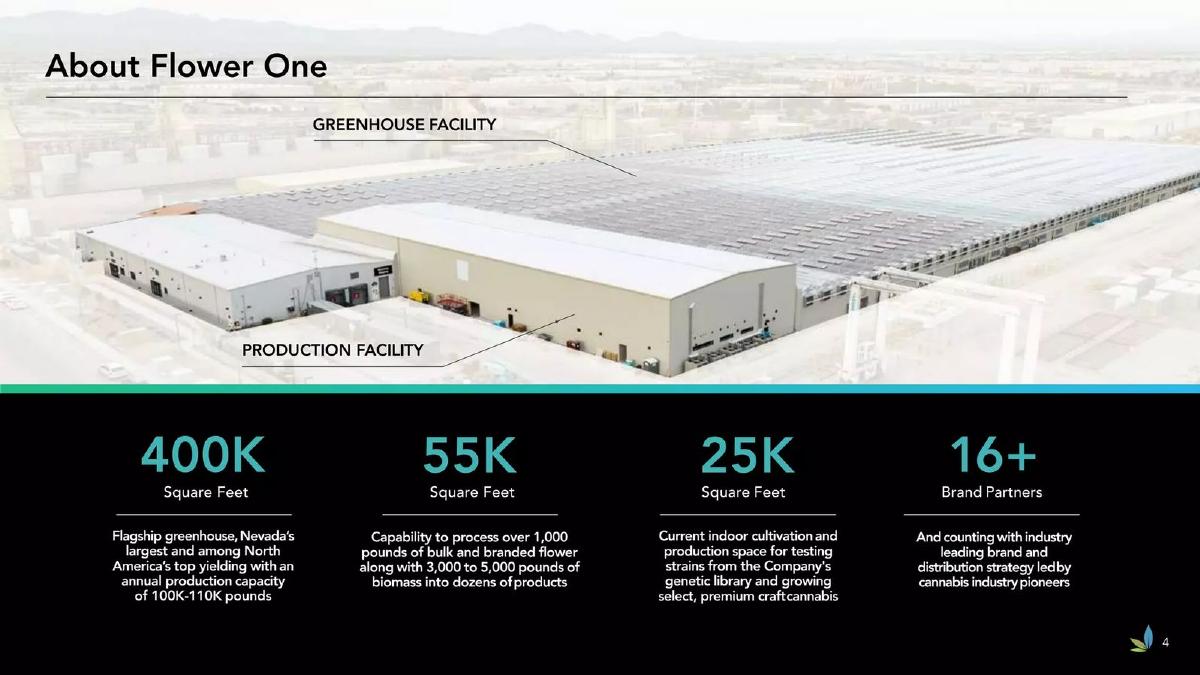
- The company operates a 400,000-square-foot flagship greenhouse in Nevada, cited as the state's largest (Slide 4).
- Annual production capacity is estimated between 100,000 and 110,000 pounds of cannabis (Slide 4).
- Extraction capabilities include ethanol, LPG, and CO2 refinement with a 50kg+ distillation capacity (Slide 13).
- Revenue performance shows a projected Q3 2020 guidance of $9.8M to $10.8M, a sharp increase from the $3.9M reported in Q2 2020 (Slide 16).
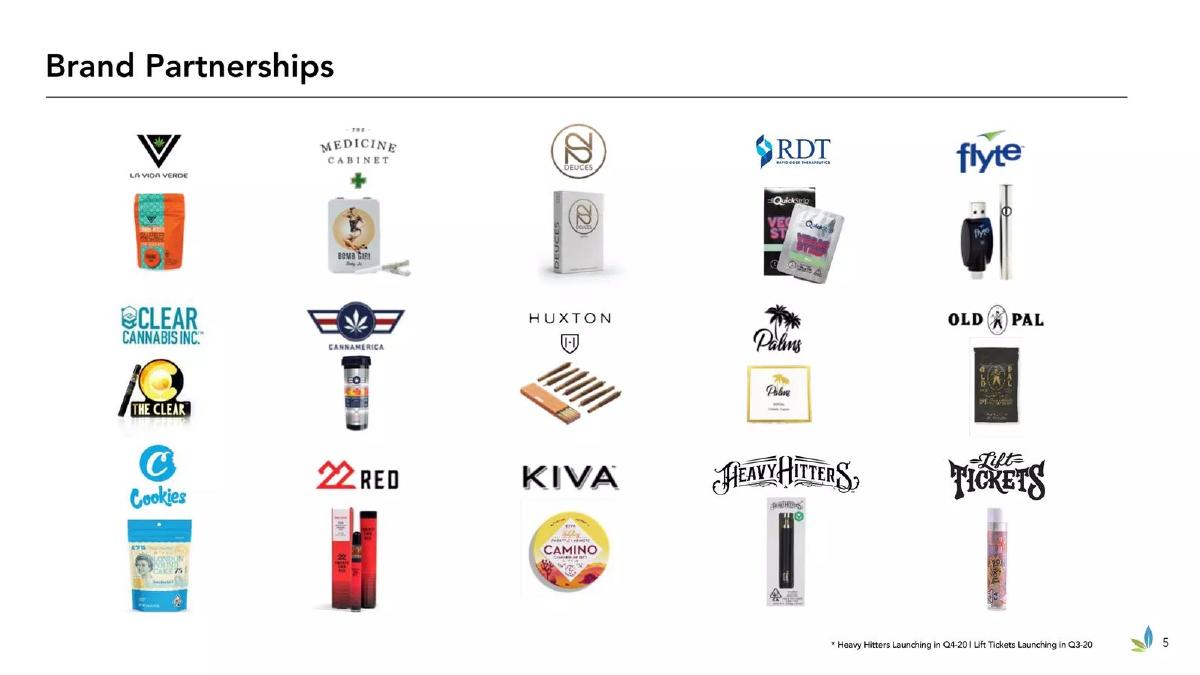
- The business model relies on 16+ brand partners, including a major partnership with the Cookies brand (Slide 4, Slide 10).
- The value proposition focuses on lowering the cost of capital for brands by providing turnkey cultivation and regulatory support (Slide 7).
- Nevada's regulatory environment during COVID-19 is highlighted, noting that cannabis was deemed an essential business as of March 20, 2020 (Slide 22).
- The presentation lacks a dedicated team slide detailing the backgrounds of the executive leadership beyond their contact information (Slide 25).
Flower One Holdings: A Deep Dive into Large-Scale Cannabis Infrastructure
The Q2 2020 investor presentation for Flower One Holdings is a study in industrial-scale agriculture applied to the cannabis sector. Unlike many early-stage cannabis decks that focus on lifestyle branding, Flower One leans heavily into its infrastructure, processing capacity, and B2B value proposition. With a flagship facility in Nevada, the company positions itself as the essential backbone for brands looking to capture market share in Las Vegas and the broader state market.
Slide 1: Title and Public Listing Information
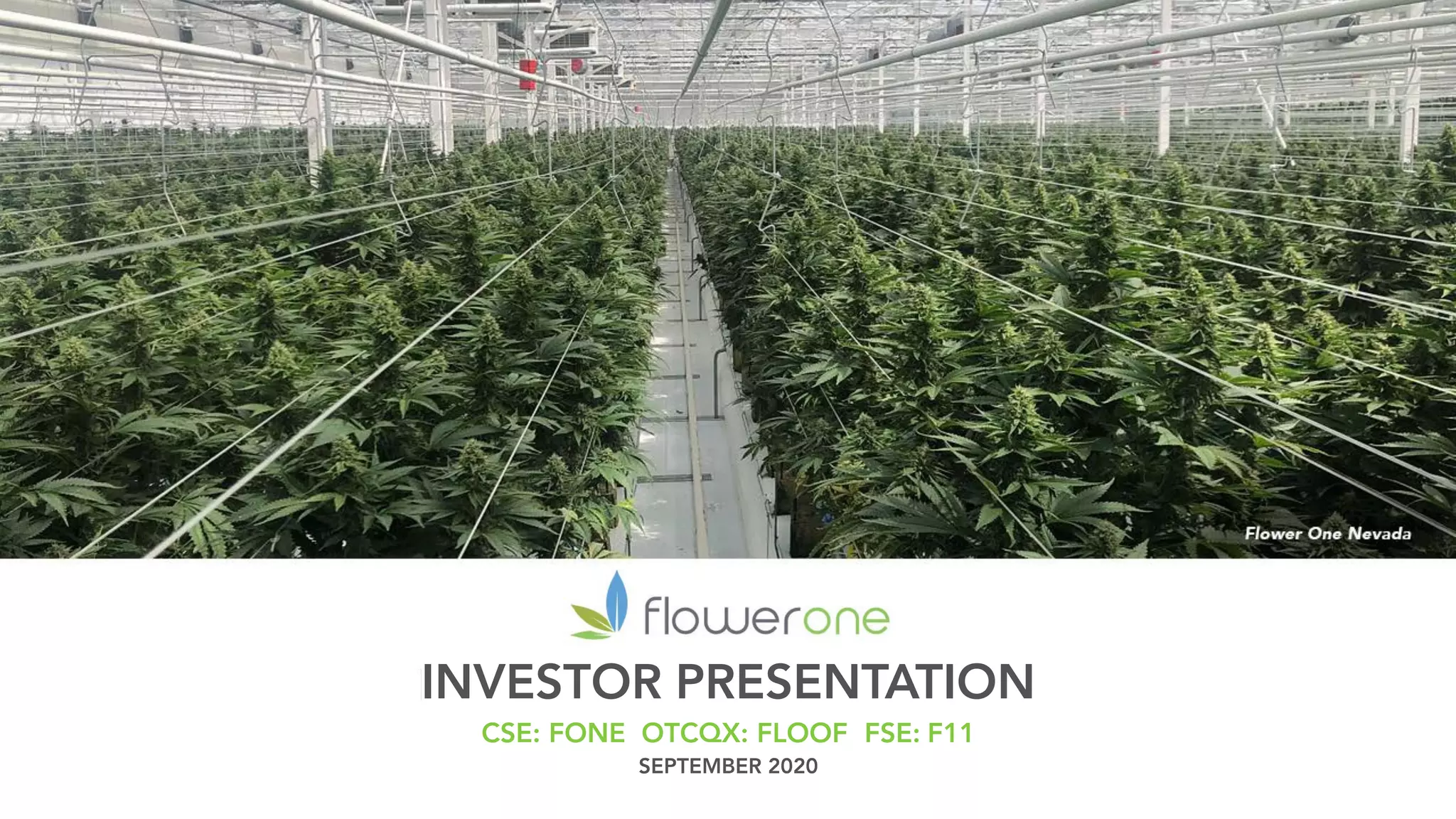
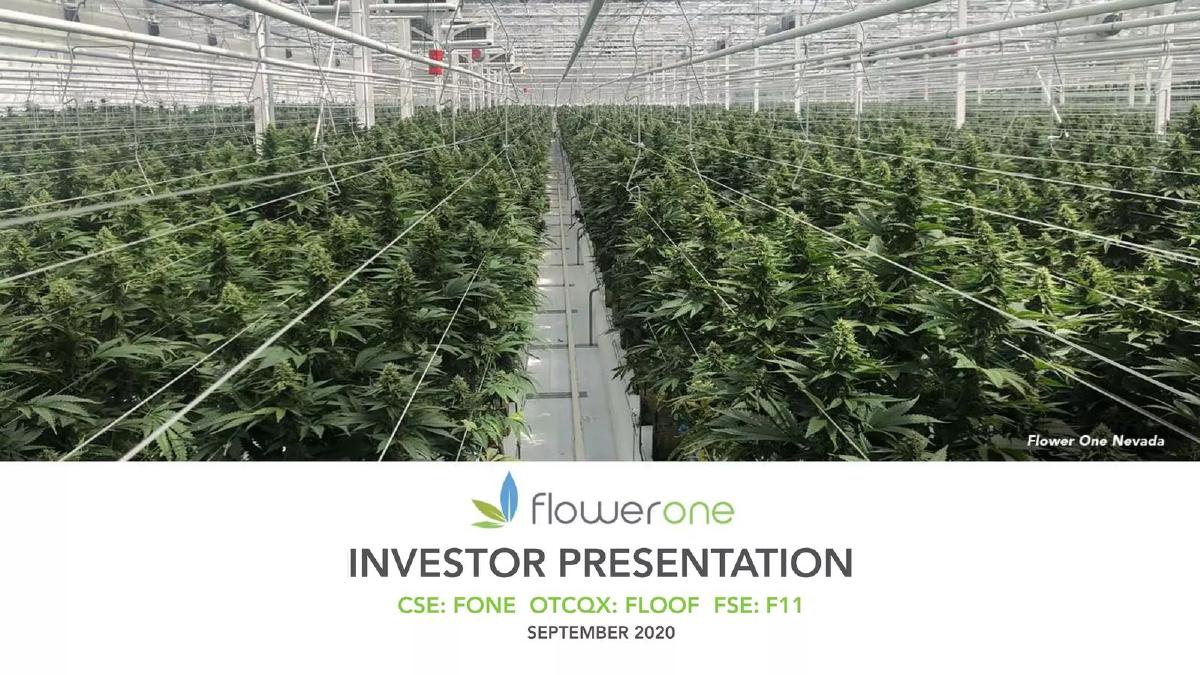
The cover slide establishes the company's identity and its status as a publicly traded entity. It lists tickers for the CSE (FONE), OTCQX (FLOOF), and FSE (F11). The background image is a high-perspective shot of a massive, high-tech greenhouse, immediately signaling that this is a play on scale. The date is noted as September 2020, placing the deck in the context of the mid-pandemic recovery period.
Slide 4: Infrastructure and Scale
This slide provides the core metrics of the company's physical footprint. It highlights a 400,000 Square Foot flagship greenhouse, which it claims is Nevada's largest and among the top-yielding in North America. The annual production capacity is stated at 100K-110K pounds . Additionally, the slide notes a 55,000 Square Foot production facility capable of processing over 1,000 pounds of flower and 3,000 to 5,000 pounds of biomass into finished products. A smaller 25,000 Square Foot indoor space is dedicated to testing genetics and premium craft cannabis. Finally, it mentions 16+ Brand Partners , framing the company as a service provider rather than just a cultivator.
Slide 7: The Value Proposition
Flower One splits its value proposition into two categories: Brand Partners and Retail Partners. For brands, the focus is on speed and ease of market entry and the elimination of the high cost of capital required to build dedicated facilities. They also offer assistance with regulatory licenses and claim the 'lowest cash cost per gram.' For retail partners, the pitch is simplified single-source ordering , just-in-time delivery to free up working capital, and total traceability of products through a controlled supply chain.
Slide 10: Strategic Partnership - Cookies
This slide serves as a case study for their brand partnership model. It focuses on Cookies , a well-known cannabis brand founded by Berner. The slide includes a quote from Berner: 'When it came to cannabis cultivation and production, it was clear that Flower One was the leader in Nevada.' The imagery shows Cookies-branded retail locations and products, emphasizing that Flower One provides the infrastructure that allows high-profile brands to scale geographically without capital-intensive construction.
Slide 13: Extraction and Refinement
Moving down the value chain, Slide 13 details the company's extraction capabilities. It lists Ethanol, LPG, and CO2 as its primary technologies. The facility boasts a 50kg+ commercial scale distillation capacity , which is described as 'sufficiently sized to easily meet all internal needs.' The slide also mentions 'Top Talent,' citing scientists and engineers, though no specific names or credentials are provided here.
Slide 16: Revenue Performance
This bar chart tracks revenue from Q1 2019 through a projected Q3 2020. The growth is significant: starting from under $1M in Q1 2019, it peaked at nearly $9M in Q1 2020. There is a visible dip in Q2 2020 (approximately $3.9M) attributed to 'COVID-19 State Closure.' However, the company provides preliminary guidance for Q3 2020 of $9.8M to $10.8M , which would represent their highest recorded revenue quarter. The chart effectively communicates a 'V-shaped' recovery.
Slide 19: Appendix - Visual Evidence
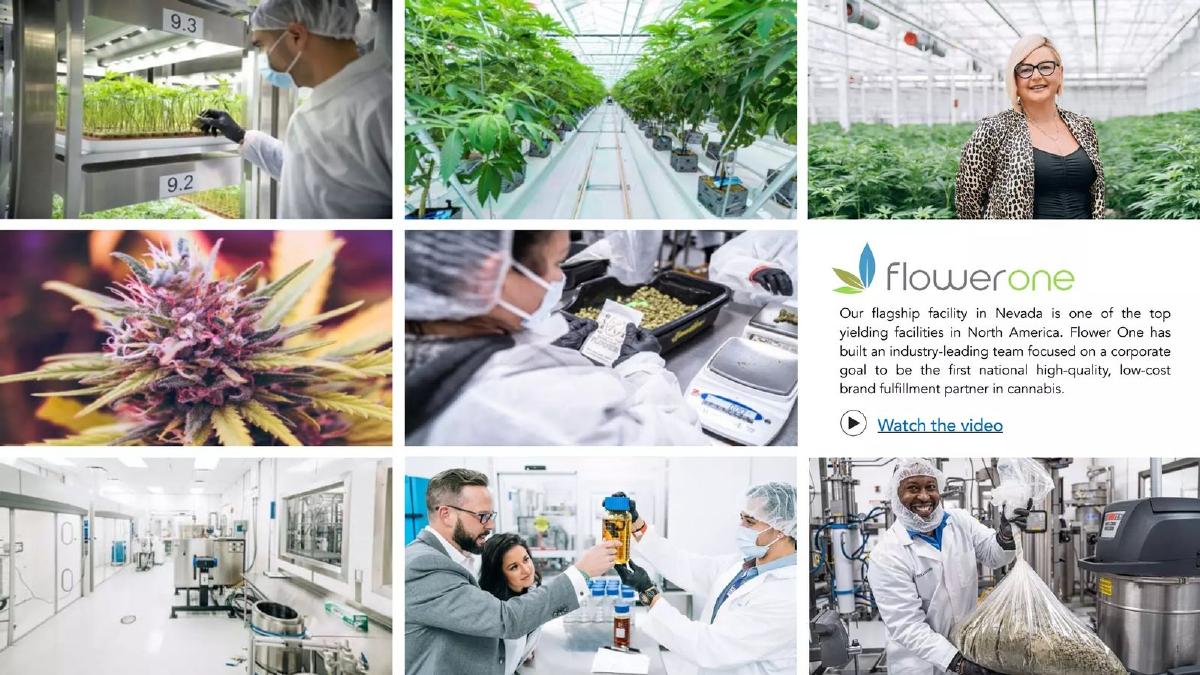
The appendix begins with a full-bleed photo of the greenhouse interior. This serves to reinforce the scale mentioned earlier in the deck. The rows of cannabis plants in a highly controlled, clean environment are intended to build investor confidence in the operational maturity of the facility.
Slide 22: Regulatory Context - Nevada & COVID-19
This timeline slide outlines the regulatory environment in Nevada during the 2020 pandemic. It notes that on March 20 , cannabis was deemed an essential business. It tracks the progression from delivery-only sales to curbside pick-up (May 1), storefront re-opening (May 9), and finally the reopening of casinos on the Las Vegas Strip (June 4). This context is vital for explaining the Q2 revenue dip and the anticipated Q3 surge, as Las Vegas tourism is a major driver for the Nevada cannabis market.
Slide 25: Contact and Leadership
The final slide provides contact information for the executive team. Ken Villazor (President & CEO) , Kellen O’Keefe (CSO) , and David Kane (Interim CFO) are listed. It also includes contact details for two investor relations firms, ADDO and NATIONAL Capital Markets. Notably, this is the only place the leadership is mentioned, and there are no details regarding their professional history or success in the cannabis or agricultural industries.
What Flower One Holdings Does Well
The deck is exceptionally strong at conveying industrial scale . By leading with the 400,000-square-foot figure and supporting it with high-quality photography of the facilities, the company differentiates itself from smaller, 'craft' operators. They successfully frame themselves as an infrastructure play, which is often more attractive to institutional investors looking for stability and volume rather than the volatility of individual consumer brands.
The partnership strategy is also well-articulated. By highlighting the Cookies partnership, they prove that their facility meets the quality standards of the industry's most discerning brands. This 'Intel Inside' model for cannabis—where Flower One provides the high-quality raw material and processing for famous brands—is a clear and scalable business model.
What is Missing from the Deck
The most glaring omission is a detailed Team Slide . In a highly regulated and operationally complex industry like cannabis cultivation, the 'who' is as important as the 'what.' Investors need to know if the leadership has experience in large-scale commercial agriculture, pharmaceutical-grade extraction, or public company management. Listing names on a contact slide is insufficient.
Furthermore, while the deck mentions having the 'lowest cash cost per gram,' it provides no specific unit economics to back this up. In a commodity-adjacent business, the margin per gram is the most important metric for long-term viability. Without showing the actual cost to produce versus the wholesale or retail price, the claim remains unsubstantiated. Finally, there is no mention of the capital structure or debt , which is a significant factor for many large-scale cannabis operators that took on high-interest loans to build their facilities.
Lessons for Founders
Founders can learn two major lessons from this deck. First, use scale as a moat . If you have a physical asset that is significantly larger or more efficient than the competition, make that the centerpiece of your pitch. Flower One does this by repeatedly referencing their square footage and poundage capacity.
Second, contextualize your setbacks . The revenue slide (Slide 16) could have been a red flag due to the Q2 drop. However, by pairing it with the COVID-19 regulatory timeline (Slide 22), the company turns a negative data point into a story of resilience and recovery. If your startup faced a macro-economic headwind, don't hide the data; explain the external factors and show the path to recovery.
Frequently asked questions
- What is Flower One's primary competitive advantage according to the deck?
- The primary advantage is physical scale and vertical integration. Slide 4 highlights a 400,000-square-foot greenhouse and a 55,000-square-foot production facility. This allows them to offer 'industry-leading cultivation analytics' and the 'lowest cash cost per gram' to their brand partners, effectively acting as a high-efficiency manufacturing hub for the Nevada market.
- How did COVID-19 impact the company's financial performance in 2020?
- Slide 16 shows that revenue dropped significantly in Q2 2020 to approximately $3.9M, down from nearly $9M in Q1 2020, due to state closures. However, the company guided for a record Q3 2020 ($9.8M-$10.8M), suggesting a rapid recovery once dispensaries were allowed to re-open for storefront sales in May 2020.
- What is the nature of their partnership with the Cookies brand?
- Slide 10 features a testimonial from Berner, the founder of Cookies, stating that Flower One is the 'leader in Nevada' for cultivation and production. Flower One acts as the licensed producer and fulfillment partner, allowing Cookies to enter the Nevada market without building its own dedicated cultivation facilities.
- What extraction technologies does the company utilize?
- According to Slide 13, the company has 'Multiple Capabilities' including Ethanol, LPG, and CO2 extraction. They emphasize 'Superior Refinement' for full-spectrum oils and distillates, supported by a commercial-scale distillation capacity of over 50kg to meet internal and partner needs.
- Who are the key executives mentioned in the presentation?
- The contact slide (Slide 25) lists Ken Villazor as President & CEO, Kellen O’Keefe as Chief Strategy Officer, and David Kane as Interim Chief Financial Officer. However, the deck does not provide professional biographies or past track records for these individuals.