Flowtab’s 10-slide deck from 2011 is a classic example of a lean, early-stage pitch focused on a specific vertical: bars and nightclubs. The company identifies clear friction points for three stakeholders—customers, bartenders, and owners—and proposes a mobile ordering and payment solution. While the deck is light on long-term financial projections, it excels at providing transparent unit economics for its early pilot phase, citing a customer acquisition cost (CAC) of $1,500 to $2,500 per bar. The deck also highlights strategic partnerships with early-stage Lyft and Dex One to solve the distr…
Key takeaways
- The deck identifies three distinct user personas (Customers, Bartenders, Owners) and their specific pain points on slide 4.
- Flowtab reports early traction of 7 venues and 2,200 users with total sales of $12,450 as of February 2013 on slide 7.
- The company discloses a high bar acquisition cost of $1,500 - $2,500 and a user acquisition cost of $4 - $19 on slide 7.
- The business model relies on three revenue streams: user fees, bar recurring fees, and a $3 billion liquor advertising market on slide 6.
- Strategic distribution is addressed through a pilot deal with Dex One and a targeted affiliate program with 10% of Lyft drivers on slide 7.
- The competitive matrix on slide 8 claims Flowtab is the only player offering 0% credit card processing and table ordering simultaneously.
- The deck outlines a funding history including a $50,000 initial seed and a $500,000 angel round, targeting a $3M Series A on slide 9.
- Exit strategies are explicitly named as Google Wallet, mFoundry, Intuit, and Micros on slide 9.
Introduction and Vision
Flowtab’s pitch deck is a product of its time, originating in 2011 when mobile payments were just beginning to move from a novelty to a utility. The deck is brief, consisting of 10 slides, and follows a standard narrative arc: problem, solution, business model, and traction. It positions itself not just as a payment tool, but as a loyalty and advertising platform specifically tailored for the high-friction environment of bars and nightclubs.
Slide 1: Title and Branding
The cover slide introduces the Flowtab brand with a dictionary-style definition of 'flow.' It defines the term as a 'mental state of operation in which a person is fully immersed in a feeling of energized focus.' This suggests the company wants to remove the friction of ordering so customers can stay 'in the flow' of their social experience. The slide includes a San Francisco address and a contact number, grounding the startup in the Silicon Valley ecosystem.
Slide 2: The Elevator Pitch
Slide 2 provides a one-sentence mission statement: 'Flowtab is a mobile ordering, payments and loyalty platform for bars and nightclubs.' This is an effective use of a summary slide, immediately narrowing the focus to a specific vertical (nightlife) rather than attempting to be a general-purpose POS system. By including 'loyalty,' they signal that the value proposition extends beyond simple transaction processing.
Slide 3: The Team
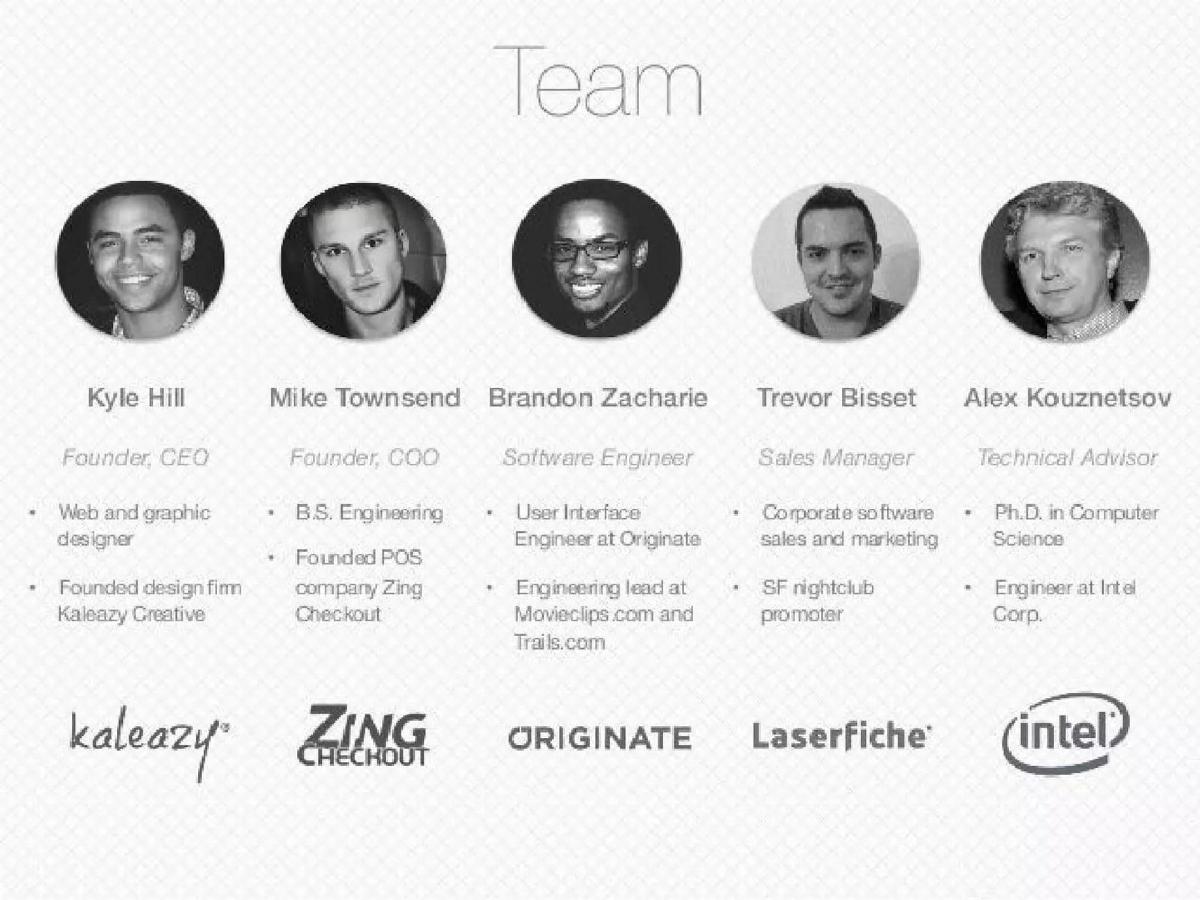
The team slide features five individuals. Kyle Hill (Founder, CEO) is noted as a web and graphic designer who founded Kaleazy Creative. Mike Townsend (Founder, COO) brings domain expertise, having founded the POS company Zing Checkout. The technical side is represented by Brandon Zacharie (Software Engineer) , formerly of Originate and Movieclips.com, and Alex Kouznetsov (Technical Advisor) , who holds a Ph.D. in Computer Science and worked at Intel. Trevor Bisset (Sales Manager) rounds out the group with experience in corporate software sales and as an SF nightclub promoter, providing the necessary 'boots on the ground' industry connections.
The Problem and Solution
Slide 4: The Friction Points
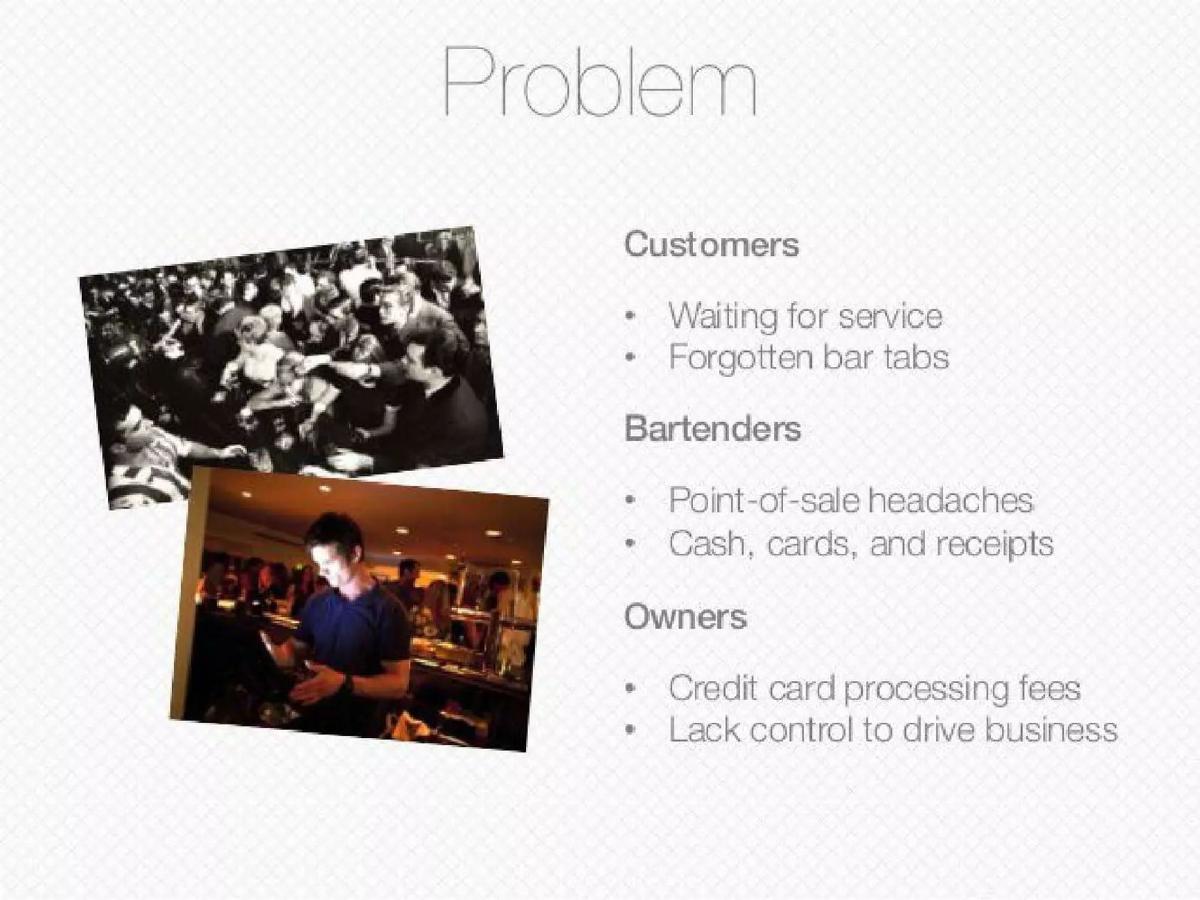
Slide 4 breaks down the 'Problem' by stakeholder, which is a sophisticated way to demonstrate market understanding. For Customers , the issues are waiting for service and forgotten bar tabs. For Bartenders , the deck cites 'Point-of-sale headaches' and the physical burden of handling cash, cards, and receipts. For Owners , the pain points are credit card processing fees and a lack of tools to drive business. This slide effectively argues that the current system is inefficient for everyone involved.
Slide 5: The Product Interface
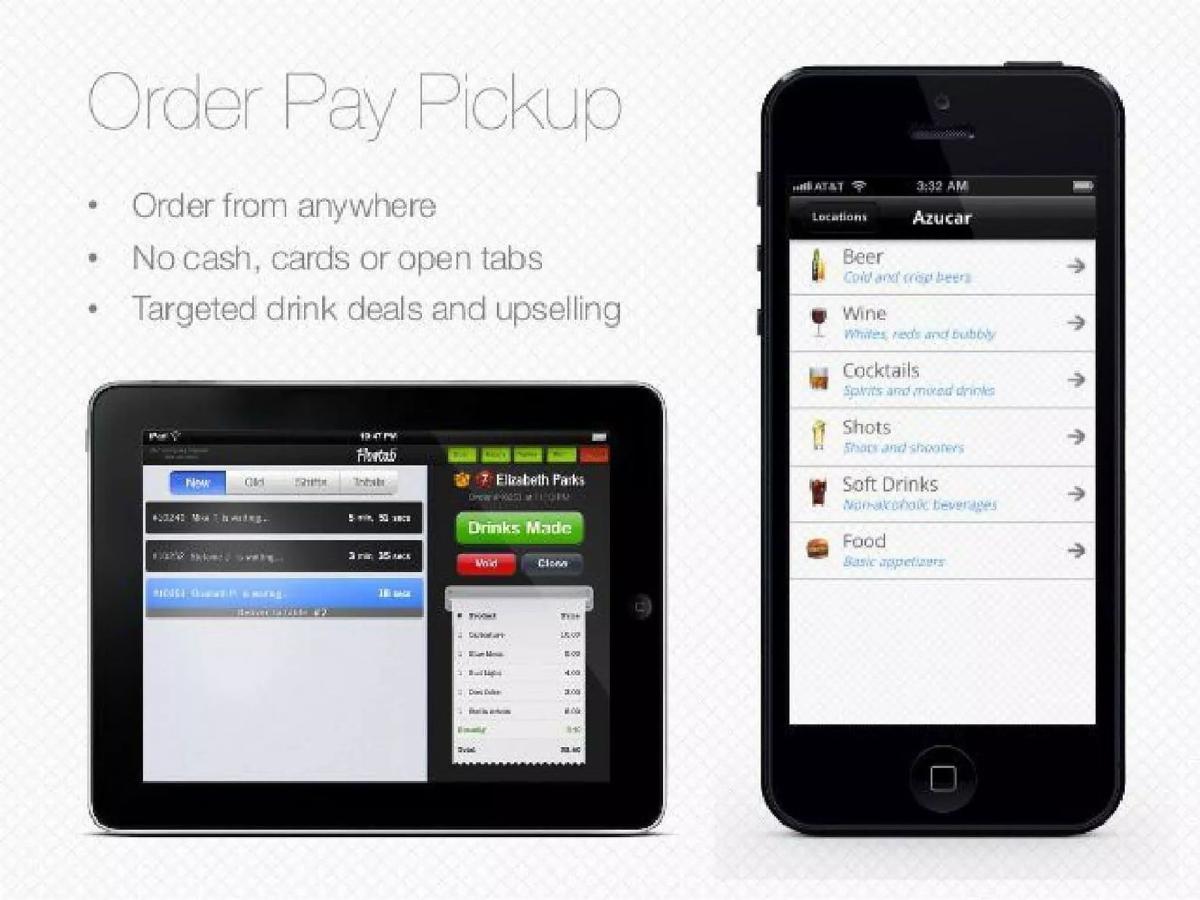
Titled 'Order Pay Pickup,' slide 5 shows the user interface on both an iPhone and an iPad. The iPhone app allows users to 'Order from anywhere' and browse categories like Beer, Wine, Cocktails, and Food. The iPad interface, presumably for the bartender, shows a queue of orders with timers (e.g., '5 min, 50 sec') to track service speed. The slide highlights three key features: no cash/cards/open tabs, and the ability to perform targeted drink deals and upselling.
Business Model and Market Opportunity
Slide 6: Revenue Streams
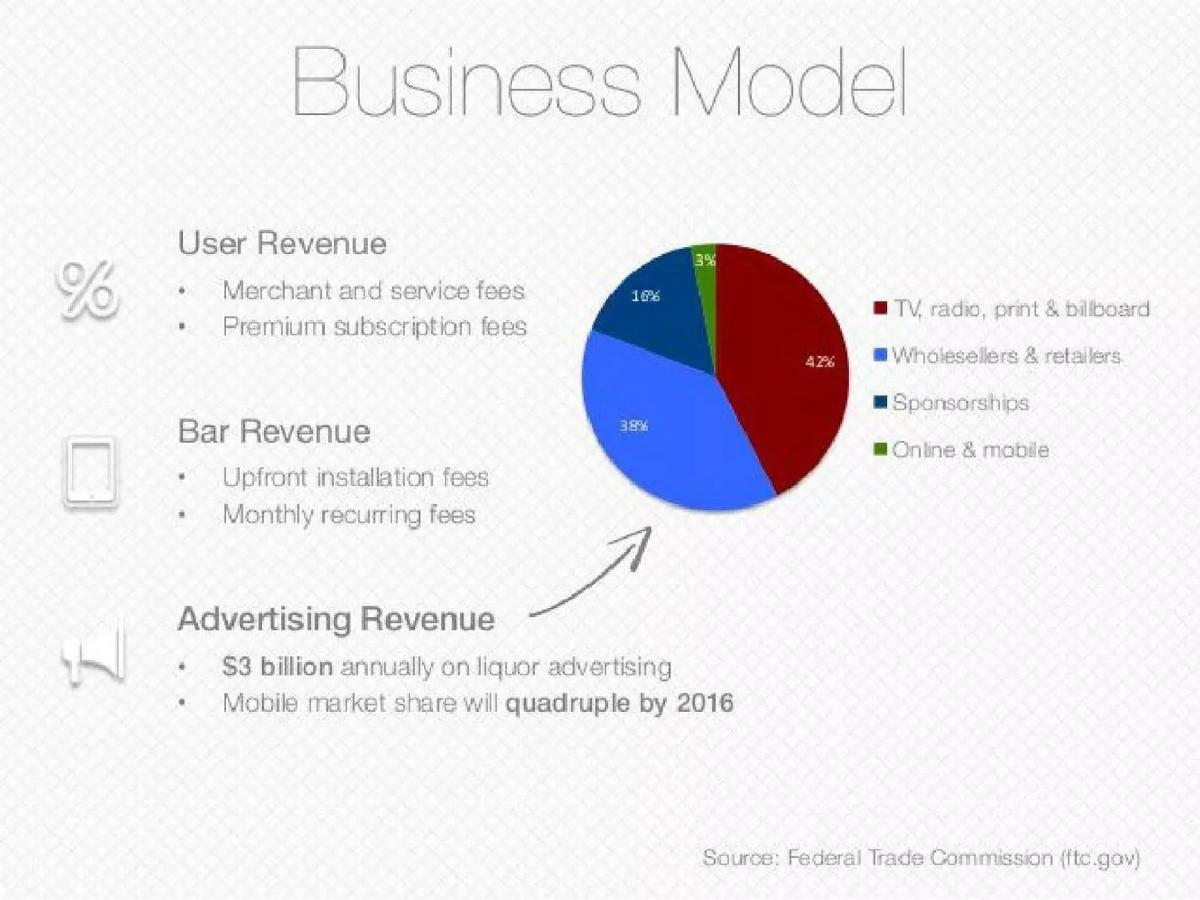
The business model on slide 6 is surprisingly complex for an early-stage startup. It lists three primary revenue sources:
User Revenue: Merchant and service fees, plus premium subscription fees. · Bar Revenue: Upfront installation fees and monthly recurring fees. · Advertising Revenue: A pie chart shows that 42% of liquor advertising goes to TV, radio, print, and billboards. Flowtab aims to capture a slice of the $3 billion annual liquor advertising spend, noting that mobile market share is expected to quadruple by 2016.
Slide 7: Traction and Unit Economics
This is the most data-dense slide in the deck. As of February 1, 2013, Flowtab reported:
Venues: 7 · Users: 2,200 · Orders / Week: 120 · Total Sales: $12,450
The slide includes a rare moment of honesty regarding costs: the Cost to acquire a bar is $1,500 - $2,500 , and the Cost to acquire a user is $4 - $19 . To solve the distribution problem, they highlight a pilot deal with Dex One (2,000 national sales force) and an affiliate program that signed 10% of Lyft drivers to act as promoters.
Competition and Financials
Slide 8: The Competitive Landscape
Slide 8 acknowledges that $90M was raised for SMB loyalty in 2011-2012 by companies like LevelUp and FiveStars. However, it claims 'Loyalty in nightlife is wide open!' A comparison matrix pits Flowtab against GoPago, Coaster, Tabbedout, and Bartab . Flowtab claims to be the only one offering the combination of 0% CC processing, a distribution partner, and table ordering. Notably, only Tabbedout is credited with POS integration on this chart, which was a significant hurdle in this industry.
Slide 9: Financial History and Exit Strategy
The 'Financials' section shows a clear progression: an Initial Seed of $50,000 in August 2012, an Angel Round of $500,000 in February 2012 (the dates appear to be out of chronological order or mislabeled), and a target Series A of $3M in Q4 2013. The 'Exit Strategy' identifies four potential acquirers: Google Wallet (to increase user base), mFoundry (to expand into nightlife), Intuit (for merchant services), and Micros (for integrated POS offerings).
Slide 10: Ad Slide
The final slide is a promotional page for the design agency 'chagency' and does not contain company information regarding Flowtab.
What Works in the Flowtab Deck
Stakeholder Analysis: By breaking the problem down into three distinct groups (customers, bartenders, and owners), Flowtab demonstrates that they understand the multi-sided nature of the hospitality market. You cannot win in a bar if the bartender hates the software, even if the owner likes the fees.
Honest Unit Economics: Most early-stage decks hide their acquisition costs because they are usually high and unoptimized. Flowtab’s willingness to state that it costs up to $2,500 to acquire a bar shows a level of maturity and realism that investors appreciate. It sets the stage for a conversation about how the Series A capital will be used to lower those costs through the Dex One partnership.
Creative Distribution: The partnership with Lyft drivers (noted on slide 7) was a clever way to reach the target demographic exactly when they were headed to the venues where Flowtab was active. This shows 'scrappy' thinking that goes beyond standard digital ad spend.
What is Missing from the Flowtab Deck
POS Integration Details: In the bar industry, the biggest barrier to entry is the Point of Sale system. If a bar has to run a separate iPad that doesn't talk to their main register, it creates an accounting nightmare. While slide 8 mentions POS integration for a competitor, it doesn't explicitly state how Flowtab handles the technical 'handshake' with legacy systems like Aloha or Micros, other than a brief mention in the catalogue description.
Retention Data: While the deck shows total users and sales, it lacks cohort data. In a loyalty-focused app, investors want to see how many users come back a second or third time. 120 orders per week across 7 venues is roughly 17 orders per venue per week, which is quite low for a high-volume bar environment.
Clear Timeline: The financial slide (Slide 9) lists an Angel Round in February 2012 and an Initial Seed in August 2012. This chronological reversal is confusing and likely a typo, which can undermine a founder's attention to detail during a pitch.
What a Founder Should Copy
The 'Problem' Slide Structure: Founders building in multi-sided marketplaces should copy the way Flowtab segmented their problem slide. Identifying the specific pain for each user type makes the solution feel more robust and well-thought-out.
The Comparison Matrix: Instead of just saying 'we are better,' Flowtab used specific features (0% CC Processing, Table Ordering) to differentiate themselves. This forces the investor to look at the market through the lens of the features the founder has chosen to prioritize.
The Exit Strategy Slide: While some investors find exit slides premature, Flowtab did it correctly by explaining why each company would want to buy them (e.g., 'Complete offering with integrated POS'). It shows the founder has thought about the long-term industry consolidation trends.
Final Summary
The Flowtab deck is a lean, focused document that successfully identifies a niche market with high friction. It doesn't hide from the difficult realities of high acquisition costs and instead presents a plan to mitigate them through strategic partnerships. While the traction numbers were early and the POS integration story was thin, the deck provided enough specific data and industry insight to serve as a viable tool for a 2011-era seed or angel raise.
Frequently asked questions
- What was Flowtab's primary value proposition for bar owners?
- According to slide 4, Flowtab addressed two main issues for owners: high credit card processing fees and a lack of control to drive business. By moving transactions to a mobile app, the company aimed to streamline the point-of-sale process and provide tools for targeted drink deals and upselling, as noted on slide 5.
- How did Flowtab plan to acquire customers at scale?
- Flowtab utilized a multi-channel distribution strategy detailed on slide 7. This included a pilot distribution deal with Dex One, which provided access to a 2,000-person national sales force, and a partnership with Lyft drivers to act as an affiliate channel for reaching nightlife patrons.
- What were the unit economics disclosed in the deck?
- On slide 7, the company was transparent about its early costs: it cost between $1,500 and $2,500 to acquire a single bar venue, while acquiring an individual app user cost between $4 and $19. At the time of the deck, they had 7 venues and 2,200 users.
- How did the company intend to generate revenue?
- Slide 6 outlines a diversified revenue model. This included 'User Revenue' from merchant/service fees and premium subscriptions, 'Bar Revenue' from upfront installation and monthly recurring fees, and 'Advertising Revenue' by capturing a portion of the $3 billion spent annually on liquor advertising.
- Who were Flowtab's main competitors in 2011-2012?
- Slide 8 lists several competitors in the SMB loyalty and mobile payment space, including LevelUp, FiveStars, BellyCard, Mogl, and Shopkick. Direct competitors in the bar space included GoPago, Coaster, Tabbedout, and Bartab.