Fluency’s Series A deck is a masterclass in establishing authority through team pedigree and quantifiable efficiency. By positioning itself as an 'Operating System' rather than a point solution, Fluency addresses the 'revolving door' of ad strategists burdened by manual workflows. The deck leans heavily on the founders' previous success—selling Dealer.com for over $1B—to de-risk the investment. Key metrics, such as managing nearly $3B in annual spend and achieving 90% time savings on account launches, provide the empirical backbone for their $42M raise. While the deck is light on specific uni…
Key takeaways
- The management team features the co-founders of Dealer.com, which sold for $1B+ in 2014 (Slide 13).
- Fluency manages nearly $3B in annual advertising spend (Slide 6).
- The platform claims to reduce time spent on account launches by 90% and budget management by 97% (Slide 11).
- Market data suggests digital advertising will make up 70%+ of total media spend by 2026 (Slide 7).
- The company identifies a $3.8B Serviceable Addressable Market (SAM) based on tiered take rates (Slide 19).
- Fluency positions itself against 'Agency-developed tech' and 'Point solutions' as a purpose-built OS (Slide 20).
- The technical workflow integrates data from CRM, ERP, and DAM systems into an AI-powered automation layer (Slide 22).
- The deck highlights a 16.7% CAGR for in-house brand advertising spend, a key growth segment for their SaaS model (Slide 17).
Executive Summary and Value Proposition
Slides 1-3: The Operating System Hook
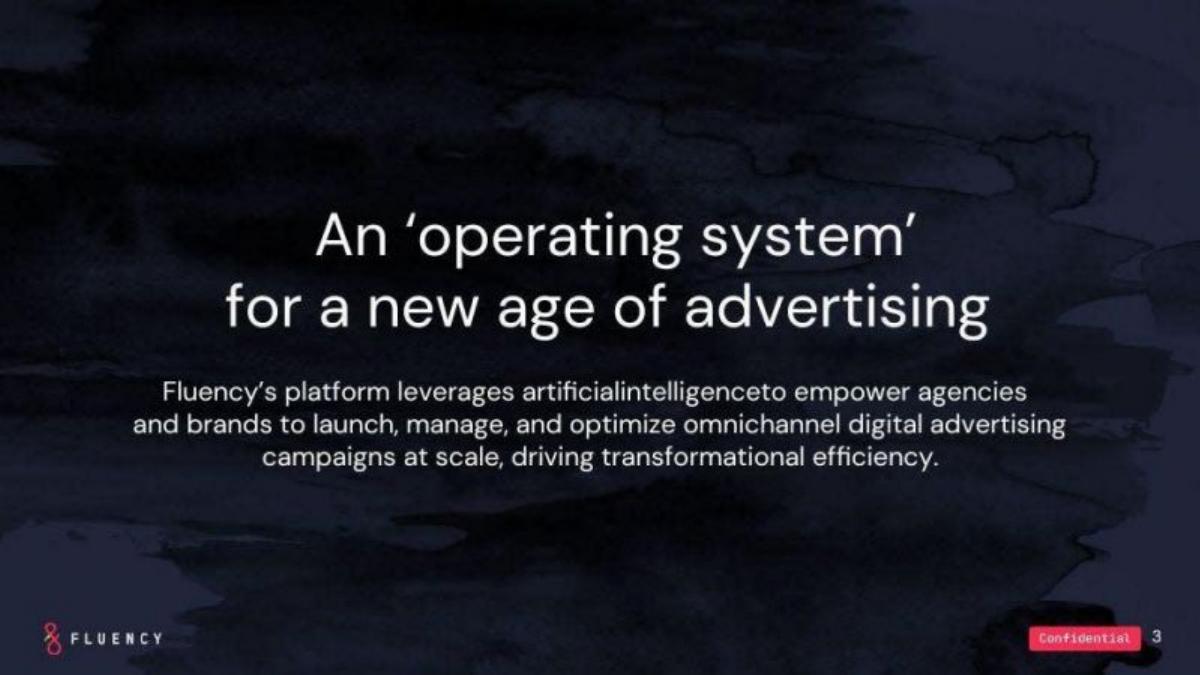
Fluency opens with a clean, minimalist title slide followed by a high-level mission statement. Slide 3 introduces the core metaphor: An 'operating system' for a new age of advertising . This is a strategic choice. By calling themselves an 'OS,' they signal that they are not just another tool in the stack, but the foundation upon which all other advertising operations run. The slide explicitly mentions leveraging artificial intelligence to help agencies and brands manage omnichannel campaigns at scale.
Slide 6: Traction and Social Proof
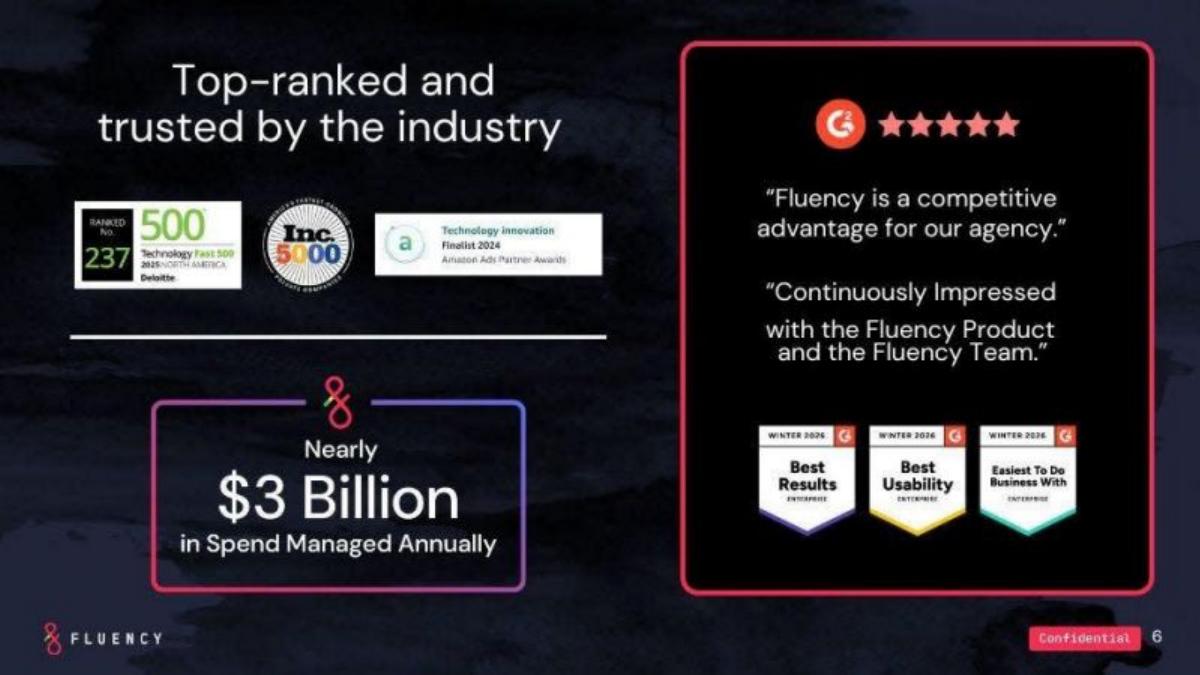
This is the 'credibility' slide. Fluency highlights three major data points: they manage nearly $3B in spend annually , they are ranked #237 on the Deloitte Technology Fast 500, and they hold multiple G2 awards for 'Best Results' and 'Best Usability.' For a Series A deck, showing $3B in managed spend is a massive indicator of platform stability and enterprise trust. The inclusion of G2 badges serves as a proxy for customer satisfaction in the absence of a dedicated testimonials slide at this stage of the deck.
Market Opportunity and Industry Challenges
Slides 7-9: The Complexity Crisis
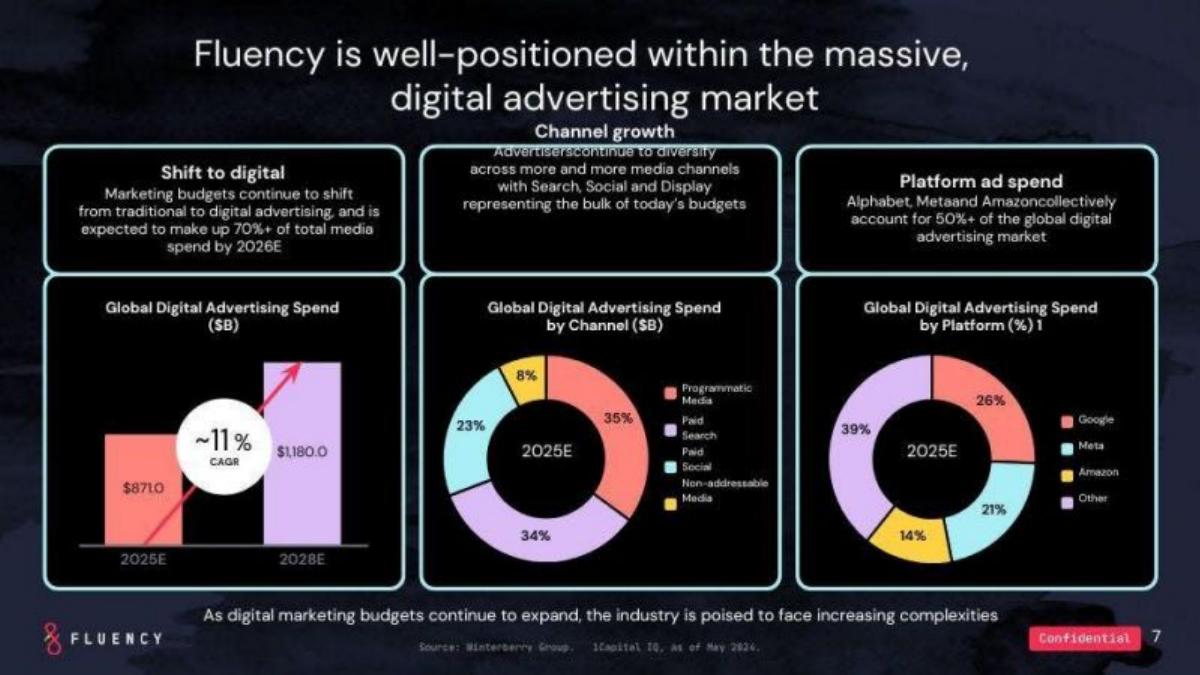
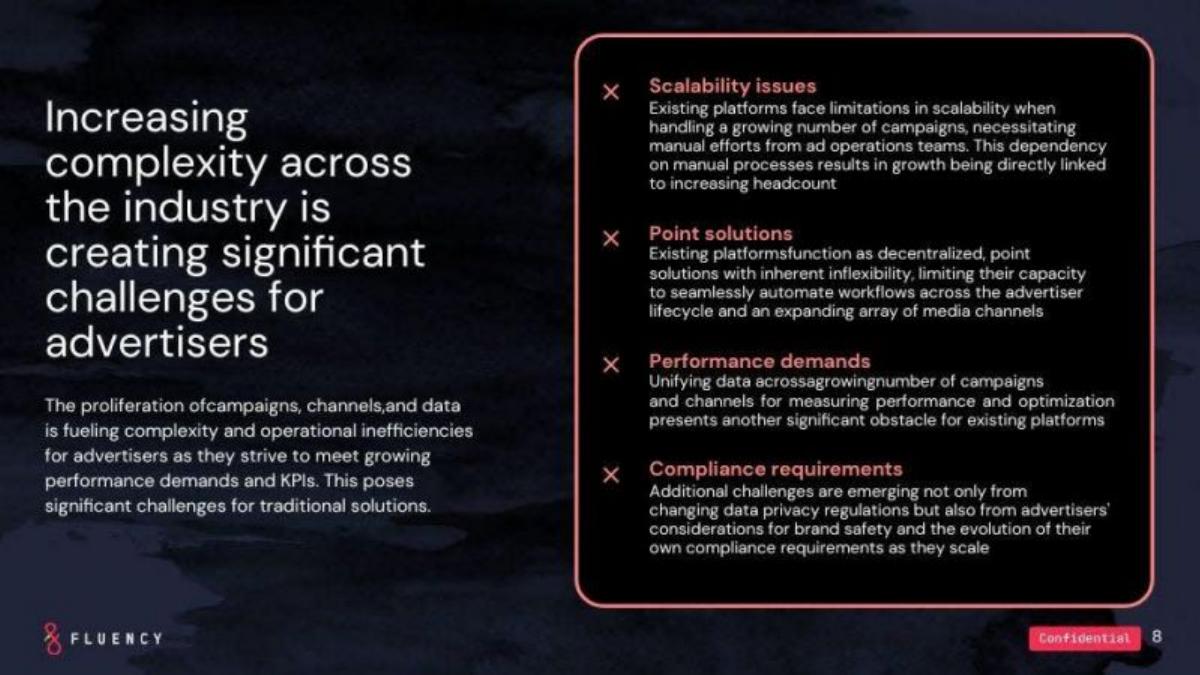
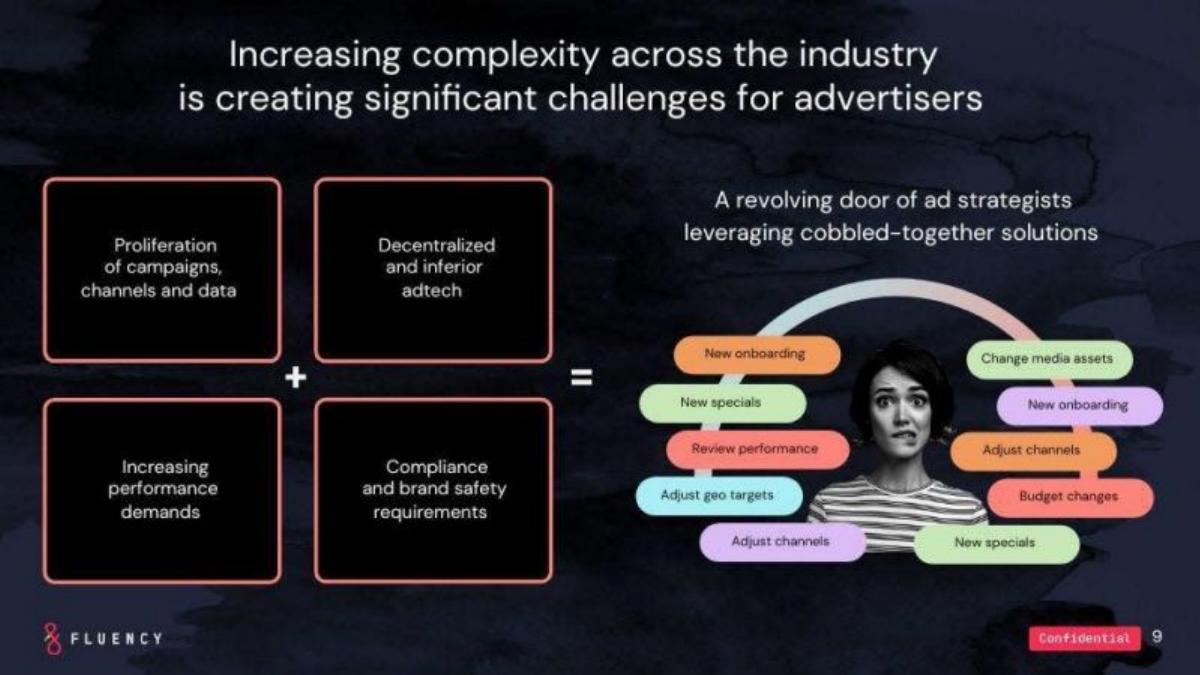
Slide 7 sets the stage with macro trends: digital advertising is expected to reach $1,180.0B by 2028 with an 11% CAGR. It also notes that Google, Meta, and Amazon account for over 50% of the market, reinforcing the need for a tool that can manage these 'walled gardens' simultaneously. Slides 8 and 9 pivot to the 'Problem.' They identify that increasing complexity leads to 'Scalability issues' where agency growth is tied directly to hiring more people. Slide 9 uses a visual of a stressed ad strategist surrounded by tasks like 'Budget changes' and 'New onboarding,' labeling the current state a 'revolving door' of talent due to 'cobbled-together solutions.'
Slide 10: The Fluency Solution
Fluency counters the problem with four pillars: Unlimited scale, End-to-end omnichannel, Unrivalled performance, and De-risked ad programs . The language here is focused on the 'ad operations team,' positioning the software as a force multiplier for human talent rather than a replacement for it.
Efficiency Metrics and ROI
Slide 11: The 'Wow' Numbers
This is arguably the most important slide for a B2B SaaS investor. Fluency claims staggering efficiency gains: 97% less time on budget management , 71% less time on monthly changes, and 90% less time on account launches. They summarize this as a 50-90% total efficiency saving . These numbers are bold, but they are backed by the 'nearly $3B' spend figure mentioned earlier, suggesting these results are achieved at scale.
Slide 23: Proven Client ROI
Later in the deck, Slide 23 provides specific use cases to ground these percentages. For example, they show that for a client with 100 location-specific campaigns, their 'Blueprints' feature reduced launch time to 5 minutes. For a client with 1,000 products, their 'Muse' AI platform pulled 4M products directly from a PIM, resulting in a +60% CPC improvement . This slide bridges the gap between 'software features' and 'business outcomes.'
Team and Track Record
Slides 12-13: The Unicorn Pedigree
Fluency leans heavily on its leadership. The management team, including Michael Lane, Eric Mayhew, Scott Gale, and Brian McVey, are all veterans of Dealer.com . Slide 13 explicitly states they are the 'Same management team that built, led, and sold Dealer.com for $1B+ in 2014.' In the world of venture capital, 'doing it before' is the strongest possible de-risking signal. They also highlight 80+ years of combined experience in ad operations.
Investment Highlights and Market Sizing
Slides 14-19: The Financial Case
Slide 14 summarizes the 'Key investment highlights,' including a 'Robust financial profile' and 'Blue-chip customer base.' While the deck does not list the names of these blue-chip customers, it emphasizes 'best-in-class retention.' Slides 16 through 18 provide a deep dive into market segments. Notably, Slide 17 highlights that in-house managed spend is growing at a 16.7% CAGR , which represents a significant expansion opportunity for Fluency beyond traditional agencies. Slide 19 calculates their Serviceable Addressable Market (SAM) at $3.8B , based on tiered take rates (3.8% for SMB down to 1.5% for Enterprise).
Technical Architecture and Competitive Landscape
Slides 20-22: The Platform Deep Dive
Slide 20 is a competitive matrix. Fluency differentiates itself from 'Agency-developed tech' (which is inefficient) and 'Point solutions' (which lack functionality). They claim that ~90% of opportunities are greenfield/non-competitive , suggesting they are often replacing manual processes rather than other software. Slide 22 provides a 'Workflow' diagram. It shows how Fluency acts as a 'Data Intake' hub for CRM, ERP, and Creative data, processing it through an 'AI Powered Automation' layer to push updates to platforms like Google, Meta, TikTok, and Amazon. This visualizes the 'OS' concept introduced at the start.
What Works in This Deck
Quantifiable Efficiency: The use of specific percentages (97%, 90%, 71%) for time savings makes the value proposition extremely tangible. · Founder-Market Fit: The connection to a previous $1B exit in the same industry (adtech/marketing) is a powerful motivator for Series A investors. · Market Segmentation: Instead of just giving a 'Trillion dollar' TAM, they break down the market by agency size and in-house vs. agency spend, showing a sophisticated understanding of their buyers. · The 'OS' Positioning: By framing the product as an Operating System, they justify a higher price point and deeper integration into the client's business.
What is Missing
Unit Economics: The deck mentions a 'Robust financial profile' but does not disclose CAC (Customer Acquisition Cost), LTV (Lifetime Value), or specific MRR/ARR (Monthly/Annual Recurring Revenue) figures. · Customer Logos: While they mention a 'Blue-chip customer base,' the deck omits actual logos of the brands or agencies using the platform, likely for confidentiality reasons. · The 'Ask': There is no slide detailing the specific amount being raised or the intended use of funds (though the catalogue facts state $42M was raised). · Burn and Runway: There is no information regarding the company's current burn rate or how long the Series A capital is expected to last.
Founder's Playbook: What to Copy
The 'Problem' Visualization: Slide 9's use of a 'revolving door' and a stressed employee is an excellent way to humanize a technical problem. Founders should aim to show the human cost of the inefficiency they are solving. · The SAM Calculation: Slide 19 is a great example of how to calculate a realistic SAM. By applying 'take rates' to the total media spend, Fluency shows they aren't just dreaming of a trillion dollars; they have a calculated path to billions. · The 'Legacy vs. Enabled' Comparison: Slide 23's side-by-side comparison of 'Legacy planning' vs. 'Fluency enabled' is a high-impact way to prove ROI. It uses real-world scenarios (100 locations, 1,000 products) that prospects and investors can easily visualize. · Highlighting Awards: If your company has been ranked by Deloitte, Inc., or G2, put those badges front and center. It provides third-party validation that your internal metrics aren't just 'founder math.'
Frequently asked questions
- What is Fluency's core value proposition?
- Fluency positions itself as the first 'Digital Advertising Operating System.' It aims to replace the 'cobbled-together' point solutions used by ad agencies with a unified platform that automates campaign launching, budget management, and omnichannel optimization. The core promise is 'transformational efficiency,' allowing agencies to scale without a linear increase in headcount.
- How does Fluency justify its market opportunity?
- The deck uses a multi-layered market analysis. It notes that global digital ad spend is expected to reach $1.18 trillion by 2028. More specifically, it identifies a $15.3B Total Addressable Market (TAM) and a $3.8B Serviceable Addressable Market (SAM) by applying tiered take rates to the media spend they can realistically service across SMB, Mid-Market, and Enterprise segments.
- What evidence of product-market fit is provided?
- Beyond managing $3B in spend, Fluency showcases high-impact ROI metrics. These include a 97% reduction in budget management time and a 71% reduction in time spent on monthly changes. They also cite being ranked #1 by G2 for 'Best Results' and 'Users Likely to Recommend,' alongside high rankings on the Deloitte Technology Fast 500.
- Who are the founders and what is their track record?
- The leadership team, including Michael Lane (CEO), Eric Mayhew (CPO), and Scott Gale (CTO), previously founded and led Dealer.com. That company was a major success in the automotive digital marketing space, eventually selling for a unicorn valuation of over $1.1 billion in 2014. This 'proven track record' is a central pillar of the deck's credibility.
- What are the primary 'pain points' Fluency addresses?
- The deck identifies four main challenges: scalability issues (growth linked to headcount), point solutions (inflexible decentralized tools), performance demands (difficulty unifying data), and compliance requirements (brand safety and privacy). They summarize the result as a 'revolving door of ad strategists' struggling with manual tasks.