Fluence is a professional education platform specializing in psychedelic-assisted psychotherapy and integration. Their 2022 Seed deck successfully raised $3M by identifying a critical 'bottleneck' in the emerging psychedelic medicine market: a severe lack of trained clinicians to administer new treatments. The deck highlights a leadership team with deep clinical research roots, including co-founders Dr. Ingmar Gorman and Dr. Elizabeth Nielson, both of whom served as investigators on FDA-approved clinical trials. With $750K+ in sales and a 318% year-over-year increase by late 2021, the company…
Key takeaways
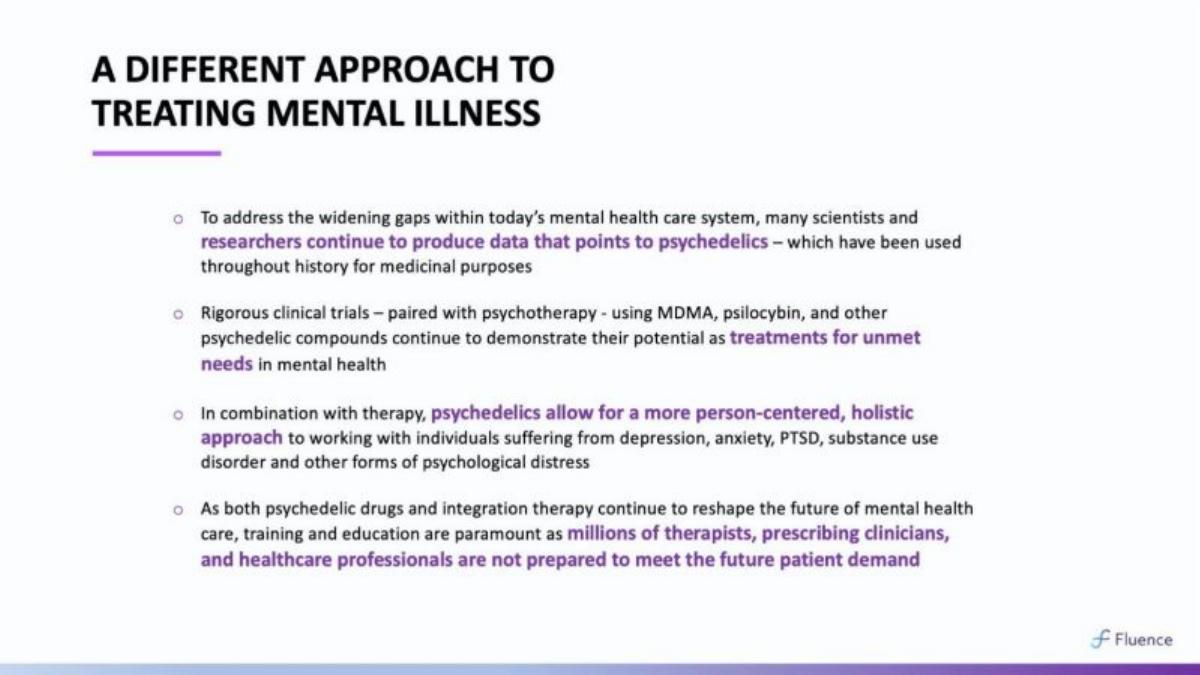
- The company identifies a massive supply-demand gap, noting that millions of healthcare professionals are unprepared for the future patient demand for psychedelic therapy (Slide 6).
- Fluence positions itself as a 'neutral' entity in the industry, allowing it to work across various drug sponsors and academic institutions (Slide 10).
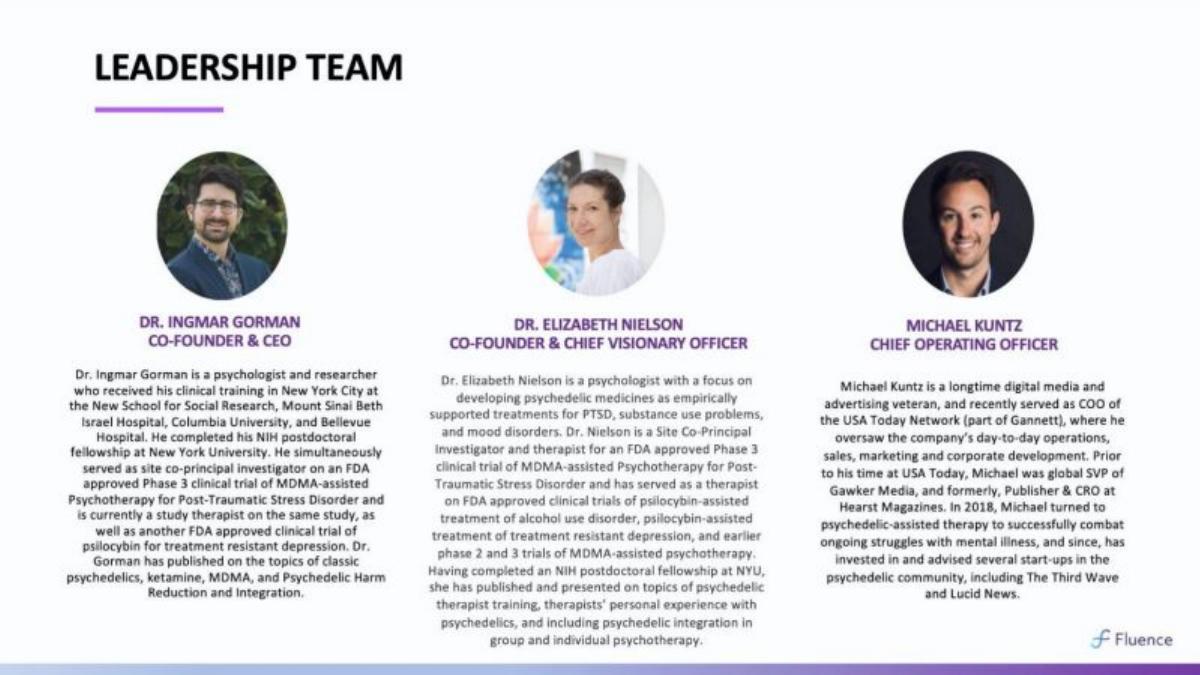
- The leadership team includes site co-principal investigators for FDA-approved Phase 3 clinical trials of MDMA-assisted psychotherapy (Slide 3).
- The deck reports significant early traction, with over 900 therapists trained and $750K+ in sales between January 2020 and December 2021 (Slide 14).
- Fluence projects a major business model shift, moving from 62% live online training in 2021 to a predicted 44% enterprise training and 12% on-demand learning by 2025 (Slide 17).
- The total addressable market is defined by 1.3M licensed therapists and 1.2M wellness professionals in the U.S. alone (Slide 9).
- The company emphasizes its academic credibility, citing partnerships or research roles at institutions like NYU, Mount Sinai, and Columbia University (Slide 3).
- A 'bottleneck' narrative is used to justify the investment, claiming drug development will stall without the 25,000+ clinicians Fluence aims to train (Slides 8, 11).
Fluence Pitch Deck Teardown: Navigating the Psychedelic Renaissance
Fluence entered the market at a unique inflection point for mental health and pharmaceutical development. As clinical trials for psychedelic compounds reached Phase 3, the industry realized that the drugs themselves were only half the equation; the other half was the highly specialized therapy required to accompany them. This teardown examines the 22-slide deck used to raise a $3M Seed round in 2022.
Slide 1-2: The Mission and Identity
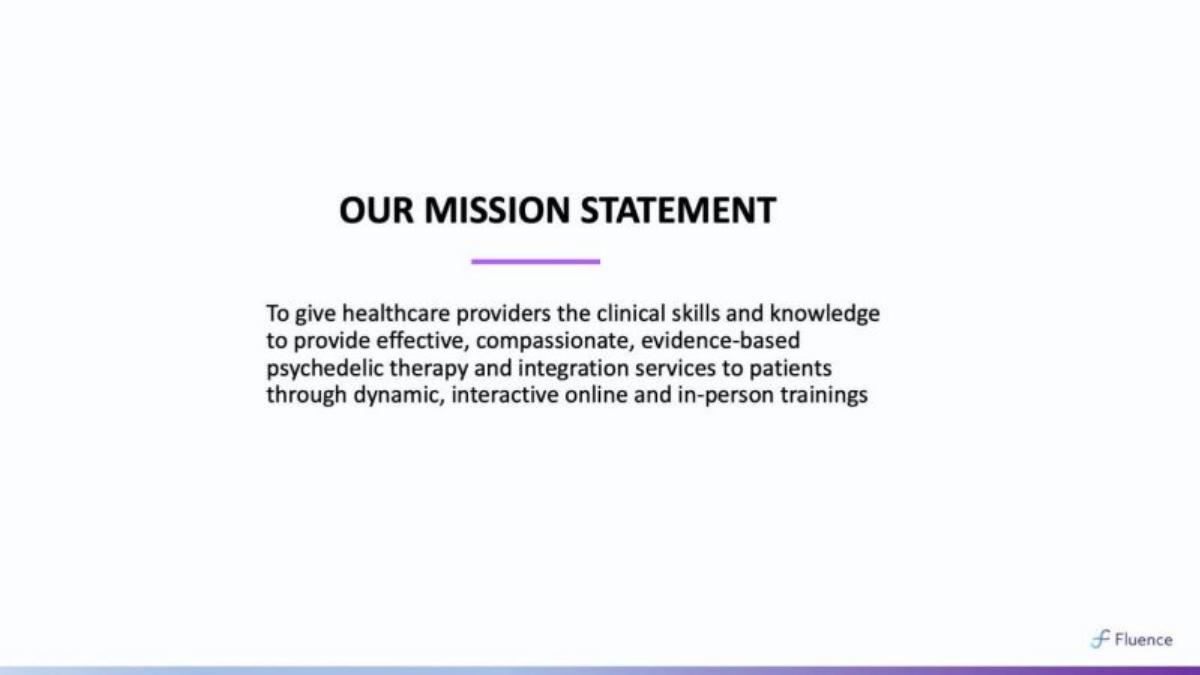
The deck opens with a clean, professional aesthetic using a purple gradient that avoids the stereotypical 'trippy' tropes often associated with the psychedelic industry. Slide 2 states the mission clearly: to provide healthcare providers with the clinical skills and knowledge for effective, evidence-based psychedelic therapy. By framing the company as an educational infrastructure play rather than a drug developer, Fluence immediately lowers the perceived risk for investors wary of biotech binary outcomes.
Slide 3: The Leadership Team
This is arguably the strongest slide in the deck. In a field that is still gaining mainstream medical acceptance, credibility is everything. Dr. Ingmar Gorman and Dr. Elizabeth Nielson are not just enthusiasts; they are psychologists and researchers with deep ties to institutions like NYU, Columbia, and Mount Sinai. Most importantly, they highlight their roles as investigators on FDA-approved Phase 3 clinical trials. The addition of Michael Kuntz as COO provides the necessary 'business' balance, citing his experience at USA Today and Hearst to signal that the company can scale beyond a small clinical practice.
Slides 4-8: The Market Opportunity and The Bottleneck
Slide 5 establishes the 'Why Now?' by citing the growing mental health crisis, noting that 1 in 5 U.S. adults experience mental illness annually. Slide 8 introduces the core investment thesis: the 'bottleneck.' It notes that the psychedelic drugs market is expected to reach $6.8 billion by 2027, but there is a 'lack of trained therapists' to disseminate these treatments. This creates a clear, urgent need for Fluence's services. The deck uses data from Nature.com and the NY Times to validate the surge in clinical trials, showing a steep upward curve from 2017 to 2021.
Slide 9: Total Addressable Marketplace
Fluence breaks down its TAM into four distinct buckets: 1.3M licensed therapists, 1.2M wellness professionals, 30+ drug developers, and 12,000+ mental health institutions. This is a sophisticated way to show that while their roots are in clinical therapy, their ceiling includes the broader wellness and institutional healthcare markets. However, the slide does not provide a dollar value for the TAM, only the headcount of potential users.
Slide 10: Competitive Positioning
The 'Intersection of Psychedelic Medicine' slide uses a four-quadrant map (Academia vs. Industry and Practice vs. Research). Fluence places itself at the center, claiming to be a 'neutral' entity. This is a strategic move. By not being tied to a specific drug developer (like Compass Pathways or Atai, which are listed in the 'Industry' quadrant), Fluence can theoretically sell training to everyone in the space without conflict of interest.
Slides 11-13: Product and Social Proof
Slide 11 sets a goal of training 25,000+ healthcare professionals over the next five years. Slide 12 shows the actual interface and course catalog, including titles like 'Understanding Ketamine' and 'Psychedelics and Psychoanalysis.' This proves the product is not vaporware. Slide 13 doubles down on social proof, featuring logos from TIME, Forbes, and The New York Times, along with quotes from the founders that emphasize the importance of training.
Slides 14-17: Business Model and Financial Evolution
Slide 14 provides the 'hard' numbers. Between Jan 2020 and Dec 2021, the company achieved $750K+ in total sales and a 318% YoY increase. Crucially, they mention they were 'self-funded to date' before this seed round, which is a strong signal of capital efficiency. Slide 17 is a 'Product Mix Shift' chart. It shows a transition from 62% live online training in 2021 to a projected 44% enterprise training and 12% on-demand learning by 2025. This tells investors that the company is moving away from labor-intensive live sessions toward scalable, high-margin software and B2B contracts.
Slides 18-22: Team Expansion and Partners
The final section of the deck showcases the breadth of the training team (Slide 19) and a list of strategic partners (Slide 20), including MAPS, Beckley Psytech, and Osmind. These partnerships are vital because they represent the 'industry' side of the bottleneck mentioned earlier. The deck concludes with a simple contact slide.
What Fluence Got Right
The Bottleneck Narrative: They successfully argued that the entire psychedelic industry's success depends on their specific service (training). · Clinical Credibility: Leading with founders who were actually running the FDA trials makes it very difficult for competitors to claim superior expertise. · Capital Efficiency: Showing $750k in revenue while being self-funded is an excellent way to start a Seed conversation. · Strategic Neutrality: Positioning themselves as the 'Switzerland' of the industry allows them to capture value from all drug developers rather than betting on one compound.
What Was Missing
Unit Economics: While they showed total sales, the deck lacks information on customer acquisition cost (CAC) or the lifetime value (LTV) of a trained therapist. · The Ask: The deck mentions they are 'currently pursuing seed financing' on Slide 14, but it does not explicitly state the amount they are looking for or the specific milestones they intend to hit with the capital. (The $3M figure is known from external listing data, not the slides). · Competitive Landscape: While they show where they sit in the ecosystem, they don't explicitly name or compare themselves to other training providers (like CIIS or MAPS's own internal training).
Founder Lessons
Sell the picks and shovels. During a 'gold rush' (like the psychedelic boom), investors often prefer the infrastructure companies that profit regardless of which 'miner' finds gold. Fluence sold the training, not the drug.
Bridge the gap between clinical and commercial. Fluence did a great job of taking high-level academic research and packaging it into a scalable business model. If you are a technical or clinical founder, your deck must show that you have a 'Michael Kuntz'—someone who understands how to turn expertise into an enterprise.
Show the evolution of your margins. Investors at the Seed stage want to see that you aren't just a services business. Fluence’s Slide 17, showing the shift toward on-demand and enterprise training, is exactly what VCs look for to justify a 'tech' valuation for an education company.
Frequently asked questions
- What is the core problem Fluence is solving?
- Fluence addresses the 'training bottleneck' in psychedelic medicine. As clinical trials for substances like MDMA and psilocybin move toward FDA approval, there is a lack of qualified therapists to administer these treatments. Slide 8 notes that while 15,000+ people have asked for training opportunities, the industry faces a projected shortage of trained clinicians to meet future patient demand.
- How does Fluence generate revenue?
- According to Slide 14, the company generated $750K+ in sales through a mix of 25+ courses and workshops. Their revenue streams include individual trainings (live online and on-demand) and enterprise partnerships, which involve protocol design and custom training modules for drug development companies. They project a shift toward higher-margin enterprise and asynchronous learning models by 2025.
- What is the background of the founding team?
- The team is led by clinical experts. Co-founder Dr. Ingmar Gorman and Dr. Elizabeth Nielson are both psychologists and researchers with experience as site co-principal investigators on FDA-approved Phase 3 clinical trials. They are joined by COO Michael Kuntz, a former media executive from USA Today and Hearst, who brings operational and scaling experience to the clinical foundation.
- Who are Fluence's primary customers?
- Fluence targets four main segments: 1.3M licensed therapists, 1.2M wellness professionals (coaches, counselors), 30+ psychedelic drug development companies, and 12,000+ mental health facilities. Slide 9 details these segments, explaining that they provide everything from credentialed professional training to custom institutional packages for integrating psychedelic healthcare.
- What traction did Fluence show in their Seed deck?
- By the time of this deck in late 2021/early 2022, Fluence had trained over 900 therapists and was on pace to surpass $600,000 in annual sales for 2021, representing a 318% year-over-year increase. They also highlighted a 20+ person training staff and established enterprise partnerships with drug developers, all achieved while being self-funded prior to this seed round.