Koia’s 14-slide pre-seed deck is a product of the 2021 Web3 era, focusing heavily on the intersection of physical collectibles and NFTs. The company successfully raised $1.4M by positioning itself as a decentralized alternative to established fractional players like Rally and Masterworks. The deck excels at explaining a complex operational flow—moving from physical acquisition to NFT minting and secondary trading—while highlighting a team with strong fintech and finance credentials. However, it lacks granular financial projections and a specific 'ask' slide, relying instead on a high-level ro…
Key takeaways
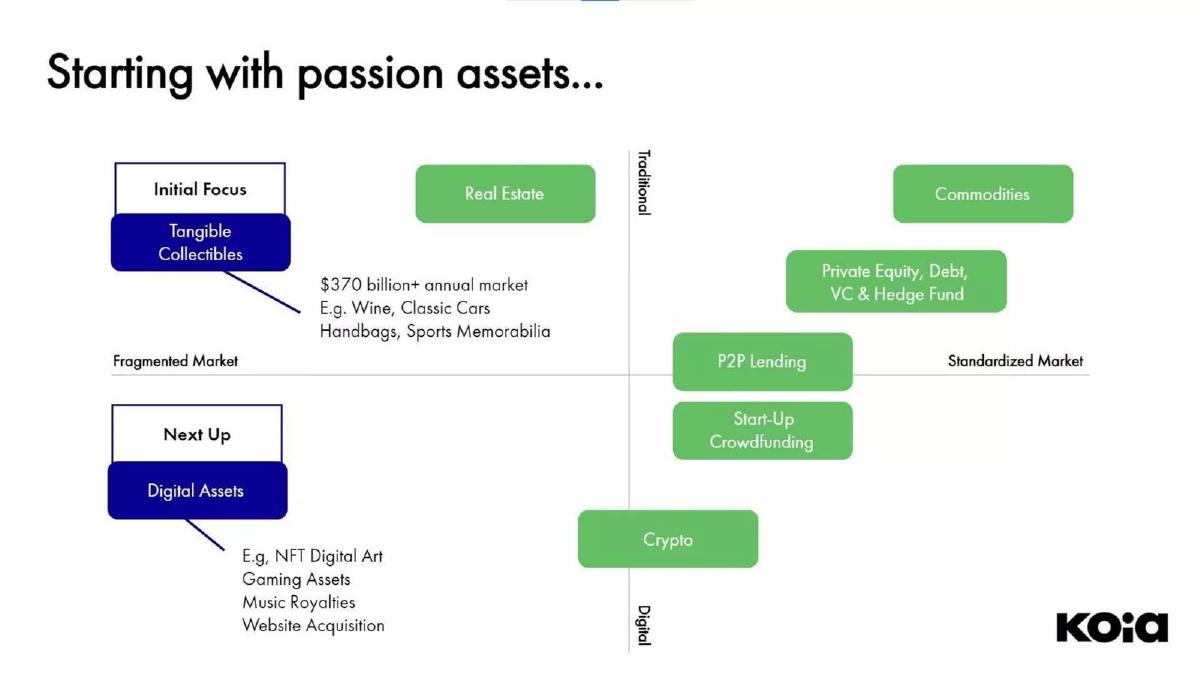
- The platform targets a $370 billion+ annual market for tangible collectibles including wine, classic cars, and sports memorabilia (Slide 5).
- Koia positions itself as a 'DeFi solution' to create more trust and liquidity compared to traditional competitors like Masterworks or Rally (Slide 9).
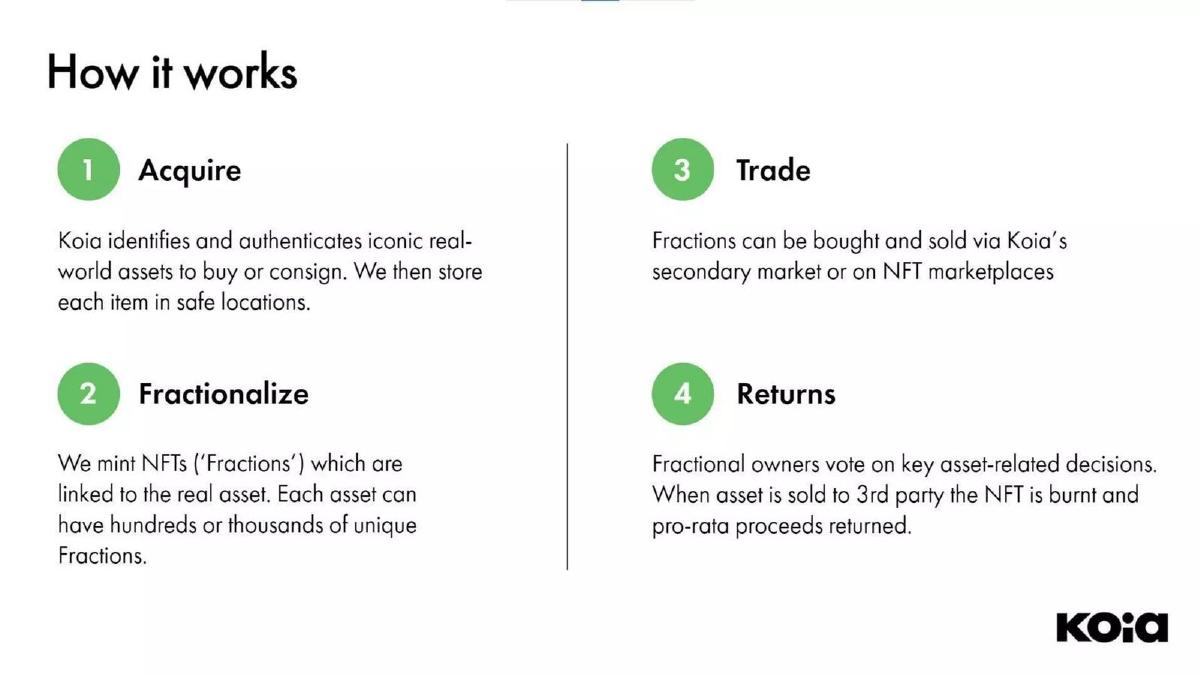
- The operational model involves minting 'Fractions' as NFTs which are linked to physical assets held in custody by Koia (Slide 6).
- The company reported reaching over 1,000 users and completing its first fractional asset sale prior to the deck's finalization (Slide 11).
- The roadmap includes a Q1 2022 goal to fractionalize over $200,000 of assets across three categories (Slide 12).
- The team features a CEO who was the first employee at Neat, a neobank that raised $15M+ (Slide 13).
- The competitive matrix explicitly identifies Web3/Decentralization as a key differentiator against eBay, StockX, and Otis (Slide 10).
- The deck omits a specific funding 'ask' or detailed use-of-funds breakdown, focusing instead on the product vision and roadmap.
Executive Summary and Vision
Slides 1-3: The Mission to Democratize Passion
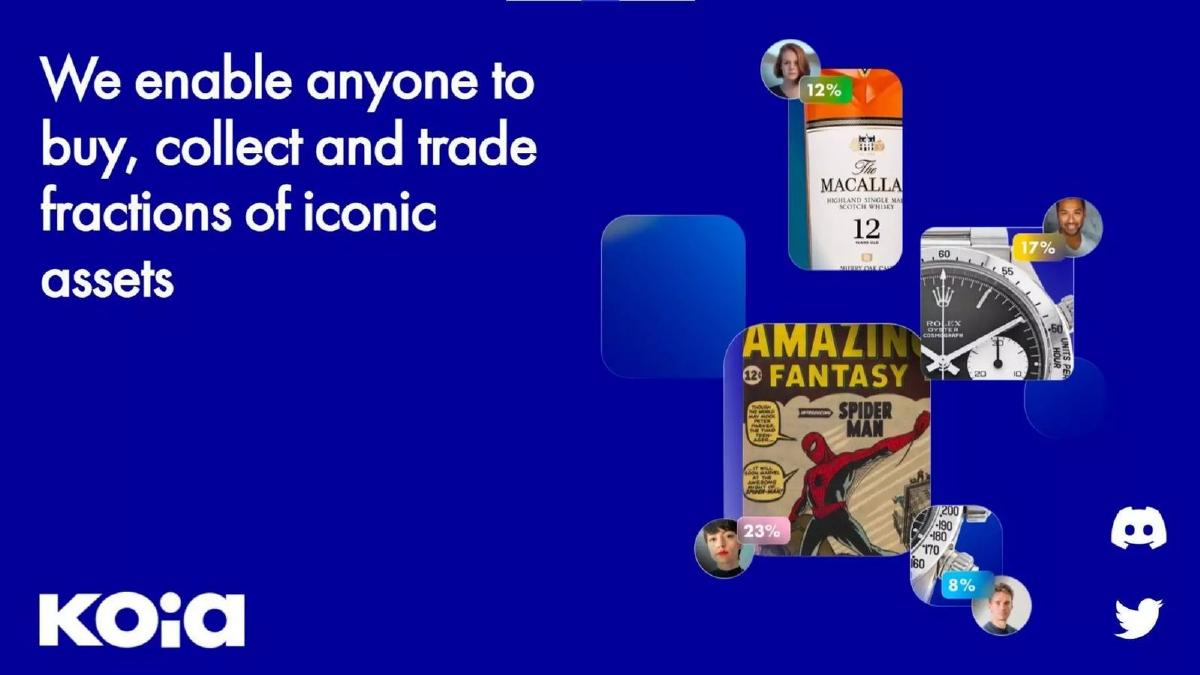
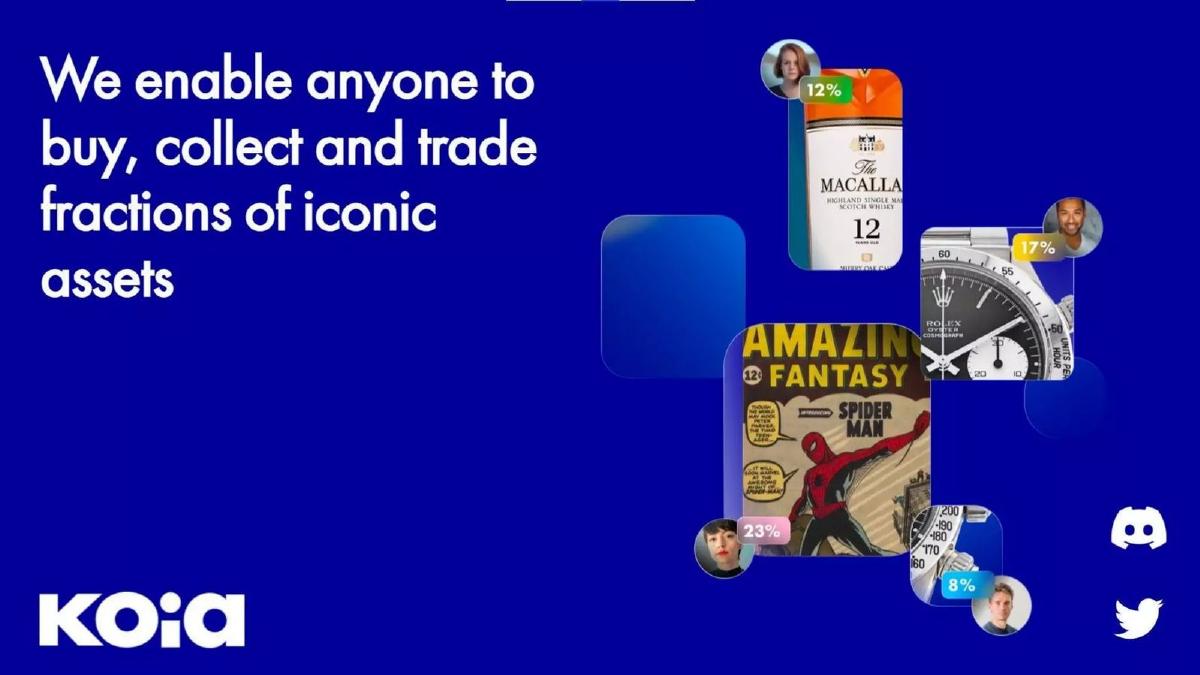
Koia opens with a clear value proposition on Slide 1 : "We enable anyone to buy, collect and trade fractions of iconic assets." The visual language immediately identifies the target categories—fine spirits (The Macallan), comic books (Amazing Fantasy Spider-Man), and luxury watches (Rolex). The inclusion of social media icons for Discord and Twitter signals a community-centric, Web3-adjacent approach from the outset.
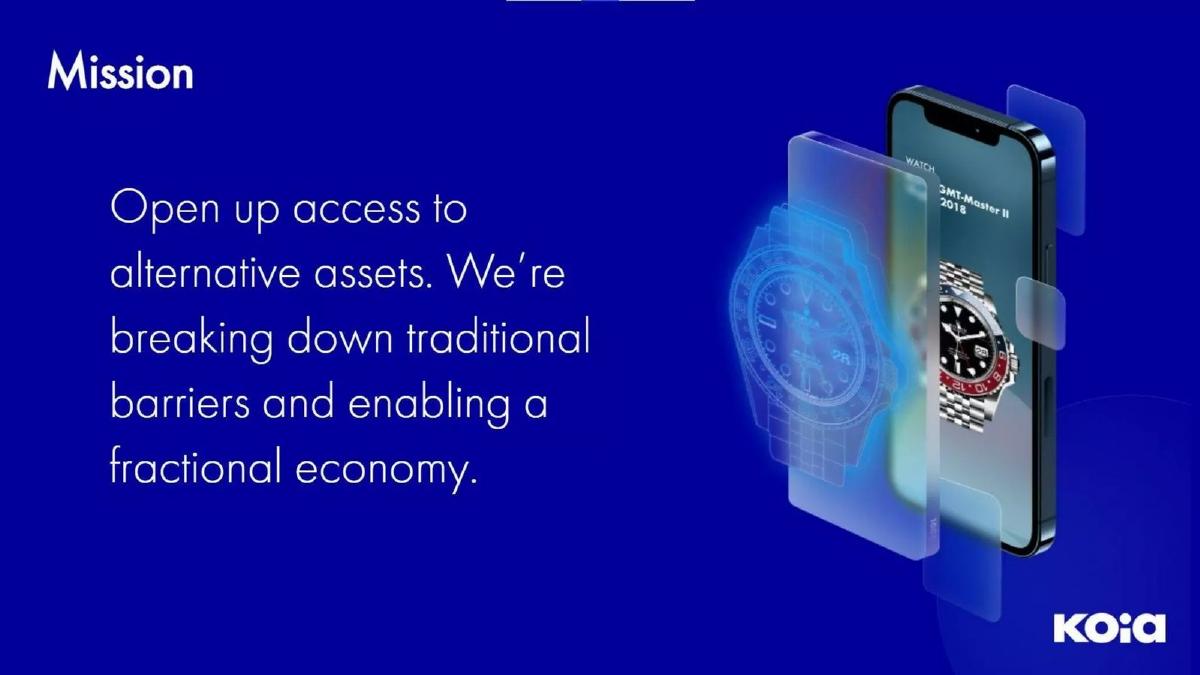
Slide 2 defines the problem through the lens of accessibility. It states that while everyone has a passion for items like watches or Pokémon cards, these "passion assets" are currently only accessible to the "wealthiest 1%." This is a classic democratization narrative used frequently in fintech and fractional investment decks. Slide 3 formalizes this as a mission to "enable a fractional economy" by breaking down traditional barriers to entry.
The Solution and Market Opportunity
Slides 4-5: Bridging Physical and Digital Markets
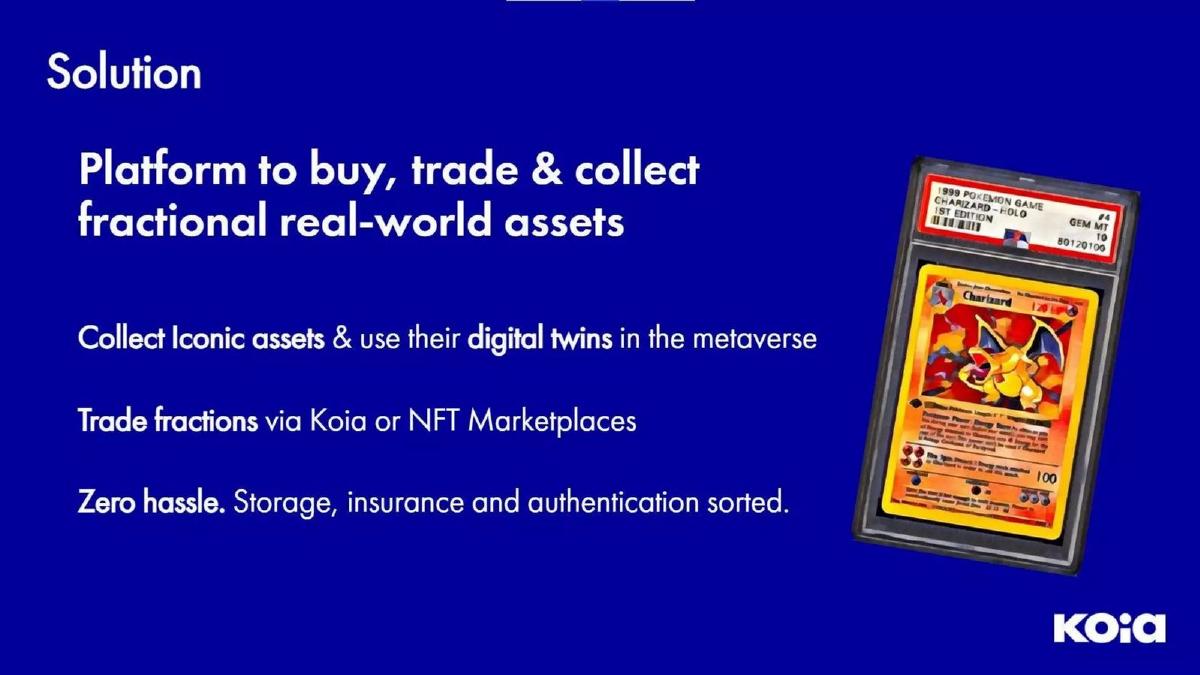
Slide 4 introduces the platform as a way to buy, trade, and collect "fractional real-world assets." Notably, it introduces the concept of "digital twins in the metaverse," a high-growth theme during the 2021-2022 period. The slide promises a "zero hassle" experience where storage, insurance, and authentication are "sorted" by the platform.
On Slide 5 , Koia maps the market. They identify a "$370 billion+ annual market" for tangible collectibles. The slide uses a quadrant chart to position their "Initial Focus" (tangible collectibles) against "Next Up" (digital assets like music royalties and gaming assets). This chart effectively shows the transition from fragmented, traditional markets to standardized, digital ones, placing Koia at the intersection of traditional assets and digital infrastructure.
Operational Mechanics
Slides 6-8: The Fractionalization Process
Slide 6 provides a four-step breakdown of the "How it works" cycle: Acquire, Fractionalize, Trade, and Returns. A key technical detail here is the minting of NFTs ('Fractions') linked to the real asset. It also mentions a governance component where fractional owners "vote on key asset-related decisions." When an asset is sold to a third party, the NFT is "burnt" and proceeds are returned pro-rata.
Slide 7 visualizes this flow using a Rolex GMT-Master II as the example. It shows the physical asset moving into custody, the minting of multiple NFTs, and the dual-path for trading: Koia's own secondary market or external NFT marketplaces. The final step shows proceeds flowing back to either a bank account or a crypto wallet, emphasizing the hybrid nature of the platform. Slide 8 expands on the "Product Vision," highlighting social commerce (live video asset drops), secondary market liquidity, and the utility of digital twins.
Competitive Landscape and Differentiators
Slides 9-10: The Web3 Advantage
Slide 9 lists "Competitive Advantages," specifically naming Masterworks and Rally as traditional competitors. Koia argues that its DeFi-based solution creates more trust and liquidity. They also cite "legal and corporate setup" as a moat, combining NFTs with real-world counterparts like insurance companies and auction houses. This is an important inclusion for investors worried about the regulatory hurdles of fractionalizing securities.
Slide 10 is a standard competitive matrix. Koia checks every box—Fractionalization, Liquid Secondary Market, Physical Assets, Marketplace for 3rd Parties, and Decentralized/Web3. Competitors like eBay and StockX are noted for having physical assets but lacking fractionalization, while platforms like 'Fractional' (now Tessera) are noted for being decentralized but lacking physical asset integration. This slide successfully carves out a unique niche for Koia.
Traction and Roadmap
Slides 11-12: Proving the Model
Slide 11 , titled "Progress," serves as the traction slide. It highlights four pillars: a released iOS app with ">1k users," developed physical infrastructure, the initial "~$1.4M pre-seed round" from Seedcamp and RTP, and a "legally compliant structure" for NFT-based fractionalization. This slide is crucial because it moves the deck from theory to execution.
Slide 12 outlines the "Product Roadmap (Year 1)." The goals are specific and measurable: fractionalizing ">$200k of assets" in Q1 2022 and ">$1m" by Q3 2022. It also mentions a "Koia Kollector PFP" (Profile Picture) NFT sale, a common community-building and capital-raising tactic in the Web3 space at the time. The long-term vision for 2023+ includes "grail" assets and lending options.
Team and Conclusion
Slides 13-14: The Pedigree
Slide 13 introduces the founders. The team has a strong mix of finance and fintech experience. COO Richard Draper is a CFA with public and private market experience. CEO Iris ten Teije was the first employee at Neat (a neobank that raised $15M+). CTO Ben Riazy brings 13 years of experience, including stints at HSBC and Lloyds Banking Group. This combination of traditional banking expertise and startup scaling experience is a significant de-risking factor for a company handling high-value physical assets and complex legal structures.
The deck concludes on Slide 14 with a simple, high-impact visual of a Rolex and the closing statement: "Merging real world assets with a digital & decentralized future."
What Works in This Deck
Clear Operational Flow: Slides 6 and 7 do an excellent job of explaining how a physical watch becomes a tradable digital token. This is often the most confusing part of a fractionalization pitch, and Koia handles it with simple visuals. · Strategic Positioning: By explicitly naming Masterworks and Rally, Koia acknowledges the existing market while clearly defining why a Web3 approach is superior (liquidity and decentralization). · Strong Team-Market Fit: The founders' backgrounds in neobanking and traditional finance (CFA) provide the necessary credibility for a platform that must navigate strict financial regulations. · Visual Consistency: The use of high-quality imagery of "iconic assets" makes the product feel premium and aspirational, matching the nature of the assets they are fractionalizing.
What Is Missing From This Deck
Financial Projections: There is no slide detailing projected revenue, burn rate, or long-term financial targets. While common in pre-seed decks, a hint at the take-rate or management fees would have been helpful. · The "Ask": The deck mentions they already raised $1.4M on Slide 11, but it does not specify what they are looking for next. If this was used for a follow-on or a bridge, the specific funding target and use of funds are missing. · Unit Economics: There is no mention of the cost to acquire an asset, the cost of insurance/storage, or the expected Customer Acquisition Cost (CAC) versus Lifetime Value (LTV). · Regulatory Detail: While they mention being "legally compliant" multiple times, they don't explain how (e.g., are these structured as SPVs, or is there a specific regulatory exemption being used?).
What a Founder Should Copy
The Quadrant Market Map: Slide 5 is a great way to show how a company plans to expand from a niche (tangible collectibles) into a broader market (all digital assets). · The Progress Slide: Grouping traction into "MVP," "Sourcing," "Investment," and "Structure" (Slide 11) is a smart way to show holistic progress beyond just user numbers. · The Competitive Matrix: Slide 10 is a textbook example of how to use a matrix to highlight a specific technological advantage (Web3) that incumbents lack. · The "How it Works" Breakdown: Founders of complex technical products should emulate the simplicity of Slide 6, which reduces a multi-step legal and technical process into four digestible points.
Frequently asked questions
- How does Koia handle the physical storage of assets?
- According to slide 6 and slide 7, Koia identifies and authenticates the assets, then stores them in 'safe locations' via storage partners. The physical asset is held in custody by Koia while the digital 'Fractions' (NFTs) are traded by users. This 'zero hassle' approach is intended to cover storage, insurance, and authentication for the investor.
- What is the primary revenue model suggested in the deck?
- The deck does not explicitly detail its fee structure or revenue model. It mentions a 'secondary market' on slide 8 and slide 12, implying potential transaction fees, and slide 9 mentions a 'marketplace for authorized sellers,' which suggests a possible commission-based model, but specific percentages or unit economics are absent.
- How does Koia differentiate itself from Rally or Masterworks?
- On slide 9 and slide 10, Koia claims its 'DeFi solution' is the primary differentiator. Unlike 'Traditional' competitors, Koia uses NFTs and Web3 infrastructure to enable secondary market liquidity, digital twins for the metaverse, and future collateralized lending. They position themselves as the only player combining fractionalization, physical assets, and decentralization.
- What kind of assets does Koia plan to support?
- Slide 5 outlines an 'Initial Focus' on tangible collectibles like wine, classic cars, handbags, and sports memorabilia. Their 'Next Up' category includes digital assets such as NFT art, gaming assets, music royalties, and website acquisitions. The roadmap on slide 12 also mentions 'grail' assets—ultra-rare million-dollar items—slated for 2023.
- What traction had the company achieved at the time of this deck?
- Slide 11, titled 'Progress,' notes that Koia had released a legally compliant TradFi iOS app, surpassed 1,000 users, and completed its first fractional asset sale. They also stated they had already raised approximately $1.4M in a pre-seed round from Seedcamp, RTP, and fintech angels.