Kollecto is an art advisory platform targeting young, first-time buyers who find the traditional art market intimidating or unaffordable. The 10-slide deck outlines a business model that combines human-led curation with financial tools, such as monthly payment plans, to lower the barrier to entry. With an average art purchase of $1,450, the company generates revenue through service fees, negotiated margins, and financing interest. The deck highlights early traction, including a 56% purchase rate among active clients and a growing waitlist. While the deck is lean on technical architecture and…
Key takeaways
- The platform targets a specific budget range of $100 to $5,000, positioning itself between DIY online galleries and high-end traditional firms (Slide 5).
- Kollecto addresses the 'intimidation' factor by providing a personal art advisor who handles taste profiles and price negotiations (Slide 2).
- Financing is a core pillar of the value proposition, with 80% of customers opting for monthly payments (Slide 4).
- The business model is diversified across three current streams: 10% service fees, 10-15% negotiated margins, and 7.5-10% financing fees (Slide 6).
- Early sales funnel data shows a high intent to buy, with 56% of clients who redeem a beta invite ultimately purchasing art (Slide 7).
- The founder, Tara Reed, brings significant tech marketing experience from Google, Foursquare, and Microsoft (Slide 10).
- The deck lacks a formal 'Ask' slide, omitting the funding amount sought, valuation, or specific use of proceeds.
- Market data suggests the online art market is expected to double to $3.7B, driven by younger buyers (Slide 3).
Executive Summary: The Democratization of Curation
Kollecto presents a solution to a classic 'luxury' problem: the high barrier to entry in the fine art market. The deck, titled 'Kollecto deck (sg)', is a 10-slide presentation that focuses heavily on the psychology of the first-time buyer. By identifying 'intimidation' and 'cost' as the two primary friction points, Kollecto positions itself not just as a marketplace, but as a service-enabled fintech platform for the home decor space. The deck is notable for its clarity on the business model and its use of founder pedigree to offset the risks associated with a solo-founder, service-heavy startup.
Slide 1: Title and Value Proposition
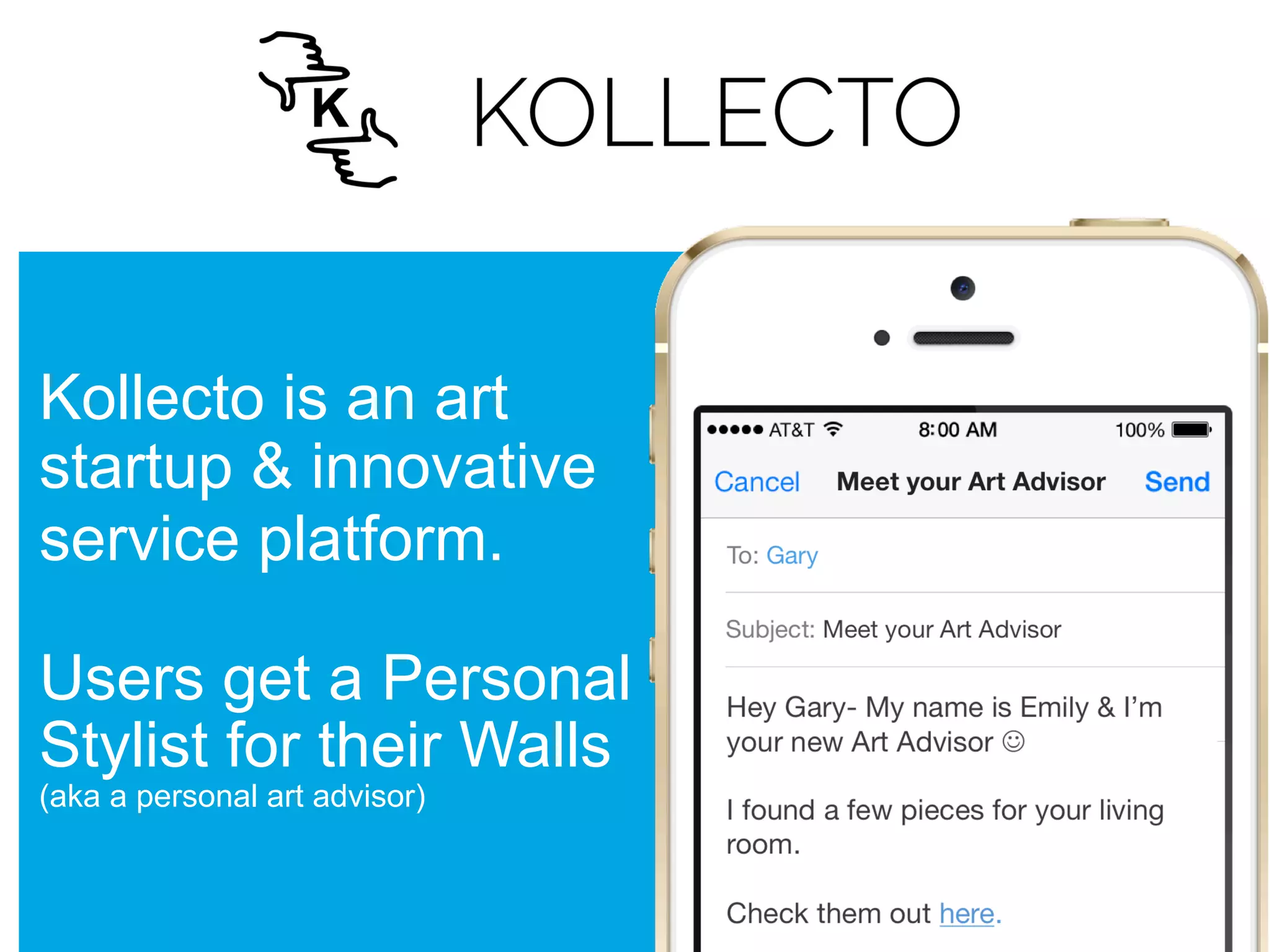
The cover slide introduces Kollecto as an 'art startup & innovative service platform.' It uses a simple mobile mockup to illustrate the core user experience: a direct message from a personal art advisor named Emily. The tagline, 'Users get a Personal Stylist for their Walls,' successfully translates the abstract concept of 'art advisory' into a relatable consumer service category similar to Stitch Fix or Trunk Club. The branding is minimalist, using a blue and white color palette that suggests a clean, gallery-like aesthetic.
Slide 2: The Workflow
Slide 2, 'HOW IT WORKS,' breaks the process into three steps: meeting an advisor via a questionnaire, receiving curated picks via email, and paying over time. This slide is crucial because it introduces the 'Pay for Art Over Time' feature early. By mentioning that users can 'Hang the art while you pay,' Kollecto addresses the immediate gratification needs of the millennial consumer. The visuals emphasize the mobile-first nature of the interaction, showing a user interface for monthly payments ($72/mo in the example).
Slide 3: Market Opportunity and Friction
Under the heading 'WHY WE’RE DOING THIS,' the deck cites a market projection that the online art market will double to $3.7B in five years. More importantly, it provides qualitative data on the problem: 20% of people find art shopping more intimidating than buying real estate, and 50% cite cost as the main barrier. This slide establishes the 'Why Now' by linking market growth to the influx of younger, first-time buyers who lack the confidence of traditional collectors.
Slide 4: The Solution Strategy
Slide 4, 'WE ADDRESS THE ACTUAL FRICTION,' uses a brain graphic to map their features to consumer pain points. It claims that 80% of customers finance their art, which is a significant data point for any potential investor interested in the fintech aspect of the business. It also notes that 53% of their customers are first-time buyers, validating their target market hypothesis. This slide transitions the deck from 'what we do' to 'how we are performing.'
Slide 5: Competitive Landscape
The competitive matrix on Slide 5 is well-structured. It compares Kollecto against online gallery 'chat' features (Artsy, Saatchi), regular online galleries (20x200), and traditional advisory firms. Kollecto claims a unique position by offering price negotiation, financing, and the ability to source from any artist or gallery, all within a $100-$5,000 budget. This 'source from anywhere' claim is a key differentiator, as most online galleries are limited to their own inventory.
Slide 6: The Business Model
Slide 6 is one of the strongest in the deck. It provides a clear breakdown of the 'Model Today': 10% service fees, 10-15% negotiated margins, and 7.5-10% financing fees. By stating an average purchase price of $1,450, the deck allows an analyst to quickly calculate the average revenue per user (ARPU). The inclusion of 'Future Models' like advertisement and listing fees shows an awareness of long-term scalability beyond labor-intensive advisory services.
Slide 7: Marketing & Sales Funnel
The sales funnel on Slide 7 shows ~1000 monthly unique visitors. The conversion metrics are impressive: a 9-14% rate for beta access requests and, most notably, a 56% purchase rate for clients who redeem a beta invite. The deck candidly notes that they are 'focused on improving' the 30% beta invite redemption rate, which adds a layer of transparency and operational focus that investors appreciate.
Slide 8: Traction and Growth
Slide 8 shows a dual-axis line graph for 'Art Advisor Applications' and 'Beta Requests.' The data covers July through October. There is a visible inflection point in September where applications for advisors spike. While the absolute numbers are still small (under 200), the trend line indicates successful early-stage customer acquisition or perhaps the result of a specific marketing push or press mention.
Slide 9: Social Proof
Slide 9, 'WHAT CUSTOMERS SAY,' features three Twitter testimonials. These are not just generic quotes; they include handles like @KateKendall and @mariahschweitz. One tweet specifically mentions being excited to be an 'Art Advisor' for the platform, which hints at a marketplace model for the advisors themselves rather than just in-house staff.
Slide 10: Founder Pedigree
The final slide introduces Tara Reed. Her background is the 'secret sauce' of the deck. Having worked in tech marketing for Google, Foursquare, and Microsoft, she possesses the high-growth tech pedigree that venture capitalists look for, especially in a solo-founder scenario. She identifies as a 'young art collector,' positioning herself as a founder with genuine empathy for the target demographic.
What Works in This Deck
Clarity of Revenue: Many early-stage decks are vague about how they actually make money. Kollecto is explicit about its three-pronged revenue stream. This transparency builds trust and demonstrates a sophisticated understanding of the unit economics involved in art brokerage.
Fintech Integration: By highlighting that 80% of users use financing, the deck moves Kollecto out of the 'lifestyle business' category and into the 'scalable platform' category. Financing creates stickiness and provides a data-driven path to increasing average order value (AOV).
Psychological Insight: The deck focuses on 'intimidation' rather than just 'inventory.' This is a smart move. In the art world, the problem isn't a lack of art; it's the lack of confidence in choosing it. Kollecto sells confidence, not just canvas.
What Is Missing
The Ask: The most glaring omission is the lack of a funding request. There is no mention of how much capital is being raised, the valuation, or what the milestones for the next 18 months look like. This makes the deck feel more like a company update or a general pitch rather than a specific fundraising tool.
The Team: While Tara Reed’s background is impressive, there is no mention of a CTO, advisors, or the 'Emily' advisors mentioned in the mockups. Investors generally want to see who is building the product and how the advisory service scales without becoming a bottleneck.
Technology/No-Code Story: Outside of this deck, Kollecto is famous in the startup world for being built using 'no-code' tools. However, that story is completely absent here. While not strictly necessary for a pitch, explaining the lean tech stack could have reinforced the company's ability to iterate quickly with minimal capital.
Founder Takeaway: Copy the Funnel Transparency
Founders should study Slide 7. Instead of just showing a 'up and to the right' chart, Kollecto shows the actual conversion leaks in their funnel. By pointing to the 30% redemption rate and saying 'We’re focused on improving this,' the founder demonstrates an analytical mindset. It shows that they aren't just looking at the wins, but are actively debugging the business model. This level of granular honesty is often more persuasive to a seasoned investor than a perfectly polished, but vague, growth chart.
Frequently asked questions
- How does Kollecto differentiate itself from sites like Artsy or Saatchi Art?
- According to Slide 5, Kollecto differentiates through active human intervention and financial services. While online galleries like Artsy require users to navigate thousands of options and negotiate prices themselves, Kollecto provides a dedicated advisor to do the work and offers integrated financing, which the deck claims competitors lack.
- What are the primary revenue drivers for the company?
- Slide 6 details three active revenue streams: a 10% advisor service fee, a 10-15% margin negotiated with galleries or artists, and 7.5-10% in art financing fees. The company also lists future potential revenue from art advertisement and listing fees.
- What is the typical price point for art sold on the platform?
- Slide 6 states that the average art purchase on the platform is $1,450. Slide 5 further defines their target budget requirement as ranging from $100 to $5,000, contrasting this with traditional advisory firms that typically require a minimum $10,000 budget.
- Does the deck show significant user growth?
- Slide 8 displays a growth chart covering a period from July to October. It shows a sharp increase in 'Art Advisor Applications' starting in September, alongside a steady rise in 'Beta Requests,' both nearing the 200-mark by the end of the period shown.
- What is missing from this pitch deck?
- The deck is missing several standard venture components: there is no 'Ask' slide detailing the investment sought, no slide on unit economics (CAC/LTV), no technical roadmap, and no mention of a broader team beyond the founder. It functions more as a proof-of-concept and traction summary than a complete Series A-style deck.