Kollecto’s 10-slide deck is a study in brevity, focusing almost exclusively on market growth and internal traction. Founded in 2014 by Tara Reed, the company positions itself as a personalized art advisory service for the 'under $3,000' market. The deck skips traditional problem/solution narratives in favor of a data-heavy approach, showcasing a $360k sales run rate and a 40% revenue growth rate. By using analogies to Spotify and Netflix, Kollecto frames art collecting as a recommendation-engine problem rather than a luxury-access problem. While it lacks a formal 'Ask' slide or detailed unit…
Key takeaways
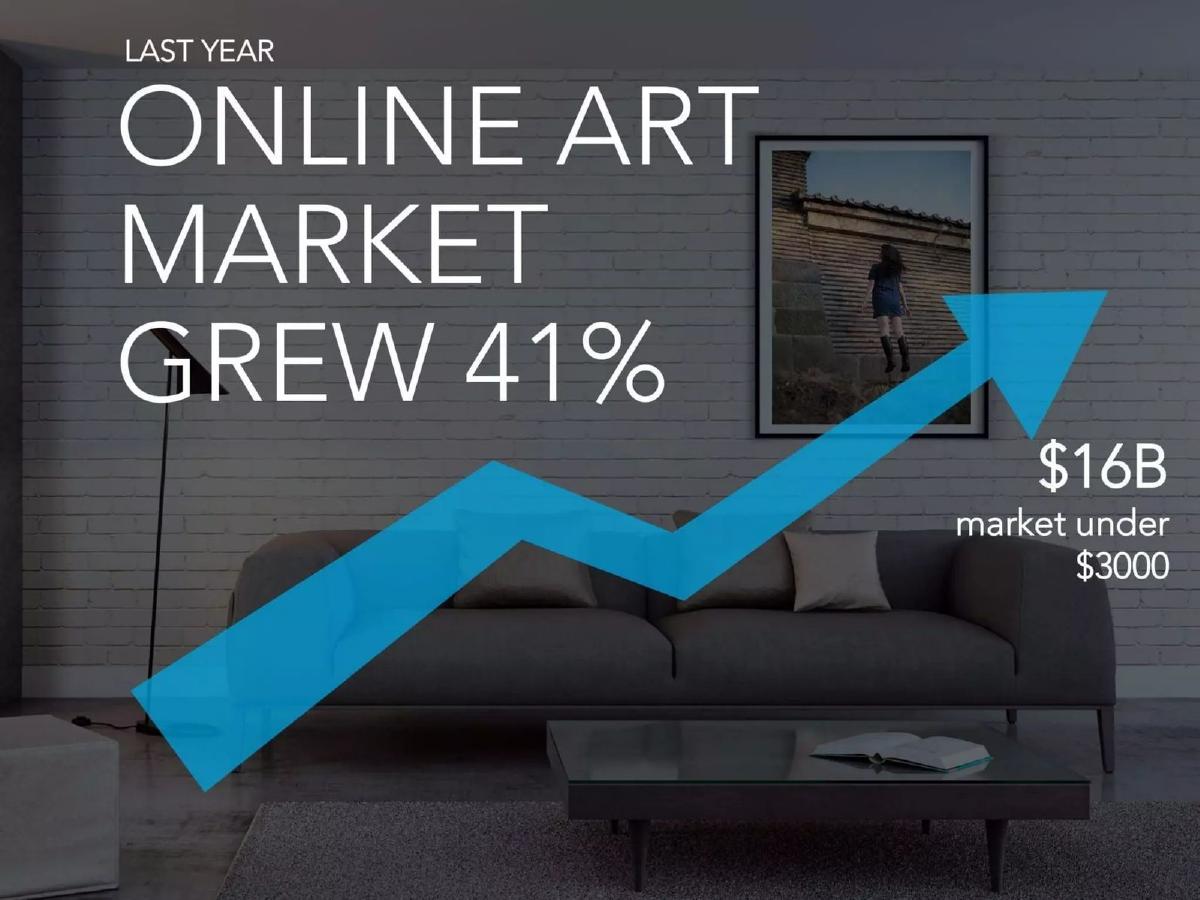
- The deck identifies a specific $16B market niche for art priced under $3,000 on slide 2.
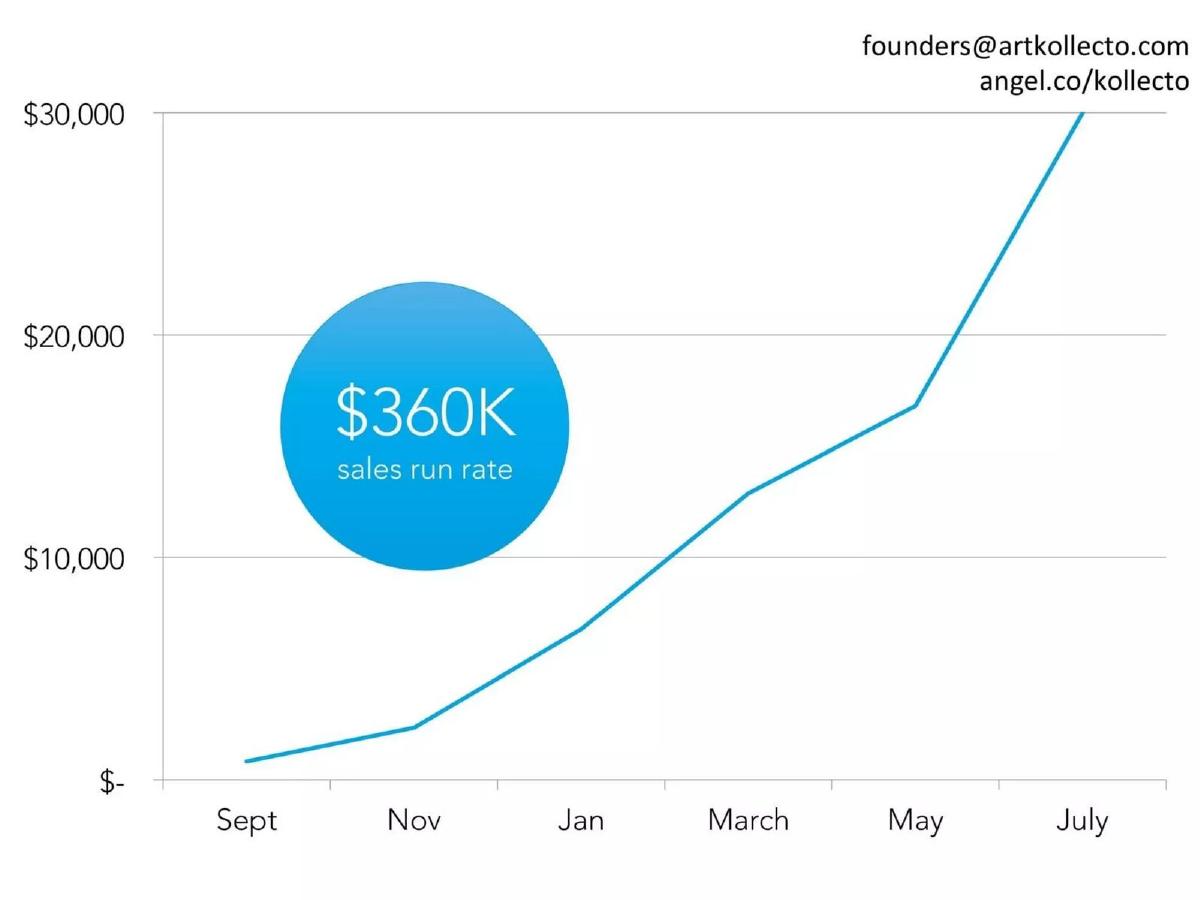
- Kollecto reports a $360k sales run rate as of July, showing a steep upward trend from the previous September on slide 3.
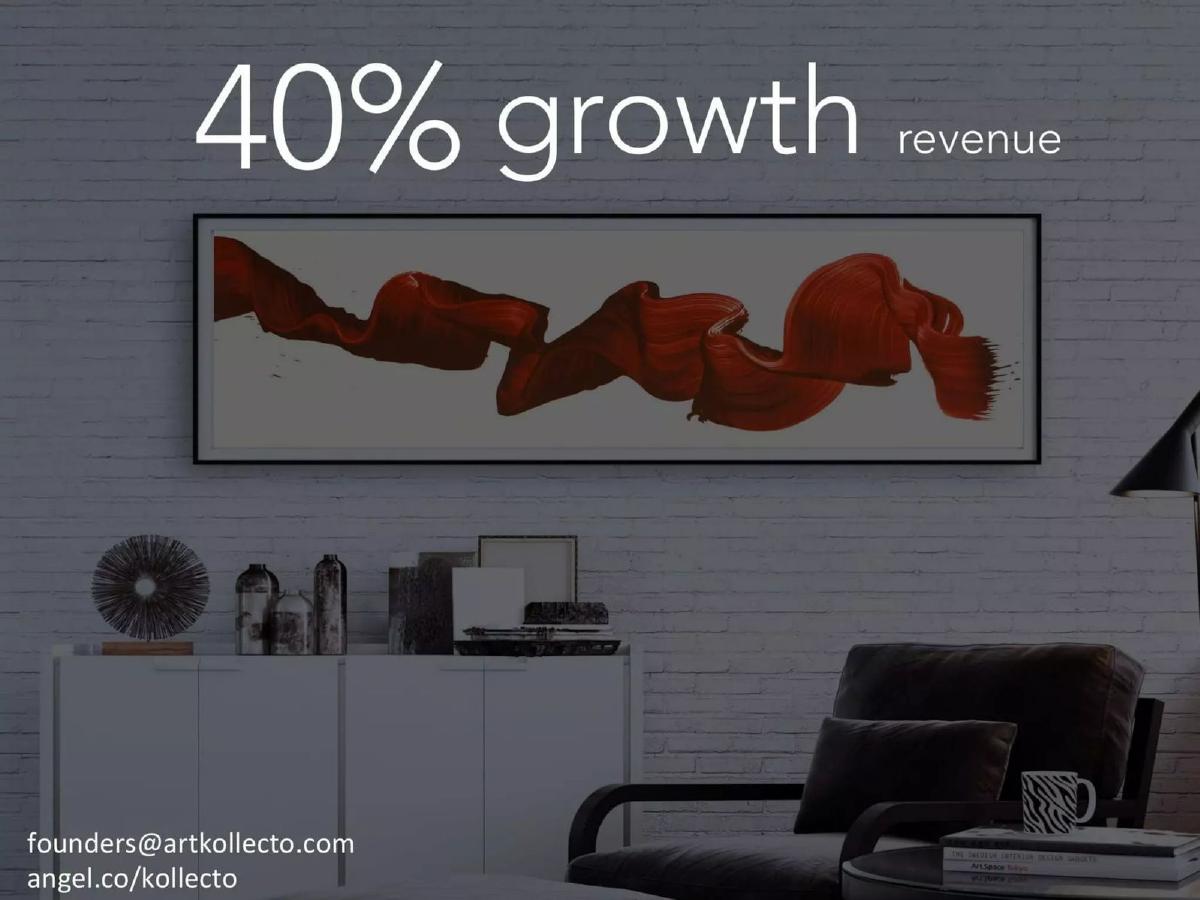
- Revenue growth is stated at 40%, though the specific time period for this growth is not defined on slide 4.
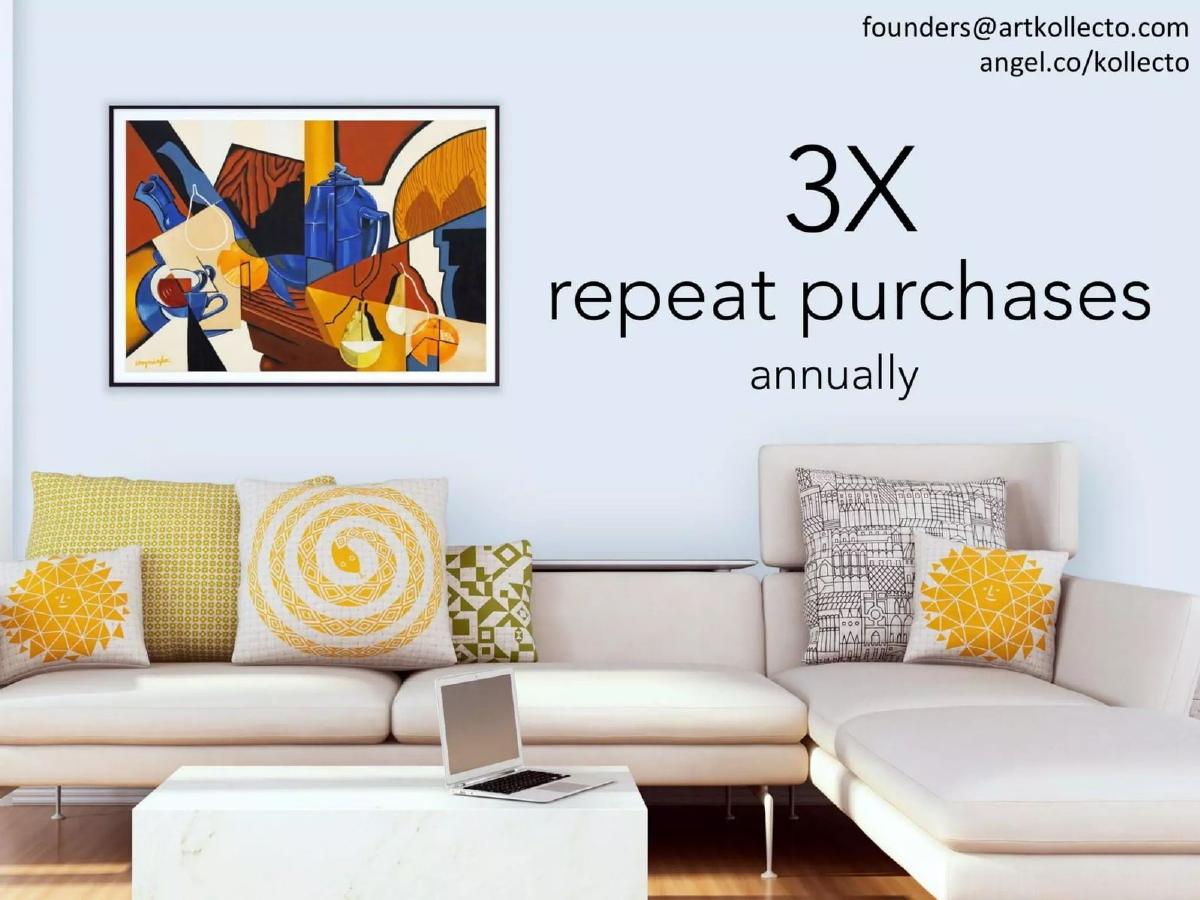
- The business model relies on high frequency for the sector, claiming 3x repeat purchases annually on slide 6.
- The average purchase price is exactly $1,500, positioning the brand in the 'affordable luxury' segment on slide 7.
- Personalization is the core product hook, demonstrated via a 5-star rating interface on mobile mockups on slide 8.
- The team features alumni from Google, Foursquare, Microsoft, and American Express on slide 9.
- The deck omits a specific funding request, valuation, or breakdown of how capital will be deployed.
The Minimalism of High-Growth Traction
The Kollecto pitch deck, dating from 2014, is a 10-slide presentation that leans heavily on the 'show, don't tell' philosophy. In an era where many founders over-explain the 'why' of art, Kollecto focuses almost entirely on the 'how much.' The deck is characterized by large-format photography, minimal text, and a relentless focus on revenue metrics. By positioning art as a data-driven recommendation problem, the company attempts to bridge the gap between the opaque world of fine art and the scalable world of SaaS and e-commerce.
Slides 1-2: The Hook and the Macro Opportunity
Slide 1 is a standard title slide featuring the company logo and the tagline 'Become an Art Collector.' It includes contact information and an AngelList URL, which was a common practice for startups in the mid-2010s to provide immediate social proof and data access to investors. The background image of a modern, art-filled living space immediately sets the aesthetic tone for the brand.
Slide 2 moves directly into the market thesis. It claims the 'Online Art Market Grew 41%' last year. More importantly, it narrows the focus to a '$16B market under $3000.' This is a critical strategic move. By capping the price point, Kollecto signals to investors that they are not competing with high-end auction houses like Sotheby's for the 1%, but rather building a scalable platform for the aspirational middle class. The blue arrow overlay is a bit literal, but the message is clear: the market is large and moving online.
Slides 3-4: The Traction Evidence
Slide 3 is perhaps the most important slide in the deck. It features a line graph showing sales growth from September to July. The graph is punctuated by a large blue circle stating a '$360K sales run rate.' The slope of the line steepens significantly between May and July, suggesting that the company found a repeatable growth lever or benefited from seasonal trends. The y-axis scales up to $30,000, implying monthly sales figures that support the annualized run rate claim.
Slide 4 reinforces this momentum with a simple headline: '40% growth revenue.' While the slide lacks a specific timeframe for this 40% (is it month-over-month or quarter-over-quarter?), it serves as a psychological reinforcement of the previous slide's graph. The background imagery continues to showcase the product in a lifestyle context, keeping the 'art' aspect of the business front and center.
Slides 5-7: The Model and Unit Economics
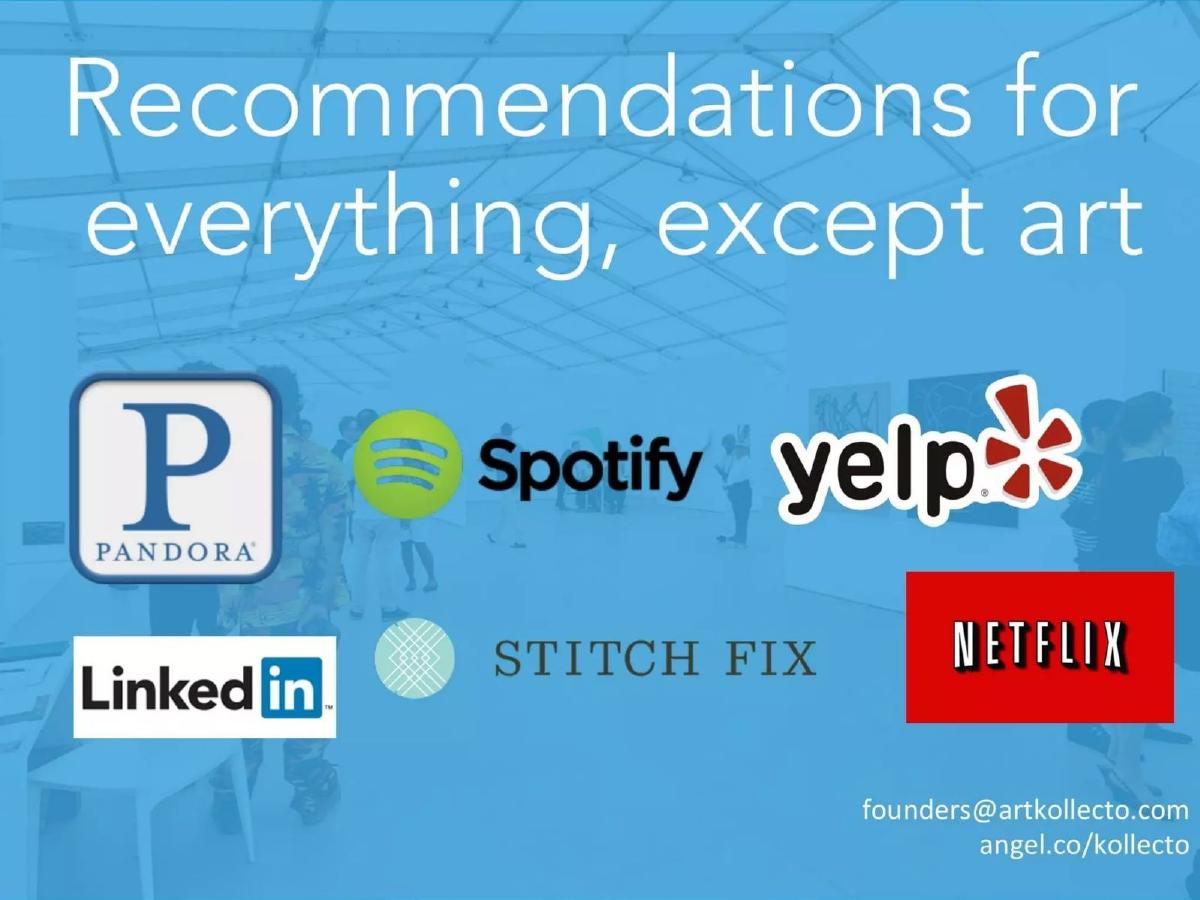
Slide 5 addresses the 'Why Now' and the 'How' through analogy. The headline 'Recommendations for everything, except art' is surrounded by the logos of Pandora, Spotify, Yelp, LinkedIn, Stitch Fix, and Netflix. This slide does the heavy lifting of explaining the product's technical soul without using jargon. It suggests that Kollecto is building the 'Discovery Engine' for art, following the successful path of other vertical-specific recommendation leaders.
Slide 6 introduces a surprising metric for the art world: '3X repeat purchases annually.' In traditional art sales, a single purchase might be a once-in-a-decade event for a casual buyer. By claiming three purchases per year, Kollecto is arguing that their advisor-led, recommendation-heavy model creates a high-frequency habit. This is a key 'venture-scale' argument; high frequency leads to higher LTV (Lifetime Value).
Slide 7 provides the other half of the economic equation: '$1500 average purchase.' When combined with the 3x frequency from the previous slide, an investor can quickly calculate a gross revenue per active user of $4,500 per year. For a seed-stage startup, these are very healthy top-line numbers, provided the margins on the art sales or advisor fees are sustainable.
Slides 8-10: Product, Team, and Summary
Slide 8 shows the product in action. Titled 'Introducing personalization!', it displays two iPhone mockups. The interface is simple: a piece of art (e.g., 'Boy in Tree' by Norm Altman) with a 5-star rating system below it. This confirms the 'Spotify for Art' analogy from Slide 5, showing that the platform relies on user feedback to refine its recommendations.
Slide 9 is the Team slide. It features CEO Tara Reed, Chief Art Advisor Emily Havens, and CTO Ebi Baralaye. The strength of this slide lies in the corporate logos at the bottom: Google, Foursquare, Microsoft, and American Express. This tells a story of a team that understands big data (Google/Microsoft), local discovery (Foursquare), and high-value transactions (Amex). Notably, Emily Havens is pictured with a goat, which, while quirky, adds a layer of personality to an otherwise very corporate-feeling set of credentials.
Slide 10 concludes the deck by repeating the core traction metrics: '$360k run rate,' 'Average $1500,' and '3X/yr.' It is a 'summary' slide that ensures the final image left in the investor's mind is the data that proves the business is working.
What Works in the Kollecto Deck
The primary strength of this deck is its clarity of signal . The founder does not hide behind complex market maps or vague 'vision' statements. Instead, the deck is built around three numbers: $360k, $1,500, and 3x. For an early-stage investor, these numbers are the most efficient way to communicate that a product-market fit has been established.
The analogous positioning on Slide 5 is also highly effective. By grouping Kollecto with Netflix and Spotify, the founders bypass the need to explain their recommendation algorithm. Investors already understand the value of a 'discovery engine,' so the founders only need to prove that they can apply that engine to the art vertical.
What is Missing from the Kollecto Deck
The most glaring omission is the Business Model detail . While we see the 'Average Purchase' price, the deck never explains how Kollecto makes money. Do they take a commission from the artist? Do users pay a subscription for the 'Personal Art Advisor'? Without knowing the take rate, the $360k run rate is difficult to value. If it is $360k in GMV (Gross Merchandise Volume) and they only take 10%, the actual revenue is quite small.
There is also no 'Ask' slide . A standard pitch deck should conclude with how much money is being raised, what milestones that money will hit, and what the current cap table looks like. By omitting this, the deck feels more like a teaser for a demo day than a complete fundraising tool.
Finally, the Competitive Landscape is absent. In 2014, companies like Artsy and 20x200 were already active. A slide addressing why Kollecto's 'advisor-led' approach is superior to these existing platforms would have strengthened the case for why this specific team will win the $16B market.
What a Founder Should Copy
The 'Rule of Three' for Metrics: Pick the three most impressive numbers about your business and repeat them at the beginning and the end. Kollecto's focus on run rate, AOV, and frequency makes the deck memorable. · High-Quality Lifestyle Imagery: If you are in a B2C or aesthetic-heavy industry, your deck should look like your product. The clean, modern interior design photos in this deck help the investor 'feel' the brand. · Logo Association: Using the logos of previous employers (Google, Microsoft) is a shortcut to establishing technical credibility. If your team has 'big tech' or 'big finance' pedigree, put the logos front and center. · The 'X for Y' Analogy: Using Slide 5 to show that you are the 'Spotify for Art' is much more effective than a 200-word paragraph explaining collaborative filtering.
Frequently asked questions
- What is Kollecto's primary value proposition?
- Kollecto aims to democratize the fine art market by providing personal art advisors and recommendation technology. According to the deck's listing and slide 8, the company uses a personalization engine—similar to Spotify or Netflix—to help users discover and purchase art, specifically targeting pieces under the $3,000 price point.
- How does Kollecto prove market demand in this deck?
- The deck uses two primary data points for market demand: a macro trend and micro traction. Slide 2 notes that the online art market grew 41% 'last year' and identifies a $16B opportunity. Slide 3 complements this with a growth chart showing sales rising from near-zero in September to a $360k run rate by July.
- What are the key unit economics mentioned?
- While the deck does not provide a full CAC/LTV breakdown, it highlights two critical metrics: an average purchase value of $1,500 (Slide 7) and a repeat purchase rate of 3x annually (Slide 6). For the art industry, which is typically low-frequency, a 3x annual repeat rate is a significant outlier that suggests high customer engagement.
- Who are the founders and what is their background?
- The team slide (Slide 9) lists Tara Reed as CEO, Emily Havens as Chief Art Advisor, and Ebi Baralaye as CTO. The slide highlights a 'big tech' pedigree, displaying logos for Google, Foursquare, Microsoft, and American Express, suggesting a blend of product, engineering, and industry-specific expertise.
- What is missing from the Kollecto pitch deck?
- The deck is missing several standard elements: a formal 'Problem' slide, a 'Competition' matrix, a detailed 'Business Model' (explaining the advisor/artist split), and a 'Financial Ask.' It functions more as a 'traction teaser' designed to secure a meeting rather than a comprehensive investment memorandum.