Koemei, a video search-as-a-service provider, utilized a 12-slide deck to raise $1.3 million in 2010. The deck is characterized by its extreme brevity and reliance on large-font traction metrics. Rather than dwelling on the technical complexities of speech recognition or natural language processing, the founders focused on validated market demand, citing $600,000 in completed revenue and a $1 million pending pipeline. The presentation targets the 'Smart Education & Learning' market, valued at $200 billion, and showcases a team with deep technical and business roots in the sector. While the de…
Key takeaways
- The deck leads immediately with a summary of $600k in revenue and patented technology on slide 1.
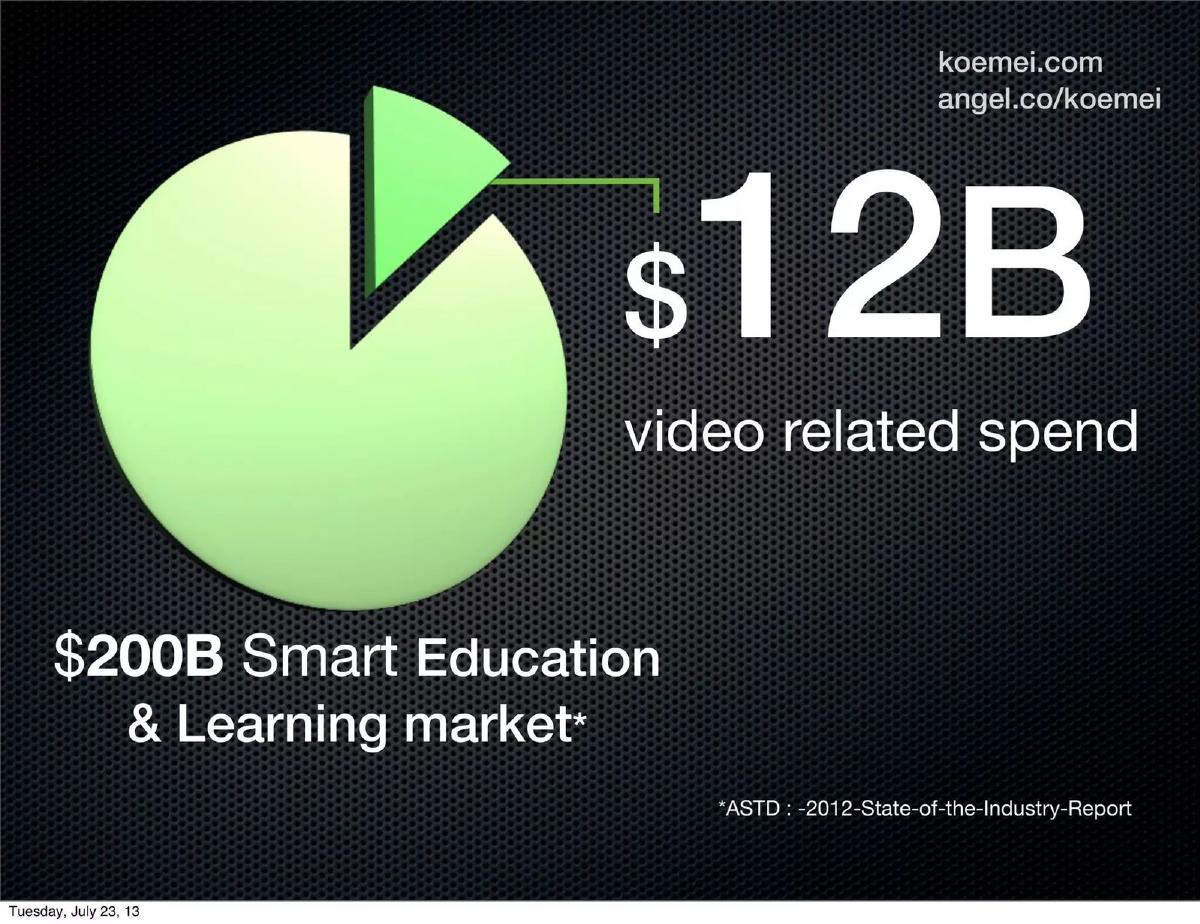
- Koemei identifies a $200B Smart Education & Learning market, with $12B specifically allocated to video-related spend on slide 3.
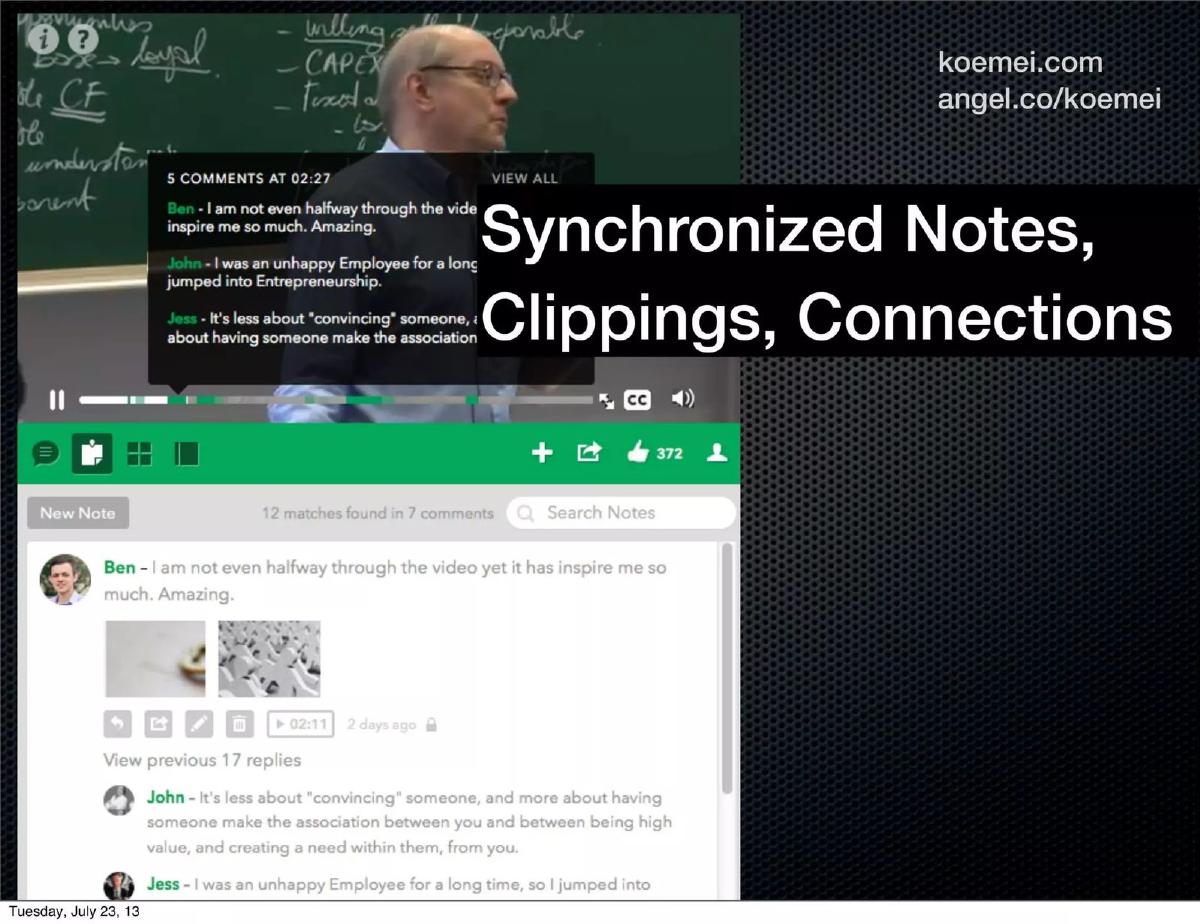
- Product functionality is demonstrated through UI mockups showing synchronized notes and searchable transcripts on slides 5 and 6.
- Traction is validated by three major completed contracts with IMD, Université de Genève, and CUNY on slide 8.
- The company presents a $1M pipeline of pending projects featuring logos like Chevron, Kaltura, and Berkeley on slide 9.
- The team slide (slide 10) highlights a CEO who is a 3x entrepreneur and a VP of Technology with a PhD and research experience at Idiap.
- Non-dilutive funding is a key highlight, with $1.2M in government grants mentioned alongside a $525k seed round on slide 11.
- The final ask is clearly defined as $1M, with $850k already committed at the time of the presentation on slide 12.
The Power of Traction-First Pitching
Koemei’s 2010 pitch deck is a relic from an era where video search was a frontier technology. Despite the technical complexity of their offering—speech recognition and natural language understanding—the deck is remarkably simple. It avoids the 'technobabble' trap that many AI startups fall into, choosing instead to lead with hard numbers and recognizable logos. By the time an investor reaches the third slide, they already know the company has revenue, patents, and a massive target market. This teardown examines how Koemei used 12 slides to turn a complex technical product into a clear investment opportunity.
Slides 1-3: The Hook and the Market
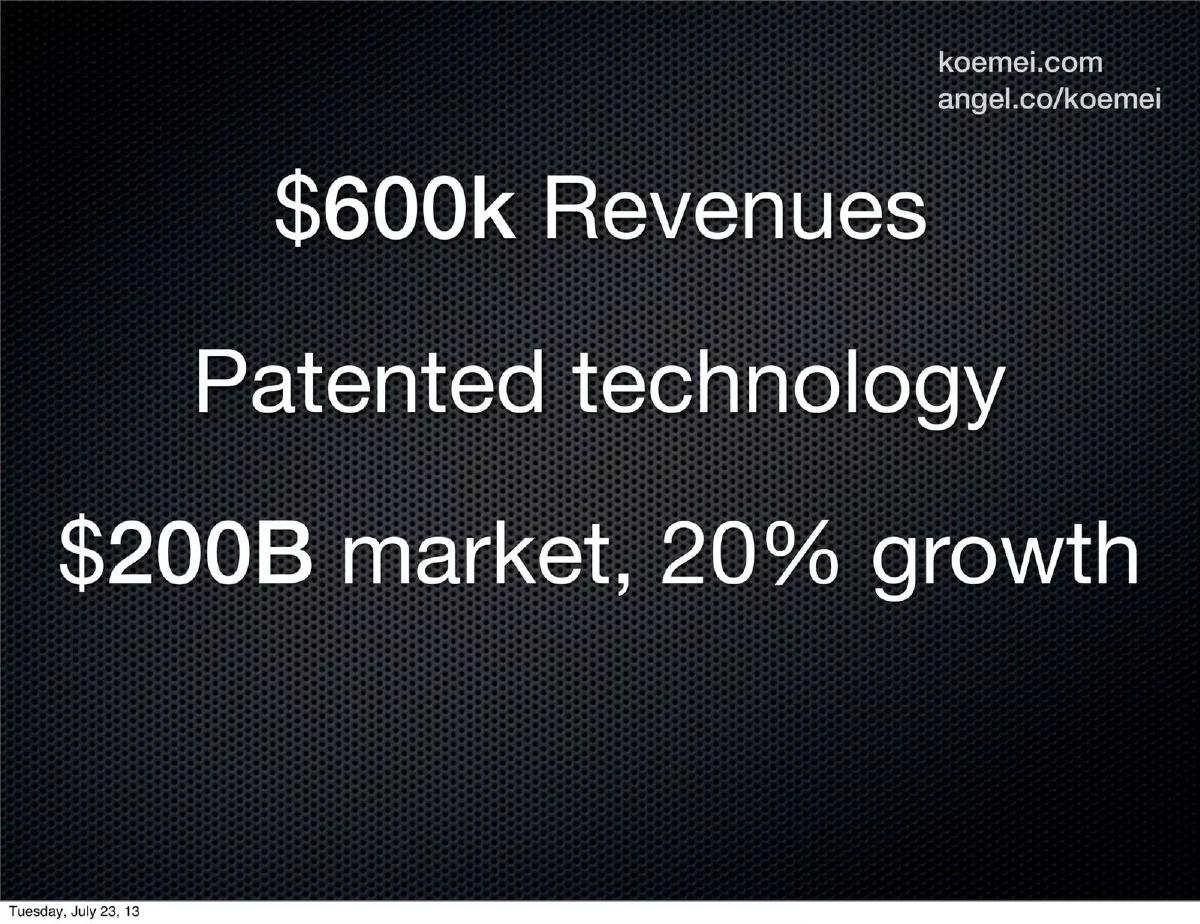
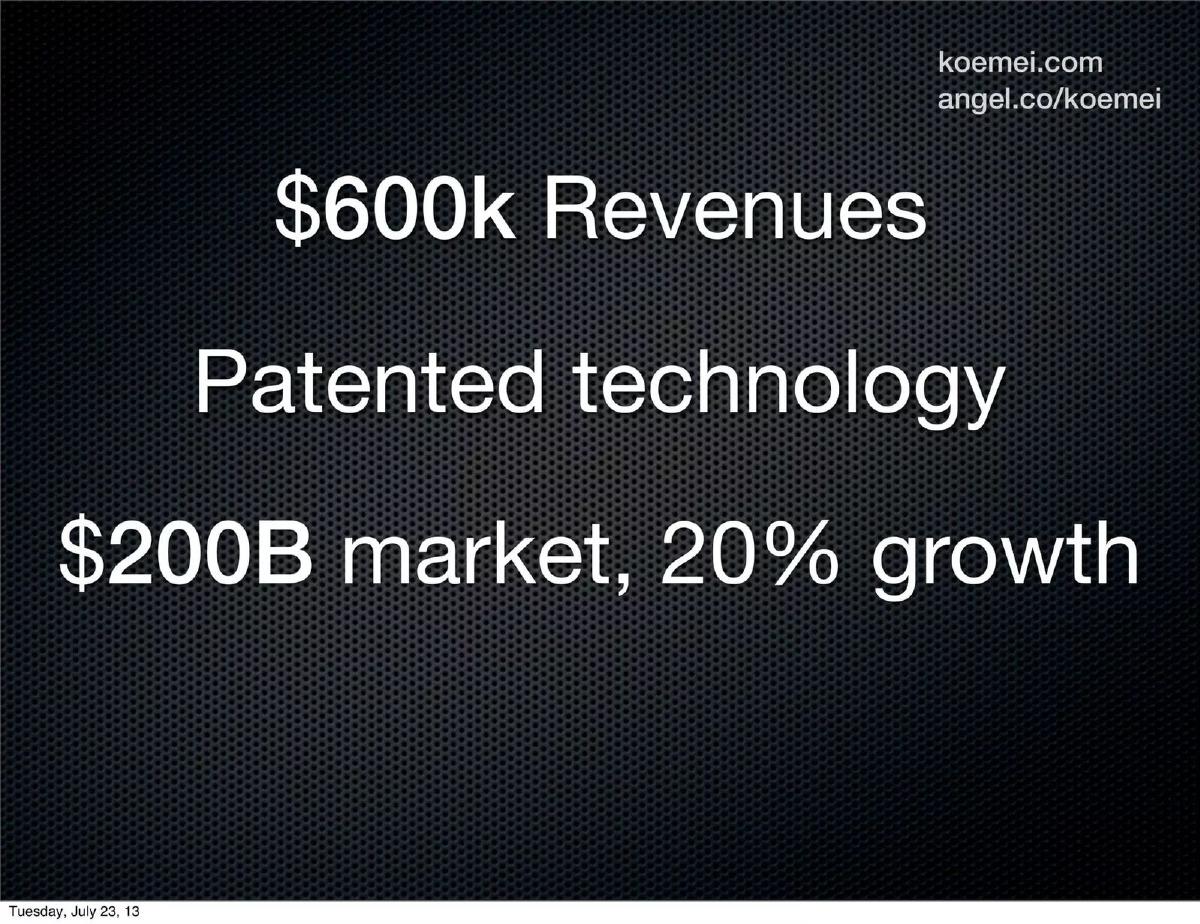
Slide 1: The Executive Summary Koemei does not waste time with a slow build. The first slide serves as a billboard for their three strongest attributes: '$600k Revenues,' 'Patented technology,' and a '$200B market, 20% growth.' By placing these figures on the very first page, they immediately frame the conversation around commercial viability rather than just technical curiosity. The inclusion of the AngelList URL in the corner also signals that they are active in the modern (for 2010) fundraising ecosystem.
Slide 2: The Value Proposition The company defines its mission clearly: 'We make educational videos searchable and collaborative.' This is a specific niche within the broader video market. The background image of a user interacting with a laptop reinforces the consumer-facing utility of what is essentially a back-end API service.
Slide 3: Market Size The deck quantifies the opportunity using a pie chart. It identifies a '$200B Smart Education & Learning market' and carves out a '$12B video related spend' slice. Citing the 'ASTD: 2012 State-of-the-Industry Report' adds a layer of third-party credibility to these large figures, though it is worth noting the deck was likely used in 2013 based on the timestamp at the bottom of the slides, despite the company's 2010 founding date.
Slides 4-7: The Product Experience
Slide 4: The User Need This slide bridges the gap between the market size and the product. It states that 'Learners want to access, share and collaborate.' It sets up the problem (video is traditionally a 'black box' that is hard to search or interact with) without needing to use the word 'problem.'
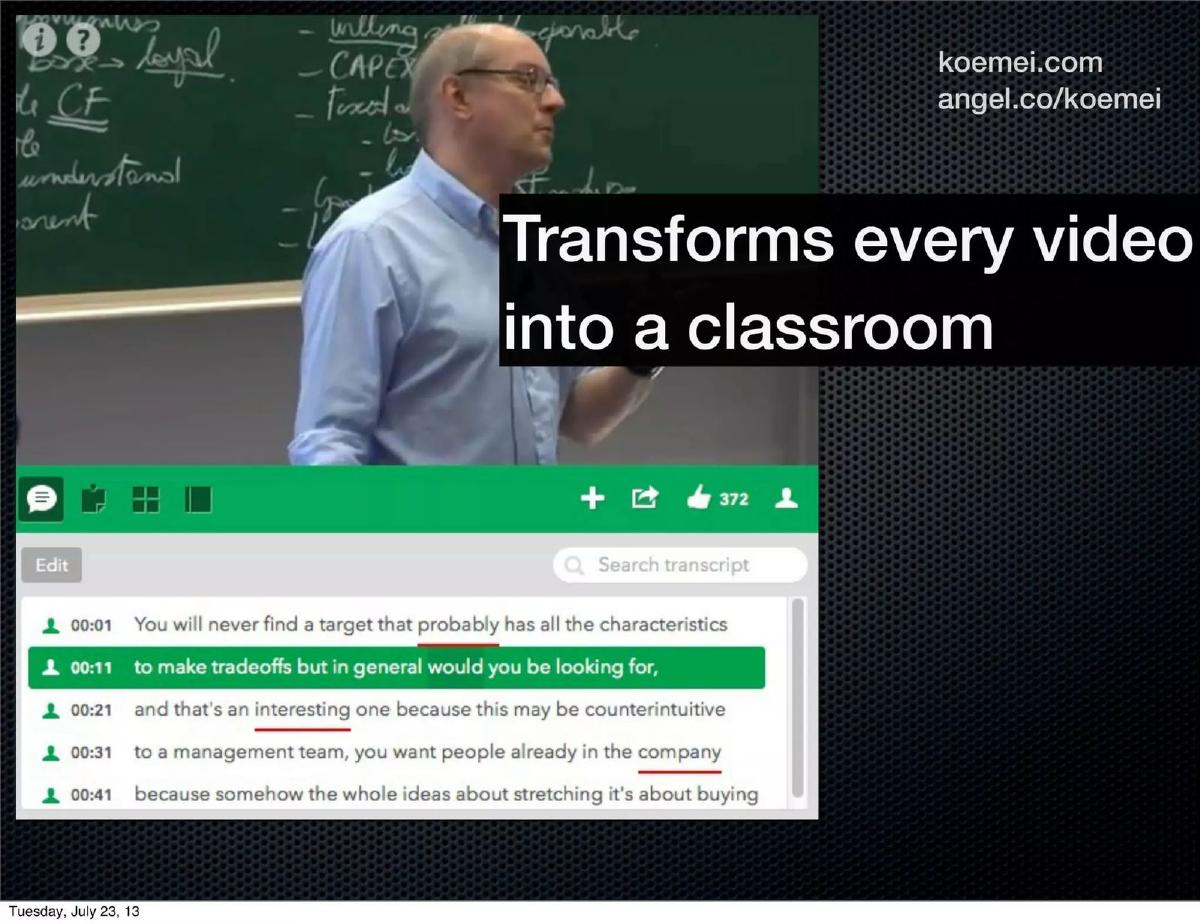
Slide 5: The Solution (Search) Here, we see the actual interface. The slide claims Koemei 'Transforms every video into a classroom.' The screenshot shows a video player with a synchronized transcript below it. Key terms are underlined, and a search bar allows users to find specific moments in the speech. This is the core of their 'video search-as-a-service' value proposition.
Slide 6: The Solution (Collaboration) Building on the search functionality, slide 6 introduces 'Synchronized Notes, Clippings, Connections.' The UI shows a social feed where users can leave time-stamped comments. This transforms video from a passive viewing experience into an active, social learning tool.
Slide 7: The Personal Learning Space The final product slide shows a dashboard view. It emphasizes the 'personal learning space to organize, create, collaborate.' By showing the 'My Notes' and 'Snippets' sections, Koemei demonstrates that they aren't just a search engine; they are a platform where users store their intellectual property.
Slides 8-9: Proof of Traction
Slide 8: Revenue and Completed Contracts This is arguably the most important slide in the deck. It reiterates the '$600k Revenues' figure and specifies that '3 Major contracts [are] completed.' The logos for IMD (a top business school), Université de Genève, and CUNY (City University of New York) prove that their product works at the enterprise level in the academic sector.
Slide 9: The Pipeline To show that the $600k wasn't a fluke, slide 9 presents a '$1M' pipeline of 'Pending projects.' The logos here are even more impressive, including Chevron, Kaltura, Berkeley, Udemy, and Columbia University. This slide is designed to show the investor that the 'train is leaving the station' and that the company has successfully moved beyond just the education niche into corporate training (Chevron) and video platform partnerships (Kaltura).
Slides 10-12: The Team and The Ask
Slide 10: The Team The team slide is strong on pedigree. CEO Temi Ola is a '3x entrepreneur' with experience at SGI. The technical side is covered by a VP of Engineering with an MSc and a VP of Technology with a PhD who was a 'Research Lead' at Idiap (a famous Swiss research institute specializing in speech recognition). The inclusion of Linda Drabik, an 'ex-Director BizDev [at] Kaltura,' is a strategic highlight, as it explains how the company secured the partnership mentioned on the previous slide.
Slide 11: Capital History Koemei highlights their capital efficiency here. They previously raised a '$525k seed round' but, more importantly, secured '$1.2M [in] government grants.' For an investor, this is highly attractive because it means $1.2M of R&D was conducted without diluting the equity pool.
Slide 12: The Current Ask The final slide is a progress bar. They are 'Now Raising $1M' and have already secured '$850k.' This creates a sense of scarcity. The slide provides direct contact information for the CEO, which is the standard call to action for a pitch deck.
What Works in the Koemei Deck
1. Extreme Clarity on Traction: Many startups hide their revenue or use 'vanity metrics' like registered users. Koemei puts their $600k revenue on the first slide and the eighth slide. This transparency builds immediate trust.
2. Strategic Use of Logos: The deck uses logos not just for 'social proof,' but to demonstrate market penetration. By showing CUNY and Berkeley, they prove they can sell to high-barrier-to-entry academic institutions. By showing Chevron, they prove their technology is horizontal and applicable to corporate environments.
3. Highlighting Non-Dilutive Funding: Mentioning $1.2M in government grants is a brilliant move. it suggests that the technology has been 'vetted' by scientific bodies and that the founders are savvy enough to find non-traditional ways to fund their growth.
What is Missing from the Koemei Deck
1. Competitive Analysis: There is no mention of other speech-to-text providers or video platforms like YouTube (which was already implementing basic captioning by 2013). Investors would naturally ask how Koemei stays ahead of Google or Nuance.
2. Business Model Details: While we see revenue, we don't see the 'service' part of 'search-as-a-service.' Is it a per-hour transcription fee? A per-user monthly fee? A flat enterprise license? The deck leaves the mechanics of their income to the imagination.
3. Use of Funds: The deck asks for $1M but doesn't explain what that money will do. Will it hire more sales staff to close the $1M pipeline? Will it go toward further R&D? A simple breakdown of 'Use of Proceeds' is a standard expectation that is absent here.
What a Founder Should Copy
1. The 'Billboard' First Slide: If you have impressive numbers, don't hide them. Copy Koemei's approach of putting your best three facts (Revenue, IP, Market Size) on slide one. It ensures that even if an investor only looks at one slide, they see your strongest arguments.
2. The Pipeline Slide: If you are in the B2B space, a 'Pending Projects' slide is a powerful way to show future growth without relying on speculative financial projections. It shows that you have an active sales funnel and that there is real market pull for your product.
3. Pedigree Alignment: Notice how the team slide doesn't just list titles; it lists specific past roles that are relevant to the current business. The VP of Sales coming from Kaltura (a potential partner/competitor) is a perfect example of 'Founder-Market Fit' that every deck should strive to highlight.
Final Thoughts
Koemei’s deck is a 'traction-first' document. It isn't particularly beautiful, and it lacks the deep financial modeling found in modern Series A decks. However, for a 2010-era startup raising a bridge or seed extension, its focus on 'money in the bank' and 'contracts on the table' was exactly what was needed to close the round. It serves as a reminder that a great product with real customers can overcome a lack of flashy design every time.
Frequently asked questions
- What was the primary market focus for Koemei in this deck?
- Koemei focused heavily on the education sector. Slide 3 identifies the '$200B Smart Education & Learning market' as their primary target, citing a 2012 State-of-the-Industry Report. Their product slides (5-7) specifically use classroom and lecture metaphors, and their traction slide (8) lists three major academic institutions as their primary revenue sources.
- How did Koemei demonstrate their technological advantage?
- Rather than explaining the 'how' of their algorithms, Koemei used slide 1 to state they have 'Patented technology' and slides 5 and 6 to show the 'what.' They showcased a searchable transcript interface where users could click on text to jump to video segments, alongside synchronized social commenting features.
- What was the status of their fundraising round at the time of this deck?
- According to slide 12, the company was in the final stages of a $1 million raise. They reported having already secured $850,000, leaving a $150,000 gap for new investors to fill. This 'momentum' strategy is often used to create a sense of urgency for remaining investors.
- Who were the key members of the Koemei leadership team?
- The team (slide 10) included Temi Ola (CEO, ex-PM at SGI), Sebastien Dupont (VP Eng, MSc CS), Linda Drabik (Sales, ex-Kaltura), and John Dines (VP Tech, PhD CS). This combination of enterprise product management, specialized academic research, and industry-specific sales experience from Kaltura was a strong signal to investors.
- Did the deck include information on how the company makes money?
- The deck is surprisingly light on business model specifics. While it lists $600k in revenue (slide 8) and a $1M pipeline (slide 9), it does not explicitly state their pricing tiers, SaaS margins, or whether these were one-off implementation contracts or recurring license fees. The catalogue listing describes them as 'search-as-a-service,' implying a subscription model.