CulturePulse is an AI-driven SaaS marketplace designed to help brands move beyond simple sentiment analysis by predicting audience behavior through 'psychologically accurate digital twins.' The deck highlights a strong academic foundation, citing over 30 years of research and a team led by PhDs from Oxford and Princeton. With a pricing model starting at $250 per month and a focus on enterprise marketing departments, the company aims to replace traditional, slow audience testing with instant, AI-simulated feedback. While the deck is visually polished and provides a clear roadmap, it lacks spec…
Key takeaways
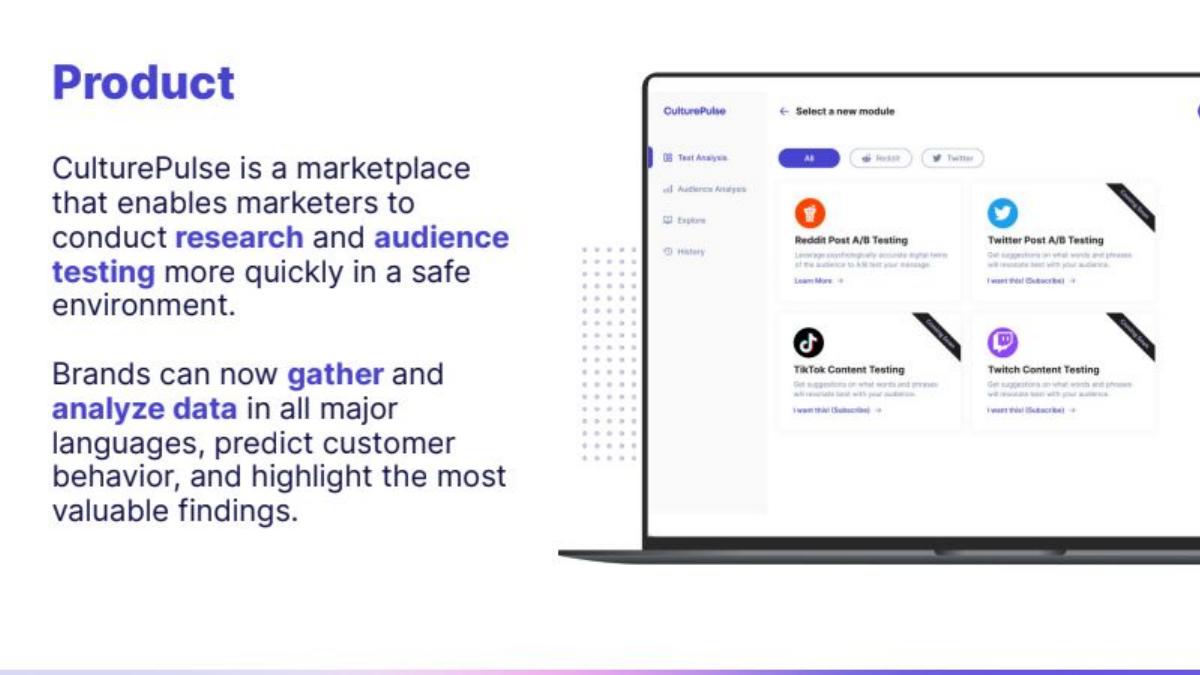
- The platform utilizes 'psychologically accurate digital twins' to A/B test messages on platforms like Reddit and Twitter (Slide 3).
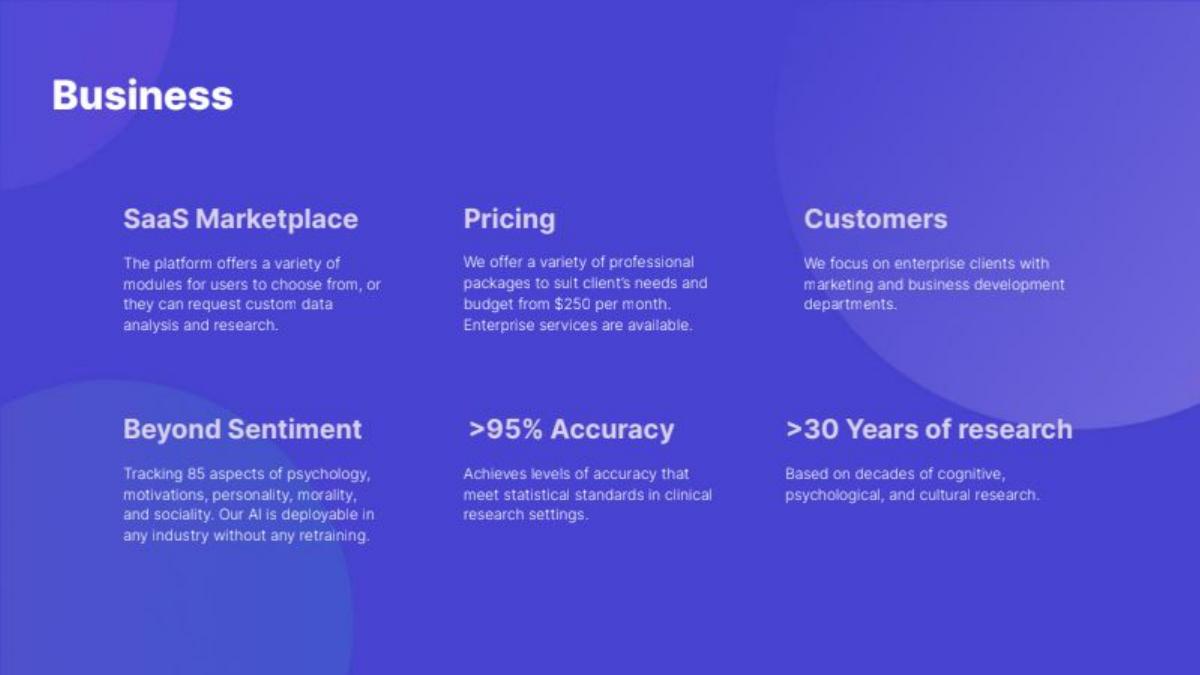
- The business model is a SaaS marketplace with entry-level pricing starting at $250 per month (Slide 4).
- The technology claims to track 85 aspects of psychology, including morality and sociality, with over 95% accuracy (Slide 4).
- The team is heavily academic, featuring a CEO with a D.Phil from Oxford and a CRO with two PhDs from Princeton (Slide 7).
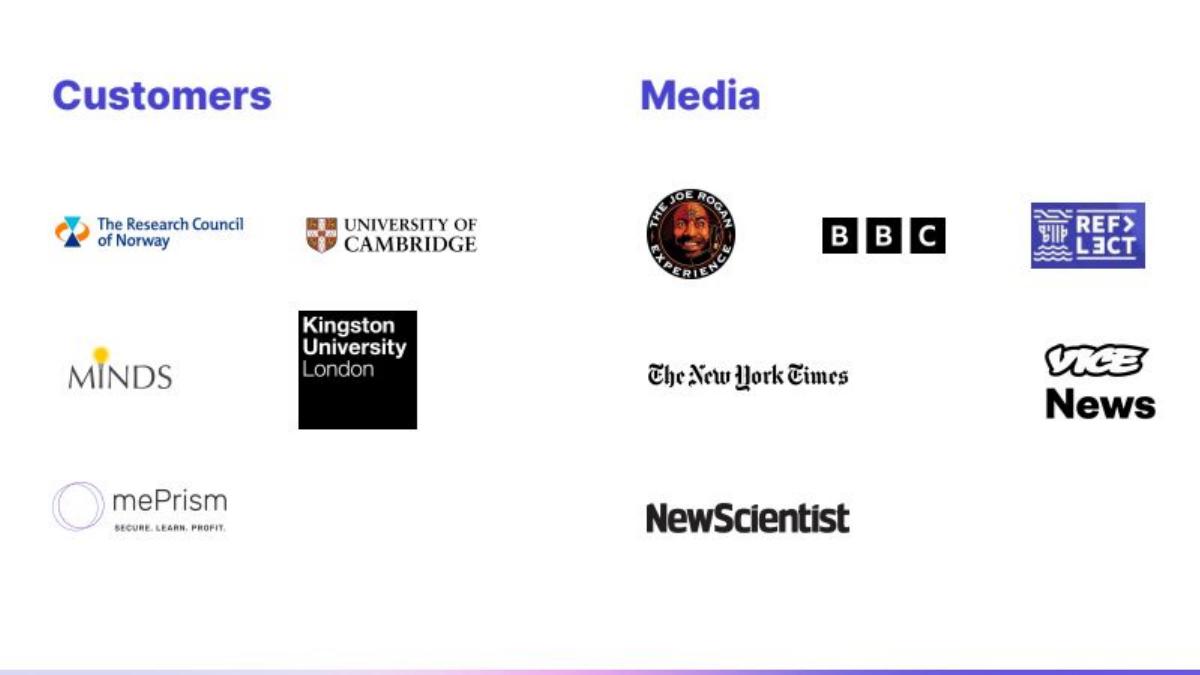
- The company has secured high-profile media mentions from the BBC, The New York Times, and NewScientist (Slide 5).
- The roadmap includes expanding into government contract support and influencer matching by Year 2 (Slide 6).
- The investment ask is for over 3 million EUR, with approximately 1 million EUR already committed at the time of the deck (Slide 8).
- The deck omits a traditional competitor slide and detailed unit economics like LTV or churn rates.
The Pitch Deck Teardown
Slide 1: Title Slide
The cover slide for CulturePulse is minimalist and focused on a single value proposition: "Make your message resonate." The visual elements include a dashboard mockup showing a 'Resonance Score' of 84 and sentiment analysis breakdowns (65% positive, 35% negative). It immediately establishes the product as a marketing tool for text analysis and A/B testing across social platforms like Reddit and Twitter.
Slide 2: Resonance Revolution
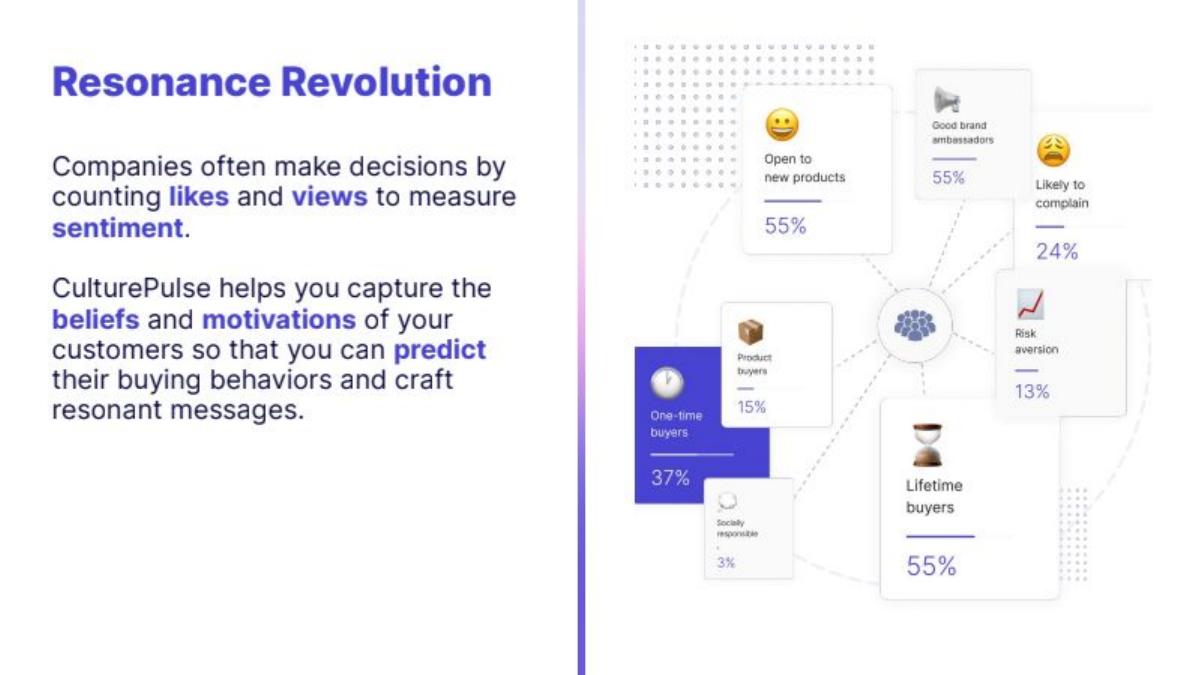
This slide serves as the 'Problem/Solution' hybrid. It argues that companies currently rely on 'likes' and 'views' to measure sentiment, which CulturePulse claims is insufficient. The solution offered is the ability to capture "beliefs and motivations" to predict buying behaviors. Icons on the right suggest the platform can segment audiences into categories like 'One-time buyers' (37%), 'Lifetime buyers' (55%), and 'Risk aversion' (13%).
Slide 3: Product Overview
Slide 3 defines CulturePulse as a "marketplace that enables marketers to conduct research and audience testing." It emphasizes speed and safety (testing in a simulated environment). The UI mockup shows modules for Reddit Post A/B Testing, while Twitter, TikTok, and Twitch modules are marked as 'Coming Soon.' A key technical claim here is the ability to analyze data in "all major languages."
Slide 4: Business Model and Claims
SaaS Marketplace: Users choose from modules or request custom research. · Pricing: Professional packages start from "$250 per month," with enterprise options available. · Customers: Focus on enterprise marketing and business development departments. · Beyond Sentiment: The AI tracks "85 aspects of psychology" including morality and sociality. · Accuracy: Claims ">95% Accuracy" that meets clinical research standards. · Research: States the tech is based on ">30 Years of research" in cognitive and cultural fields.
Slide 5: Social Proof (Customers and Media)
CulturePulse displays significant institutional credibility here. Listed customers include The Research Council of Norway, University of Cambridge, Kingston University London, Minds, and mePrism. The 'Media' section is equally robust, featuring logos for The Joe Rogan Experience, BBC, The New York Times, NewScientist, and Vice News. This slide aims to validate the academic and public interest in their psychological modeling.
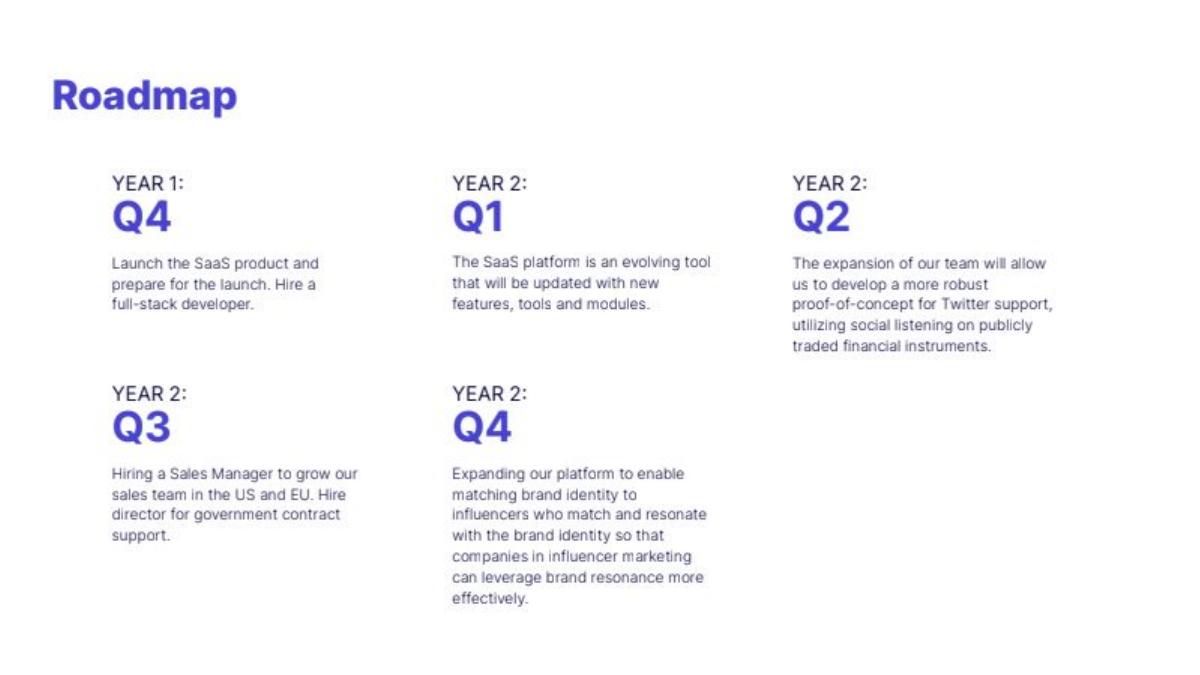
Slide 6: Roadmap
The roadmap spans from Year 1, Q4 to Year 2, Q4. Key milestones include:
Year 1 Q4: Launch SaaS product and hire a full-stack developer. · Year 2 Q2: Develop proof-of-concept for Twitter support using social listening. · Year 2 Q3: Hire a Sales Manager for US/EU and a director for government contract support. · Year 2 Q4: Expand into influencer matching based on brand resonance.
Slide 7: Core Team
The team slide is a major strength for a deep-tech/AI play. It features:
Justin E. Lane (CEO): D.Phil from University of Oxford. · F. LeRon Shults (CRO): Two PhDs from Princeton. · John Zdanowski (Co-CFO): Former CFO of Second Life and General Assembly. · Brian Swichkow (CMO): 7 years as a 'Growth Hacker.' · Maja Roknic (CPO): 7 years as a Product Manager.
The presence of two Co-CFOs and multiple PhDs suggests a heavy emphasis on both financial structure and scientific rigor.
Slide 8: The Ask
The investment opportunity is clearly stated: "We are looking to raise +Three million EUR." It also notes that "~1 [million] already committed." This creates a sense of momentum for potential investors joining the round.
Slide 9: Closing Quote
The deck ends with a quote from Nobel Prize winner Daniel Kahneman: "No one ever made a decision because of a number. They need a story." This reinforces the company's mission to move beyond raw data into psychological narrative and resonance.
Slide 10: BestPitchDeck.com Promo
This is a standard library slide and not part of the company's original pitch content.
What CulturePulse Does Well
The CulturePulse deck excels at establishing authority . In the crowded AI space, many startups struggle to prove their algorithms aren't just wrappers for existing LLMs. By citing 30 years of research and showcasing a team with PhDs from Oxford and Princeton, CulturePulse positions itself as a deep-tech company with proprietary intellectual property. The inclusion of high-level academic institutions like Cambridge as customers further solidifies this 'scientific' brand identity.
The visual design is clean and consistent, using a purple-to-blue gradient that feels modern but professional. The product mockups are effective because they don't just show a dashboard; they show the output (e.g., 'Resonance Scores' and 'Psychological Markers'), which helps the investor visualize the end-user's experience.
What is Missing from the Deck
Despite the strong academic backing, the deck is light on commercial traction . While it mentions a $250/month starting price, it does not disclose current revenue, number of active users, or growth rates. For a seed round asking for 3 million EUR, investors typically expect to see some evidence of product-market fit beyond pilot programs with universities.
The deck also lacks a Competitor Slide . The AI-driven sentiment and audience analysis market is highly competitive, with players ranging from legacy social listening tools (Brandwatch, Sprout Social) to newer AI startups. Failing to acknowledge the landscape can make a team look naive about market dynamics. Finally, there is no Market Size (TAM/SAM/SOM) slide, leaving the potential scale of the business to the investor's imagination.
Founder Takeaways: What to Copy
1. Lead with Credibility: If your team has elite academic or professional backgrounds, make that a focal point. CulturePulse uses their PhDs to justify their claim of '95% accuracy,' which is a bold statement that needs the weight of Oxford and Princeton behind it.
2. Specific Pricing: Many early-stage decks hide their pricing. By stating a starting point of $250/month, CulturePulse makes it clear they are a volume-accessible SaaS, not just a high-touch consultancy. This helps investors understand the sales velocity required.
3. Use a 'Coming Soon' Strategy: On Slide 3, CulturePulse shows logos for TikTok and Twitch with 'Coming Soon' banners. This is a smart way to show future platform extensibility without over-promising what the product can do today.
4. The 'Momentum' Ask: Stating that 1 million EUR is already committed (Slide 8) is a classic fundraising tactic. It reduces the perceived risk for the next investor and suggests that the 'train is leaving the station.'
Frequently asked questions
- What is the core technology behind CulturePulse?
- CulturePulse uses AI to create 'psychologically realistic digital twins' of specific audiences. According to the deck, this technology is based on 30 years of cognitive and cultural research. It allows marketers to simulate how an audience will react to a message before it is actually posted, tracking 85 different psychological markers including personality and morality.
- How does CulturePulse make money?
- The company operates as a SaaS marketplace. Slide 4 indicates they offer various professional packages starting at $250 per month, with custom data analysis and enterprise-level services also available. They target marketing and business development departments within enterprise-level clients.
- Who are the founders and what is their background?
- The leadership team is highly academic. CEO Justin E. Lane holds a D.Phil from the University of Oxford, and CRO F. LeRon Shults holds two PhDs from Princeton. The team also includes experienced financial leadership, such as Co-CFO John Zdanowski, who was formerly the CFO at Second Life and General Assembly.
- What is the current funding status of CulturePulse?
- As of the 2023 seed round represented in the deck, CulturePulse was seeking to raise over 3 million EUR. The deck notes that approximately 1 million EUR had already been committed. Catalogue data confirms they successfully raised $1M from investors like Zero Gravity Capital.
- What is missing from the CulturePulse pitch deck?
- The deck lacks a competitive landscape analysis, which is standard for most seed-stage pitches. It also omits detailed financial traction metrics such as Monthly Recurring Revenue (MRR), Customer Acquisition Cost (CAC), or specific growth percentages. Additionally, there is no mention of the total addressable market (TAM) size.