The cultureRush pitch deck, intended for a first seed round, centers on the concept of a social network designed to harness the power of specific cultural communities. The narrative is heavily driven by the personal immigration story of founder Kenny Pang, positioning the platform as a digital evolution of the support systems found in immigrant churches. However, the deck suffers from significant omissions: there are no screenshots of the 'prototype website' mentioned on slide 6, no clear definition of the target user beyond 'minorities,' and no specific funding amount requested for the curre…
Key takeaways
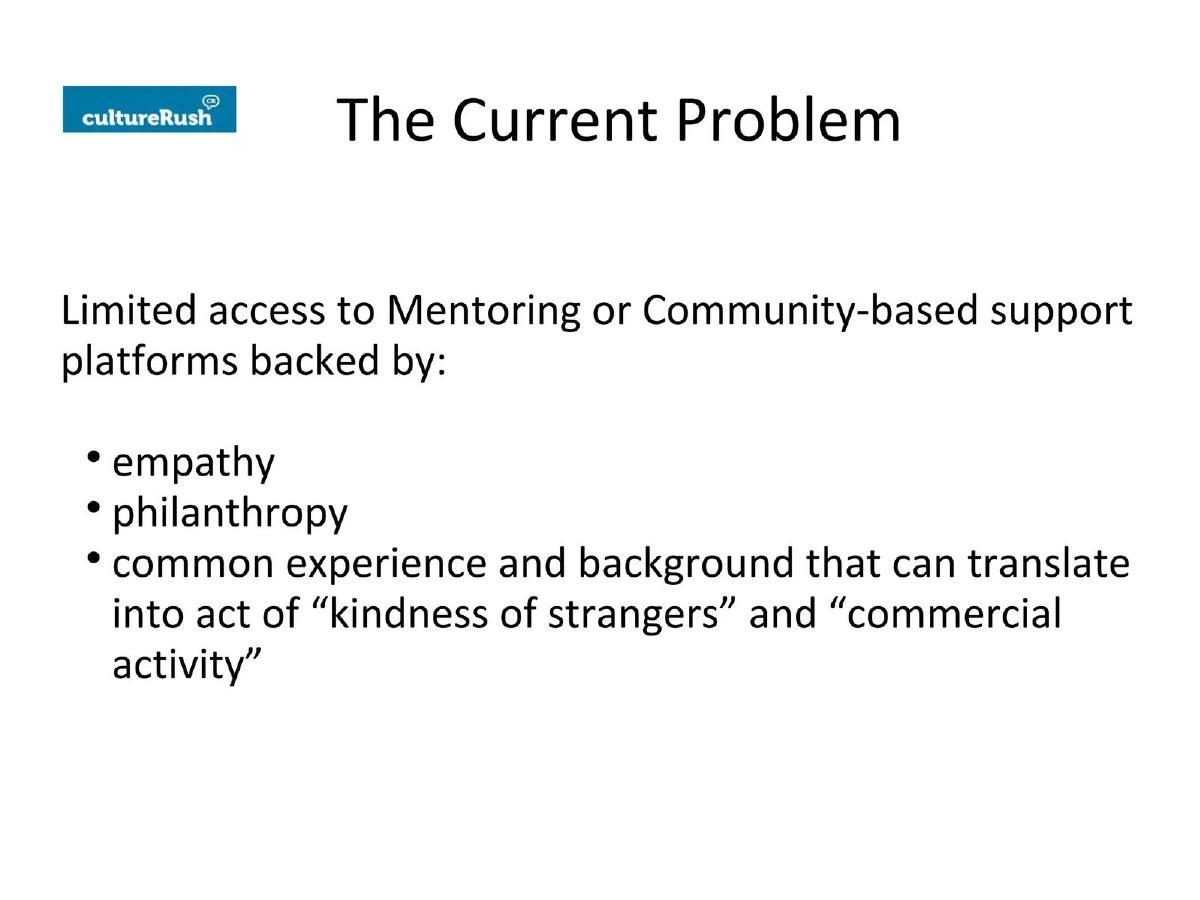
- The company frames its mission as providing community-based support backed by empathy and philanthropy (Slide 3).
- Founder Kenny Pang's personal history as a South Korean immigrant in 1981 serves as the primary 'Why' for the company (Slide 2).
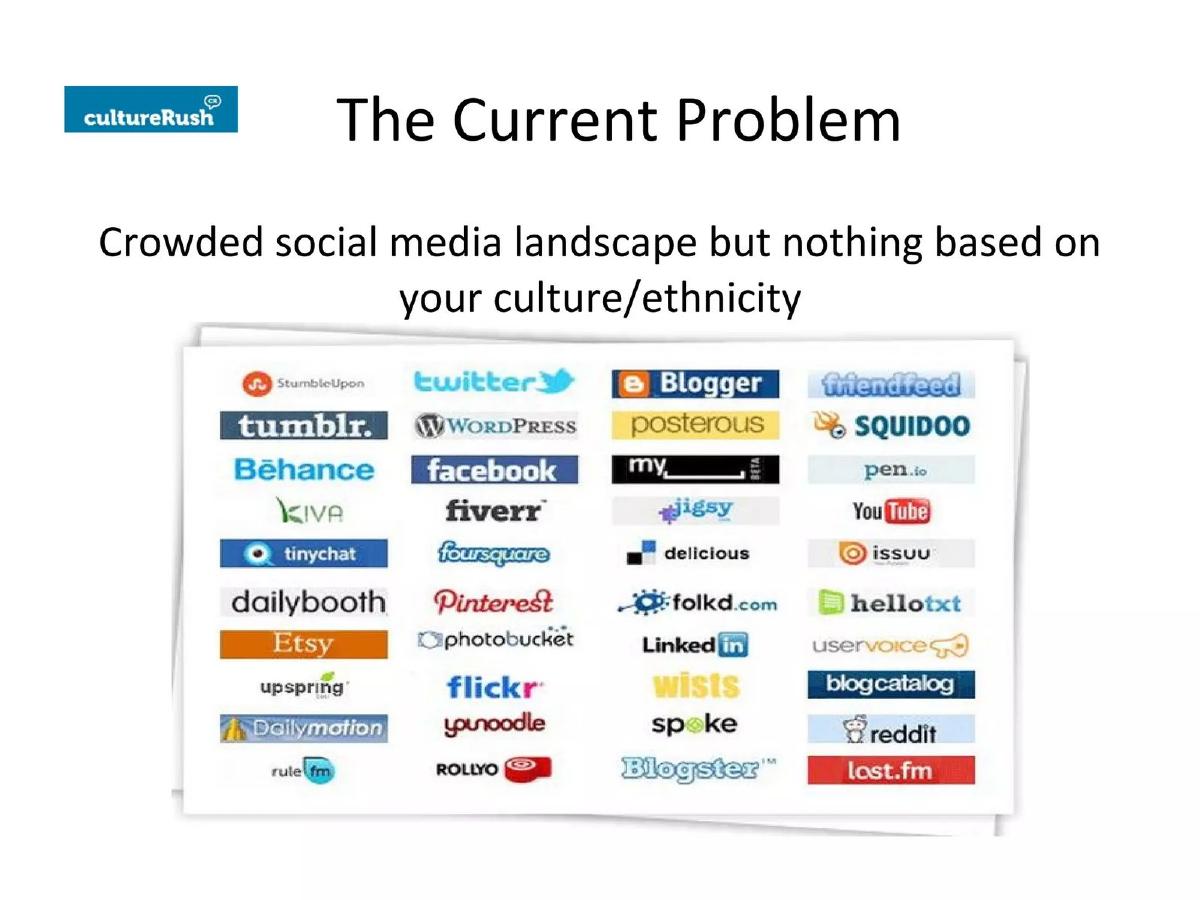
- The deck identifies a 'bifurcation' in social networking, citing legacy platforms like MySpace and Google+ as the current landscape (Slide 4).
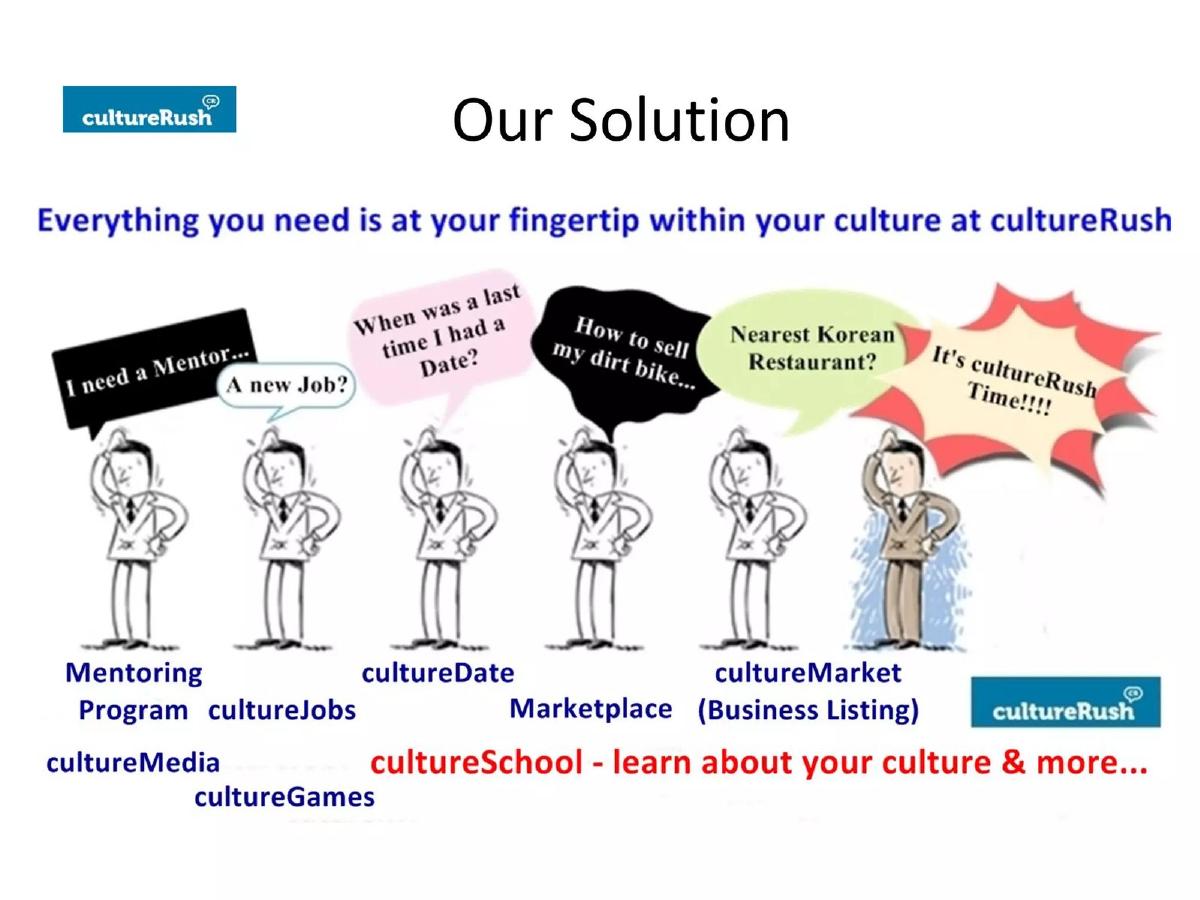
- The revenue model proposes four streams: Advertising, Lead Generation, Affiliate Programs, and 'Pay to play' features like cultureDate and cultureJobs (Slide 6).
- The startup has already raised 37.5K and built a prototype website, though no visuals of the site are included (Slide 6).
- Market strategy lists massive corporations like Microsoft, Sony, and Nintendo as 'Strategic Partners' without defining the nature of these partnerships (Slide 5).
- The deck lacks a specific 'Ask' slide detailing how much capital is being raised in this 1st seed round or how it will be allocated.
- There is no mention of unit economics, user acquisition costs, or projected growth metrics beyond a general demographic shift (Slide 4).
Executive Summary: A Vision for Cultural Connectivity
The cultureRush pitch deck is a conceptual presentation for a social networking platform that seeks to digitize the support structures of immigrant and cultural communities. While the deck is strong on 'founder-market fit' through personal narrative, it is light on technical execution and market validation. The presentation relies heavily on text-dense slides and lacks the visual data or product demonstrations typically expected in a seed-stage pitch.
Slide 1: Title Slide
The deck opens with the cultureRush logo—a simple blue wordmark with a 'CR' speech bubble icon. The tagline is stated as "Connect, Share and Network within Your Culture," followed by the parenthetical sub-header "(A Place Where You can Harness the Power of Your Culture)." This slide establishes the company as a niche social network, though it does not immediately define which cultures or demographics it targets first.
Slide 2: How Did We Get Here? (Background)
This slide serves as the 'Team' and 'Origin' slide combined. It provides significant biographical detail on the two founders, Kenny Pang and Robert Reed. Kenny Pang is identified as the primary founder, with a narrative focused on his 1981 immigration from South Korea. The slide credits a Korean-American church for his family's successful relocation, which serves as the blueprint for the cultureRush platform. Robert Reed is positioned as the business lead, with fourteen years of experience in banking and executive recruiting. The slide notes they met in late 2010. While the backgrounds are impressive, the slide is very text-heavy, which can be difficult to digest during a live presentation.
Slide 3: The Current Problem
The problem is defined as a lack of mentorship and community support platforms that prioritize empathy and philanthropy. The slide uses bullet points to argue that common experiences should translate into both "acts of kindness" and "commercial activity." This is a critical slide because it hints at the dual nature of the platform: a social good initiative that also functions as a marketplace. However, it does not provide data to prove that this 'limited access' is a felt pain point for a specific number of people.
Slide 4: Why cultureRush Now?
This slide attempts to capture the 'Market Timing.' It mentions a "critical evolutionary phase" in social networking, listing competitors like Facebook, MySpace, LinkedIn, Twitter, and Google+. The inclusion of MySpace and Google+ suggests the deck may be several years old. The slide makes a bold claim that cultureRush is the "only social media site that can evoke kindness, generosity, compassion and productivity." It also cites a demographic shift where "minorities are becoming majority," though it does not provide a specific source for this trend or explain how cultureRush will capture this shift better than existing platforms.
Slide 5: Market Strategy
Slide 5 is perhaps the most controversial in the deck. Under "Strategic Partners," it lists a massive array of multi-billion dollar companies including eHarmony, Match.com, Zynga, King, Yelp, LinkedIn, Microsoft/Xbox, Sony/PS4, Nintendo, and YouTube . There is no explanation of whether these are actual partners, desired partners, or companies they intend to integrate with. In a fundraising context, listing such high-profile names without context can be seen as a 'vanity' list. The marketing strategy section is more grounded, focusing on local culture media outlets, press releases, and standard social media reach.
Slide 6: Business Model / Milestones
This slide provides the most concrete business data. The revenue model is diversified across advertising, lead generation, affiliates, and premium features (cultureDate, cultureJobs). Under Milestones, the company discloses it has "37.5K raised" and a "Prototype website built." The omission of the prototype's appearance is a missed opportunity to show investors what the user experience actually looks like. There are no financial projections or user growth targets listed here.
Slide 7: Contact Information
The final slide returns to the logo and tagline, providing direct phone numbers and email addresses for both Kenny Pang and Robert Reed. It also lists the URL www.cultureRush.com. This is a standard closing slide, though it lacks a final 'call to action' or a summary of the investment opportunity.
What cultureRush Does Well
The deck excels at establishing a strong emotional hook . By grounding the company's mission in the personal immigration story of the founder, it creates a compelling 'Why' that is difficult to dismiss. Investors often look for founders who have a deep, personal connection to the problem they are solving, and Slide 2 accomplishes this effectively. Additionally, the revenue model on Slide 6 shows that the founders are thinking beyond simple ad-based monetization, looking at high-value verticals like dating and recruitment.
What Is Missing from the cultureRush Deck
Product Visuals: Despite mentioning a built prototype on Slide 6, there are no screenshots or mockups. Investors need to see the UI/UX to understand how 'culture' is actually integrated into the networking experience. · The Ask: The deck mentions a 1st seed round in the title but never specifies how much money they are looking to raise or what the valuation expectations are. · Market Size (TAM/SAM/SOM): While Slide 4 mentions a demographic shift, it does not quantify the market. How many people identify with these cultural niches? What is the total addressable spend in these communities? · Competitive Analysis: The deck mentions other social networks as part of the 'evolutionary phase' but does not provide a feature-by-feature comparison or a positioning map to show where cultureRush sits relative to Facebook or LinkedIn. · Use of Funds: There is no breakdown of how the seed capital will be spent (e.g., 40% engineering, 30% marketing, etc.).
Founder Takeaways: Lessons to Apply
Avoid 'Logo Soup' without context: Listing major corporations as strategic partners (Slide 5) without defining the relationship is a common mistake. If you don't have a signed MOU or a clear API integration, it is better to list these as 'Target Channels' or 'Integration Opportunities' to remain credible. Show, don't just tell: If you have a prototype, it should be the star of the deck. A single high-fidelity screenshot is worth more than three slides of text describing 'kindness' and 'empathy.' Specifics over Generalities: The deck uses broad terms like 'minorities' and 'culture.' A more successful approach would be to identify a specific 'wedge'—such as the Korean-American community mentioned in the background—and explain how the platform will dominate that niche before expanding. Finally, always include a clear 'Ask' slide so investors know exactly what you are looking for and what milestones that capital will help you achieve.
Frequently asked questions
- What is the core problem cultureRush aims to solve?
- According to slide 3, the problem is 'limited access to Mentoring or Community-based support platforms' that are rooted in empathy, philanthropy, and common cultural backgrounds. The founders believe current social media is too cluttered and fails to evoke kindness or productivity, creating a gap for a platform that facilitates the 'kindness of strangers' within specific cultural groups.
- Who are the founders and what is their background?
- Slide 2 introduces two founders: Kenny Pang and Robert Reed. Pang is the visionary founder whose interest in community support stems from his family's immigration from South Korea. Reed brings a background in banking, capital markets, and executive recruiting, having spent fourteen years in financial services. They met in late 2010 to discuss business opportunities and inefficiencies in human capital markets.
- How does cultureRush plan to make money?
- Slide 6 outlines a multi-pronged revenue model. This includes traditional digital methods like advertising and lead generation, as well as an affiliate program. Most notably, it suggests 'Pay to play' vertical services, specifically naming 'cultureDate' and 'cultureJobs.' This indicates the platform intends to be a multi-service hub rather than a single-purpose social feed.
- What is the current stage of the company based on the deck?
- The company is in its '1st seed round' according to the source listing. Slide 6 notes that they have already raised 37.5K and have completed a prototype website. However, the deck does not provide data on active users, traffic, or engagement, suggesting the company is at the pre-revenue, early-prototype stage.
- What are the biggest red flags in this pitch deck?
- The primary red flags are the lack of product visuals and the unrealistic 'Strategic Partners' list on slide 5. Listing global giants like Microsoft, Sony, and eHarmony as partners without any evidence of existing agreements or a clear integration plan is often viewed as a credibility risk. Additionally, the absence of a clear financial ask or use-of-funds breakdown makes it difficult for investors to evaluate the deal.