CulturePulse is an AI-driven audience testing platform that moves beyond traditional sentiment analysis by tracking 85 aspects of psychology, including morality and sociality. The 9-slide deck highlights a marketplace model where marketers can A/B test messages against 'digital twins' of specific audiences on platforms like Reddit and Twitter. With a core team boasting multiple PhDs from Oxford and Princeton, the company emphasizes a research-backed accuracy rate of over 95%. While the deck successfully establishes credibility through academic pedigree and high-profile media mentions, it lack…
Key takeaways
- The platform claims to achieve over 95% accuracy in predicting customer behavior based on 30 years of cognitive and cultural research (Slide 4).
- CulturePulse functions as a SaaS marketplace where users can select modules for specific platforms like Reddit, Twitter, TikTok, and Twitch (Slide 3).
- The technology tracks 85 distinct psychological aspects, including motivations, personality, and morality, to go 'beyond sentiment' (Slide 4).
- Pricing starts at $250 per month for professional packages, with a primary focus on enterprise-level clients (Slide 4).
- The core team features significant academic depth, including a CEO with a D.Phil from Oxford and a CRO with two PhDs from Princeton (Slide 7).
- The company has secured notable media attention, citing logos from The New York Times, BBC, and The Joe Rogan Experience (Slide 5).
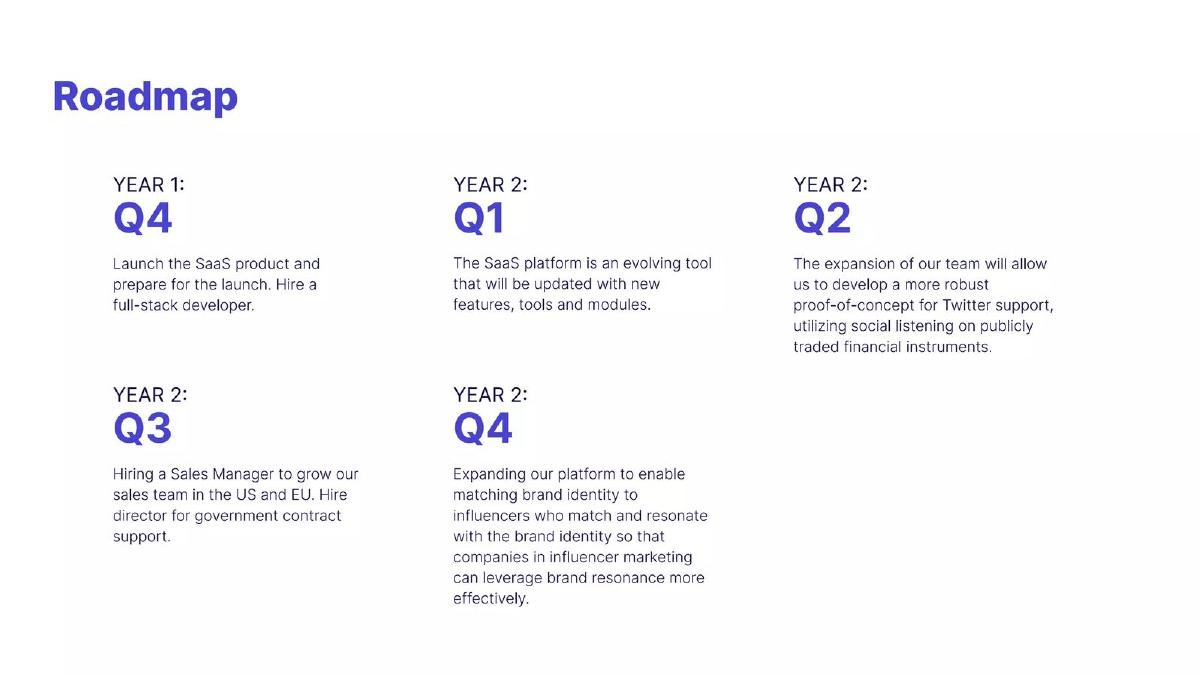
- A structured roadmap outlines plans to hire a Sales Manager for US and EU growth and a director for government contract support in Year 2 (Slide 6).
- The investment ask is for +3 million EUR, noting that ~1 million EUR is already committed (Slide 8).
Slide-by-Slide Analysis
Slide 1: Title Slide
The deck opens with the brand name CulturePulse and the tagline "Make your message resonate." The visual features a product mockup showing a 'Reddit Post A/B Testing' interface. Key UI elements visible include a 'Resonance Score' of 84, sentiment analysis percentages (65% Positive, 35% Negative), and a 'Cost Saving Calculation' of $2000. This slide immediately establishes the product as a marketing tool focused on message optimization and financial efficiency.
Slide 2: Resonance Revolution
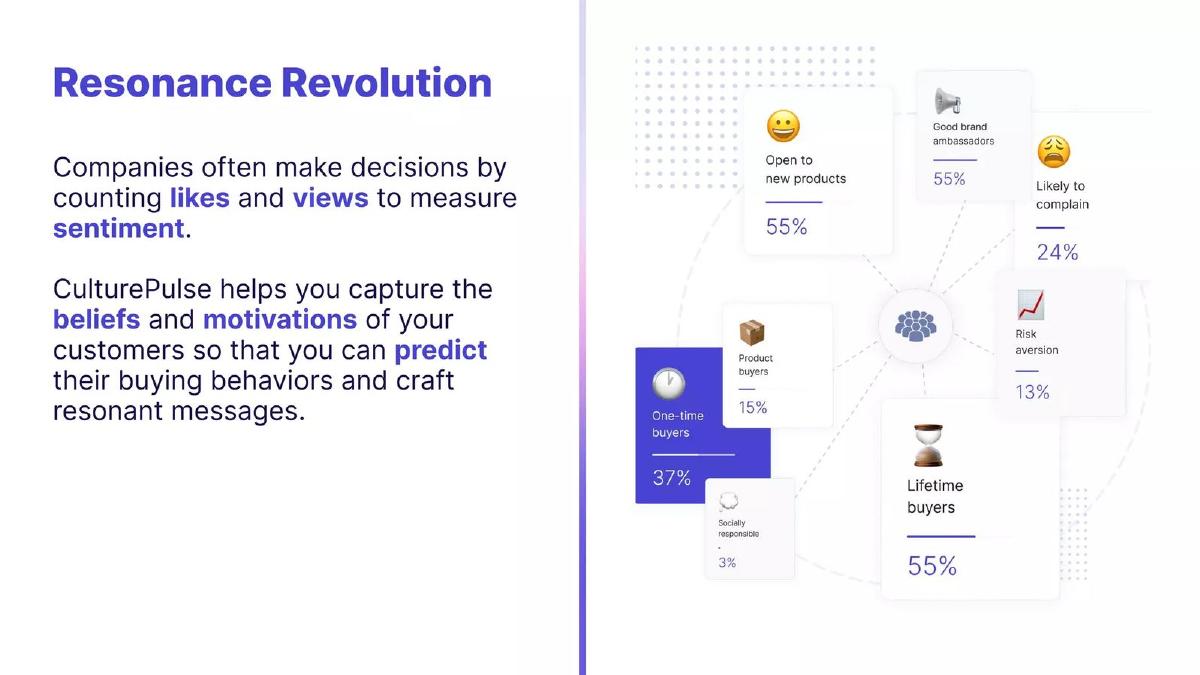
This slide defines the problem and the solution. It states that companies currently make decisions by counting "likes and views" to measure sentiment, which is framed as an outdated or incomplete method. CulturePulse's value proposition is to capture "beliefs and motivations" to predict buying behaviors. The right side of the slide features a graphic categorizing audience segments such as 'Lifetime buyers' (55%), 'One-time buyers' (37%), and 'Socially responsible' (3%), suggesting the tool provides deep demographic and psychographic segmentation.
Slide 3: Product
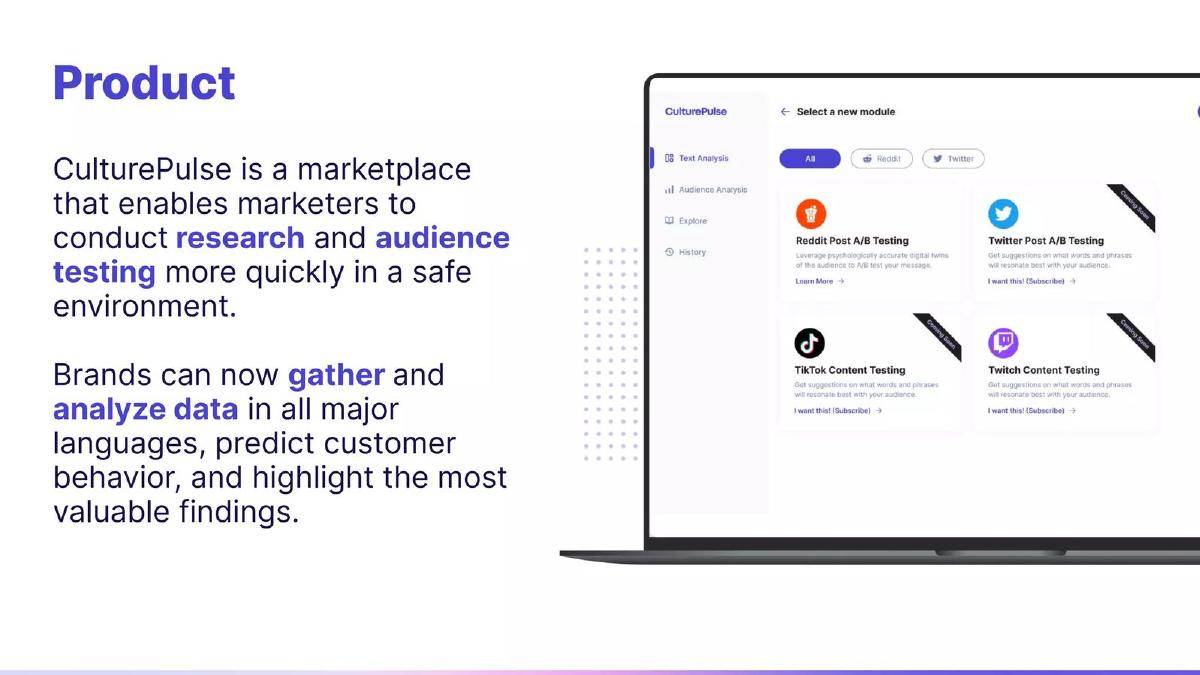
Slide 3 characterizes CulturePulse as a "marketplace" for research and audience testing. It emphasizes a "safe environment" for testing, likely referring to the use of digital twins rather than live testing on real audiences. The mockup shows modules for Reddit, Twitter, TikTok, and Twitch, with the latter three marked as "Coming Soon." The text claims the ability to analyze data in "all major languages" and highlight the most valuable findings for brands.
Slide 4: Business
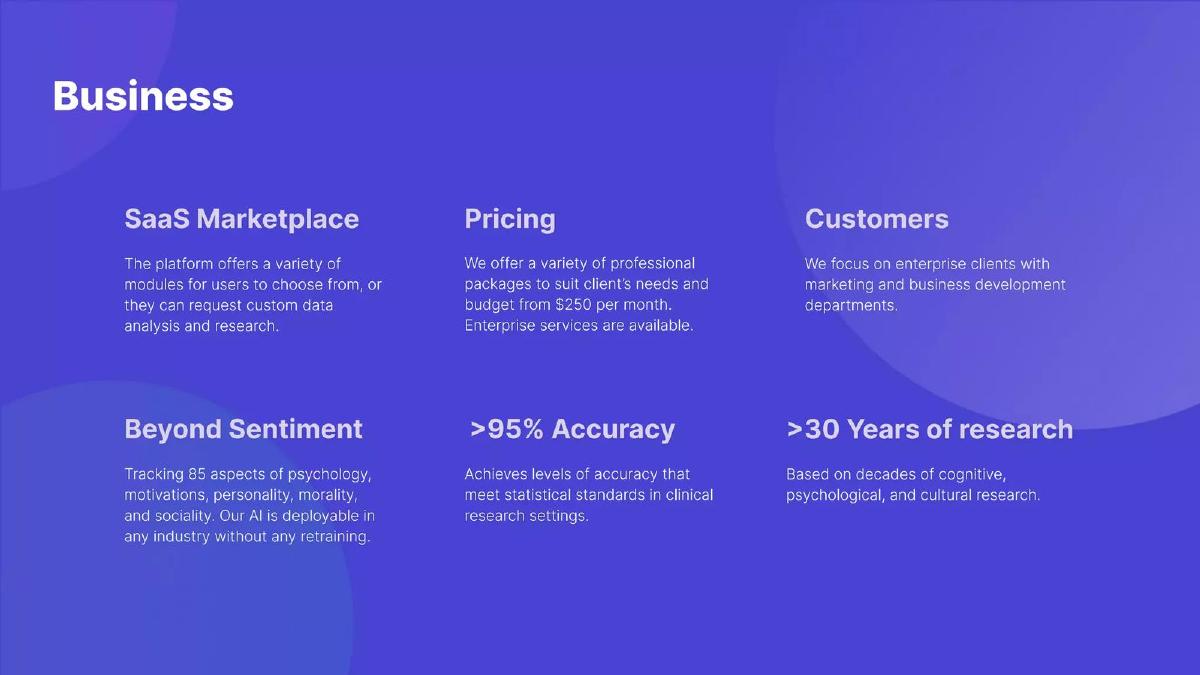
This slide serves as a multi-purpose summary of the business model and technical advantages. It lists three business points: a SaaS Marketplace model, pricing starting from $250 per month , and a focus on enterprise clients . It also lists three technical pillars: tracking 85 aspects of psychology , achieving >95% Accuracy , and being based on >30 Years of research . This slide attempts to bridge the gap between academic rigor and commercial viability.
Slide 5: Customers and Media
The slide displays logos for customers including The Research Council of Norway , University of Cambridge , Kingston University London , MINDS , and mePrism . The 'Media' section includes high-profile logos such as The New York Times , BBC , NewsScientist , Vice News , and The Joe Rogan Experience . This slide is intended to build social proof and demonstrate that the technology has been vetted by both academic institutions and mainstream media.
Slide 6: Roadmap
The roadmap covers a two-year period. Year 1 Q4 focuses on launching the SaaS product and hiring a full-stack developer. Year 2 milestones include updating the platform with new modules (Q1), developing a proof-of-concept for Twitter support utilizing social listening for financial instruments (Q2), hiring a Sales Manager and a director for government contracts (Q3), and expanding into influencer marketing matching (Q4). The inclusion of government contract support suggests a secondary revenue stream beyond enterprise marketing.
Slide 7: Core Team
The team slide emphasizes academic credentials. Justin E. Lane (CEO) holds a D.Phil from Oxford, and F. LeRon Shults (CRO) holds two PhDs from Princeton. John Zdanowski (Co-CFO) brings operational experience from Second Life and General Assembly. The team is rounded out by Sam Kaplan (Co-CFO) , Brian Swichkow (CMO) , Dino Aganovic (Lead Designer) , and Maja Roknic (CPO) . The heavy concentration of PhDs and C-suite titles for a seed-stage company is notable.
Slide 8: Investment Opportunity
The ask is clearly stated: "WE ARE LOOKING TO RAISE +Three million EUR." It also notes that "~1 already committed," which provides a sense of momentum to potential investors. There is no mention of valuation or specific equity terms on this slide.
Slide 9: Closing Quote
The deck ends with a quote from Daniel Kahneman (2002 Nobel Prize Winner in Economics): "No one ever made a decision because of a number. They need a story." This reinforces the company's focus on psychology and narrative resonance, while also providing a final nod to their academic foundations.
What CulturePulse Does Well
The deck excels at establishing authority and credibility . By highlighting the academic backgrounds of the founders (Oxford and Princeton PhDs) and citing 30 years of research, the company positions itself as a deep-tech play rather than a simple wrapper for existing AI models. The use of the term "digital twins" for audience testing is a strong conceptual hook that explains a complex process in a way that enterprise marketers can easily grasp.
The visual clarity of the product mockups is also a strength. By showing the specific UI for Reddit A/B testing, the founders move the conversation from abstract psychological theory to a concrete tool that a marketing department can use. The inclusion of a "Cost Saving Calculation" directly in the UI mockup (Slide 1) addresses the bottom-line concerns of enterprise buyers immediately.
What is Missing from the CulturePulse Deck
The most significant omission is a Market Size (TAM/SAM/SOM) slide. While they mention a focus on enterprise clients, they do not quantify the total addressable market for psychological audience testing or the broader martech space they inhabit. Investors typically want to see the scale of the opportunity to justify a 3 million EUR seed round.
There is also a lack of Unit Economics and Traction Data . While Slide 5 lists customers, it does not specify if these are paying enterprise clients, pilot programs, or academic partners. There are no metrics regarding churn, customer acquisition cost (CAC), or the growth rate of the user base. For a seed round of this size, providing even preliminary data on pilot results or early revenue would strengthen the case.
Finally, the Competitor Analysis is entirely absent. The deck claims to go "Beyond Sentiment," but it does not name or compare itself to existing sentiment analysis tools or traditional market research firms. Explaining why a brand would choose CulturePulse over a standard social listening tool like Brandwatch or Sprout Social is a missed opportunity to define their unique market position.
Founder Takeaways: What to Copy
Lead with Credibility: If your team has significant academic or industry pedigree, make it central to your narrative. CulturePulse uses their PhDs to justify their "95% accuracy" claim, which might otherwise seem hyperbolic. · Show the Product Early: Don't wait until the end of the deck to show the interface. By putting a mockup on the title slide, CulturePulse grounds the entire presentation in a tangible product. · Use Social Proof Strategically: Mixing academic logos (Cambridge) with media logos (NYT) and popular culture (Joe Rogan) shows that the technology has broad appeal and has been stress-tested in different environments. · Clear Investment Ask: State the amount you are raising and, if applicable, how much is already committed. This transparency helps qualify investors and builds urgency.
Frequently asked questions
- What is the core problem CulturePulse aims to solve?
- According to Slide 2, companies often rely on superficial metrics like 'likes' and 'views' to measure sentiment. CulturePulse argues these are insufficient for predicting buying behavior. Their solution captures deeper beliefs and motivations, allowing marketers to craft resonant messages by understanding the psychological drivers of their audience rather than just counting engagement actions.
- How does the product actually function for a marketer?
- Slide 3 describes the product as a marketplace for research and audience testing. Marketers use 'digital twins' of audiences to A/B test text analysis. The interface shown suggests users can select specific modules for different social platforms to get suggestions on which words and phrases will resonate best before actually publishing the content.
- What is the significance of the '85 aspects of psychology' mentioned?
- Slide 4 highlights that the AI tracks 85 aspects including morality, sociality, and personality. This is a differentiator from standard sentiment analysis (positive/negative). By using these variables, CulturePulse claims their AI can be deployed in any industry without retraining, meeting statistical standards used in clinical research settings.
- Who are the key members of the leadership team?
- The team is led by CEO Justin E. Lane (Oxford D.Phil) and CRO F. LeRon Shults (dual Princeton PhDs). They are supported by two Co-CFOs, John Zdanowski (former CFO at Second Life and General Assembly) and Sam Kaplan. The team also includes a CMO with growth hacking experience and a CPO with seven years of product management (Slide 7).
- What are the primary omissions in this pitch deck?
- The deck lacks a clear 'Market Size' (TAM/SAM/SOM) slide, which is standard for seed rounds. It also omits specific current traction metrics such as active user counts, monthly recurring revenue (MRR), or case study results from the customers listed on Slide 5. Furthermore, there is no detailed breakdown of how the 3 million EUR investment will be allocated beyond general hiring goals.