Freshsound’s deck is a study in brevity, using only seven slides to articulate a clear value proposition: transforming the archaic, manual process of commercial music licensing into a self-service marketplace. By highlighting a massive reduction in friction—moving from a 12-month manual cycle to a 30-second digital transaction—the company addresses a specific, high-pain problem for ad agencies and content creators. The deck relies on strong social proof from a 'stealth-test' phase involving 1,500 artists and major agencies like McCann. While it lacks a formal 'Ask' slide or detailed financial…
Key takeaways
- The deck claims to reduce a 12-month manual licensing process to less than 30 seconds (Slide 2).
- Freshsound operates on a marketplace model with a reported revenue take-rate of 20-35% (Slide 2).
- The platform targets a $5-6 billion SAM within a $40-50 billion TAM (Slide 2).
- Early traction is demonstrated by a 'stealth-test' involving over 1,500 songwriters and artists (Slide 2).
- The problem slide identifies five core pain points: time, lack of transparency, manual admin, legal complexity, and overhead costs (Slide 3).
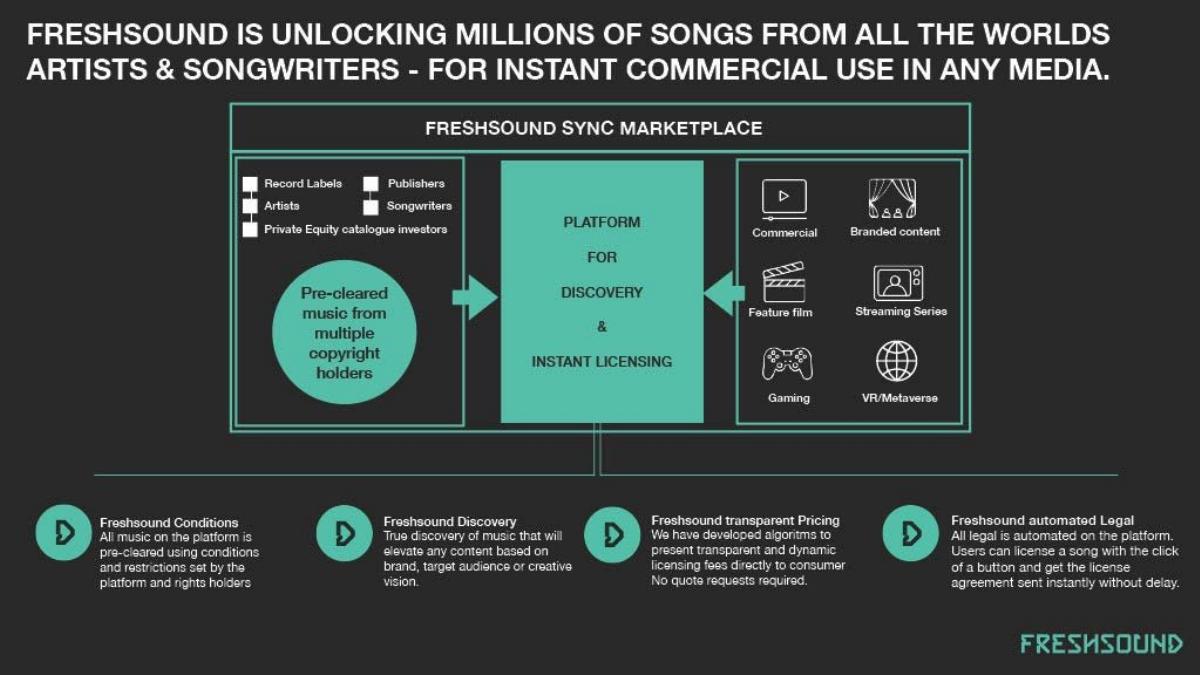
- The solution utilizes automated legal agreements and dynamic licensing algorithms to remove the need for quote requests (Slide 4).
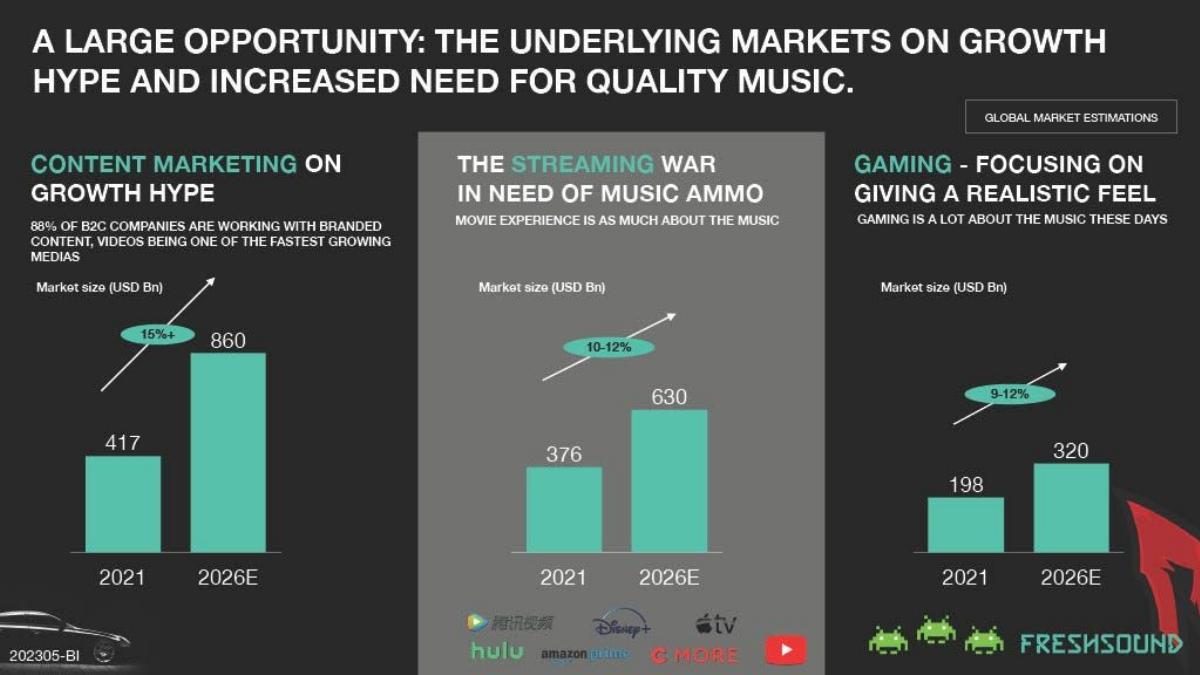
- Market growth is quantified across three sectors: Content Marketing ($860Bn by 2026), Streaming ($630Bn by 2026), and Gaming ($320Bn by 2026) (Slide 6).
- The team slide leverages heavy-hitting industry logos including Sony Music, Warner Music Group, EMI, and Spotify (Slide 7).
Executive Summary: The 30-Second Licensing Revolution
Freshsound’s pitch deck is remarkably lean at just seven slides, yet it managed to secure a $2.2M Seed round in a challenging 2024 venture environment. The core of the pitch is a classic 'efficiency play.' By identifying a legacy industry—music synchronization—that is still governed by manual emails, phone calls, and months of legal negotiation, Freshsound positions itself as the digital layer that makes this process instantaneous. The deck succeeds by focusing on the 'how' of the marketplace: pre-cleared rights and algorithmic pricing.
Slide 1: Title Slide
The opening slide is minimalist, featuring the Freshsound logo and the tagline: "THE MARKETPLACE ENABLING THE FUTURE OF SYNC." The background uses a dark, high-contrast aesthetic with collage-style imagery of artists and creators, immediately signaling that the company operates at the intersection of technology and the creative arts.
Slide 2: The Executive Summary / Traction
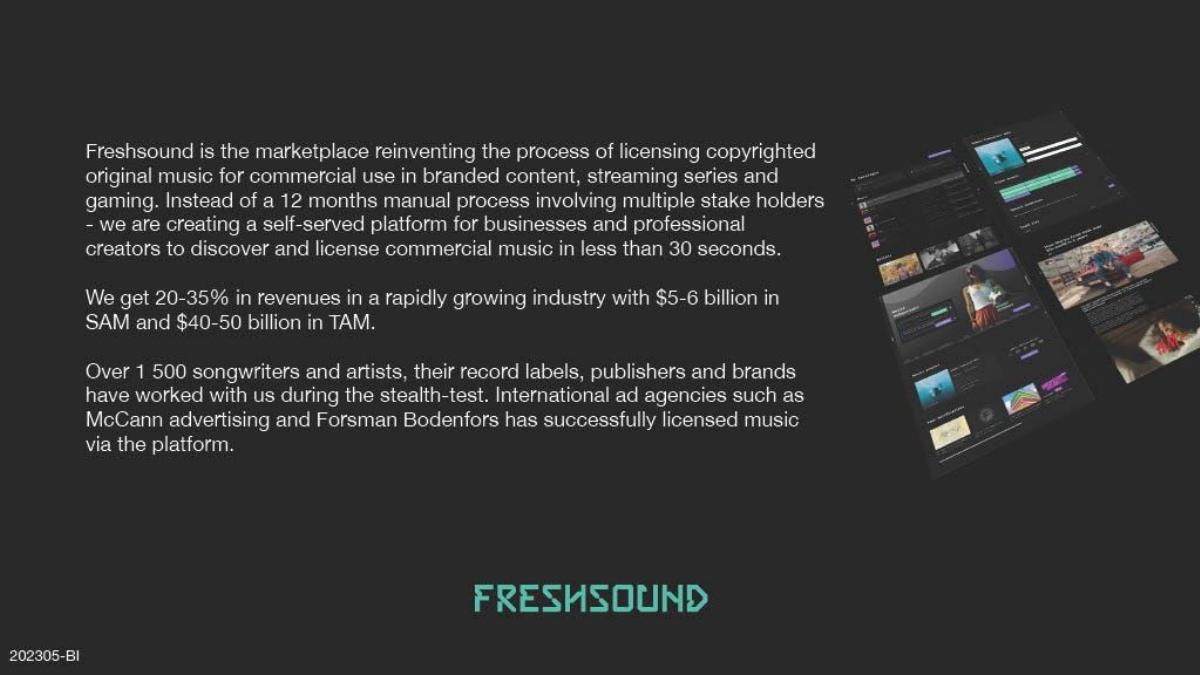
Slide 2 acts as a 'TL;DR' for the entire business. It defines the product as a self-served platform for businesses to discover and license commercial music in "less than 30 seconds," contrasting this against a "12 months manual process." This is a powerful 10x (or in this case, a 1,000x) improvement claim. The slide also lists key metrics: a 20-35% revenue take-rate, a $5-6 billion SAM, and a $40-50 billion TAM. Crucially, it provides social proof by mentioning that 1,500 songwriters and artists participated in a "stealth-test" and that major agencies like McCann have already used the platform.
Slide 3: The Problem – A "Very Very Boring" Process
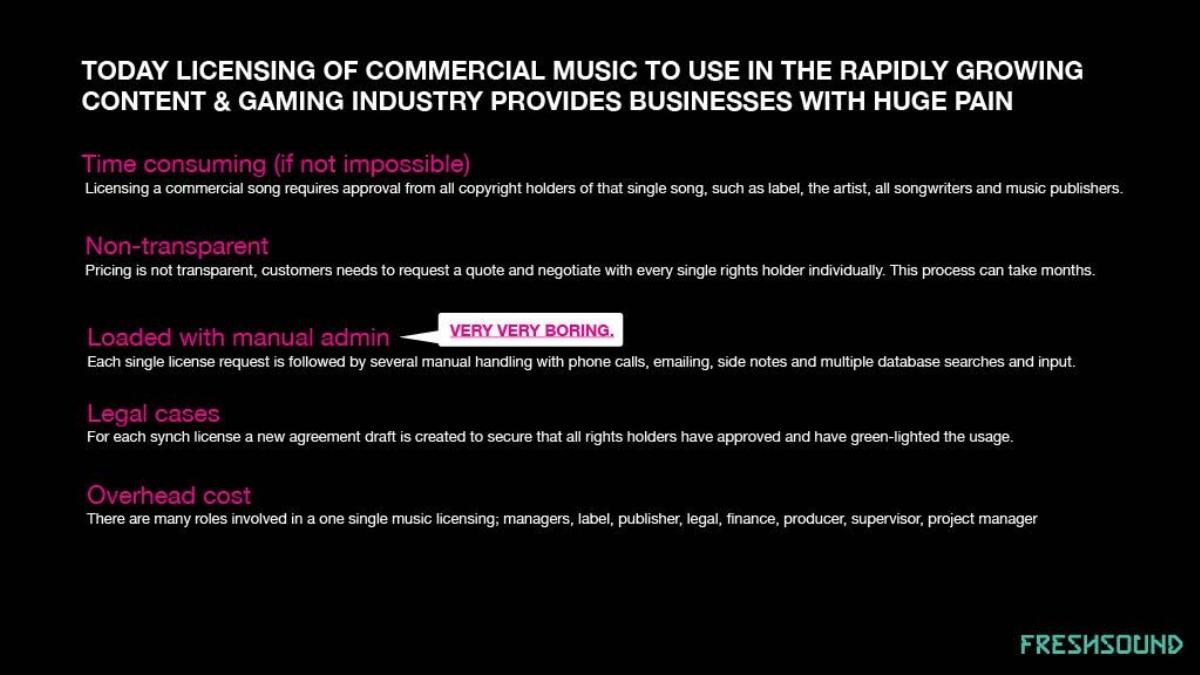
Slide 3 breaks down the friction in the current music licensing landscape. It lists five specific pain points: Time consuming (often impossible), Non-transparent pricing, Manual admin (noted as "VERY VERY BORING"), Legal cases (requiring new drafts for every license), and high Overhead costs involving multiple roles like music supervisors and project managers. By quantifying the number of stakeholders involved, Freshsound makes the case that the current system is too expensive for the high-volume needs of modern content creators.
Slide 4: The Solution – The Sync Marketplace
This slide uses a flow diagram to show how Freshsound sits between supply (Labels, Artists, Publishers) and demand (Commercials, Gaming, VR/Metaverse). The solution is categorized into four pillars: Freshsound Conditions (pre-cleared music), Freshsound Discovery (creative search), Freshsound Transparent Pricing (algorithmic fees), and Freshsound Automated Legal (instant agreements). The emphasis here is on removing the "quote request" phase, which is the primary bottleneck in traditional licensing.
Slide 5: Value Proposition for Both Sides
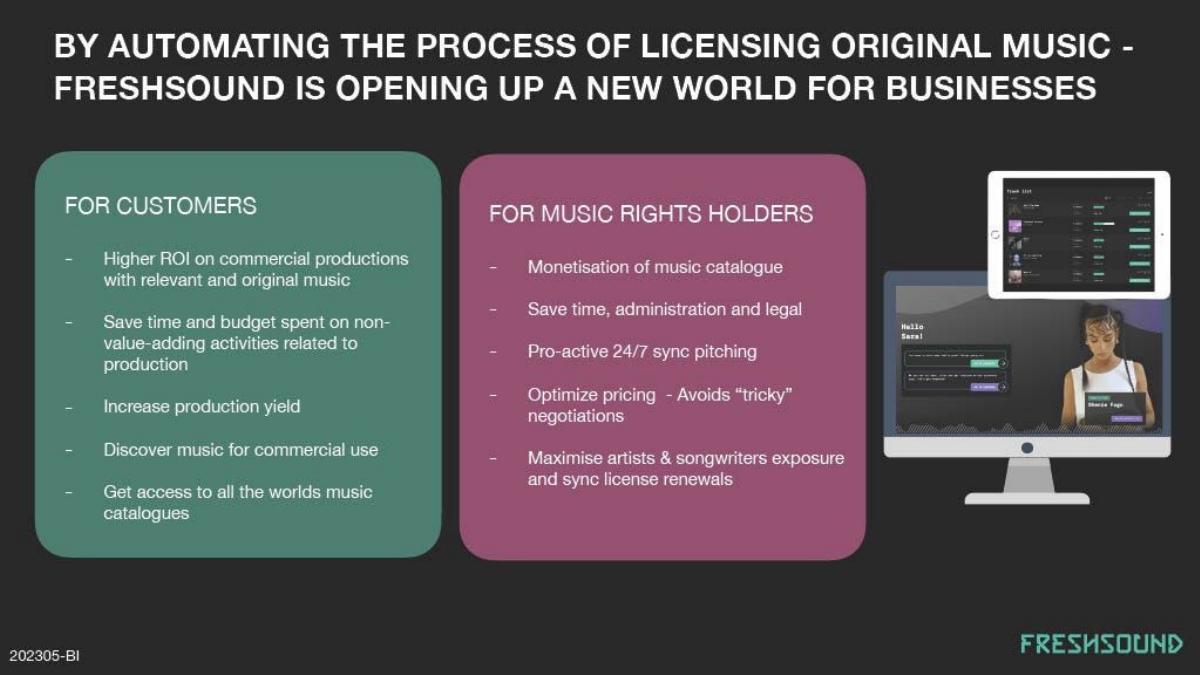
As a marketplace, Freshsound must prove value to both buyers and sellers. For customers, the benefits are higher ROI and increased production yield. For rights holders, the focus is on monetization, 24/7 proactive pitching, and avoiding "tricky" negotiations. The slide includes a product mockup showing a clean, Spotify-like interface, suggesting that the user experience is as intuitive as consumer music apps.
Slide 6: Market Opportunity and Growth
Slide 6 shifts to the macro environment, arguing that the need for quality music is exploding due to three factors: the "Content Marketing Growth Hype" ($860Bn by 2026), the "Streaming War" ($630Bn by 2026), and "Gaming" ($320Bn by 2026). By showing 15%+ and 10-12% CAGRs for these underlying markets, Freshsound suggests that even if they only capture a small slice of the sync spend within these industries, the upside is massive.
Slide 7: The Team and Investors
The final slide is a dense "Right People" slide. It highlights the founders, Stephen Gyasi (CEO) and Sara Larsson (COO), with logos from Warner Music, BCG, and Accenture. The broader team includes specialists from Sony Music, EMI, and Spotify. The right side of the slide lists an impressive roster of angel investors and advisors, including former executives from Hipgnosis Songs Fund, Spotify, and Truecaller. This slide is designed to de-risk the investment by showing deep domain expertise in both music rights and scaling tech platforms.
What Freshsound Does Well
The deck’s greatest strength is its clarity of conflict . It doesn't just say licensing is slow; it says it takes 12 months and involves ten different job titles. By being specific about the "boring" manual admin, they make the 30-second solution feel like a necessity rather than a luxury. The use of "pre-cleared" as a core product feature is the most important technical detail in the deck, as it explains how they bypass the legal gridlock that usually kills these types of startups.
Furthermore, the social proof is integrated early. Mentioning McCann and Forsman & Bodenfors on Slide 2 prevents the investor from wondering if agencies will actually use a self-service tool. The team slide is also exceptionally strong for a Seed round, featuring logos from the very incumbents (Sony, Warner) that Freshsound needs to partner with to succeed.
What is Missing from the Deck
The most glaring omission is the Ask and Use of Funds . There is no slide stating how much capital is being raised, the valuation target, or what the specific milestones for the next 18 months are. While this information is often handled in the verbal pitch or a follow-up document, its absence in the core deck is unusual for a Seed stage teardown.
Additionally, there is no Competitive Landscape slide. The music licensing space is crowded with players like Epidemic Sound (which focuses on royalty-free/owned libraries) and Songtradr. Freshsound alludes to their difference (licensing "commercial" music vs. library music), but a direct comparison would have helped clarify their moat against established competitors. Finally, there are no Unit Economics . While they mention a 20-35% take-rate, they don't provide data on average transaction size or customer acquisition costs (CAC), which are vital for marketplace businesses.
Founder's Guide: What to Copy
Founders should emulate Freshsound’s Executive Summary Slide (Slide 2) . Too many decks wait until Slide 10 to mention traction or the business model. Freshsound puts their take-rate, market size, and pilot results on the very first content slide. This ensures that even if an investor only spends 30 seconds on the deck, they understand the economic engine of the company.
Another element to copy is the Problem/Solution Symmetry . Every pain point listed on Slide 3 (Time, Transparency, Admin, Legal, Cost) is directly answered by a feature on Slide 4. This logical tight-coupling makes the product feel like a direct cure for a specific disease, rather than a collection of random features. Lastly, the use of Industry Logos on the team slide (Slide 7) is a masterclass in building credibility through association; by placing the Sony and Warner logos under their staff photos, they signal that they aren't outsiders trying to disrupt the industry, but insiders building the tools the industry needs.
Frequently asked questions
- What is Freshsound's primary business model?
- Freshsound operates as a two-sided marketplace for music synchronization (sync) licensing. According to Slide 2, they take a 20-35% commission on transactions. The platform connects music rights holders (labels, publishers, artists) with commercial users (ad agencies, gaming studios, streaming platforms) through a self-service portal.
- How does Freshsound solve the legal hurdles of music licensing?
- Slide 4 explains that all music on the platform is 'pre-cleared' based on conditions set by rights holders. The platform uses automated legal tools to generate license agreements instantly upon purchase, eliminating the need for the manual drafting of new agreements for every use case.
- Who are the target customers for this platform?
- The deck identifies two primary customer groups. On the demand side, they target ad agencies (mentioning McCann and Forsman & Bodenfors on Slide 2), streaming series, and gaming companies. On the supply side, they target songwriters, artists, record labels, and private equity catalogue investors (Slide 4).
- What market size is Freshsound targeting?
- Slide 2 defines the Serviceable Addressable Market (SAM) as $5-6 billion and the Total Addressable Market (TAM) as $40-50 billion. Slide 6 further breaks down the growth of underlying industries, projecting a combined market opportunity exceeding $1.8 trillion across content marketing, streaming, and gaming by 2026.
- What is missing from the Freshsound pitch deck?
- The deck is missing several standard components, most notably a specific 'Ask' slide detailing how much they are raising and what the milestones are. It also lacks a detailed competition slide, a financial roadmap, and specific unit economics beyond the high-level take-rate percentage.