Moderna's May 2017 investor presentation is a masterclass in platform storytelling for deep tech. By the time of this Series G, the company had already raised significant capital and established a 'software of life' narrative that justified its massive valuation. The deck highlights 12 development programs, five of which were already in clinical trials, and a cash position of $1.22 billion as of March 2017. Rather than focusing on a single drug, Moderna pitches an integrated 'Research Engine' capable of supporting over 1,000 novel mRNA deliveries per month. This teardown examines how they bal…
Key takeaways
- Moderna frames mRNA as the 'software of life,' where only the coding region varies while the delivery formulation remains identical across applications (Slide 4).
- The company demonstrated significant clinical momentum, growing from one development candidate in 2014 to 12 by early 2017 (Slide 10).
- A massive cash position of $1.22 billion was disclosed to show stability, despite net outflows for OpEx and CapEx reaching $260 million in 2016 (Slide 2 and Slide 19).
- Strategic partnerships with industry giants like Merck, AstraZeneca, and Alexion are used to validate the platform's utility across different therapeutic modalities (Slide 7).
- The 'Research Engine' slide emphasizes speed, showing a development candidate (mRNA-1388) nominated just 7 months after the initial idea (Slide 9).
- Moderna utilizes a risk-diversification strategy, mapping programs from low-risk prophylactic vaccines to high-risk exploratory CNS and ophthalmology research (Slide 7).
- The deck provides specific clinical timelines, such as moving the Zika vaccine (mRNA-1325) to first-in-human trials in less than one year (Slide 13).
- Financial transparency is high for a private company, showing audited historical outflows for R&D and G&A from 2012 through 2016 (Slide 19).
The Platform Play: Moderna’s $500M Series G Narrative
In May 2017, Moderna was already a unicorn several times over, but it still needed massive infusions of capital to fuel its ambitious R&D engine. This 40-slide deck (of which 20 key slides are analyzed here) served as the foundation for their Series G. The core thesis of the deck is not a single drug, but the industrialization of biology. By treating mRNA as 'software,' Moderna argued they could bypass the traditional, slow drug discovery process in favor of a digital-to-biological manufacturing pipeline.
Slide 1: Title and Branding
The cover slide is minimalist, featuring the Moderna logo and a simple iconographic representation of mRNA entering a cell to produce proteins within the human body. Dated May 2017, it sets a professional, clinical tone. The simplicity suggests a company that no longer needs to explain what it is in broad strokes, but is ready to dive into the how of its execution.
Slide 2: The Six-Year Progress Report
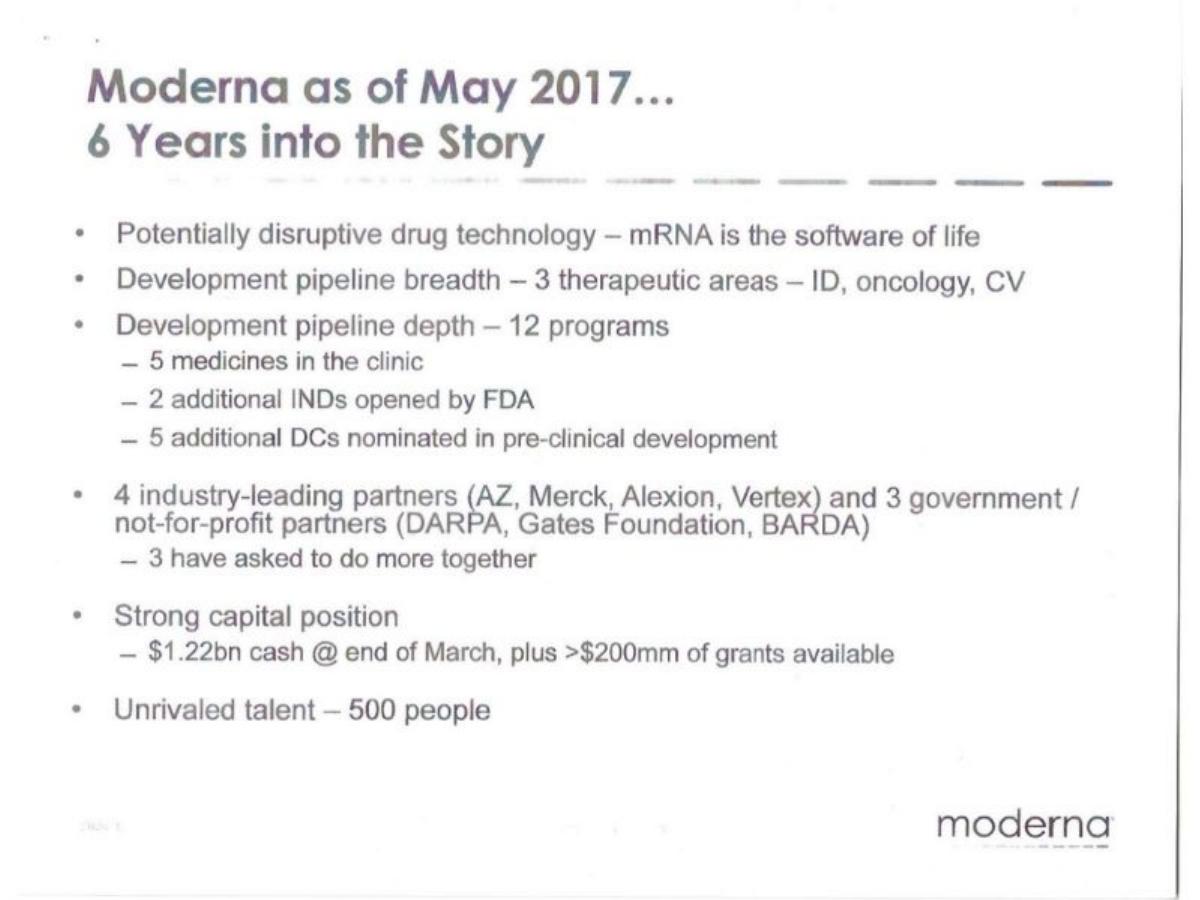
Slide 2 serves as an executive summary. It highlights that the company is '6 Years into the Story.' Key metrics include 12 programs in the pipeline, 5 medicines in the clinic, and 4 major industry partners (AZ, Merck, Alexion, Vertex). Crucially, it mentions a 'Strong capital position' with $1.22bn cash at the end of March 2017. This is a power move; most startups raise because they are running out of money, but Moderna raises to expand an already massive war chest.
Slide 3 & 4: The 'Software of Life' Analogy
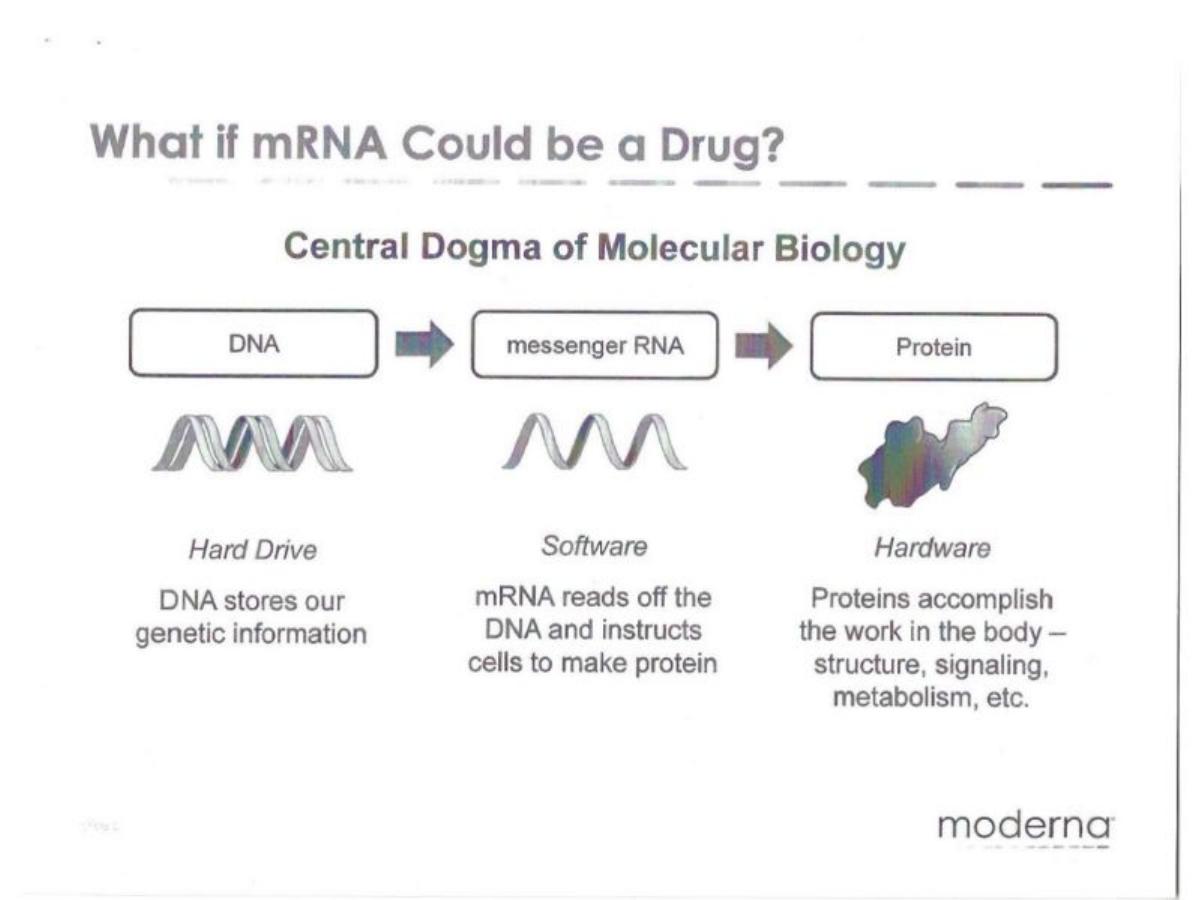
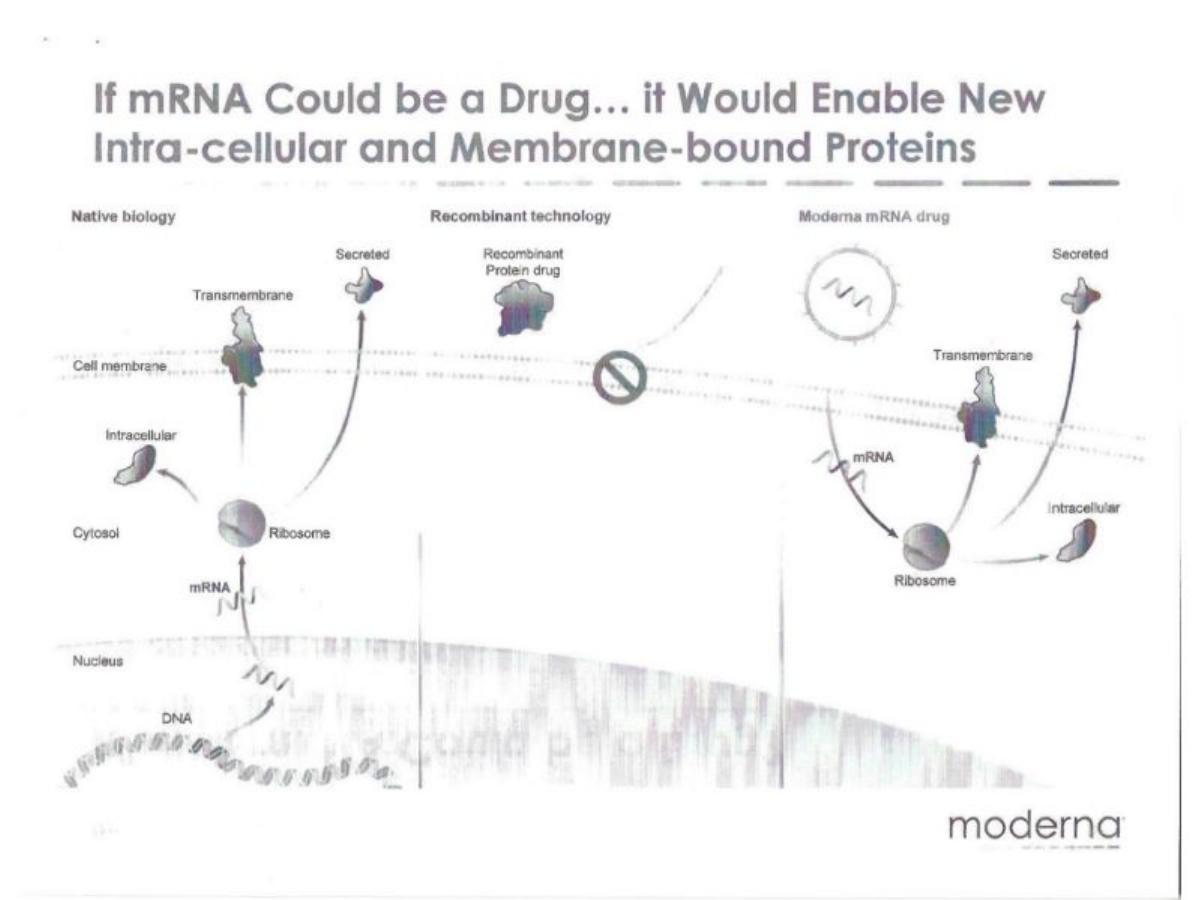
These slides establish the scientific foundation. Slide 3 explains the 'Central Dogma of Molecular Biology,' comparing DNA to a hard drive, mRNA to software, and proteins to hardware. Slide 4 takes this further, arguing that mRNA is a 'Platform' because the formulation and the 5'/3' regions remain identical; only the coding region (the 'software') changes. The takeaway is printed at the bottom: 'If mRNA works once, it should work many times.'
Slide 5: Integrated Drug Design
This slide illustrates the 'Key Platform Components': Chemistry, Process, Bioinformatics, mRNA Engineering, and Formulation. It shows the transition from raw materials (Adenine, Uracil, Cytosine, Guanine) to a finished mRNA Drug Product. This reinforces the idea that Moderna is a technology company applying engineering principles to biology, rather than a traditional pharma lab relying on serendipitous discovery.
Slide 6 & 7: Modalities and Risk Management
Slide 6 introduces the concept of 'Modalities,' ranging from low-risk Prophylactic Vaccines to high-risk Lung treatments. Slide 7 is a sophisticated bubble chart mapping these modalities against 'Technology Risk' and 'Biologic Risk.' It shows that while vaccines are lower risk, the company is already pushing into 'Frontier Research' like the Central Nervous System and Ophthalmology. This slide is critical for Series G investors because it shows a diversified portfolio; even if the high-risk oncology programs fail, the vaccine platform provides a safety net.
Slide 8 & 9: The Research Engine
Slide 8 acts as a transition, noting investments in the mRNA platform and research engines. Slide 9 provides the proof of speed. It shows a timeline where an idea can move to a Development Candidate (DC) nomination in just 7 to 12 months. It also claims their automated systems support 'more than 1,000 novel mRNA deliveries per month.' This is a scale metric that few biotech companies can match.
Slide 10: Clinical Momentum
This slide uses bar charts to show the exponential growth of the pipeline. In 2014, they had 1 candidate; by 'Today' (May 2017), they had 12. Similarly, drugs in clinical trials jumped from 1 in 2015 to 5 in 2017. This visualizes 'momentum,' a key psychological trigger for late-stage investors.
Slide 11, 12 & 13: The Vaccine Pipeline
Slides 11 and 12 provide detailed tables for Pandemic Flu and Zika programs. Slide 13 is a standout 'speed' slide, showing that mRNA-1325 (Zika) moved to First-in-Human trials in less than one year. It tracks the timeline from 'First construct ordered' in Dec 2015 to 'FIH' (First-in-Human) in Dec 2016. In the world of drug development, this is light-speed, and it serves as the primary evidence for the platform's efficiency.
Slide 14: The CMV Opportunity
Slide 14 focuses on Cytomegalovirus (CMV), highlighting a 'high unmet need' and an annual cost of $2 billion in the US. By including a chart comparing CMV to other childhood diseases like Down Syndrome and HIV/AIDS, Moderna is framing the market size and the social impact of their work. This provides the 'Why' behind the science.
Slide 15, 16 & 17: Oncology and Cardiovascular Pipelines
These slides follow the same format as the vaccine slides but focus on higher-value therapeutic areas. Slide 15 shows the Personalized Cancer Vaccine (mRNA-4157) in partnership with Merck, and Slide 17 shows the Cardiovascular program (mRNA AZD-8601) with AstraZeneca. The presence of these partner names in the 'Lead' and 'Funding' columns provides massive third-party validation.
Slide 18 & 19: Financials and The Balance Sheet
Slide 18 is a simple divider, leading into Slide 19, which is a detailed financial table. It shows 'Inflows' from reimbursements and milestones growing from $2M in 2013 to $36M in 2016. However, it also shows the massive 'Outflows'—$225M for R&D in 2016 alone. The 'Year End Cash' row is the most important, showing how they have managed their capital to end 2016 with $1.307 billion. This transparency is intended to build trust with institutional investors.
Slide 20: The Mission
The deck concludes with a mission statement: 'Deliver on the promise of mRNA science to create a new generation of transformative medicines for patients.' It is a standard but necessary closing that refocuses the technical and financial data back onto the human element.
What Moderna's Deck Does Well
Platform vs. Product: The deck successfully argues that Moderna is a platform. By using the 'software' analogy, they justify a valuation that is much higher than a typical biotech company with only 12 candidates. They aren't selling a drug; they are selling a factory for drugs.
Validation through Partnership: The constant mention of Merck, AstraZeneca, and DARPA serves as a proxy for due diligence. A Series G investor feels safer knowing that Merck has already vetted the science for the cancer vaccine.
Visualizing Speed: In biotech, time is the greatest expense. Slide 13, showing the sub-one-year path to human trials for the Zika vaccine, is the most persuasive piece of evidence in the deck for the platform's technical superiority.
What is Missing from the Deck
Unit Economics of Manufacturing: While the deck mentions '1,000 deliveries per month,' it does not detail the cost per gram of mRNA or the projected margins once these drugs hit the market. For a Series G, one might expect more detail on the path to commercial profitability.
Competitive Landscape: The deck completely ignores other mRNA players (like BioNTech or CureVac) or traditional vaccine technologies. It assumes mRNA is the future and that Moderna is the only relevant player in it.
Detailed Team Slide: In the 20 slides provided, there is no mention of the leadership team or the scientific advisory board. While Slide 2 mentions '500 people,' the specific pedigree of the executives is omitted, likely because the company was already well-known in the industry by 2017.
Lessons for Founders
Standardize your 'Engine': If you are building a platform, show how the 'fixed' parts of your process allow you to iterate on the 'variable' parts quickly. · Use 'Proxy' Validation: If you don't have revenue, use the names of your partners, grant-makers, and early clinical trial results to build credibility. · Address Risk Head-On: Moderna's Slide 7, which maps risk vs. opportunity, is a great way to show investors that you aren't just chasing 'moonshots' but have a balanced portfolio of 'sure bets' and 'frontiers.' · Show the Cash: If you are in a capital-intensive industry, being transparent about your burn rate and your cash-on-hand is essential for building late-stage investor confidence.
Frequently asked questions
- What was the primary goal of this pitch deck?
- The deck was designed to support Moderna's Series G round in 2017, which ultimately raised $500 million. It aimed to transition the investor perception of Moderna from a speculative biotech startup to a mature, multi-modality platform company with a deep clinical pipeline and significant institutional backing.
- How does Moderna explain its business model in this deck?
- Moderna pitches a 'Platform' model rather than a 'Product' model. By standardizing the 5' and 3' regions of the mRNA and the delivery formulation, they argue that 'if mRNA works once, it should work many times.' This allows them to scale across infectious diseases, oncology, and cardiovascular segments simultaneously.
- What clinical evidence did Moderna provide at this stage?
- Slide 10 shows that by May 2017, Moderna had 12 development candidates nominated and 5 drugs in clinical trials. The deck highlights specific progress in Pandemic Flu (H10 and H7), Zika, and a personalized cancer vaccine in partnership with Merck, which was in the 'Ongoing' GLP Toxicology phase at the time.
- Why did Moderna emphasize its cash position so heavily?
- Biotech development is capital intensive. By showing $1.22 billion in cash and over $200 million in available grants (Slide 2), Moderna signaled to Series G investors that they had the 'dry powder' to survive long R&D cycles and were not raising out of desperation, but to accelerate an already winning engine.
- Who were Moderna's key partners mentioned in the deck?
- The deck lists major pharmaceutical partners including AstraZeneca, Merck, Alexion, and Vertex. It also highlights non-profit and government collaborators such as DARPA, the Bill & Melinda Gates Foundation, and BARDA, which provided both funding and technical validation for their vaccine programs.