Mojo’s 12-slide Series A deck is a high-gloss visual narrative that successfully bridged the gap between fintech and sports betting. By positioning athlete performance as a 'real asset' with 'real stats,' the company bypassed the stigma of traditional gambling to court institutional capital. The deck’s strength lies in its regulatory transparency, explicitly detailing how they secured approval from the New Jersey Division of Gaming Enforcement to treat player stocks as long-term futures contracts. While the deck lacks a formal team slide or detailed unit economics in this version, the focus o…
Key takeaways
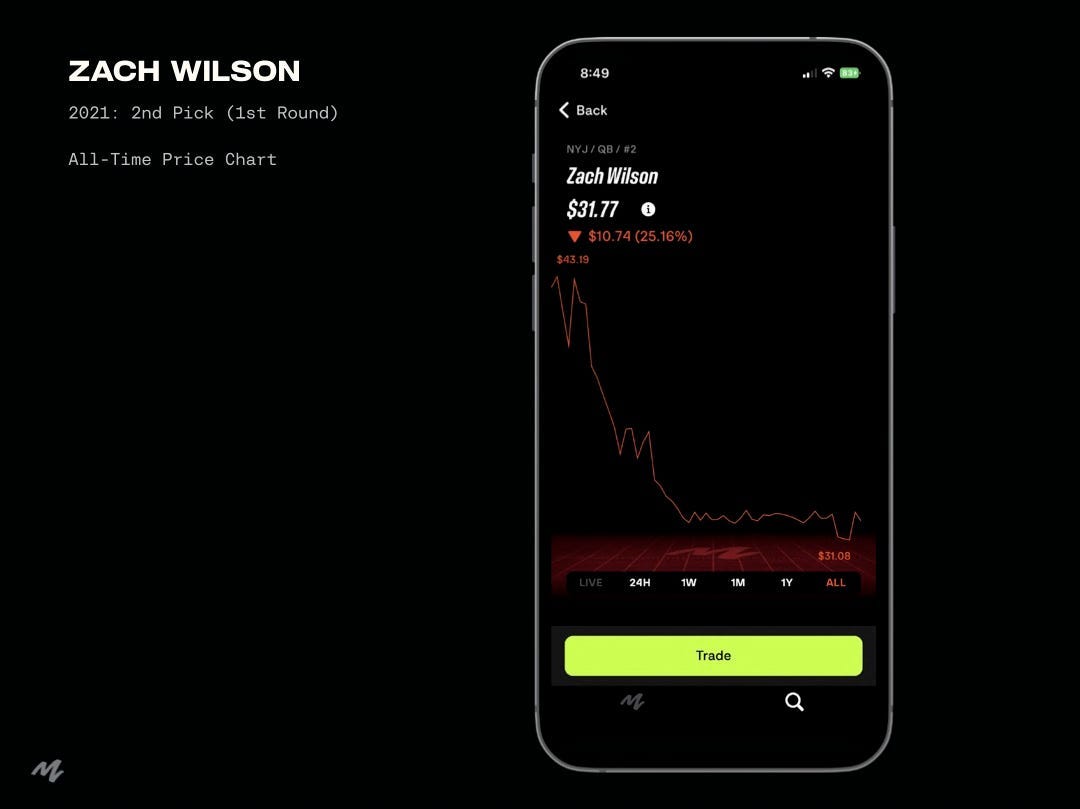
- The deck leads with a product-first approach, using a Zach Wilson stock chart on Slide 1 to immediately communicate the 'stock market for sports' concept.
- Mojo cites Goldman Sachs data on Slide 6 to project a $500B+ US betting market by 2030, growing at a 40% CAGR.
- The product mechanism is defined on Slide 8 as a 'long-term sports futures contract' where shares entitle users to payouts based on career-ending stats.
- Regulatory strategy is a core pillar, with Slide 10 detailing their August 2022 approval from the New Jersey Division of Gaming Enforcement.
- The company claims 'Additional Market Access in 10 States' on Slide 10, signaling a clear path to national scale.
- Social proof is emphasized on Slide 3 through a collage of media appearances on NFL Live, NBA Countdown, and various betting podcasts.
- The deck omits a traditional 'Team' slide, though the $100M raise suggests a high-pedigree founding group not shown in these 12 slides.
- Unit economics and specific user acquisition costs (CAC) are entirely absent from the presentation.
The $100M Bet on Sports Liquidity
Mojo’s Series A deck is a masterclass in 'category creation.' By the time they raised $100M in 2022, the US sports betting market was already crowded with giants like DraftKings and FanDuel. Mojo’s challenge was to convince investors that they weren't just another sportsbook, but a financial exchange for human performance. The 12-slide deck achieves this by leaning heavily into fintech aesthetics and regulatory moats.
Slide 1: The Hook
The deck opens not with a title, but with a high-fidelity screenshot of the Mojo app. It features Zach Wilson, the 2021 2nd overall NFL draft pick, displayed as a stock chart. The price is listed at $31.77, showing a 25.16% decline ($10.74). This slide does two things immediately: it explains the product without a single bullet point, and it establishes a 'dark mode' aesthetic that mirrors popular retail trading apps like Robinhood. By showing a price drop, Mojo also subtly highlights the 'Short' side of their market, a feature often missing in traditional sports betting.
Slides 2-3: Brand and Cultural Relevance
Slide 2 is a collage of the app's various interfaces—portfolios, mystery stocks, and player cards for stars like Josh Allen and Odell Beckham Jr. It emphasizes the breadth of the offering. Slide 3 shifts to 'Social Proof,' featuring the headline 'WE’LL CHANGE SPORTS FOREVER.' The background is a grid of media hits, including appearances on NFL Live, NBA Countdown, and various social media influencers. This slide is intended to show that Mojo is already part of the cultural conversation, reducing the perceived risk of user acquisition.
Slide 6: The Macro Opportunity
Titled 'FANS ARE POURING THEIR MONEY INTO SPORTS BETTING,' this slide provides the quantitative 'Why Now?' Mojo cites Goldman Sachs to support three massive claims: sports betting is the #1 growing US consumer market, it will maintain a 40% CAGR over the next decade, and total US bets will exceed $500B by 2030. By anchoring their pitch in Goldman Sachs data, Mojo elevates the conversation from a 'gambling startup' to a 'macro-economic play.'
Slide 8: The Mechanics of the Market
This is the most critical slide for understanding the business model. It breaks 'How Mojo Works' into three pillars: Real Asset, Real Stats (shares entitle customers to payouts based on career-ending stats); Live Odds on a Career (prices fluctuate based on real-time projections); and Buy or Sell Anytime (liquidity for the user). This slide addresses the 'liquidity' problem in sports betting—traditional bets are locked until the game ends, but Mojo allows for continuous trading, which theoretically increases engagement and transaction volume.
Slide 10: The Regulatory Moat
In the fintech and gambling space, regulation is the ultimate barrier to entry. Slide 10, 'FULLY-LICENSED IN NEW JERSEY,' is a detailed breakdown of their legal strategy. It notes that the CFTC does not regulate sports, and state commissions typically only handle conventional bets. Mojo’s breakthrough was petitioning the NJ Division of Gaming to treat their product as a 'long-term sports futures contract.' Securing this approval in August 2022 was likely the catalyst for the $100M round, as it proved the model could exist within the US legal framework. The slide also mentions 'Additional Market Access in 10 States,' signaling a clear expansion roadmap.
What Mojo Gets Right
Fintech Framing: Mojo successfully avoids the 'gambling' label by using financial terminology like 'shares,' 'portfolios,' 'assets,' and 'liquidity.' This allows them to tap into a different pool of venture capital that might be restricted from investing in pure-play casinos or sportsbooks.
Regulatory Transparency: Most startups gloss over legal hurdles. Mojo puts them front and center, turning a potential weakness (the difficulty of getting licensed) into a massive competitive advantage (the 'moat' of being the first to get this specific contract type approved).
Visual Storytelling: The deck is light on text and heavy on product visuals. By Slide 8, the investor knows exactly what the app looks like, how it feels, and how the underlying math works.
What is Missing from the Deck
The Team: In the 12 slides provided, there is no mention of the founders or their backgrounds. Given the complexity of this business—requiring expertise in high-frequency trading, sports data, and gaming law—the team slide is a glaring omission in this version of the deck. (Note: Mojo was co-founded by Marc Lorre and Alex Rodriguez, which likely carried significant weight in the actual pitch meetings).
Unit Economics: There is no mention of Customer Acquisition Cost (CAC), Lifetime Value (LTV), or the 'take rate' (commission) Mojo earns on trades. While the market size is clear, the path to profitability is not detailed here.
Competition: The deck operates in a vacuum. It does not address how Mojo will compete for user attention against established giants like FanDuel or other 'sports stock market' competitors like PredictionStrike.
Founder's Playbook: Lessons from Mojo
1. Use 'Third-Party Authority' for Market Size: Don't just say your market is big. Cite a top-tier investment bank like Goldman Sachs or Morgan Stanley. It adds immediate credibility to your projections.
2. Define Your Own Regulatory Category: If your product doesn't fit into existing boxes, show how you are working with regulators to create a new one. Mojo’s 'long-term sports futures contract' label is a brilliant piece of legal positioning.
3. Lead with the Product: If you have a beautiful, intuitive interface, show it on Slide 1. Don't make the investor wait until Slide 10 to see what you've actually built.
4. Focus on 'Liquidity' as a Value Prop: In any marketplace or exchange pitch, the ability for users to enter and exit positions at will is a powerful hook. Mojo emphasizes 'Buy or Sell Anytime' to contrast with the rigid nature of their competitors' products.
Frequently asked questions
- How does Mojo actually work according to the deck?
- According to Slide 8, Mojo functions by treating athlete performance as a 'real asset.' Users buy shares in players, and these share prices fluctuate based on real-time projections of career-ending statistics. Unlike a one-off bet, these are structured as long-term futures contracts that users can buy or sell at any time, whether play-to-play or season-to-season.
- What is the regulatory status of the company?
- Slide 10 states that Mojo is 'Fully-Licensed in New Jersey.' They secured approval in August 2022 after petitioning the NJ Division of Gaming Enforcement to treat their player stocks as a new type of sports futures contract. The slide also notes they have secured market access in 10 additional states.
- What market data did Mojo use to justify its valuation?
- Mojo relied on a Goldman Sachs report cited on Slide 6. The data points to sports betting being the #1 growing US consumer market, with a projected 40% CAGR over the next decade, leading to an estimated $500B+ in total US bets by the year 2030.
- Is there a breakdown of the management team in the deck?
- No. The 12-slide deck provided does not include a team slide. In a $100M Series A, the team is usually a primary selling point, but Mojo chose to focus this specific narrative on the product interface, market size, and regulatory milestones.
- How does Mojo position itself against traditional sportsbooks?
- Mojo positions itself as a 'stock market' rather than a sportsbook. Slide 8 emphasizes 'Live Odds on a Career' and 'Real Assets,' using the language of finance to differentiate from the 'win-or-lose' binary nature of traditional gambling. This fintech framing is reinforced by the app's UI, which mirrors modern brokerage platforms.