MojiLaLa's 11-slide deck from 2016 is a masterclass in demonstrating early-stage traction and market fit. By positioning itself as the essential bridge between independent artists and fragmented messaging platforms like iMessage, Line, and WeChat, the company successfully raised $1.5 million. The deck relies heavily on impressive growth metrics, such as acquiring over 2,000 artists and 15,000 emojis within five months. While it lacks explicit financial projections or a detailed business model slide, it compensates with strong social proof—including a slide featuring caricatures of top-tier VC…
Key takeaways
- The company achieved 200,000 organic downloads in just four months with zero marketing spend (Slide 7).
- MojiLaLa successfully onboarded over 2,000 artists within its first six months of operation (Slide 7).
- The platform's library grew to 15,000 emojis in five months, demonstrating rapid supply-side scaling (Slide 7).
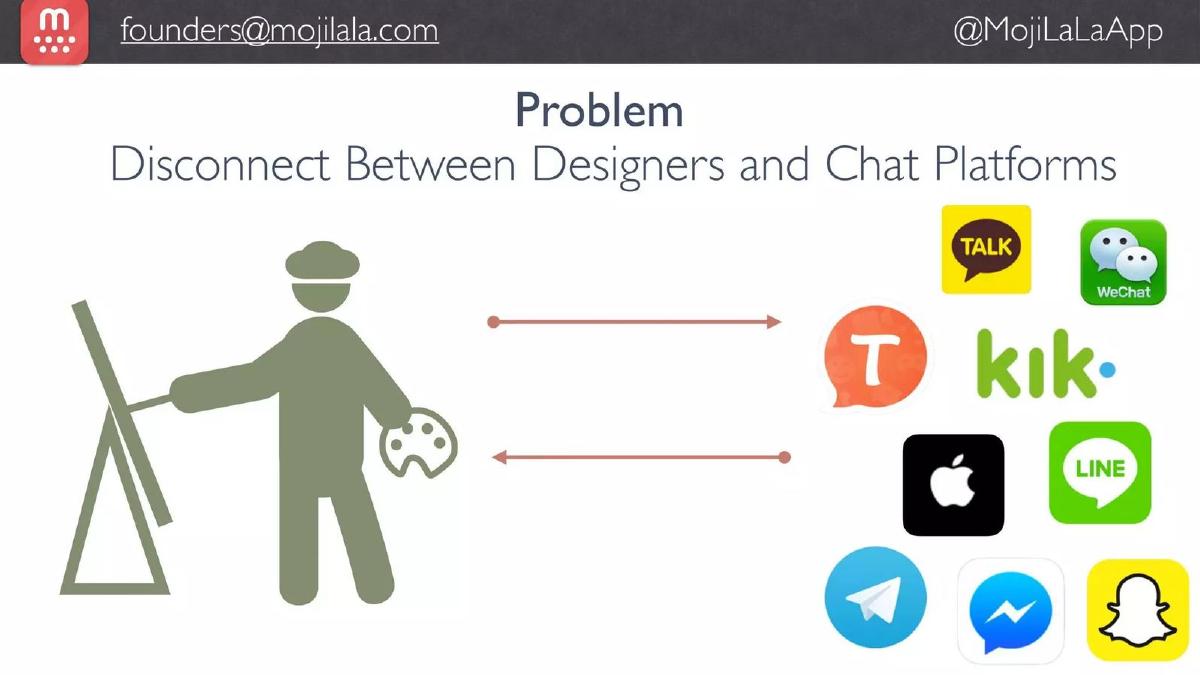
- The deck identifies a 'Disconnect Between Designers and Chat Platforms' as the core problem it solves (Slide 5).
- MojiLaLa claims the #1 position as a sticker distributor for Apple iMessage (Slide 8).
- The engineering team holds significant technical credibility, with 7,000 stars on GitHub and a top 20 ranking in San Francisco for Swift (Slide 10).
- Distribution is diversified across major global platforms including Baidu, Line, Kika, and Gfycat (Slide 9).
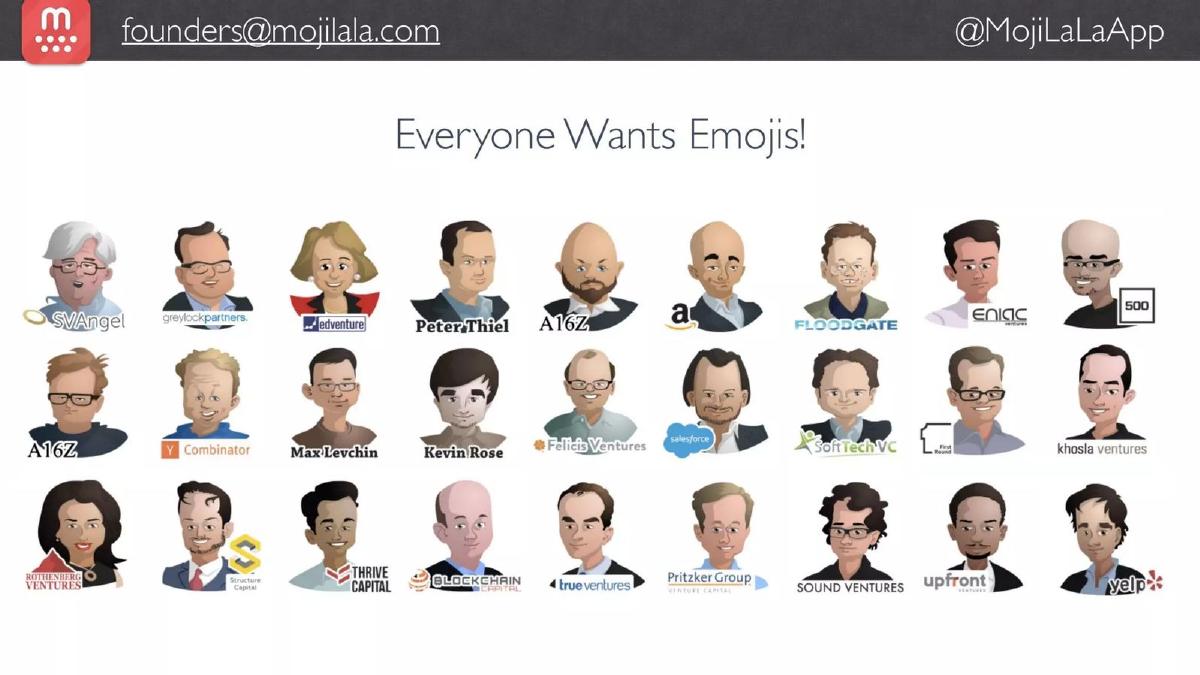
- The deck uses caricatures of prominent investors like Peter Thiel and Marc Andreessen to suggest a broad market desire for the product (Slide 3).
The Marketplace for Digital Expression
MojiLaLa’s 2016 pitch deck is a concise, visually-driven presentation that captures the peak of the 'sticker' and 'emoji' craze. At a time when messaging platforms were opening up their ecosystems to third-party developers, MojiLaLa positioned itself not just as an app, but as a marketplace. The deck is designed to prove one thing: that there is a massive, untapped supply of creative talent that needs a bridge to the billions of users on chat platforms.
The Hook: Market Scale and Social Proof (Slides 1-3)
Slide 1: Title Slide The deck opens with a clean logo and the simple descriptor: 'Emoji Marketplace.' It establishes the brand identity immediately with a playful character in the corner, signaling the creative nature of the business.
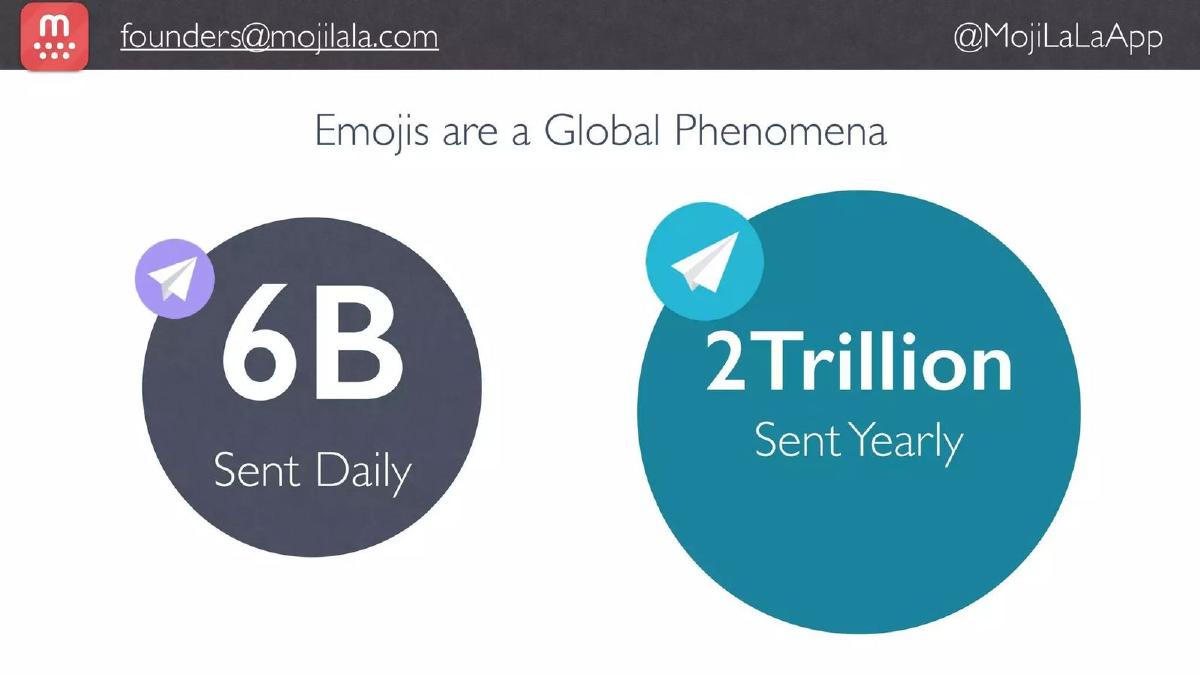
Slide 2: Emojis are a Global Phenomena This slide establishes the Total Addressable Market (TAM) through usage volume rather than dollar amounts. It cites '6B Sent Daily' and '2 Trillion Sent Yearly.' By using the paper plane icon (commonly associated with Telegram or messaging), it anchors the product in the communication sector.
Slide 3: Everyone Wants Emojis! This is a unique 'social proof' slide. Instead of listing logos of partner companies, it features caricatures of high-profile venture capitalists and tech leaders (including Peter Thiel, Marc Andreessen, and Kevin Rose) alongside their firm logos (A16Z, Y Combinator, Greylock). While it doesn't explicitly claim these individuals are investors, it uses their likeness to suggest that the smartest minds in tech recognize the emoji trend as a significant movement.
Defining the Gap (Slides 4-6)
Slide 4: Transition Slide A repeat of the title slide, used to reset the narrative before diving into the problem/solution phase.
Slide 5: Problem - Disconnect Between Designers and Chat Platforms The core conflict is presented visually. On one side, an artist; on the other, a fragmented wall of logos including WeChat, Line, Snapchat, and Facebook Messenger. The arrows indicate a broken or difficult path for artists to get their work onto these platforms. This identifies MojiLaLa's role as a middleman or aggregator.
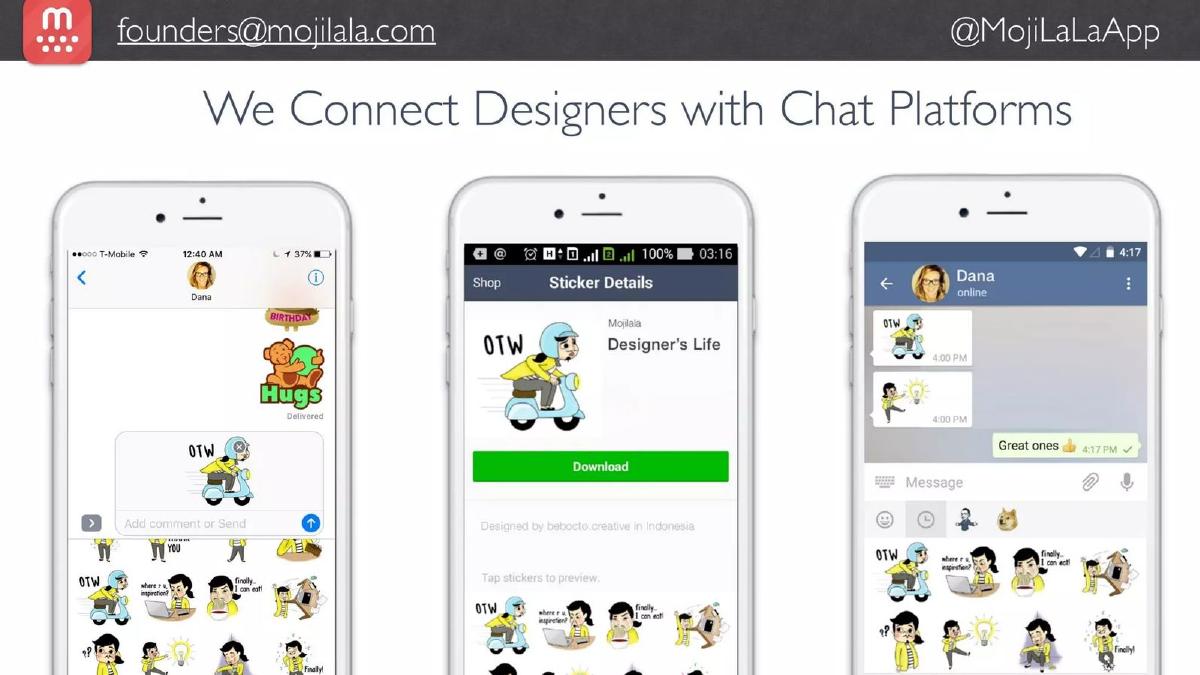
Slide 6: We Connect Designers with Chat Platforms The solution slide shows the product in action across different interfaces. It displays an iMessage-style interface and an Android-style sticker shop. This proves the product is cross-platform and already functional, showing specific sticker packs like 'Designer’s Life' by an artist in Indonesia.
The Traction Flywheel (Slides 7-9)
Slide 7: 2,000+ Artists Joined MojiLaLa in Just 6 Months This is the 'money slide' of the deck. It features a steep growth curve showing artist acquisition from August to January. Key metrics highlighted include:
15k Emojis in 5 Months · 200k Downloads in 4 months with $0 Market Spend
This slide is critical because it proves the marketplace is working on both sides: artists are joining (supply) and users are downloading (demand) without the company needing to pay for users.
Slide 8: #1 Sticker Distributor for Apple iMessage MojiLaLa stakes a claim to dominance in the most important ecosystem of the time. Being '#1' provides a powerful competitive moat and suggests that their curation or distribution tech is superior to individual artists trying to go it alone.
Slide 9: Key Distribution Channels This slide expands the scope beyond Apple. By listing Baidu, Line, Kika, and Gfycat, MojiLaLa demonstrates that they are not platform-dependent. The mention of Kika as the 'Largest Android Keyboard' is a strategic nod to their reach in the Android ecosystem, which is often harder to monetize but offers massive scale.
The Team and Summary (Slides 10-11)
Slide 10: Powerful Engineer Team The team slide focuses on the two co-founders, Dana Loberg (CEO) and Sahin Boydas (CTO). The 'Powerful Engineer Team' headline is backed by two specific technical accolades:
Engineer Team has 7K Stars in GitHub · Ranked Top 20 in San Francisco in Swift
The inclusion of logos like Yale, 500 Startups, and 20th Century Fox provides institutional credibility. The focus on GitHub stars is a clever way to quantify technical talent for non-technical investors.
Slide 11: Summary and Contact The final slide reiterates the three most impressive metrics: the #1 ranking in iMessage, the 15k emoji library, and the 200k organic downloads. It ends with a clear call to action (the founders' email address) and a whimsical graphic of a flying stack of cash, perhaps a nod to the $1.5M they were seeking or the revenue potential of the marketplace.
What Works in the MojiLaLa Deck
The deck excels at quantifying traction . In an era where many 'content' startups struggled to show growth, MojiLaLa provided hard numbers on both supply (artists/emojis) and demand (downloads). The fact that this growth was achieved with '0 Market Spend' is a massive signal to investors that the product has inherent virality or strong SEO/ASO (App Store Optimization).
The visual storytelling is also highly effective. By showing the 'Disconnect' on Slide 5 and the 'Connection' on Slide 6, the founders explain a complex marketplace dynamic in seconds. They don't over-explain the tech; they show the result.
What is Missing from the MojiLaLa Deck
The most glaring omission is the Business Model . There is no mention of how MojiLaLa makes money. Do they take a cut of sticker pack sales? Is it an ad-supported model? Is there a subscription? While the 'flying cash' on the last slide hints at monetization, the mechanics are left to the imagination. For a 'Later' stage deck (as categorized), investors would typically expect a slide on Unit Economics, LTV (Lifetime Value), and CAC (Customer Acquisition Cost), even if the current CAC is zero.
Additionally, there is no Competition Slide . In 2016, the sticker market was crowded with players like Giphy, Bitmoji (acquired by Snapchat), and various platform-native stores. Failing to address how MojiLaLa differentiates from these giants is a missed opportunity to define their 'moat.'
What a Founder Should Copy
Founders should emulate the Technical Credibility section on Slide 10. Instead of just saying 'we have great engineers,' MojiLaLa used third-party validation (GitHub stars and Swift rankings). This is much more persuasive than a list of previous job titles.
Another takeaway is the Supply-Side Focus . If you are building a marketplace, proving you can acquire the 'supply' (in this case, artists) is often harder than getting users. MojiLaLa’s graph showing 2,000+ artists joining in six months proves there is a 'push' from the creative community to use their platform, which is a leading indicator of long-term success.
Frequently asked questions
- How much did MojiLaLa raise with this deck?
- According to the catalogue data, MojiLaLa raised $1,500,000 in 2016 following this presentation. The deck itself does not specify the 'Ask' amount or the terms of the round, which is common in decks shared publicly after a successful close.
- What was MojiLaLa's primary growth strategy?
- The strategy was entirely organic. Slide 7 highlights that they reached 200,000 downloads with '$0 Market Spend.' This was achieved by building a massive library of 15,000 emojis from 2,000+ independent artists, creating a marketplace effect where the content itself drove user discovery.
- Which messaging platforms did MojiLaLa support?
- The deck lists several major global platforms as key distribution channels on Slide 9, including the Apple iMessage Store, Baidu, Line, Gfycat, and Kika (the largest Android keyboard). Slide 5 also references WeChat, Kik, Telegram, Messenger, and Snapchat.
- Who were the founders of MojiLaLa?
- The company was co-founded by CEO Dana Loberg and CTO Sahin Boydas. Their backgrounds include education at Yale and professional experience or affiliations with 500 Startups, Fox, and McCann Worldgroup, as shown on Slide 10.
- Is there a business model or revenue slide in the deck?
- No. The 11-slide deck completely omits a business model, revenue projections, or unit economics. It focuses exclusively on the problem, the solution, the growth of the artist community, and user traction metrics.