Catch+Release used this 12-slide deck to secure $8.8M in Series A funding in 2023. The narrative centers on the 'licensing bottleneck,' positioning the platform as a necessary legal and operational layer for brands that want to move beyond stale stock photography and expensive custom shoots. By highlighting high-profile IP lawsuits and the limitations of Generative AI, the deck creates a sense of urgency around compliance. While the deck is visually polished and features a team with deep domain expertise from companies like Meta and Amazon, it is notably light on hard financial metrics, unit…
Key takeaways
- The deck positions the product as a solution to a 'manual, complex, risky, & time consuming' licensing process (Slide 3).
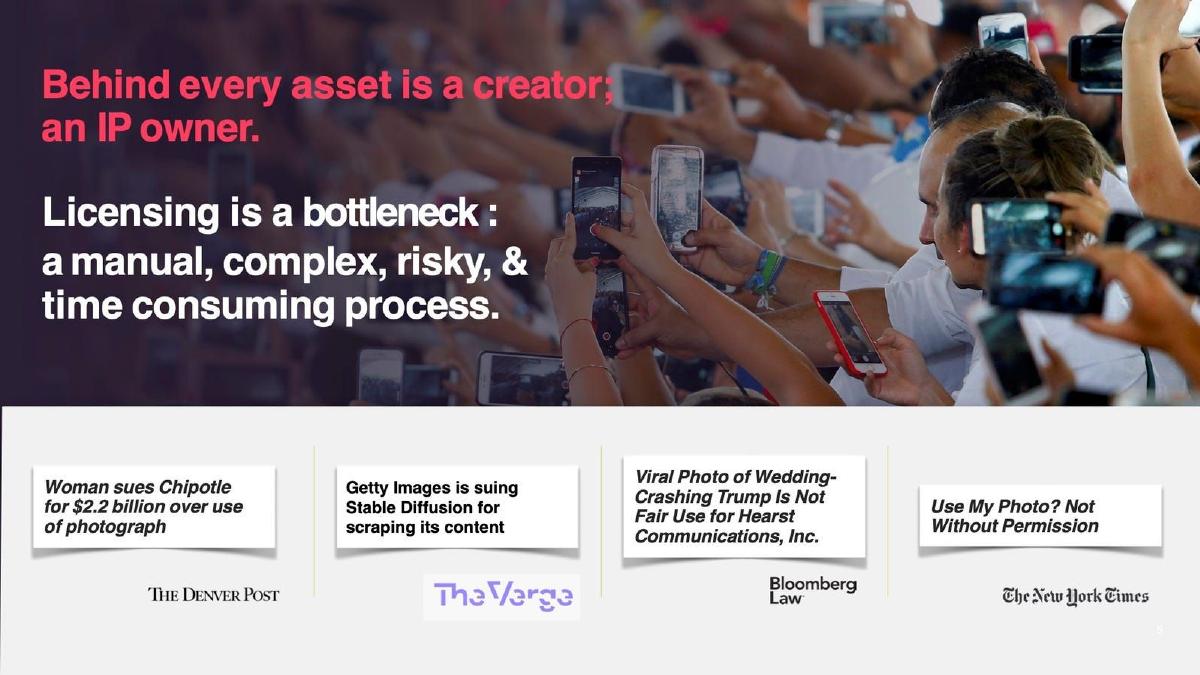
- It uses social proof through news headlines of major IP lawsuits, including a $2.2 billion suit against Chipotle, to establish the cost of failure (Slide 3).
- The company explicitly distances itself from Generative AI, citing 'licensing and infringement issues' as a reason it isn't commercially viable (Slide 2).
- The product workflow is simplified into a three-step process: Paste a URL, Specify rights, and License it (Slide 4).
- CEO Analisa Goodin emphasizes founder-market fit, noting she has 'cleared thousands of pieces of creator owned content' herself (Slide 11).
- The team slide features heavy-hitting logos from previous employers including Meta, Amazon, J.P. Morgan, and Nike (Slide 11).
- The deck mentions existing backing from Accel and Cervin, signaling institutional confidence to new investors (Slide 11).
- The long-term vision shifts from a service-based platform to a programmatic licensing API for 'all creative IP on the internet' (Slide 12).
The Series A Narrative: Compliance as a Competitive Advantage
Catch+Release entered the market at a time when brands were desperate for 'authentic' content but terrified of the legal repercussions of using social media posts without proper clearance. The deck, used for their $8.8M Series A in 2023, reflects a sophisticated understanding of the enterprise buyer: it focuses less on the 'fun' of content creation and more on the 'risk' of intellectual property (IP) theft. By framing the internet as a vast, untapped library that is currently locked behind a 'manual, complex, and risky' gate, Catch+Release positions itself as the key-holder.
Slide 1: The Hook
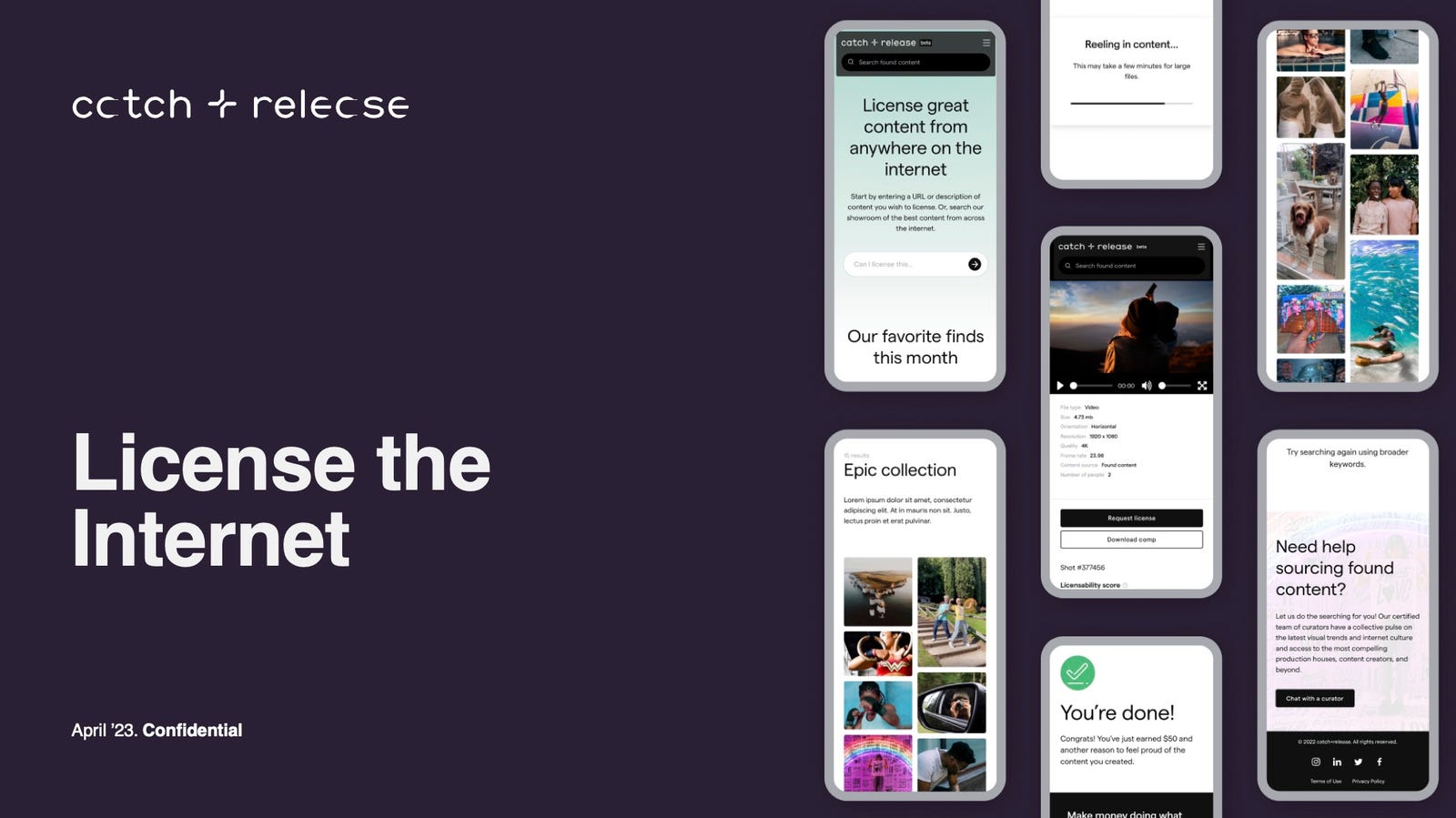
The title slide is minimalist, featuring the brand's lowercase aesthetic and the bold tagline: 'License the Internet.' The date 'April ’23' and the 'Confidential' mark establish the round's timing. The right side of the slide displays a collage of mobile UI mockups, showing a 'Licensability score,' a 'Request license' button, and a confirmation screen stating 'You’re done! Congrats! You’ve just earned $50.' This immediately communicates a two-sided marketplace: brands get the content, and creators get paid.
Slide 2: The Content Gap
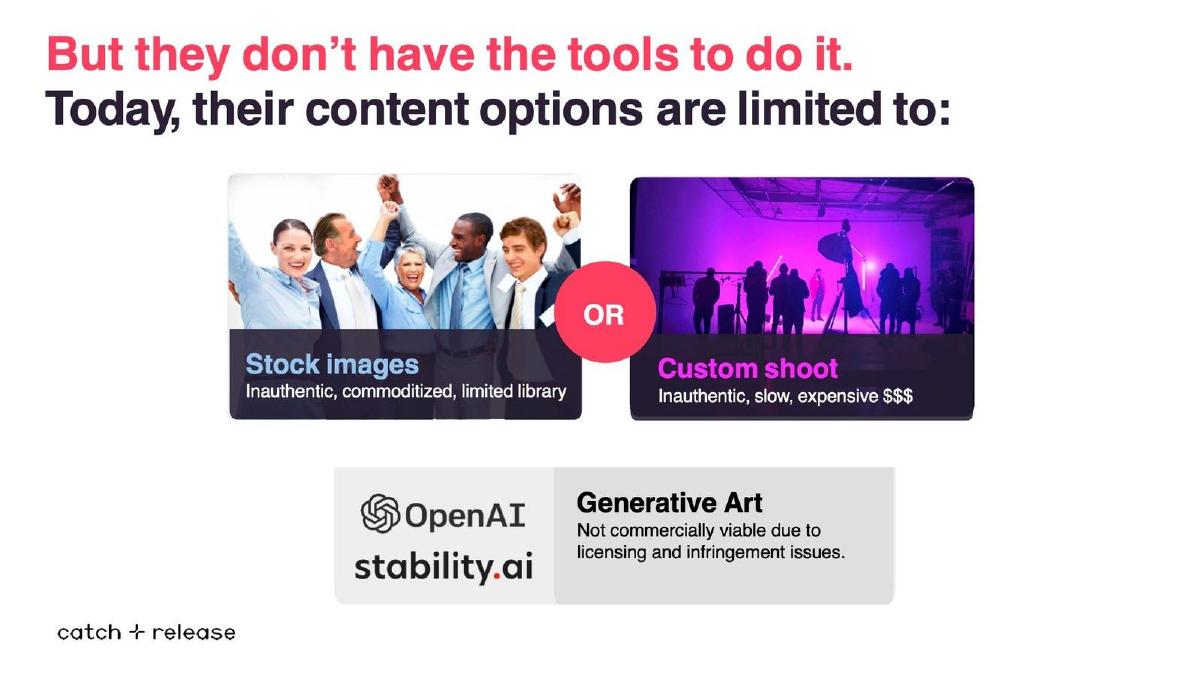
Slide 2 sets up the 'Enemy.' It argues that brands have limited options: Stock images (inauthentic), Custom shoots (expensive), or Generative Art. Notably, the slide takes a direct shot at OpenAI and Stability.ai, stating that AI art is 'not commercially viable due to licensing and infringement issues.' This is a strategic move to insulate the company from the AI hype cycle by highlighting the one thing AI lacked in 2023: clear legal provenance.
Slide 3: The Fear Factor
This is the 'Problem' slide, and it uses fear effectively. Under the header 'Licensing is a bottleneck,' the deck displays four news clippings. The most prominent is a Denver Post headline: 'Woman sues Chipotle for $2.2 billion over use of photograph.' By showing real-world consequences from The New York Times and Bloomberg Law, Catch+Release moves the conversation from 'marketing efficiency' to 'legal necessity.'
Slide 4: The Solution Workflow
Slide 4 explains 'How the Catch+Release licensing product works.' It breaks a complex legal process into three simple steps: 'Paste a url,' 'Specify rights,' and 'License it!' The bottom of the slide mentions an 'Automated rights and IP verification / acquisition engine in background.' This is the 'magic' of the deck—suggesting that what used to take weeks of legal back-and-forth is now handled by a proprietary backend engine.
Slide 11: The Team and Social Proof
The team slide is a masterclass in establishing authority. CEO Analisa Goodin is presented as a domain expert who has 'lived and breathed the pain' for 15+ years and personally cleared thousands of assets. The supporting team brings pedigree from Meta, Amazon, and J.P. Morgan. Furthermore, the inclusion of Accel and Cervin as investors, alongside advisors from Google and Stripe, provides the institutional validation necessary for a Series A round.
Slide 12: The Vision
The final slide expands the scope of the company. It moves from 'photos and videos' to 'all creative IP on the internet' and from a platform for 'brands and agencies' to a 'licensing API' for the 'entire communications industry.' This tells investors that while they are starting with advertising, the technology is built to be the underlying infrastructure for how any business uses any digital asset.
What Catch+Release Does Well
Strategic Positioning against AI: In 2023, every VC was looking at AI. Catch+Release successfully argued that AI is a legal liability, whereas their platform provides 'clean' IP. This turned a potential threat into a tailwind for their human-centric marketplace.
Founder-Market Fit: The deck leans heavily on Analisa Goodin’s personal experience. In a space as nuanced as IP law and creator relations, having a founder who has 'cleared thousands of pieces' manually is a significant trust signal for investors.
Clarity of Process: Licensing is boring and complicated. Slide 4 does an excellent job of making a 'boring' back-office function look like a sleek, modern SaaS product. The 'Paste a URL' call to action is particularly strong because it highlights the ease of discovery.
What is Missing from the Deck
Hard Metrics: The most glaring omission in the provided slides is the lack of a traction slide. There are no figures for Gross Merchandise Volume (GMV), Year-over-Year (YoY) growth, or take rates. For a Series A, investors typically expect to see a clear path to scale backed by historical data.
Customer Logos: While the team slide mentions companies they used to work for (Nike, Apple, Twitter), the deck doesn't explicitly list current enterprise customers or case studies. Showing a 'before and after' for a major brand would have strengthened the 'Solution' narrative.
The 'Ask': The slides provided do not include a formal 'Ask' slide detailing how much they are raising (though we know it was $8.8M) or how they plan to deploy the capital. This is common in 'leaked' decks but is a critical component of a live pitch.
Lessons for Founders
Use 'The Fear': If your product solves a compliance or legal problem, don't just talk about efficiency. Show the $2.2 billion lawsuit. Make the cost of not using your product feel visceral.
Simplify the Complex: If your backend involves complex legal workflows or heavy manual labor, present it as a 'black box' engine with a simple 3-step frontend. Investors buy the outcome, not the complexity of the process.
Leverage Your Pedigree: If your team comes from industry giants, don't just list the names. Explain why that experience matters. Catch+Release didn't just say 'we worked at Meta'; they said 'we cleared thousands of assets for brands like Nike.'
Frequently asked questions
- How much did Catch+Release raise with this deck?
- According to publisher reports from Business Insider, Catch+Release raised $8.8 million in a Series A round in 2023.
- What is the core problem Catch+Release is solving?
- The deck identifies the 'licensing bottleneck' as the core problem. It argues that brands are currently stuck between inauthentic stock images, expensive custom shoots, or risky unlicensed social content that leads to lawsuits.
- Does the deck address the threat of AI-generated content?
- Yes, Slide 2 specifically addresses Generative Art from providers like OpenAI and Stability.ai, claiming it is 'not commercially viable' due to licensing and infringement issues, thereby positioning Catch+Release's human-created content as the safer alternative.
- Who are the key investors mentioned in the deck?
- Slide 11 lists Accel and Cervin as investors, along with notable advisors such as Gokul Rajaram (Google/Stripe) and Gary Swart (Upwork).
- What is the company's long-term product strategy?
- As stated on Slide 12, the goal is to move beyond a manual platform to an open licensing API that integrates programmatically into the internet, covering all forms of creative IP for the entire communications industry.