Kut Auto Finance (operating as Kut Auto Finance LLC) presented a pitch deck in April 2020 focused on 'ethical refinancing' within the subprime auto sector. The company identifies a critical market failure where auto loan defaults reached $66 billion by Q4 2019, surpassing 2010 post-financial crisis levels. Their solution involves refinancing predatory 28% APR loans down to 8%, significantly reducing monthly payments and total debt for consumers. The deck outlines a plan to scale a portfolio to over $450 million by Year 4, supported by a 2:1 collateralization ratio. Seeking a maximum of $6,000…
Key takeaways
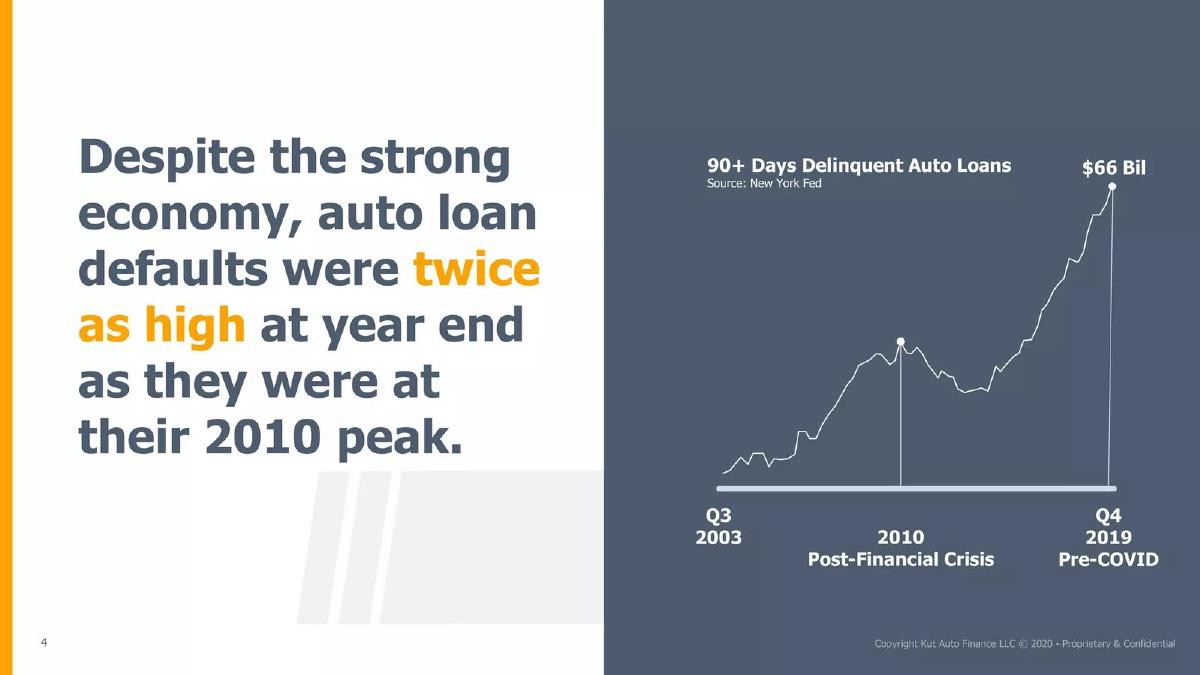
- The deck identifies a specific market timing window, noting that 90+ day delinquent auto loans hit $66 billion in Q4 2019 (Slide 4).
- The core value proposition is a drastic reduction in APR from a market average of 28% to a Kut-offered 8% (Slide 10).
- The financial model assumes a significant reduction in loan terms, moving from 72 months to 48 months for the average customer (Slide 10).
- Kut Auto Finance projects a portfolio growth reaching approximately $450 million by Year 4 of operations (Slide 13).
- The business model relies on a 2:1 collateralization ratio to mitigate risk while scaling (Slide 13).
- The fundraising ask is structured with a minimum threshold of $750,000 and a maximum cap of $6,000,000 (Slide 18).
- Efficiency is a primary focus, with 87.6% of the capital raised intended for initial loan acquisition (Slide 19).
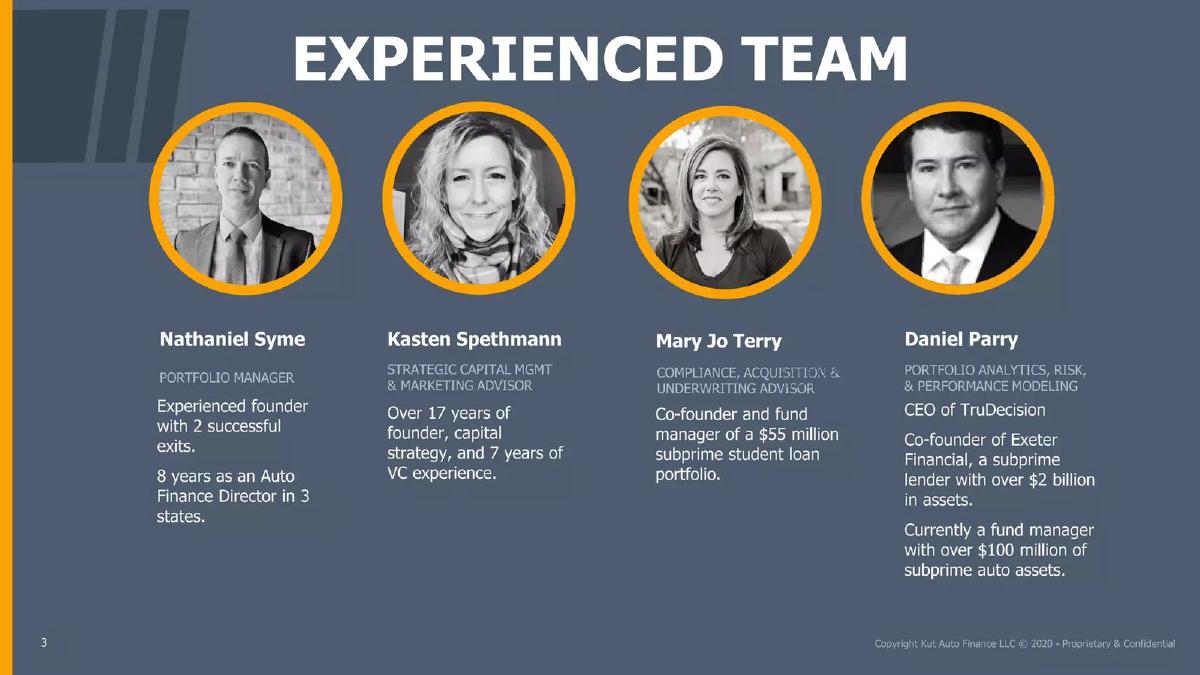
- The deck omits critical information regarding the founding team's background, specific underwriting technology, and competitive landscape.
Introduction: The Ethics of Subprime Lending
Kut Auto Finance LLC, as identified in the April 2020 deck, positions itself at the intersection of social impact and fintech. The deck, titled "Introducing Integrity to Subprime Auto Lending," attempts to frame a traditional lending business as a solution to a systemic economic problem. By focusing on the "integrity" gap, the company signals to investors that their competitive advantage lies in fairer pricing and better consumer outcomes, which theoretically leads to lower default rates and more stable long-term returns.
Slide 1: Title and Positioning
The cover slide establishes the brand identity. The logo for "kut FINANCIAL" includes the tagline "expect better." The primary headline, "Introducing Integrity to Subprime Auto Lending," immediately identifies the sector and the company's intended disruption. The date, April 2020, is significant as it marks the very beginning of the global COVID-19 pandemic, a period of extreme economic uncertainty that would have heavily influenced investor sentiment regarding subprime debt.
Slide 4: The Macro Problem
This slide uses data from the New York Fed to establish a sense of urgency. It features a line graph showing "90+ Days Delinquent Auto Loans" from Q3 2003 to Q4 2019. The key data point is that defaults reached "$66 Bil" by the end of 2019. The text emphasizes that despite a strong economy, defaults were "twice as high at year end as they were at their 2010 peak." By labeling the Q4 2019 data point as "Pre-COVID," the deck suggests that the market was already in a fragile state, creating a massive opportunity for a lender that can offer more sustainable terms.
Slide 7: The Mission Statement
Slide 7 serves as the bridge between the problem and the solution. It states the mission of Kut Auto Finance: "Improve customers’ economic health and increase profits through ethical refinancing." This is a classic double-bottom-line pitch. It suggests that profitability and social good are not mutually exclusive in this model. However, the slide is light on detail, serving more as a thematic transition than a functional explanation of the business mechanics.
Slide 10: The Product Comparison
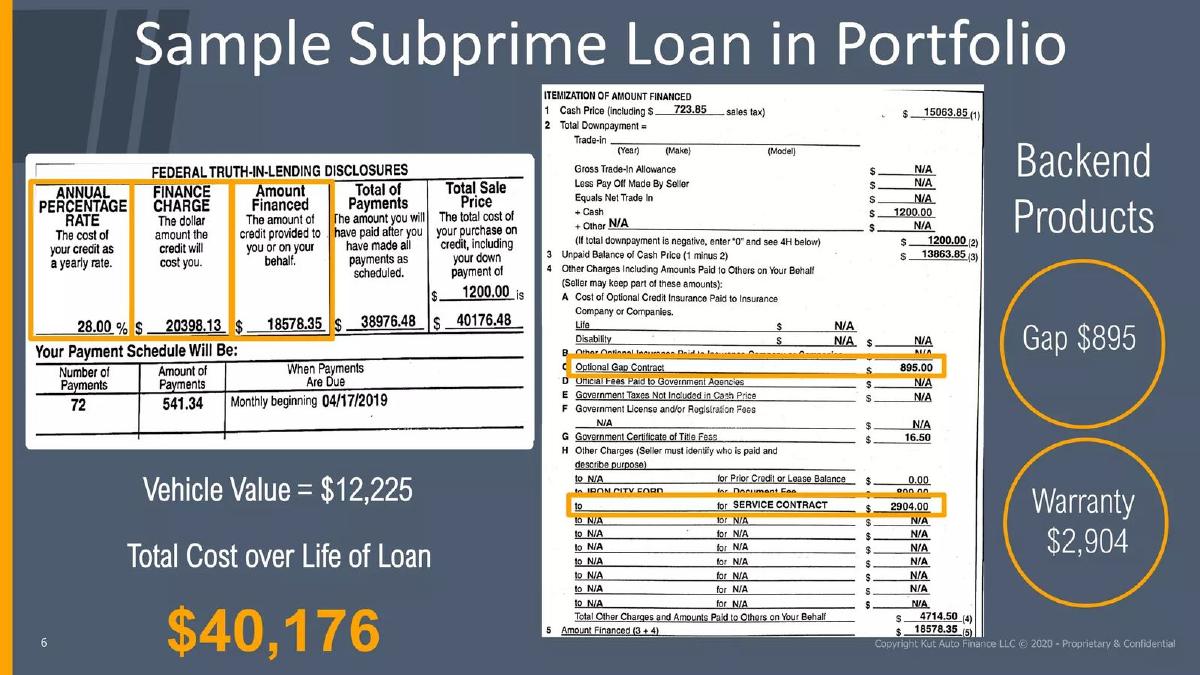
This is the most critical slide in the deck for understanding the value proposition. It presents a side-by-side comparison titled "OUT WITH THE OLD... & ...IN WITH THE NEW." The comparison assumes a borrower has already made 12 months of payments on a predatory loan before defaulting or seeking refinancing. The "Current Lender" column shows an APR of 28%, an amount financed of $18,578, total payments of $40,176, a 72-month term, and a $541 monthly payment. In contrast, the "Kut Auto Finance" column offers an 8% APR, a $16,600 amount financed, total payments of $19,452, a 48-month term, and a $405 monthly payment. The slide claims "Loan Savings over $20,000" and a goal of "Lowering PTI [Payment-to-Income] below 12%." Additional benefits listed include faster repayment of principle, larger positive impact on credit, and higher resale value of the vehicle.
Slide 13: Growth and Scalability
Slide 13, titled "GROWING BALANCE SHEET," provides a four-year projection of the company's investment versus its portfolio size. The chart shows a "2:1 Collateralized" model. By Year 4, the orange "Investment" area reaches just over $200 million, while the dark blue "Portfolio" area climbs to approximately $450 million. This visual represents a highly aggressive growth trajectory, suggesting that the company plans to leverage its initial equity to secure significant debt facilities to fund the loan book. The note at the bottom indicates "Showing numbers in $Millions."
Slide 18: The Call to Action
This slide serves as the primary investment summary. It repeats the "2:1 Collateralized" claim and sets a target of "GROWING REVENUE OVER $140,000,000." The investment terms are clearly defined: Kut will begin loan acquisition once $750,000 is raised, with a "Maximum raise of $6,000,000." It also sets a "$100,000 minimum investment." To maintain the social impact narrative, it adds that this investment "will help 88 families have opportunities they would not otherwise have," though it does not explain how the number 88 was calculated.
Slide 19: Use of Proceeds
The final slide in this selection provides a detailed breakdown of how the capital will be spent under both the "Max. Proceeds" ($6M) and "Min. Proceeds" ($750k) scenarios. Under the maximum raise, $320,000 goes toward offering expenses and commissions (including $300,000 in estimated brokerage commissions). The "Corporate Applications" section is the most telling: $260,000 for acquisition expenses, $160,000 for working capital, and a massive $5,260,000 for "Initial Loan Acquisition." The deck highlights that 87.6% of the total proceeds are dedicated to buying loans. This indicates a very lean corporate structure where the vast majority of investor capital is being put directly to work as productive assets rather than being spent on high salaries or marketing overhead.
What Works in This Deck
The deck excels at identifying a clear, quantifiable market pain point. By using New York Fed data, the founders ground their pitch in macroeconomic reality. The side-by-side comparison on Slide 10 is also highly effective; it translates the abstract concept of "ethical lending" into concrete dollar savings for the consumer and risk reduction for the lender. The transparency of the Use of Proceeds slide (Slide 19) is another strength, as it clearly shows that the founders intend to be good stewards of capital by directing the majority of funds into the core revenue-generating activity: the loan portfolio.
What Is Missing
The most glaring omission is the Team slide. In a highly regulated and risk-heavy industry like subprime lending, the background of the management team is paramount. Investors need to know if the founders have experience in credit modeling, debt collection, or financial compliance. Additionally, the deck lacks a "How It Works" slide regarding their proprietary technology or underwriting process. How do they identify which 28% APR borrowers are actually "good" risks that deserve an 8% APR? Without explaining the secret sauce of their underwriting, the 8% rate looks like a gamble rather than a calculated risk. Finally, there is no mention of the competitive landscape or how they plan to acquire these customers (their Go-To-Market strategy) beyond a vague mention of "Acquisition Expenses."
Founder Takeaways
Founders should emulate the way this deck uses a "Current vs. Future" table to demonstrate value. It is much more persuasive than a list of bullet points. However, founders must ensure they don't skip the human element. Even the best financial model needs a team slide to prove the execution capability. Furthermore, if you are raising for a capital-intensive business like a lending platform, being as specific as Slide 19 about the percentage of funds going toward assets versus operations is a great way to build trust with sophisticated investors.
Frequently asked questions
- What is the primary problem Kut Auto Finance is solving?
- The company targets the subprime auto lending crisis. According to slide 4, 90+ day delinquent auto loans reached $66 billion in Q4 2019, which was twice as high as the 2010 post-financial crisis peak. They aim to address the 'integrity' gap in lending by providing more affordable terms to borrowers trapped in high-interest debt.
- How does the refinancing product compare to traditional subprime loans?
- Slide 10 provides a direct comparison. A typical 'Current Lender' loan at 28% APR with a $541 monthly payment is replaced by a Kut loan at 8% APR with a $405 monthly payment. This results in total payment savings of over $20,000 and reduces the loan term from 72 to 48 months.
- What are the financial projections for the company?
- Slide 13 shows a 'Growing Balance Sheet' where the investment and portfolio scale aggressively. By Year 4, the company projects a portfolio value of approximately $450 million. Slide 18 further mentions a goal of growing revenue to over $140,000,000 while maintaining a 2:1 collateralized position.
- How will the raised funds be utilized?
- The company is highly focused on asset acquisition. Slide 19 shows that out of a $6,000,000 maximum raise, $5,260,000 (87.6%) is allocated to 'Initial Loan Acquisition.' Only $160,000 is earmarked for working capital, suggesting the company relies on the performance of the loan book to fund operations.
- What information is missing from this pitch deck?
- The deck is missing several standard components, including a Team slide detailing the founders' experience in fintech or lending. It also lacks a Competitor slide, a detailed Go-To-Market strategy, and specific information on the 'ethical' underwriting criteria used to select borrowers who are likely to succeed after refinancing.