Cardiff International's January 2017 deck outlines a holding company strategy aimed at acquiring income-producing assets across three distinct pillars: real estate, closely held companies, and second-stage startups. The company, trading on the OTC under the ticker CDIF, uses this presentation to highlight existing assets like Repicci’s Italian Ice ($3M revenue run-rate) and Edge View Properties (30 acres in Idaho) while pitching a $1M capital raise. The raise is structured as a convertible debenture with a 10% annual interest rate and a conversion discount of 30% to the open market price. The…
Key takeaways
- The company operates as a diversified holding company focusing on three areas: Income Producing Real Estate, Closely Held Companies, and Second Stage Startups (Slide 4).
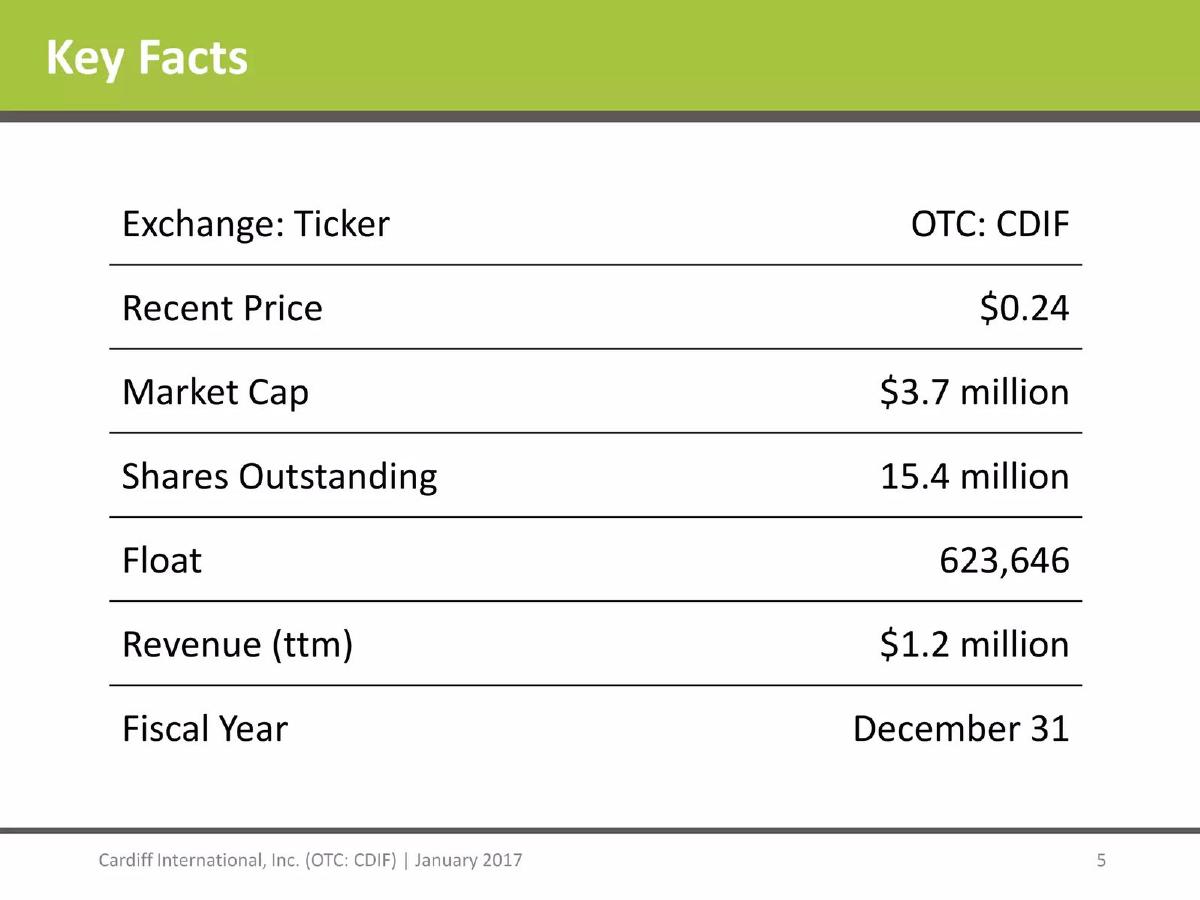
- Cardiff International is a publicly traded entity on the OTC markets under the ticker CDIF (Slide 1).
- One of their primary subsidiaries, Repicci’s Italian Ice & Gelato, is cited as having a $3M revenue run-rate and 48+ franchise units (Slide 10).
- Real estate holdings include Edge View Properties, consisting of 30 acres in Idaho with plans for storage facilities and RV/Cabin timeshare units (Slide 13).
- The acquisition pipeline is highly fragmented, listing targets such as a $31M gourmet super market, a sub-prime motorcycle financing company, and a dental chain (Slide 16).
- The company is seeking a $1M equity raise from accredited investors through a convertible debenture (Slide 19).
- The investment terms include a 10% annual interest rate paid quarterly and a conversion to common stock at 70% of the open market price (Slide 19).
- The deck lacks specific biographical details for the executive team, providing only a high-level organizational chart (Slide 7).
Cardiff International: The Micro-Cap Conglomerate Play
The investor presentation for Cardiff International, Inc. (CDIF) dated January 2017, presents a strategy common in the OTC (Over-the-Counter) markets: the roll-up or holding company model. The deck aims to convince accredited investors that a $1M injection will unlock a diverse pipeline of cash-flowing assets. By spanning industries from frozen desserts to sub-prime lending, the company attempts to build a narrative of diversified risk and steady yield.
Slide 1: Title and Ticker
The cover slide establishes the company's identity as Cardiff International, Inc. and prominently displays its ticker, OTC: CDIF. The date, January 2017, places this deck in a specific period of micro-cap activity. The branding is professional but generic, utilizing a green and grey color palette that persists throughout the deck.
Slide 4: 3 Areas of Concentration
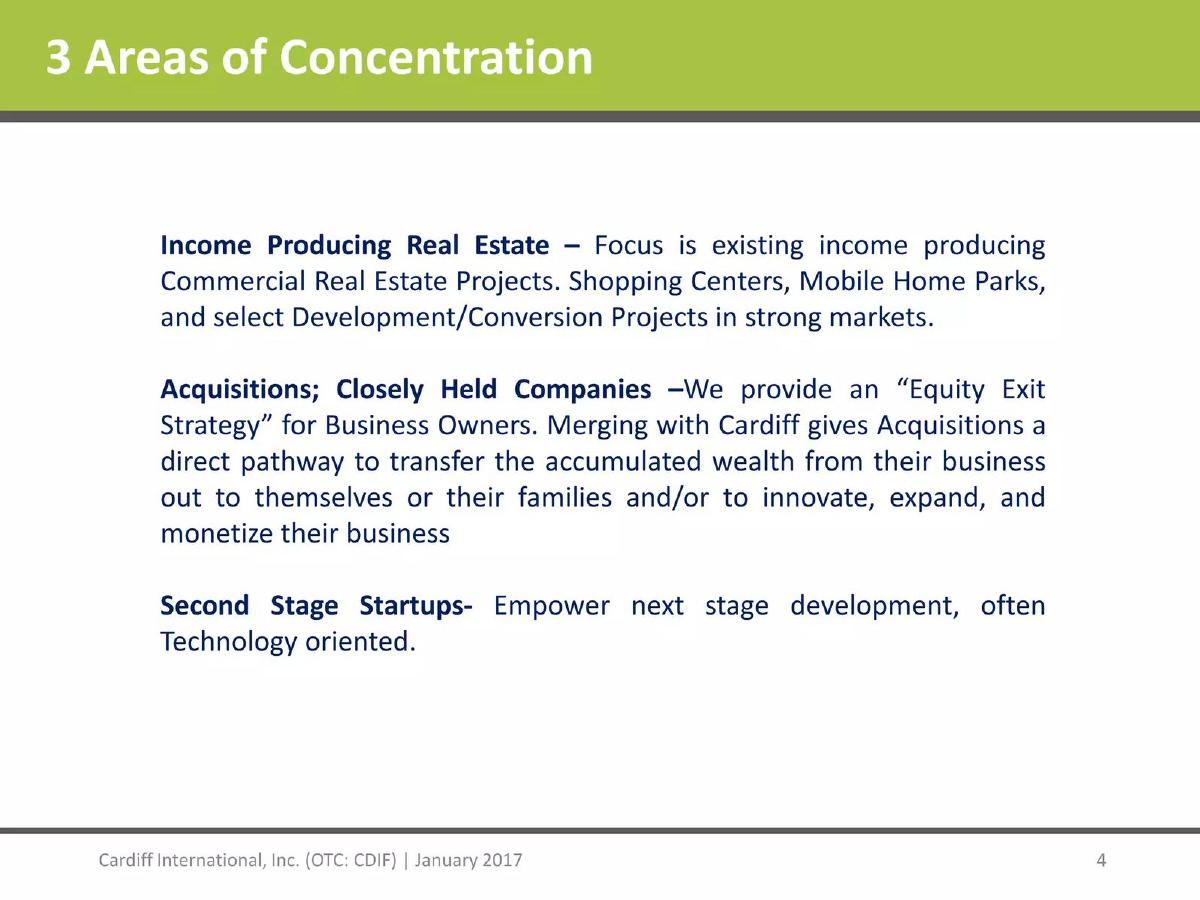
This slide defines the company's investment mandate. Cardiff focuses on three distinct silos: Income Producing Real Estate (shopping centers, mobile home parks), Closely Held Companies (offering an 'Equity Exit Strategy' for business owners), and Second Stage Startups (technology-oriented growth companies). This broad mandate suggests a generalist approach to private equity rather than a specialized industry focus.
Slide 7: Organizational Chart
Slide 7 displays a standard hierarchical tree. It lists a Chairman at the top, followed by a President & CEO, and four functional heads: Chief Marketing Officer, Chief Development Officer, Chief Operating Officer, and Chief Financial Officer. Below these roles sits 'Subsidiary Companies.' Notably, this slide contains no names or biographies. In fundraising, the 'who' is often more important than the 'what,' and the omission of the leadership team's identities is a significant gap in this presentation.
Slide 10: Repicci’s Italian Ice & Gelato
This slide serves as a case study for their 'Closely Held Companies' pillar. It claims a $3M revenue run-rate for Repicci’s, a brand with history dating back to 1911. The slide notes that franchising began in 2005 and that the company now has 48+ units, a manufacturing plant, and Mercedes Benz food trucks. This is the most concrete piece of financial data in the deck, providing a tangible example of the types of businesses Cardiff seeks to own.
Slide 13: Edge View Properties
Shifting to the 'Real Estate' pillar, Slide 13 details a 30-acre land holding in Idaho near the Salmon River. The slide breaks down the zoning: 23.5 acres for residential (12 MDR lots and 48 HDR lots), 4 acres for recreation, and 2.5 acres for commercial use. The stated plan is to develop storage facilities and RV/Cabin timeshare units. This slide provides specific asset details but lacks a timeline for development or projected valuation upon completion.
Slide 16: Acquisition Targets
This slide lists five potential acquisitions, which is intended to show the 'deal flow' Cardiff has access to. The targets are remarkably diverse:
Target 1: Gourmet Super Markets ($31M Value, $45M Revenue, $5.2M Earnings) · Target 2: Real Estate related to Target 1 ($51.5M Value, $6.6M Generation) · Target 3: Sub-Prime Motorcycle Financing Company ($15M Value, $14M AR) · Target 4: Mobile Home Park (47 units, $144,000 generation) · Target 5: Rapid Growth Dental Chain (14 locations, $12M Value)
The total value of these targets far exceeds the $1M being raised, suggesting the raise is likely for operating capital or earnest money rather than full acquisitions.
Slide 19: Direct Investment Capital Raise
The final substantive slide outlines the 'Ask.' Cardiff is seeking $1M in equity from accredited investors. The vehicle is a Convertible Debenture with a 10% annual interest rate paid quarterly. The debt converts to common stock at a 30% discount (70% of open market price) after 365 days. The minimum check size is $25,000. The slide also mentions 'positioning for future uplift to a larger exchange,' a common goal for OTC companies seeking to move to the NASDAQ or NYSE.
What Cardiff International Does Well
The deck is clear about its structure. By categorizing its activities into three 'Areas of Concentration,' it helps the investor understand how a gelato franchise and an Idaho land plot can coexist under one roof. The use of a specific subsidiary (Repicci’s) with a stated revenue run-rate ($3M) provides a necessary anchor of reality for an otherwise speculative holding company model. Furthermore, the terms of the capital raise are explicit. Investors aren't left guessing about the interest rate (10%) or the conversion mechanics (70% of market price), which is helpful for transparency in the micro-cap space.
What is Missing from the Deck
The most glaring omission is the Management Team . While Slide 7 shows an org chart, it does not name the individuals or provide their track records. In a conglomerate model, the investor is essentially betting on the capital allocation skills of the CEO; without knowing who that is, the risk profile is impossible to assess. Additionally, the deck lacks Consolidated Financials . While individual assets like Repicci’s are mentioned, there is no balance sheet for Cardiff International, Inc. itself, nor is there a clear explanation of how the company will service the 10% interest payments on the debenture if the $1M is spent on new acquisitions that may not yet be cash-flow positive. Finally, there is no Competition Slide . Cardiff is competing with other micro-cap holding companies and private equity search funds for these deals, but the deck does not address their competitive advantage in sourcing or closing these transactions.
Founder Lessons: The Importance of Focus and Personnel
Founders can learn two primary lessons from this deck. First, diversification can look like a lack of focus . While Cardiff calls them 'Areas of Concentration,' a startup or small-cap company trying to manage a dental chain, a gelato franchise, and a sub-prime lender simultaneously faces massive operational complexity. Investors often prefer a 'pure play' where the management team is an expert in one specific vertical. Second, never hide the team . Even if the founders are not industry veterans, their backgrounds provide the context for why they are capable of executing the strategy. A generic org chart is a missed opportunity to build trust. If you are raising money for a holding company, your 'product' is your ability to pick winners; your resume is the only evidence you have to prove that ability before the deals are closed.
Frequently asked questions
- What is the core business model of Cardiff International?
- Cardiff International operates as a conglomerate or holding company. As stated on Slide 4, they focus on three specific areas: acquiring income-producing commercial real estate (like shopping centers and mobile home parks), providing an 'Equity Exit Strategy' for owners of closely held companies, and investing in second-stage, often technology-oriented startups.
- What are the specific terms of the $1M capital raise?
- According to Slide 19, the company is raising $1M via a Convertible Debenture. The terms include a 10% annual interest rate paid quarterly, a 365-day term, and a conversion feature allowing the debt to convert to common stock at a 30% discount (70% of open market price). The minimum investment is $25,000.
- What existing assets does the company currently hold?
- The deck highlights two main assets: Repicci’s Italian Ice & Gelato, which has a $3M revenue run-rate and 48+ units (Slide 10), and Edge View Properties, which owns 30 acres of land in Idaho zoned for residential, recreational, and commercial use (Slide 13).
- How does the company plan to use the new capital?
- While a specific breakdown of funds is not provided, Slide 16 and Slide 19 imply the capital is intended to facilitate its acquisition pipeline. The company lists five specific targets including a gourmet supermarket, a motorcycle financing firm, and a dental chain, noting that these acquisitions are expected to positively impact the price per share (PPS) long term.
- What is the management structure of the company?
- Slide 7 provides an organizational chart showing a Chairman, a President & CEO, and four C-suite officers (Marketing, Development, Operating, and Financial). However, the deck omits names, professional backgrounds, or track records for these individuals, which is a significant departure from standard venture-style pitch decks.