CeIR (Centre for elearning and Information Technology Research) presents a pitch deck for a multi-disciplinary educational venture based in Zambia. The company aims to address a gap in the market caused by the introduction of compulsory computer studies in primary and junior secondary schools, which suffers from a lack of textbooks and ICT equipment. The deck highlights significant traction, claiming a $2.5 million annual revenue run rate and 1.2 million paying clients, though it lacks a clear breakdown of how these figures are achieved across its diverse service lines. Seeking $150,000 via a…
Key takeaways
- The company identifies a specific regulatory driver: computer studies becoming a compulsory subject in Zambian primary and junior secondary education (Slide 2).
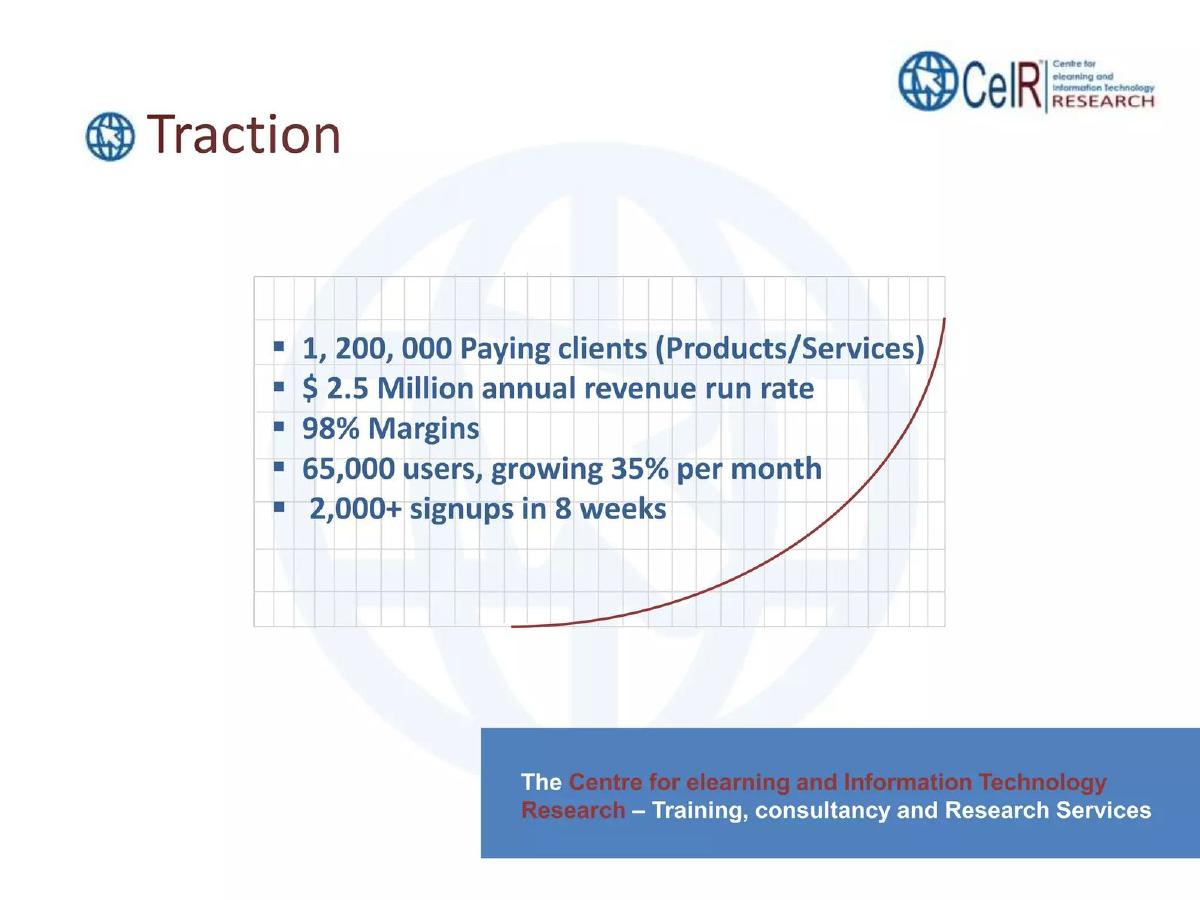
- CeIR claims a substantial $2.5 million annual revenue run rate and a user base of 65,000 growing at 35% per month (Slide 3).
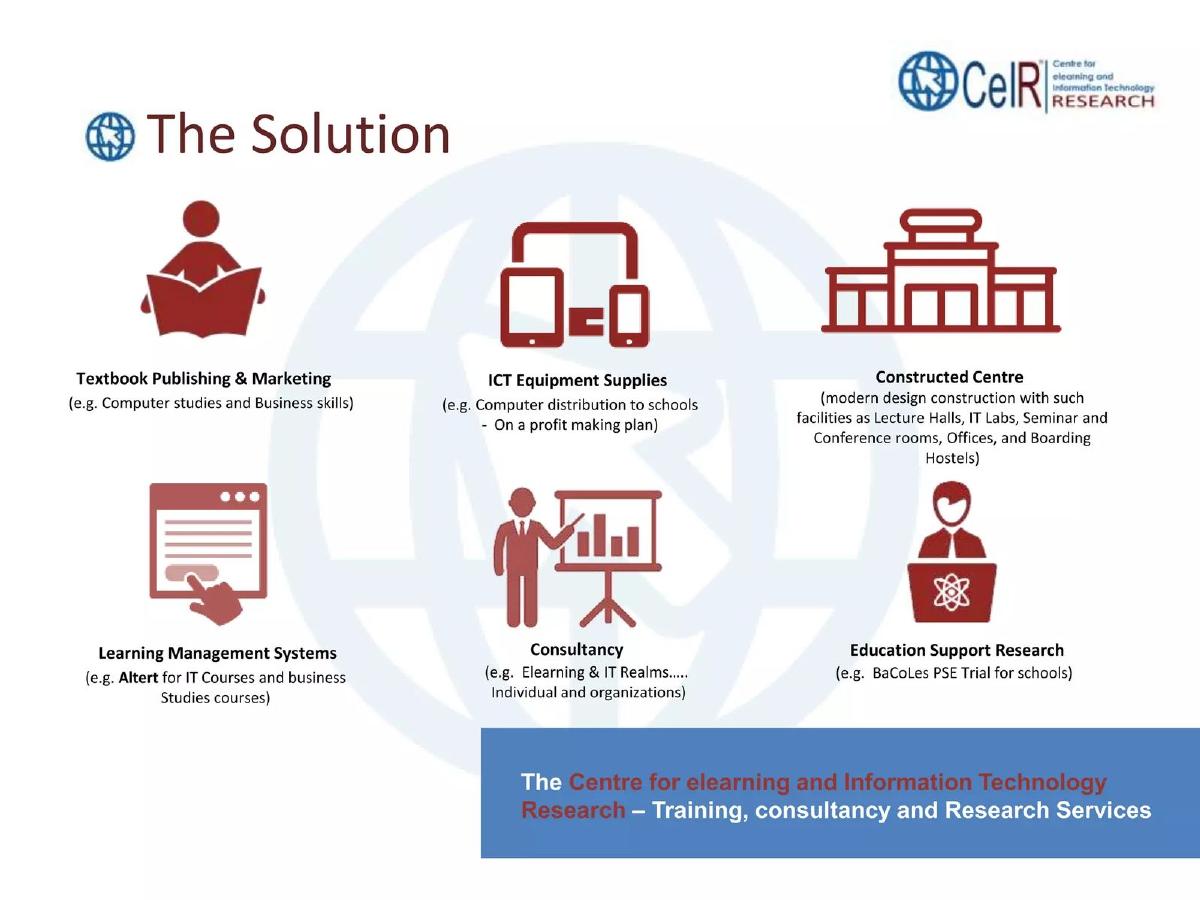
- The business model is highly diversified, including textbook authoring, publishing, marketing, and ICT equipment distribution (Slide 2).
- The competitive landscape is segmented into five distinct areas, including global MOOCs like Coursera and local institutions like the University of Zambia (Slide 5).
- The funding ask is $150,000 in the form of a convertible note to provide 15 months of runway (Slide 6).
- A significant portion of the long-term strategy involves physical infrastructure, specifically constructing a 'Centre' in Lusaka, Zambia (Slide 6).
- The deck reports extremely high profitability with stated margins of 98% (Slide 3).
- The Go-to-Market slide uses a generic template that asks questions rather than providing specific strategic answers (Slide 4).
CeIR Pitch Deck Analysis
The CeIR (Centre for elearning and Information Technology Research) pitch deck presents a localized solution for the Zambian educational market. The deck focuses on the intersection of government policy changes and the resulting demand for educational resources. With a relatively small ask of $150,000, the company positions itself as a high-growth entity with significant existing traction. However, the deck reveals a complex, multi-pronged business model that ranges from physical hardware distribution to academic research, which presents both opportunities and significant operational risks.
Slide 1: Title Slide
The title slide introduces the company as the "Centre for elearning and Information Technology Research." The subtitle defines their scope as "Training, consultancy and Research Services." The branding is professional, utilizing a globe-and-cursor logo that emphasizes their focus on information technology and global connectivity. The slide establishes the company as a service-oriented institution rather than a pure software startup.
Slide 2: The Problem
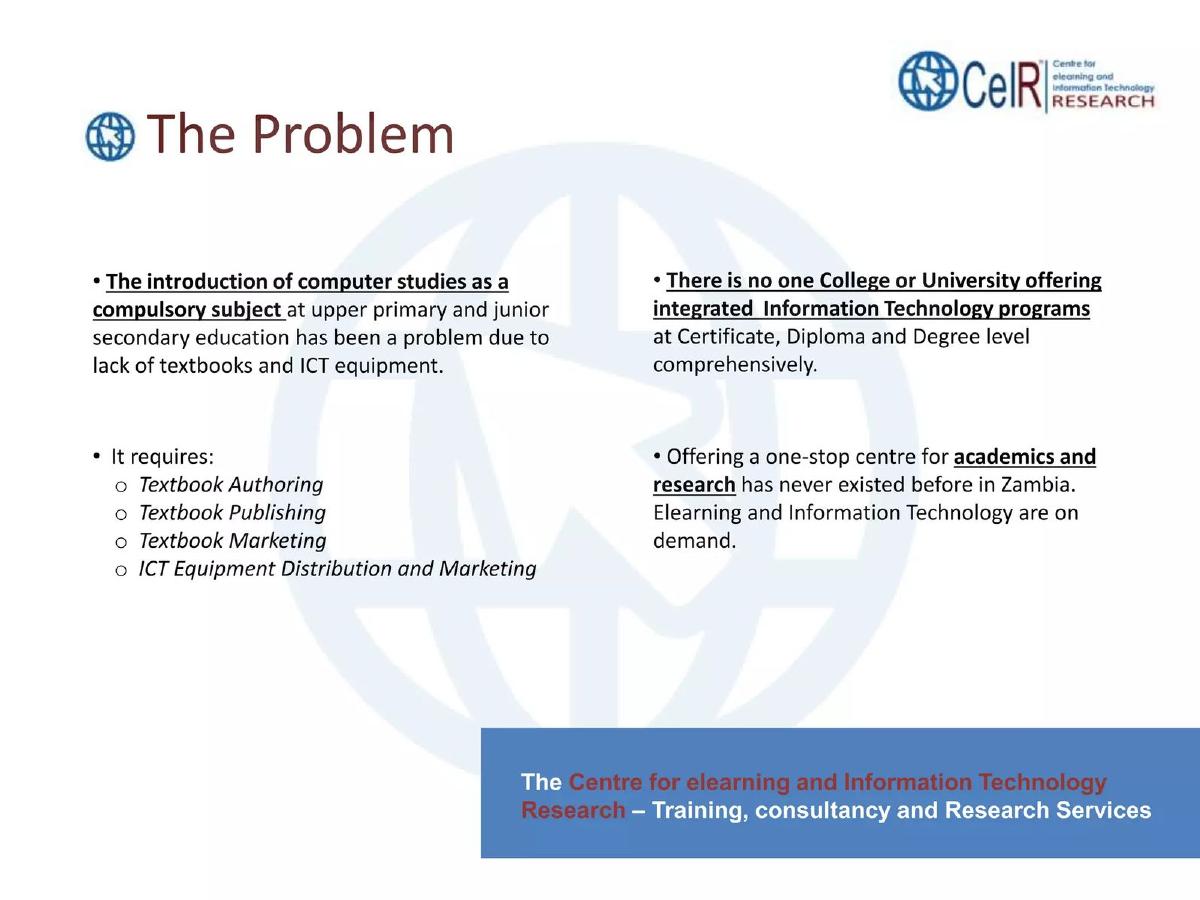
Slide 2 identifies a clear market catalyst: the introduction of computer studies as a compulsory subject in Zambian primary and junior secondary schools. The company notes that this mandate has created a vacuum because of a "lack of textbooks and ICT equipment." The slide further claims that no single college or university in Zambia offers integrated IT programs at all levels (Certificate, Diploma, and Degree). By framing the problem around a government mandate, CeIR demonstrates a clear, non-discretionary demand for their services. The slide lists four specific requirements to solve this: textbook authoring, publishing, marketing, and ICT equipment distribution. This suggests the company is not just a content provider but a full-stack educational supply chain player.
Slide 3: Traction
This is the most data-heavy slide in the deck, claiming significant market penetration. The figures cited are: 1,200,000 paying clients , a $2.5 million annual revenue run rate , and 98% margins . It also notes 65,000 users growing at 35% per month and 2,000+ signups in the last 8 weeks. While these numbers are impressive, the 98% margin figure is highly unusual for a company that lists "ICT Equipment Distribution" and "Textbook Publishing" as core activities on the previous slide, as these typically involve significant cost of goods sold (COGS). The discrepancy between 1.2 million paying clients and 65,000 users is also not explained; it is possible the 1.2 million refers to historical textbook sales while the 65,000 refers to an active digital platform.
Slide 4: Go-to-market Strategy
Slide 4 is perhaps the weakest in the deck from a strategic perspective. It uses a generic infographic template titled "Who Are We Selling To?" that contains placeholder questions rather than specific answers. The slide asks questions about industry, product solution, buying process, distribution model, size of organization, technology adoption, and price point. For an investor, this slide fails to explain how CeIR will acquire customers. It identifies the "Target Market" in a central bubble but provides no data on the specific segments or the cost of acquisition (CAC) for the Zambian market.
Slide 5: Landscape/Competitors
CeIR provides a comprehensive view of their competitive environment, broken down into five sectors. In "Textbook Publishing & Marketing," they list incumbents like Longman and MK Publishers. In "Learning Management Systems," they acknowledge global players like Coursera and edX. The remaining categories—ICT Equipment Supplies, Consultancy, and Education Support Research—list local Zambian entities and universities. This slide demonstrates that CeIR is fighting a multi-front war. While it shows a deep understanding of the local landscape, it also highlights the risk of being spread too thin across disparate business lines (e.g., competing with both a hardware supplier and a global MOOC).
Slide 6: What we are looking for
The final slide outlines the investment ask: $150,000 via a Convertible Note . The company estimates this will provide 15 months of runway to focus on product-market fit, customer development, marketing, and profitability. Interestingly, the slide includes an icon of a building and explicitly states a plan to raise a further round in 15-20 months for the "purpose of constructing the Centre in Lusaka, Zambia." This confirms that CeIR views physical infrastructure as a core part of its value proposition, moving away from the asset-light model typical of many EdTech startups.
What Works in the CeIR Pitch Deck
The deck excels at identifying a regulatory tailwind . By anchoring the business in a compulsory government mandate, they demonstrate a built-in customer base that must find a solution. The traction slide, while needing more context, presents growth metrics (35% monthly growth) that suggest strong market pull. The competitive landscape slide is also well-researched, showing that the founders understand both their local peers and the global digital threats.
What is Missing from the CeIR Pitch Deck
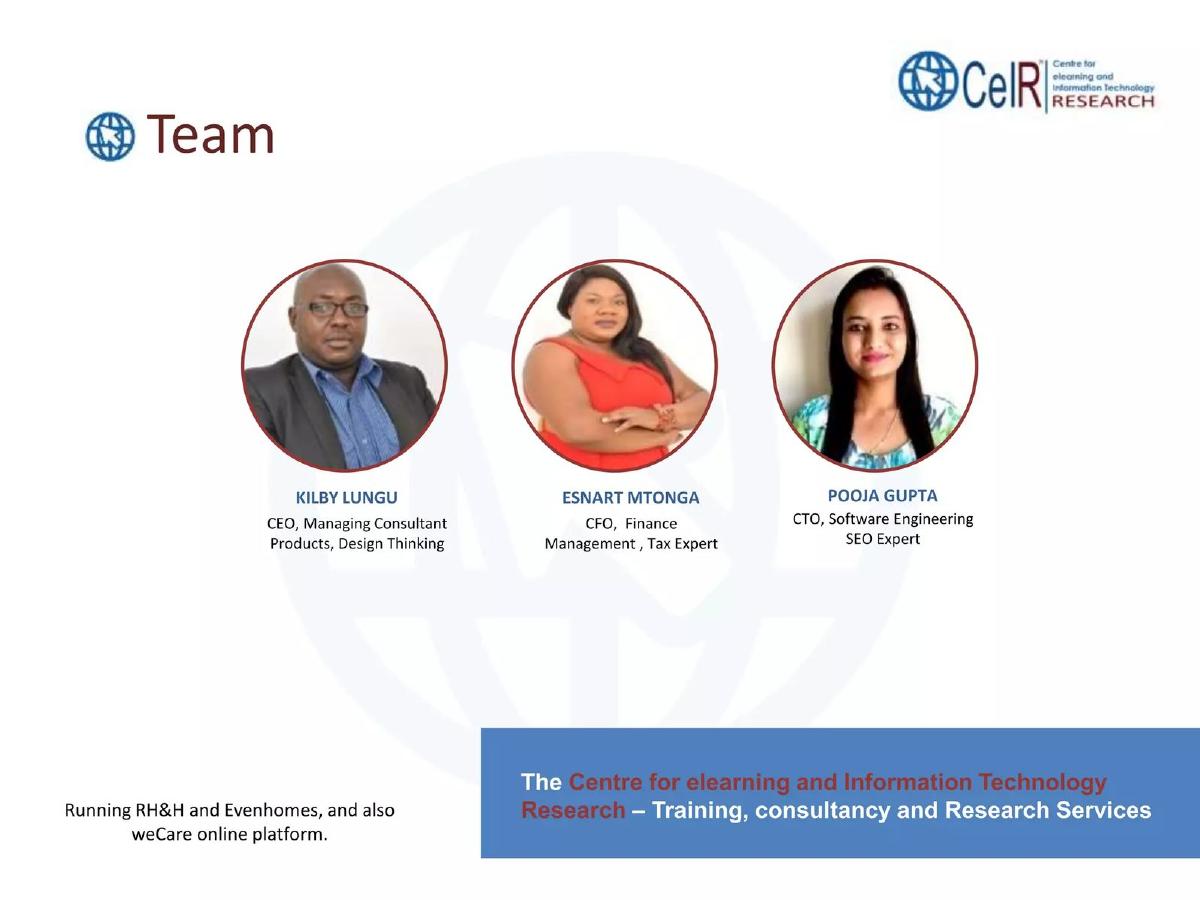
Team Slide: There is no mention of the founders, their backgrounds, or their expertise in education or technology. In a seed-stage round, the team is often the most important factor. · Unit Economics: The deck claims 98% margins but also mentions hardware distribution and physical publishing. A breakdown of how they achieve these margins while dealing with physical goods is missing. · Product Visuals: For a company with "elearning" in the name, there are no screenshots of the platform or examples of the textbooks they have authored. · Specific GTM Plan: As noted, Slide 4 is a template of questions. Investors need to know the actual sales channels—are they selling to the Ministry of Education, directly to schools, or to parents? · Financial Projections: While they mention a run rate, there are no forward-looking projections or a breakdown of how the $150k will be allocated beyond general categories.
What a Founder Should Copy
Founders should emulate the clear problem-solution alignment found on Slide 2. Identifying a specific change in law or regulation that creates an immediate need is a powerful way to prove market urgency. Additionally, the segmentation of the competitive landscape on Slide 5 is a good model for companies operating in complex markets; it shows investors that you aren't just looking at one type of competitor but are aware of the entire ecosystem that could threaten your market share.
Final Analyst Thoughts
CeIR is a classic example of a "full-stack" regional play. They are attempting to solve the entire problem—content, hardware, and physical training—within a specific geography. While the traction numbers are high, the business model appears capital-intensive and operationally complex. The $150,000 ask seems small relative to the ambition of building a physical center and managing a national distribution network for equipment and books. Investors would likely require a much deeper dive into the management team and the actual source of the 1.2 million paying clients to validate the stated 98% margins.
Frequently asked questions
- What is the primary problem CeIR is solving?
- CeIR is addressing the resource gap created by the Zambian government's mandate for compulsory computer studies. According to Slide 2, there is a critical shortage of textbooks and ICT equipment at the upper primary and junior secondary levels. Furthermore, the company notes that no single institution in Zambia currently offers integrated IT programs across Certificate, Diploma, and Degree levels comprehensively.
- How does CeIR justify its $2.5 million revenue run rate?
- The deck does not provide a detailed financial breakdown. Slide 3 states the $2.5 million run rate and 1.2 million paying clients for products and services. Given the 98% margins also claimed on Slide 3, the revenue likely stems from high-volume, low-cost digital products or services, though the inclusion of 'ICT Equipment Distribution' on Slide 2 usually implies lower margins due to hardware costs.
- What is the intended use of the $150,000 investment?
- As detailed on Slide 6, the $150,000 convertible note is intended to provide 15 months of runway. The specific goals for this period include achieving product-market fit, customer development, early marketing efforts, and reaching profitability. This capital is a precursor to a larger round planned for 15-20 months later to fund the construction of a physical facility in Lusaka.
- Who are CeIR's main competitors?
- Slide 5 categorizes competition into five groups. In textbook publishing, they face MK Publishers and Longman. In the LMS space, they compete with global giants like Coursera, edX, and Alison. Locally, they compete with institutions like the University of Zambia and the Zambia Centre for Accountancy Studies for consultancy and research services.
- Is the business model purely digital?
- No. While 'elearning' is in the name, the business is a hybrid. Slide 2 lists textbook publishing and ICT equipment distribution as core requirements. Slide 6 explicitly mentions the plan to raise a future round for 'constructing the Centre in Lusaka, Zambia,' indicating a significant brick-and-mortar component to their long-term scaling strategy.