The NinzaBiz "Pitch Deck Format" is a 12-page Sequoia-style template produced by BrandStudios in 2016, not a real fundraising deck — every slide states what belongs on it instead of pitching a company. Its running order and business-model page hold up a decade later, but it never asks for traction, treats the ask as a sub-bullet on the last page, and invites top-down TAM. Filled in faithfully, it produces a structured deck that is still not a fundable one.
Key takeaways
- The NinzaBiz deck is a blank 12-page template, not a funded company deck: it contains section prompts, not claims, numbers or an ask.
- Its running order is the Sequoia sequence — Purpose, Problem, Solution, Why Now, Market, Competition, Product, Business Model, Team, Financials — and that order still holds up in 2026.
- The template explicitly labels its agenda page as internal ("NOT a slide for your deck"), which is the single most-ignored instruction in template decks.
- There is no traction section anywhere in the outline, which is the largest gap between a 2016 template and how investors read decks today.
- The ask appears only as "the deal," a sub-bullet on the financials page; in a fundable deck it is its own slide with amount, runway and milestone.
- The market-size prompt asks for top-down TAM first, a habit that now signals a lack of rigour — investors want bottoms-up reachable accounts multiplied by contract value.
- The business model page is the template's strongest: revenue model, pricing, account value, distribution and pipeline on one slide, missing only cost of acquisition.
- Competition is reduced to two lists, when the slide that works is positioning on the two axes buyers actually choose between.
What this deck actually is
The NinzaBiz "Pitch Deck Format" is not a fundraising deck. It is a 12-page outline — a blank Sequoia-style skeleton produced by BrandStudios for NinzaBiz in April 2016 — where every slide states what belongs on it rather than what the company is. There is no company purpose sentence, no problem statement, no numbers, no team, no ask. Slide 2 says so out loud: "Flow — FYI only, NOT a slide for your deck."
That makes it a strange thing to tear down, and also a useful one. Most founders will never see the deck a fund actually funded; they will, however, download something exactly like this and treat it as a fill-in-the-blanks contract with investors. So the honest question is not "did this deck raise money?" — it did not, because it never pitched anything. The question is: if you filled this template in faithfully, would you end up with a fundable deck in 2026? Partly. And the gaps are predictable enough to name slide by slide.
The lineage is obvious. The ten-section running order — Company Purpose, Problem, Solution, Why Now, Market Size, Competition, Product, Business Model, Team, Financials — is the Sequoia Capital "Writing a Business Plan" sequence, near-verbatim. NinzaBiz's contribution is packaging: a clean Keynote file, one section per page, with two or three instruction bullets underneath each heading.
Slide-by-slide walkthrough
Slide 1 — Title
"NinzaBiz — Fundraising Pitch Deck," with a footer credit: "Produced by BrandStudios for NinzaBiz." Nothing else. Note what is missing from the template's own title slide, because founders copy it exactly: no one-line descriptor of the company, no date, no round, no contact details. A title slide is not decoration — it is the slide an investor screenshots and forwards. Yours should carry the company name, a seven-word descriptor, and the founder's email.
Slide 2 — Flow
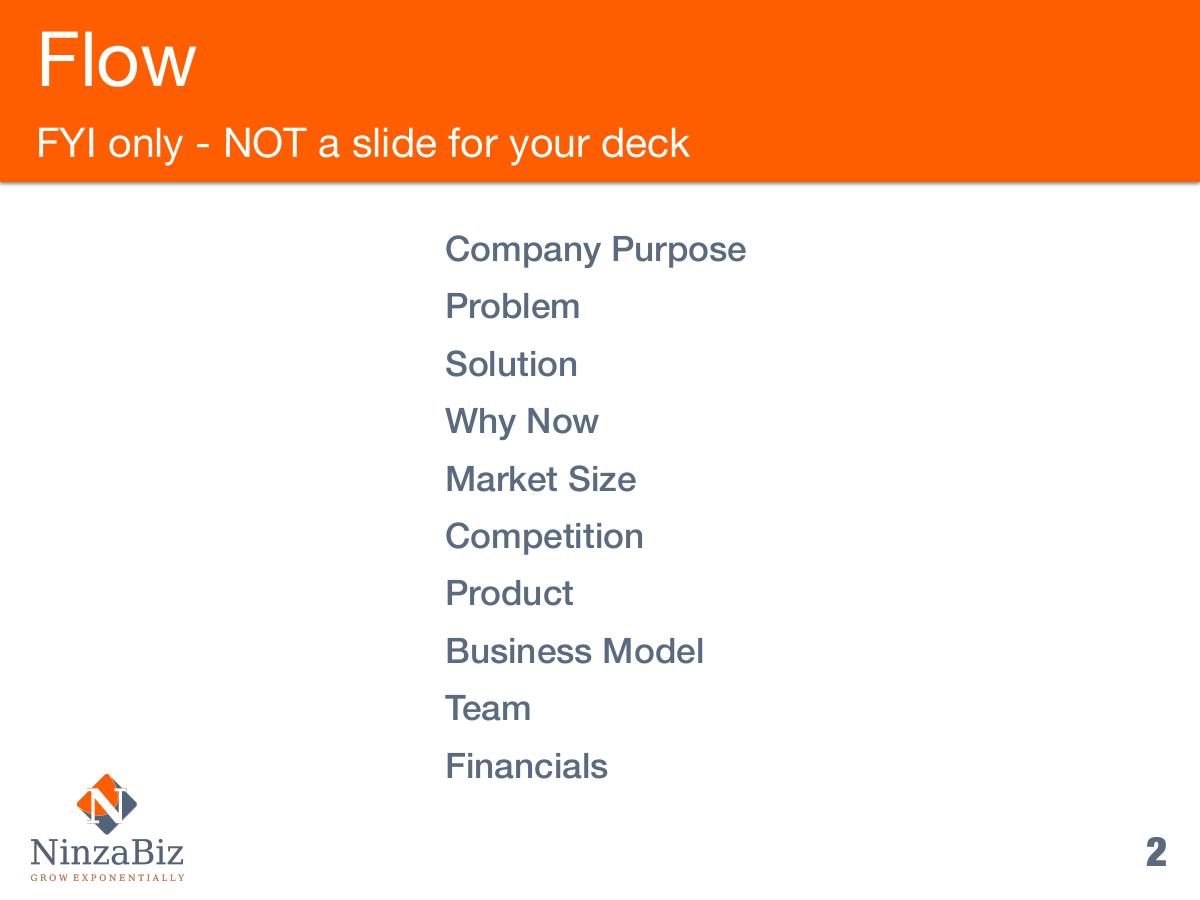
The full agenda, marked explicitly as internal: "FYI only - NOT a slide for your deck." This is the single best instruction in the file, and the one most often ignored. Founders paste the agenda in as slide 2 and burn the most valuable real estate in the deck on a table of contents no investor asked for. If the order is right, the deck explains itself.
Slide 3 — Company Purpose
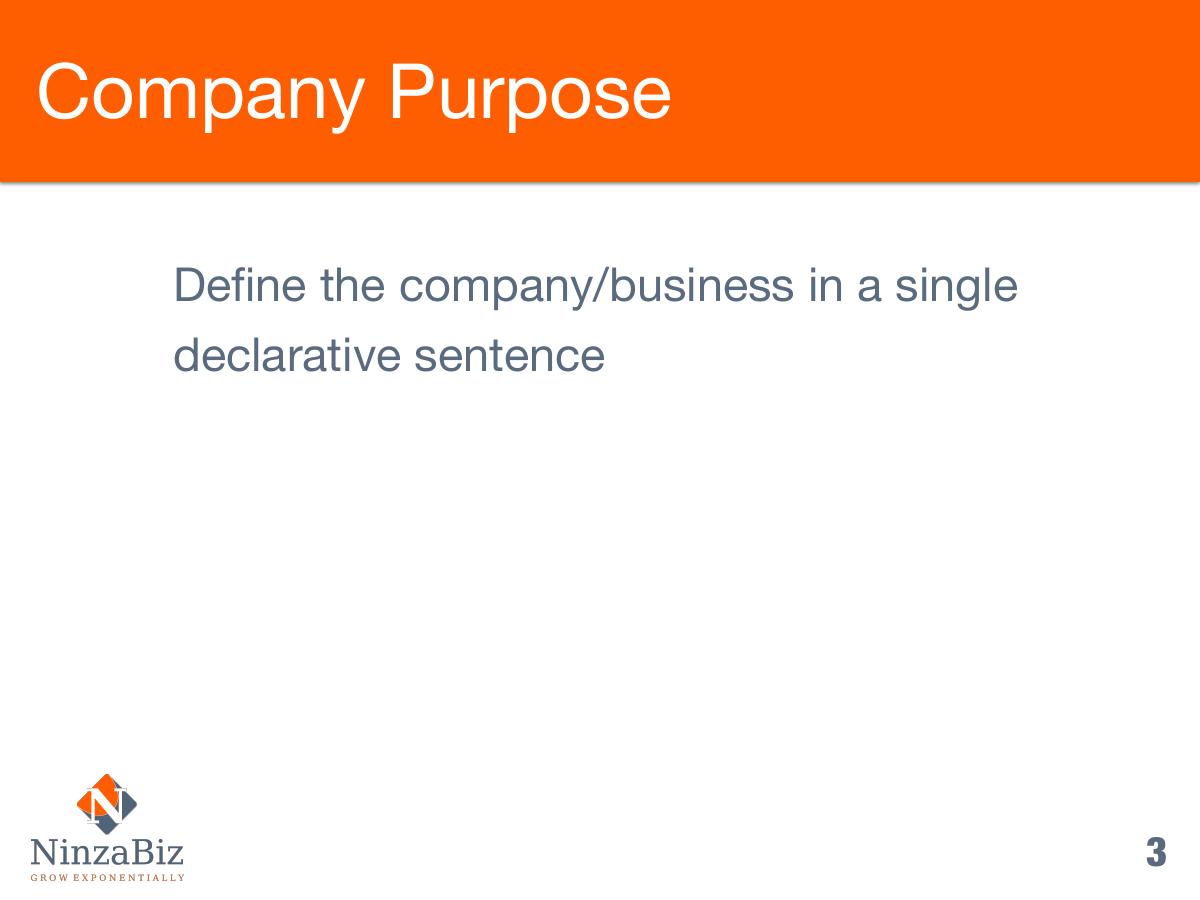
One instruction: "Define the company/business in a single declarative sentence." Correct, and much harder than it looks. The constraint that matters is the word declarative : not a mission, not an aspiration, not "we are reimagining how the world…". A declarative sentence contains a subject, a category and a customer. The template gives no example, which is its first real weakness — a founder who could already write that sentence would not need the template.
Slide 4 — Problem
Two instructions: "Describe the pain of the customer (or the customer's customer)" and "Outline how the customer addresses the issue today." The second bullet is the good one and the rarest in the wild. Most problem slides describe a condition of the universe; almost none describe the incumbent behaviour — the spreadsheet, the agency, the three part-time hires — that your product has to displace. Naming the status quo is what turns a problem slide into a wedge.
Slide 5 — Solution
Three instructions: demonstrate the value proposition, "show where your product physically sits," and "provide use cases." The middle bullet is unusually smart for a 2016 template. It is asking for a systems diagram — where you sit in the stack, between which existing tools, on which side of the money flow. Investors who have seen forty decks in a category use that one picture to decide whether you are a feature, a layer, or a platform.
Slide 6 — Why Now
"Set-up the historical evolution of your category" and "define recent trends that make your solution possible." This is the slide founders skip and investors miss most. The template is right to give it a full page. The weakness is that it asks only for trends, not for evidence: a Why Now slide is only persuasive when the trend is dated and sourced — a regulation that passed, a cost curve that crossed, a platform that opened an API — rather than asserted.
Slide 7 — Market Size
"Identify/profile the customer you cater to" and "Calculate the TAM (top down), SAM (bottoms up) and SOM." Two things to flag. First, the ordering is right: customer profile before market maths, because a TAM without a named buyer is arithmetic, not a market. Second, "TAM top down" is where a decade of bad decks came from. In 2026, top-down TAM is close to a negative signal; the number investors want is bottoms-up — number of reachable accounts multiplied by realistic annual contract value.
Slide 8 — Competition
The thinnest page in the deck: "List competitors. List competitive advantages." A list is the weakest possible form for this slide. It invites the two failure modes investors punish — claiming no competitors, and a feature-comparison table where you happen to have all the ticks. The instruction should be to position, not to list: choose the two axes on which the market actually splits, and show where the money currently goes.
Slide 9 — Product
"Product line-up (form factor, functionality, features, architecture, intellectual property)" and "Development roadmap." Two comments. Feature enumeration is a 2016 habit; a modern product slide is a screenshot or a fifteen-second flow of the core loop. And a roadmap is only credible next to what has already shipped — a roadmap slide with no shipped column reads as a wish list.
Slide 10 — Business Model
The most complete instruction set in the template: revenue model, pricing, average account size and/or lifetime value, sales and distribution model, customer/pipeline list. This page alone justifies the download. It forces the four numbers most seed decks omit — what you charge, what an account is worth, how you acquire it, and who is already in the pipe — and it treats distribution as part of the business model rather than a later problem. The missing fifth line is cost of acquisition; value without cost is half a unit economic.
Slide 11 — Team
"Founders & Management. Board of Directors/Board of Advisors." Accurate but hollow. The team slide is not a roster question, it is a "why you?" question: what have these specific people done that makes them the ones to win this specific market. The template's framing produces headshot grids with job titles, which is precisely the version that carries no information.
Slide 12 — Financials
"P&L. Balance sheet Cash flow. Cap table. The deal." Note the typo running two lines together — a small tell that this is a quickly produced asset. More importantly, note the scope. P&L, balance sheet and cap table are diligence documents, not deck slides; asking a pre-seed founder for three financial statements on slide 12 produces fiction. And "the deal" — the ask, the use of funds, the milestone the money buys — is buried as the fourth sub-bullet of the last page, which is exactly where founders lose it. In a real deck, the ask is its own slide, with a number, a runway, and the milestone it unlocks.
What this deck does better than most startup pitch decks
The running order is genuinely correct. Purpose → Problem → Solution → Why Now → Market → Competition → Product → Model → Team → Financials still survives contact with real investor meetings ten years later. · It labels its own internal slide. Telling the founder that the agenda page is not part of the deck removes one of the most common wasted slides. · It puts Why Now on a dedicated page. Most templates fold timing into the problem slide, where it disappears. · It asks where the product physically sits. A stack/position diagram answers the "feature or company?" objection before it is raised. · Business model is treated as five questions, not one. Pricing, account value, distribution and pipeline in one place is more rigour than most seed decks show. · One idea per page. Twelve pages, ten sections, no page trying to do two jobs. The restraint is the lesson.
Where this deck would fail in an investor meeting
There is no traction slide. Nowhere in the ten sections is the founder asked what has already happened — users, revenue, retention, pilots, waitlist. In 2026 that is the slide investors read first. · The ask is a sub-bullet. "The deal" appears fourth on the financials page instead of as its own slide with amount, runway and milestone. · Top-down TAM is invited. The instruction actively encourages the market-sizing style that now reads as a lack of rigour. · Competition is reduced to two lists. No positioning, no axes, no explanation of where budget goes today. · Team is a roster, not an argument. No prompt for founder–market fit, prior outcomes, or unfair access. · Financials over-ask at the wrong stage. Balance sheet and cash flow statements are diligence artefacts; a pre-seed deck needs a simple three-year model and a burn number. · No examples anywhere. Every page states a requirement and shows no filled-in version, so the founder most likely to use it gets the least help. · No guidance on length, order of send, or appendix. The template is silent on the practical mechanics of an email deck versus a presented deck.
Template deck vs the deck that actually gets funded
Opening Title, then agenda Title with one-line descriptor, then the single strongest proof point
Traction Not a section Dedicated slide, usually slide 3–5, with a growth curve
Market size TAM top-down first Bottoms-up: reachable accounts × ACV, with the assumption shown
Competition Two lists Positioning on two axes, plus where budget goes today
Product Feature and architecture inventory Screenshot or short flow of the core loop, plus what shipped
Team Founders, management, board Why these people win this market: prior outcomes and unfair access
Financials P&L, balance sheet, cash flow, cap table Three-year model, burn, runway — statements go in the data room
The ask Sub-bullet on the last page Its own slide: amount, runway, and the milestone it buys
How you would rebuild this template into a fundable 12 slides
Delete the agenda page and reclaim it for traction. Twelve pages is the right length; spend the recovered slide on evidence. · Rewrite slide 1 as company name plus a seven-word descriptor plus contact details. · Keep Purpose, Problem, Solution, Why Now in that order, but add a dated source to Why Now — a regulation, a price curve, a platform change. · Insert Traction as the new slide 6 : one chart and three numbers. If there is no revenue, use usage, retention, pilots or letters of intent. · Flip Market Size to bottoms-up. Show reachable accounts, ACV, and the arithmetic. Keep the top-down number as a footnote if at all. · Turn Competition into positioning. Two axes that reflect how buyers actually choose, and an honest statement of who you lose to today. · Replace the product inventory with the core loop — one screenshot, one sentence on what the user does, one line on what has shipped versus what is next. · Keep the business model page almost as written , and add cost of acquisition next to account value. · Rewrite Team as an argument. One line per founder answering why this market, plus advisors only if they are materially involved. · Split Financials in two: a simple three-year model with burn and runway, then a dedicated ask slide — amount, months of runway, and the specific milestone that money buys.
Who was NinzaBiz, and does it matter?
Honest answer: the file itself tells you almost nothing, and we are not going to invent the rest. The metadata says the deck was created in Keynote on 26 April 2016 and exported on macOS; the footer credits BrandStudios as the producer and NinzaBiz as the client. There is no funding announcement, no round, no team page and no disclosed outcome attached to this document. It circulated as a downloadable "pitch deck format," which is why it still appears in founder searches a decade later.
That anonymity is worth sitting with, because it is the core risk of template decks. A deck produced for a company by an outside studio, before the company has decided what it is, tends to optimise for looking like a pitch deck rather than for making an argument. Investors read hundreds of decks a quarter and recognise the shape instantly: correct sections, competent typography, and no evidence. The shape is not what gets a second meeting.
How to use a template deck without sounding like one
Templates are not the problem. Treating the prompts as the content is. Three habits separate founders who use an outline well from founders it flattens:
Write the slide titles as sentences first. Instead of "Market Size," write the claim: "18,000 mid-market clinics spend $12K a year on this today." If you can write ten claim-titles that add up to an argument, the deck is finished before you open Keynote. If you cannot, no template will rescue it. · Fill the sections out of order. Start with traction and business model — the two pages you cannot bluff — then work backwards to problem and purpose. Founders who start at slide 1 spend their best energy on the vision statement and run out of it by the numbers. · Delete any section you cannot evidence. An empty competition slide filled with adjectives is worse than no competition slide. A missing page reads as focus; a padded page reads as a lack of it.
The three questions this template never asks
"What has already happened?" No traction prompt anywhere in ten sections. This is the single largest gap between the 2016 outline and how decks are read now. · "What do you want, and what will it buy?" The ask exists only as the words "the deal" on the final page. A round size with no milestone attached invites the worst question in fundraising: "what would you actually do with it?" · "Why would this fail?" No template asks it, and the best founders answer it anyway — usually in one line on the ask slide. Naming the primary risk and the experiment that retires it does more for credibility than any hockey stick.
The transferable lesson
A template can give you the order. It cannot give you the evidence, and the order is the easy half. The NinzaBiz format survives because its sequence is borrowed from a good one, but a faithfully completed copy of it in 2026 would still arrive without traction, without a bottoms-up market, without positioning, and with the ask hidden on the last page. That is the difference between a deck that is structured and a deck that is fundable .
The useful exercise is not downloading another outline. It is taking the deck you already have and checking it against the way investors actually read: what they see in the first thirty seconds, which slide makes them stop, and which of the ten sections above is doing no work. Every deck has two or three slides carrying the whole story and four or five that are quietly costing credibility. Finding out which is which is the fastest edit available to you.
Frequently asked questions
- Is the NinzaBiz pitch deck a real fundraising deck?
- No. The NinzaBiz file is a 12-page pitch deck format template produced by BrandStudios in April 2016. Each page names a section — Company Purpose, Problem, Solution and so on — and lists what belongs on it, but contains no company information, numbers, team or ask. It is an outline founders fill in, not a deck that was used to raise a round.
- What is the NinzaBiz pitch deck template based on?
- Its ten sections follow the Sequoia Capital business plan sequence almost verbatim: Company Purpose, Problem, Solution, Why Now, Market Size, Competition, Product, Business Model, Team and Financials. NinzaBiz's contribution is packaging — one section per Keynote page with two or three instruction bullets each — rather than a new framework.
- How many slides is the NinzaBiz pitch deck?
- Twelve pages: a title slide, an internal flow/agenda page explicitly marked as not part of the deck, and then ten section pages, one for each part of the pitch. Twelve is a reasonable length target for a real deck too, provided the agenda page is replaced with something that carries evidence.
- Which slides from this template should founders copy?
- Three hold up well. The Why Now page, because timing gets buried when it is folded into the problem slide. The Solution prompt to show where the product physically sits in the stack. And the Business Model page, which forces pricing, account value, distribution and pipeline onto one slide — add cost of acquisition and it is close to complete.
- What is missing from the NinzaBiz pitch deck template?
- Four things: a traction slide, a dedicated ask slide, positioning instead of a competitor list, and bottoms-up market sizing. It also asks pre-seed founders for a balance sheet and cash flow statement, which are data-room documents rather than deck slides, and it provides no filled-in examples anywhere.
- Should you use a pitch deck template at all?
- Yes, for the order — but not for the content. Write your slide titles as claims rather than section labels, fill in traction and business model first because those are the pages you cannot bluff, and delete any section you cannot evidence. A missing slide reads as focus; a padded one reads as the opposite.