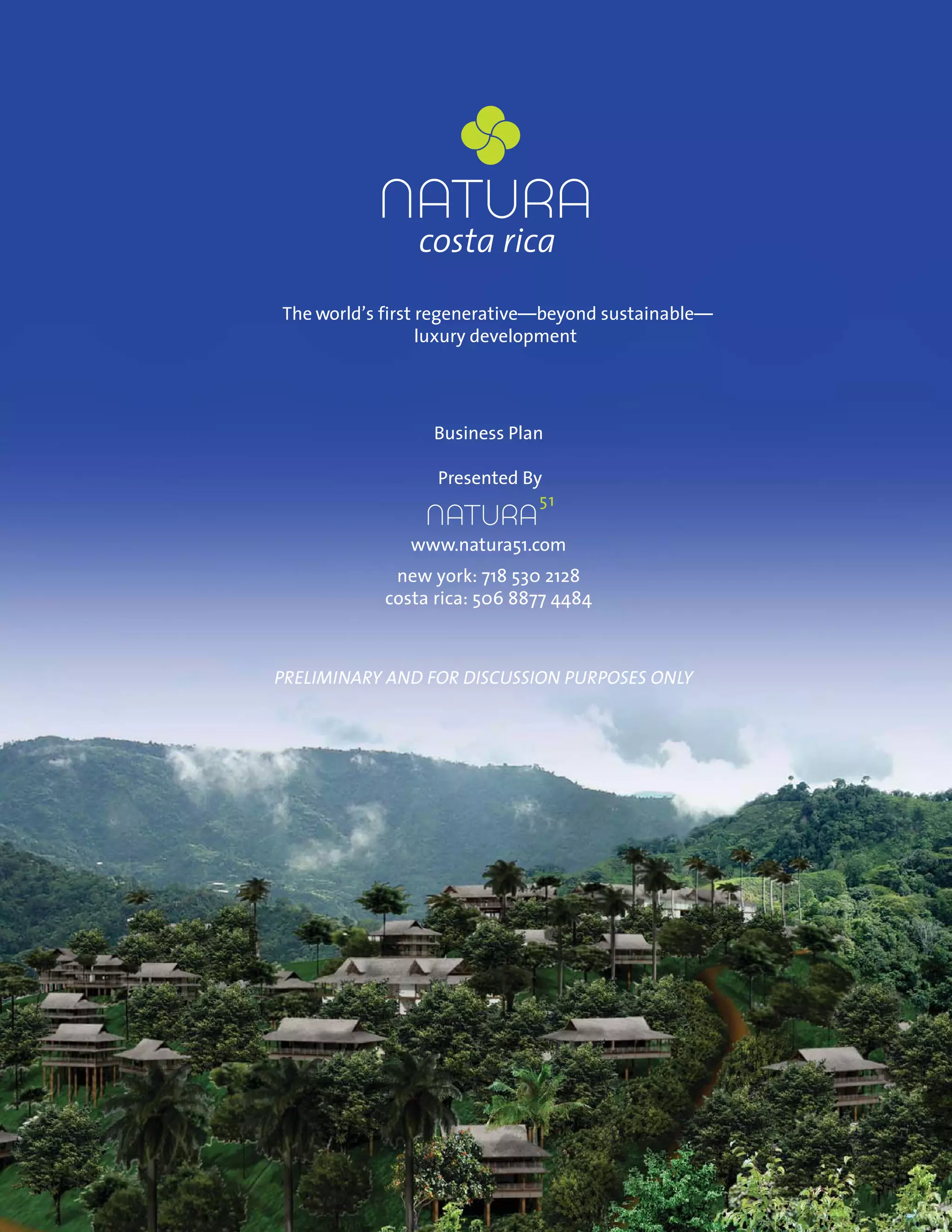
Natura Costa Rica’s deck is less of a pitch and more of a comprehensive 68-slide operations manual for a regenerative luxury real estate development. The company aims to build high-end homes using modular bamboo platforms that are twice as strong as concrete in compression. The deck is heavy on technical specifications, such as the 'ECO-Machine' for wastewater and detailed carbon footprint comparisons (18.6 metric tons of CO2 for an NCR building versus 109.27 for traditional builds). While the financial projections are granular, spanning a 10-year cash flow model, the deck suffers from extrem…
Key takeaways
- The project utilizes Guadua angustifolia bamboo, which the company claims is twice as strong as concrete in compression (Slide 8).
- Natura Costa Rica homes are projected to contain 0.32 GJ/m2 of embodied energy, just 6.3% of a traditional building (Slide 15).
- The development includes a natural wastewater-treatment system called the 'ECO-Machine' using bacteria, fungi, and aquatic life (Slide 15).
- Service offerings range from standard property management to luxury options like private chefs and 24-hour bilingual concierge (Slide 22).
- The competitive analysis lists five major Costa Rican developments, including the $800 million One&Only Cacique (Slide 36).
- The team includes high-profile advisors like Fredrik Eklund for sales and marketing and Bill Reed for sustainability (Slide 43).
- Financial projections are modeled over 10 years, detailing deposit schedules for five different unit types from 1-bed condos to 5-bed mansions (Slide 50).
- The total project sources are projected at $175,164,879 over the 10-year period (Slide 50).
Executive Summary and Vision
Natura Costa Rica (NCR) presents a business plan for what they term the world’s first "regenerative—beyond sustainable—luxury development." The cover slide (Slide 1) immediately sets a high-end tone with a lush, mountainous render of the development, emphasizing a New York and Costa Rica presence. The terminology used throughout the deck suggests a move away from simple sustainability toward a model that actively improves the environment it inhabits.
The Material Science of Bamboo
On Slide 8, the deck dives into the specifics of their primary building material: Guadua angustifolia bamboo. The company claims this species is twice as strong as concrete in compression and matches the tensile strength of mild steel. The strategy involves a bamboo plantation that reaches maturity in 3 to 5 years, providing a renewable source for their modular building platform. Notably, the slide also mentions a social component: using these materials to build "decent homes for local Costa Ricans who might otherwise have to live in a slum," illustrated by a contrasting photo of the Dharavi slum in India. This suggests a dual-track business model involving both luxury real estate and low-income disaster-relief housing.
Ecological Infrastructure and Embodied Energy
Slide 15 is perhaps the most data-dense technical slide in the deck. It introduces the "ECO-Machine," a natural wastewater-treatment system that uses biological organisms (bacteria, fungi, plants, snails) to treat sewage to reusable quality. This slide also introduces the concept of "embodied energy." NCR claims their homes contain approximately 0.32 GJ/m2 of embodied energy, compared to 5 GJ/m2 for traditional dwellings. By their estimates, an NCR home consumes just 6.3% of the energy of a traditional building of the same size. They attribute this to the selection of air-dried hardwoods and recycled steel, claiming an 83% reduction in the total carbon footprint.
Luxury Service Model
Despite the heavy focus on ecology, Slide 22 reminds the reader that this is a luxury product. The "Service Overview" lists a comprehensive suite of amenities. Included services feature 24-hour bilingual concierge, airport pick-up in carbon-neutral vehicles, and a learning center. Optional services move into the ultra-luxury tier, offering private chefs, domestic staff, and pre-arrival grocery stocking. This slide indicates that NCR is evaluating "high-end, branded hospitality service providers" to manage these operations, though no specific partners are named as signed.
Architectural Inspiration and Competitive Landscape
Slide 29 showcases the aesthetic direction of the project through photos of a "Javanese joglo," part of the company's research into sustainable vernacular architecture. This visual evidence supports the claim of using naturally pest- and rot-resistant hardwoods. Slide 36 then transitions to a market analysis, listing five major competitors in Costa Rica: One&Only Cacique, Reserva Conchal, Rancho Manzanillo (Mandarin Oriental), Tamarindo Preserve, and Valle de Machuca. The deck provides specific details on these projects, such as the $800 million investment in One&Only and the sales velocity of Tamarindo Preserve (27 units sold since 2007). This context is vital for justifying the luxury price point NCR likely intends to command.
Team and Advisory Board
Slide 43 lists the "Project Team," which is a significant strength of this deck. The inclusion of Fredrik Eklund as a Sales & Marketing Advisor provides immediate credibility in the luxury real estate space. The sustainability side is bolstered by Croxton Collaborative Architects (involved with the USGBC) and Bill Reed, a founding board member of the U.S. Green Building Council. The presence of John Todd, Ph.D., for wastewater management further reinforces the technical claims made earlier in the deck regarding the ECO-Machine.
Financial Projections and Regional Context
Slide 50 contains a massive spreadsheet of "Cash Flow Projections" for a 30-unit-per-year development. The total sources are projected at $175,164,879 over a 10-year period. The revenue is broken down by unit type, ranging from 1-bedroom condos to 5-bedroom mansions. The projections show no revenue in Year 1, with a significant ramp-up starting in Year 2 ($13.8M) and peaking in Year 7 ($29.4M). Slide 57 provides an appendix on Costa Rica, covering currency (the colón), private education, and real estate transparency, ranking the country 5th in Latin America for property registration. Finally, Slide 64 provides technical floor plans, giving a concrete look at the layout of the proposed residences.
What Works in This Deck
Technical Depth: The deck does not shy away from the science of sustainability. By citing specific figures for embodied energy (0.32 GJ/m2) and carbon footprints (18.6 metric tons), the founders move beyond "greenwashing" and provide a measurable basis for their claims. This is essential for attracting ESG-focused investors.
Team Credibility: The advisory board is exceptionally well-aligned with the project's goals. Having the founder of the regenerative planning movement (Bill Reed) and a high-volume luxury broker (Fredrik Eklund) covers both the "green" and the "luxury" aspects of the pitch.
Granular Financials: The 10-year cash flow model is highly detailed, showing a clear understanding of the real estate development cycle, including deposit schedules tied to construction milestones (foundation, roof, close).
What Is Missing or Weak
Excessive Length: At 68 slides, this is not a pitch deck; it is a full business plan. A modern investor deck should ideally be 15-20 slides. The density of text on slides like 8 and 15 makes them nearly impossible to read during a live presentation.
Lack of a Clear 'Ask': In the provided selection of slides, there is no specific funding request. While the total project sources are listed as $175M, the deck does not specify how much equity or debt the founders are seeking from the recipient of this specific document.
Visual Consistency: The deck fluctuates between high-quality renders, dense spreadsheets, and academic-style text blocks. It lacks a cohesive visual narrative that guides the investor through the story of the development.
Founder Takeaways
Lead with Data: If your startup makes environmental claims, use specific metrics like embodied energy or carbon reduction percentages. It transforms a vague promise into a technical advantage. · Leverage Advisors: If you are a first-time founder in a complex space like real estate, your advisory board is your most valuable asset. NCR uses their advisors to bridge the gap between "big idea" and "executable project." · Segment Your Documents: Keep a 12-slide "teaser" deck for first meetings and save the 68-slide "business plan" for the due diligence phase. Mixing the two creates a document that is too long for a pitch and too fragmented for a manual. · Show the Product: The inclusion of floor plans (Slide 64) and material studies (Slide 29) helps ground the high-level ecological talk in physical reality. Investors need to see what they are actually building.
Frequently asked questions
- What is the core construction material used by Natura Costa Rica?
- The company primarily uses Guadua angustifolia bamboo. According to slide 8, this material reaches maturity in 3 to 5 years and is harvested to build both luxury homes and modest housing for local residents. The deck claims this bamboo is twice as strong as concrete in compression and equal in tensile strength to mild steel.
- How does the company measure its environmental impact?
- Natura Costa Rica uses 'embodied energy' and carbon footprint metrics. Slide 15 states that an NCR building has a carbon footprint of 18.6 metric tons of CO2, which is 83% smaller than a traditional building of equal size (109.27 metric tons). They also aim for a service life of more than 100 years for structural components.
- Who are the key people involved in this project?
- The project features a mix of luxury real estate and sustainability experts. Slide 43 highlights Fredrik Eklund as a Sales & Marketing Advisor, noted for over $250 million in residential sales. Other key figures include sustainability consultants Croxton Collaborative Architects and Bill Reed, a principal of the regenerative planning firm Regenesis.
- What kind of amenities does the development offer?
- The development is positioned as a luxury resort. Slide 22 lists included services such as airport pick-up in carbon-neutral vehicles, a fitness center with towel service, and a learning center. Optional services include room service, certified child care, and private chefs managed to suit the owner's needs.
- What are the financial expectations for the project?
- Slide 50 provides a 'Cash Flow Projections' table showing total sources of $175,164,879. The revenue is driven by a mix of 1-bed, 2-bed, 3-bed, 4-bed, and 5-bed units, with sales activity peaking between Year 2 and Year 8. The model includes detailed deposit schedules for reservations, foundations, and roof completion.