noborder, the parent company of TeamFinder, utilized a highly minimalist 12-slide deck to raise $300,000 in 2018. The deck focuses heavily on the founder's 18-year background at Recruit, a dominant force in Japanese HR, to establish immediate credibility. By contrasting the inefficiency of high-volume job boards with the scarcity of high-quality referrals, the deck positions its chatbot as a middle-ground solution. While the deck lacks detailed financial projections, a competitive landscape, and a specific use-of-funds breakdown, it successfully communicates early momentum with 150 companies…
Key takeaways
- The deck relies heavily on founder pedigree, highlighting 18 years of experience at Recruit on slide 2.
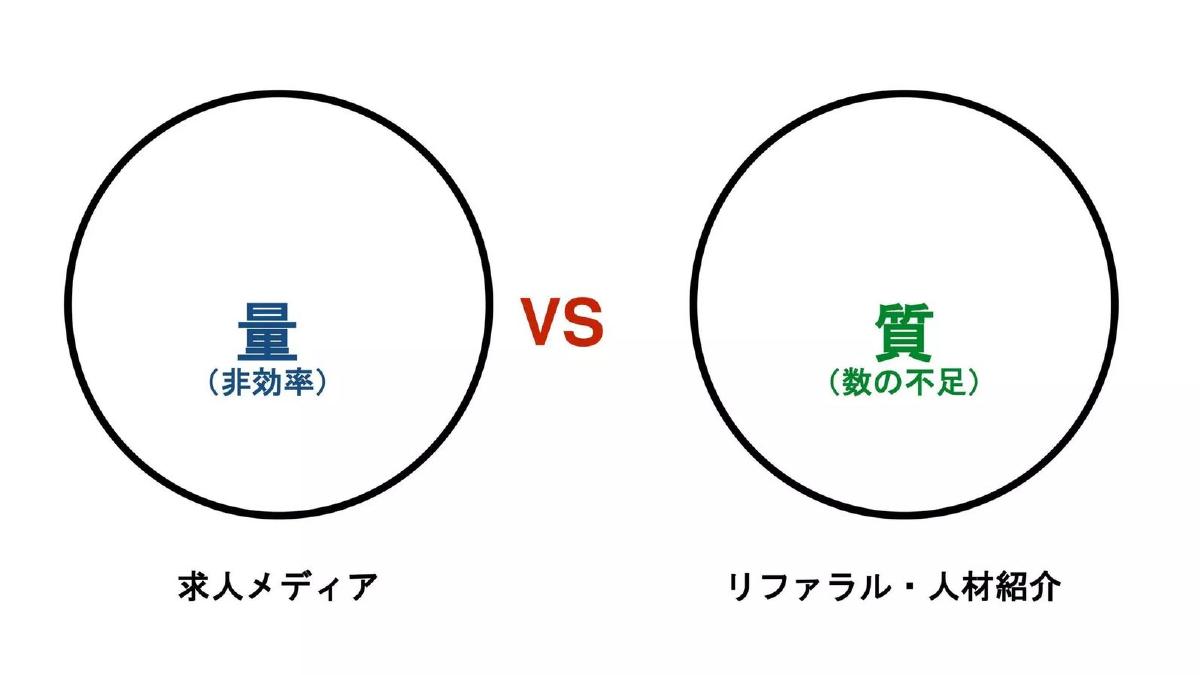
- It frames the market problem as a trade-off between volume/inefficiency and quality/scarcity on slide 3.
- Early traction is quantified as 150 companies and 520 individuals signed up on slide 8.
- The business model is a flat-rate subscription ranging from free to 200,000 yen per month, as stated on slide 9.
- The total addressable market is defined by two segments totaling 8.8 trillion yen on slide 11.
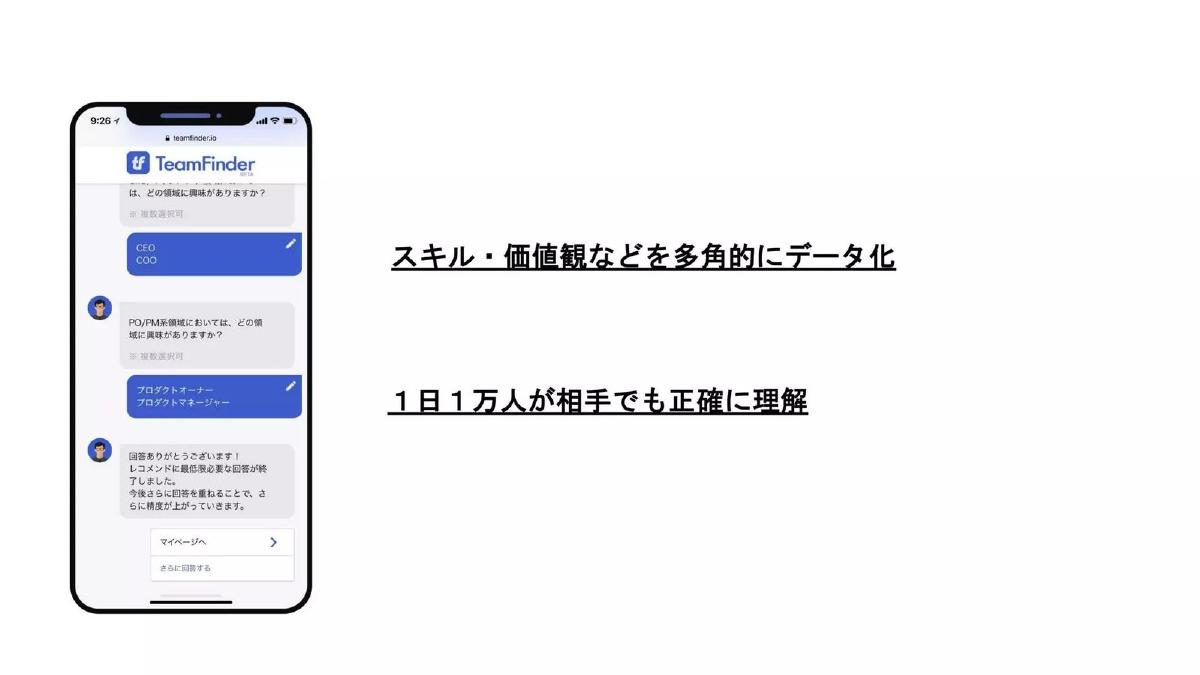
- The product uses a chatbot interface to collect deep candidate data, shown in the mockup on slide 6.
- The deck omits a formal 'Ask' slide, failing to specify how the $300,000 would be spent.
- There is no mention of unit economics, churn rates, or customer acquisition costs.
The Minimalist Seed Deck: noborder's $300,000 Raise
The 2018 seed deck for noborder (promoting their product, TeamFinder) is a study in Japanese minimalist business communication. With only 12 slides and very little text, the deck relies on the 'show, don't tell' principle, backed by significant founder pedigree. In a market like Japan, where the HR tech space is dominated by massive incumbents like Recruit Holdings, a startup's best weapon is often a founder who understands those incumbents from the inside. Noborder leans into this immediately.
Slide 1: Title and Branding
The deck opens with a simple blue background. The product name, TeamFinder , is prominent, followed by a subtitle in Japanese: "chatbot x recruitment matching service." The company name, NOBORDER Inc. , and the CEO's name appear in the bottom right. It is a standard, no-frills entry point that establishes the product category immediately.
Slide 2: The Pedigree Play
Slide 2 is arguably the most important slide in the deck for a seed-stage investor. It features a large photo of the CEO and a single, underlined sentence: "18 years of HR business experience." Below this is the logo for Recruit . In the Japanese venture ecosystem, 18 years at Recruit is a gold-standard credential. It implies the founder has a deep network, understands the mechanics of the labor market, and has seen the internal failings of the industry's largest player. This slide attempts to de-risk the investment through sheer domain expertise.
Slide 3: The Market Tension
Slide 3 uses a simple visual metaphor to explain the problem. On the left, a circle represents "Job Media," labeled with "Quantity (Inefficiency)." On the right, a circle represents "Referrals/Recruitment Agencies," labeled with "Quality (Lack of Numbers)." The "VS" in the middle sets up the classic market gap: companies either get too many bad candidates or too few good ones. This framing is effective because it is a universal pain point in recruitment.
Slides 4-5: The Solution Synthesis
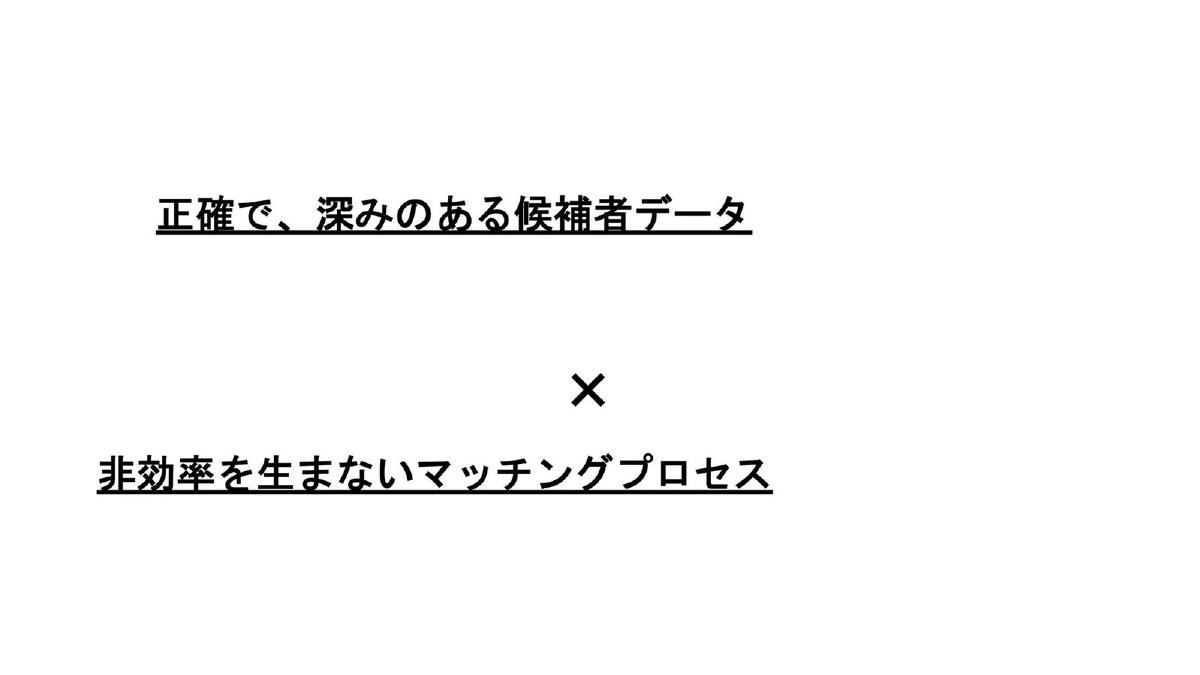
Slide 4 reintroduces TeamFinder as the service that combines "Quantity and Quality." Slide 5 breaks this down into two components: "Accurate and deep candidate data" multiplied by an "Efficient matching process." The deck is positioning the product not just as a tool, but as a bridge between the two failed extremes identified on the previous slide.
Slide 6: Product Interface and Capability
Slide 6 provides the first look at the product. A mobile mockup shows a chatbot interface (TeamFinder Beta). The text claims the system can "Data-fy skills and values from multiple perspectives" and can "Accurately understand even if the opponent is 10,000 people a day." This is the core of their technological claim: that a chatbot can scale the 'deep' interviewing process that usually requires a human recruiter, allowing for high-quality data collection at a high-volume scale.
Slide 7: The Matching Logic
Slide 7 is a simple flow diagram. The chatbot sits in the center, recommending candidates to companies and companies to individuals. When both sides express interest (indicated by 'thumbs up' icons), a match is made. This confirms the business is a two-sided marketplace, using the chatbot as the automated intermediary.
Slide 8: Early Traction
Slide 8 presents the results following a beta release at the end of August. The metrics are presented in three blue circles: 150 companies , 520 individuals , and 30 matches . For a seed round, these numbers are modest but critical. They prove that the matching algorithm actually works and that there is initial B2B interest. The 30 matches represent the 'North Star' metric for the company.
Slide 9: Revenue Model
The business model on Slide 9 is straightforward: "Free to 200,000 yen / month." It is described as a "completely flat-rate subscription." This is a significant departure from the traditional Japanese recruitment model, which usually charges 30-35% of a hire's annual salary. By moving to a SaaS subscription model, noborder is pitching a more predictable, scalable revenue stream that appeals to tech investors.
Slide 10: The Extended Team
Slide 10 showcases the team. Rather than listing long bios, they use logos to communicate prestige. The team includes individuals with experience at Salesforce , Microsoft , and Tableau . Academic credentials from the University of Tokyo , University of Washington , and Duke University are also highlighted. This reinforces the idea that the CEO has been able to attract high-tier talent from both the US and Japan.
Slide 11: Market Opportunity
Slide 11 defines the Total Addressable Market (TAM). It combines the 1 trillion yen new grad/mid-career market with a 7.8 trillion yen side-job/freelance market. By including the freelance market, noborder expands its potential reach nearly eightfold. This suggests that the chatbot matching technology is intended to be applied to the broader gig economy, not just traditional full-time roles.
Slide 12: Contact and Call to Action
The final slide provides a QR code, a URL (teamfinder.io), and the CEO's email address. It is a standard closing slide for a pitch deck.
What Works in the noborder Deck
Clarity of Problem: The "Quantity vs. Quality" slide (Slide 3) is a masterclass in simplicity. It identifies a structural flaw in the HR industry that every hiring manager understands, without needing complex charts or data points.
Founder-Market Fit: The deck correctly identifies that in the HR space, experience is the primary currency. By highlighting 18 years at the industry leader (Recruit), the founder establishes himself as an insider capable of disrupting the status quo.
Focus on Matches: Many early-stage marketplace decks focus on sign-ups or traffic. Noborder focuses on "30 matches" (Slide 8). This is the only metric that truly matters for a recruitment platform, and showing it early builds trust.
What is Missing from the noborder Deck
The 'Ask': The most glaring omission is a slide detailing how much money is being raised and what it will be used for. While the catalogue facts state $300,000 was raised, the deck itself does not mention a target amount, valuation, or milestone plan.
Competitive Landscape: The HR tech space is incredibly crowded. The deck does not mention competitors like BizReach, Wantedly, or LinkedIn. Investors would naturally want to know how TeamFinder protects its margins against these giants.
Unit Economics: While the subscription price is listed (Slide 9), there is no information on the cost to acquire a company (CAC) or the lifetime value (LTV) of a user. Without these, the scalability of the 200,000 yen/month model is purely theoretical.
Technology Deep-Dive: The deck claims the chatbot can "data-fy skills and values" (Slide 6), but it doesn't explain how. Is there proprietary NLP (Natural Language Processing)? Is it a simple decision tree? In 2018, "chatbot" was a buzzword, and more technical detail would have helped validate the "Quality" claim.
What a Founder Should Copy
Logo-Based Credibility: If your team has worked at prestigious firms or attended top universities, use the logos. As seen on Slide 10, it is much faster for an investor to process a Microsoft logo than a paragraph of text describing a software engineer's history.
The 'X' Formula: Slide 5 uses a simple "A x B = C" logic. "Deep Data x Efficient Process." This is a very effective way to communicate a complex value proposition in a way that feels inevitable and logical.
Minimalist Design: The deck uses a consistent color palette (blue, white, and black) and avoids cluttered slides. This forces the audience to listen to the presenter rather than getting lost in small text on the screen. For a seed round, where the goal is to get a second meeting, this level of brevity is often an advantage.
Final Thoughts
The noborder deck is a "pedigree deck." It works because the founder has nearly two decades of relevant experience and the team looks like a high-performance unit. While it lacks the financial rigor of a Series A deck, it provides just enough traction and market framing to justify a $300,000 seed check. Founders without 18 years of industry experience, however, would likely need to provide much more data to achieve the same result.
Frequently asked questions
- What is the core value proposition of TeamFinder?
- According to slides 4 and 5, TeamFinder aims to provide a recruitment matching service that combines high volume with high quality. It achieves this by using a chatbot to collect 'accurate and deep candidate data' and an 'efficient matching process' that avoids the traditional inefficiencies of mass-market job media.
- How does the company generate revenue?
- Slide 9 outlines a subscription-based business model. The pricing is listed as a flat rate ranging from free to 200,000 yen per month. This suggests a SaaS-style recurring revenue model rather than a traditional recruitment agency success fee model, which is common in the Japanese HR tech sector.
- What level of traction did noborder have at the time of this deck?
- Slide 8 reports that following a beta release at the end of August, the platform secured 150 participating companies and 520 registered individuals. Most importantly for a matching platform, they recorded 30 successful matches during this early period, demonstrating proof of concept.
- Who are the key members of the noborder team?
- The team is led by a CEO with 18 years of experience at Recruit (Slide 2). Slide 10 shows a broader team with backgrounds from Salesforce, Microsoft, Tableau, and academic credentials from the University of Tokyo, University of Washington, and Duke University. The slide categorizes them into Sales and Engineer/Data roles.
- What market size is noborder targeting?
- Slide 11 breaks the market into two segments: the new graduate and mid-career recruitment market (1 trillion yen, 3 million people) and the side-job/freelance market (7.8 trillion yen, 7.44 million people). This indicates the company views the gig economy and freelance matching as a significantly larger opportunity than traditional hiring.