emplu's 2021 pre-seed deck focuses on the €213bn German employee benefits market. The 16-slide presentation identifies a critical gap: while 68% of employees prefer benefits over salary increases, companies struggle with administrative overhead and personalization. The deck uses a clean, high-contrast aesthetic to walk investors through a three-step solution—analysis, budgeting, and personalized experience. While the deck excels at establishing market need and product-market fit through industry testimonials, it notably lacks a detailed team slide, financial projections, and a specific capita…
Key takeaways
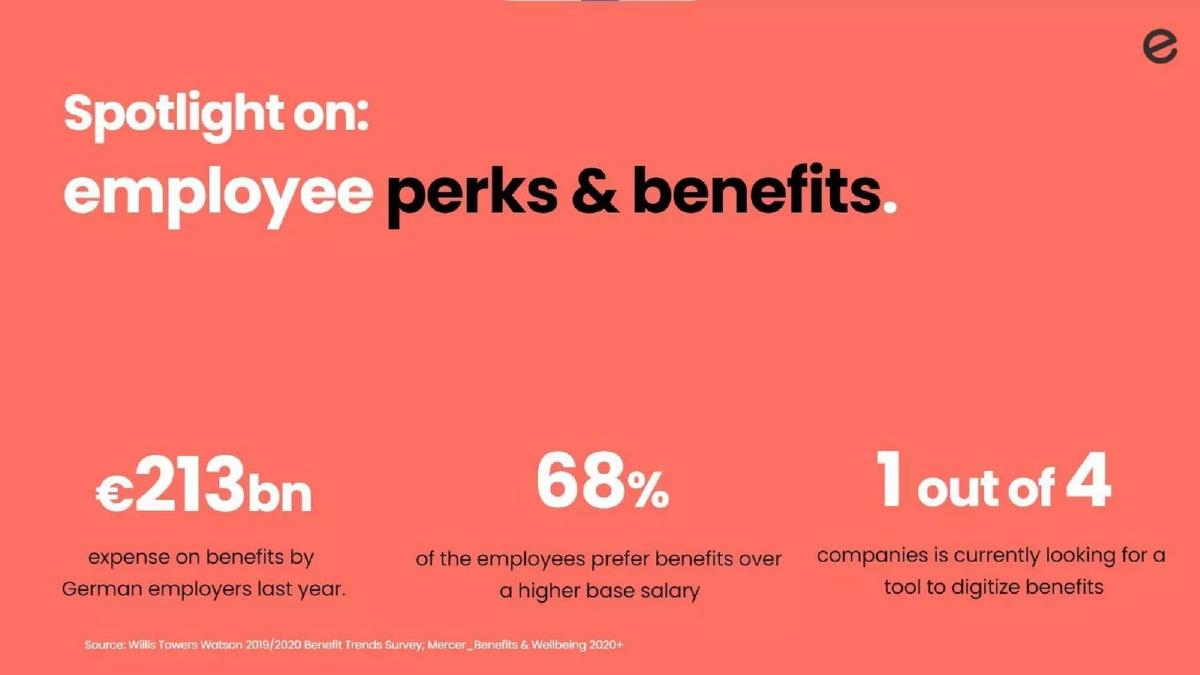
- German employers spent €213bn on benefits last year, yet 1 out of 4 companies is currently seeking a tool to digitize them (Slide 3).
- 68% of employees prefer benefits over a higher base salary, highlighting a shift in workforce expectations (Slide 3).
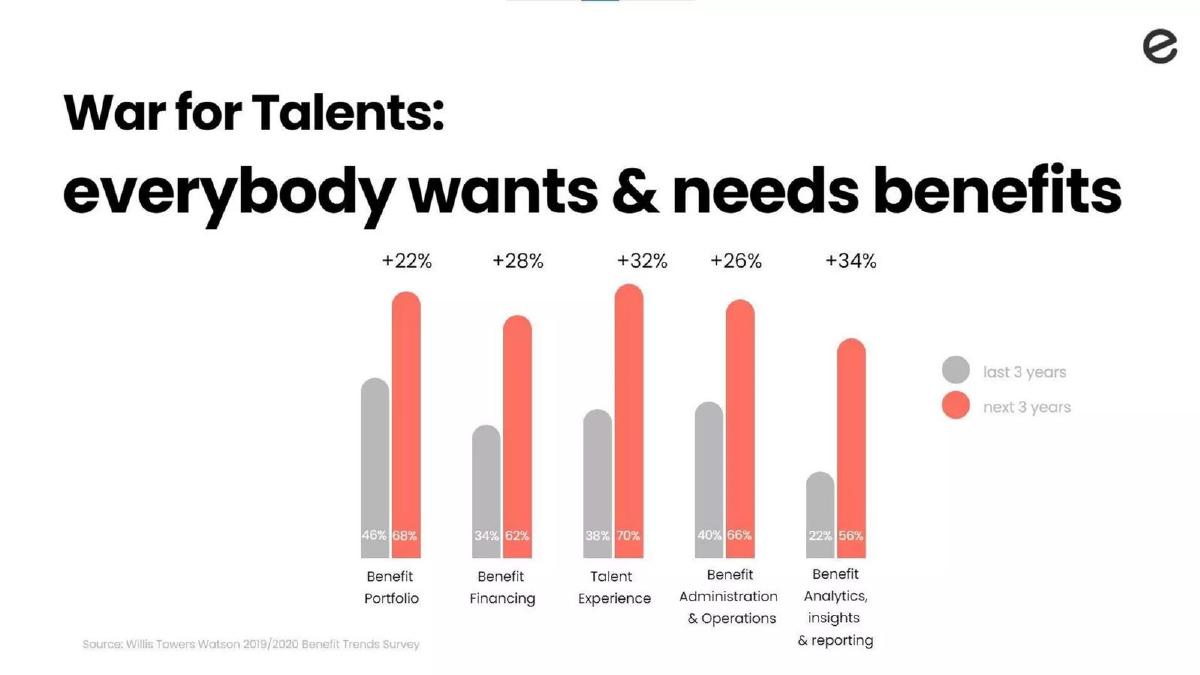
- The deck identifies a 'War for Talents' where demand for benefit analytics and insights is projected to grow by 34% over the next three years (Slide 4).
- The solution is framed as a three-step process: analyzing needs, setting individual budgets, and providing a personalized mobile experience (Slides 9-11).
- emplu positions itself as a '360-degree solution' catering to three distinct stakeholders: the CEO, HR, and the Employee (Slide 7).
- The platform promises technical depth through API integration with existing HRM systems and compliance/legal certainty (Slide 12).
- Industry validation is provided through testimonials from leaders associated with Siemens Nixdorf, Henkel, and Ingram Micro (Slide 13).
- The deck omits a traditional team slide, listing only Founder & CEO Anika Brunner in the vision section (Slide 14).
Introduction: The Minimalist Vision of #NewPay
The emplu pitch deck, produced in 2021 for a pre-seed round, is a striking example of modern, minimalist design. It avoids the cluttered, text-heavy slides typical of early-stage startups, opting instead for a narrative-driven approach that emphasizes the emotional and administrative pain points of HR management. The company positions itself at the intersection of Fintech and HR Tech, focusing on the digitization of the massive German benefits market.
Slides 1-2: Setting the Emotional Hook
Slide 1 is a clean title slide featuring the company logo and a 3D illustration of a gift box descending via parachute. This immediately establishes the theme of 'delivery' and 'rewards.' Slide 2 moves directly into the problem statement with a simple question: How can we attract & retain workforce? It answers this with the red-text hook: It takes more than money! This sets the stage for a discussion on non-salary compensation.
Slides 3-4: Quantifying the Opportunity
Slide 3 provides the 'Hard Facts' to ground the emotional hook. It cites a €213bn expense on benefits by German employers last year , sourced from Willis Towers Watson and Mercer. Crucially, it notes that 68% of employees prefer benefits over a higher base salary and 1 out of 4 companies is currently looking for a tool to digitize benefits . This slide successfully establishes both the Total Addressable Market (TAM) and a clear 'why now' catalyst.
Slide 4, titled War for Talents: everybody wants & needs benefits , uses a bar chart to show the growth in demand for benefit-related services over the last three years versus the next three years. The most significant projected growth is in Benefit Analytics, insights & reporting (+34%) and Talent Experience (+32%) . This indicates that emplu isn't just a distribution platform; it is an intelligence platform.
Slides 5-6: The Pain of the Status Quo
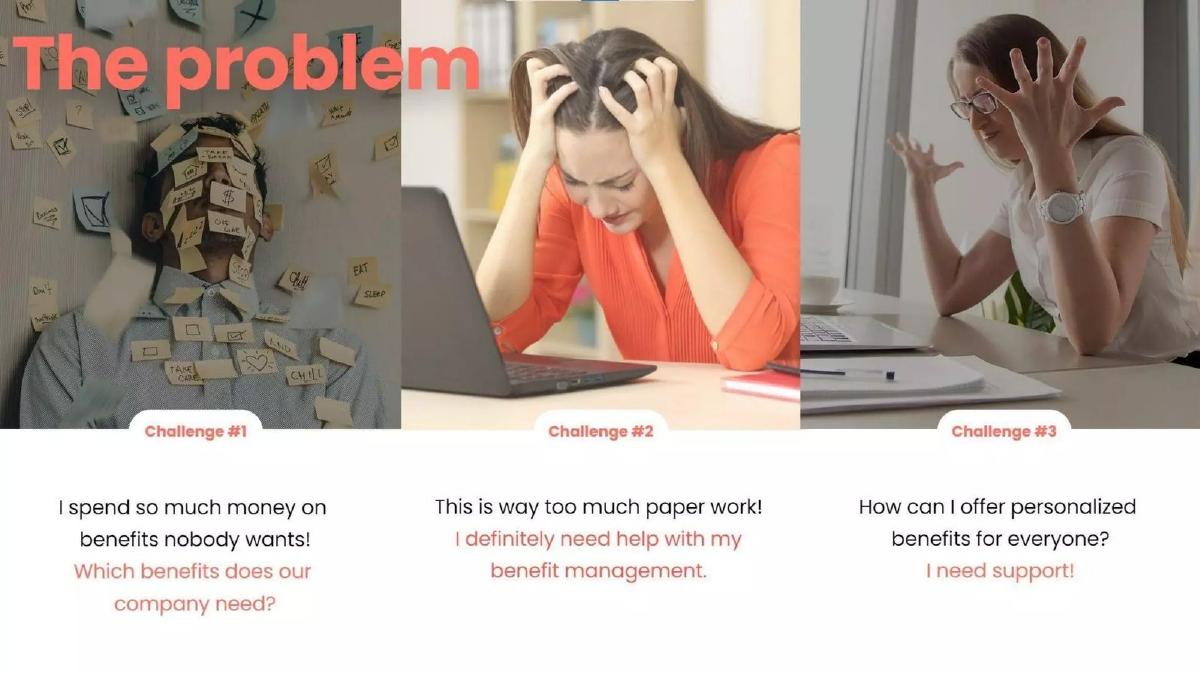
Slide 5 is a transition slide asking if benefits are easy, followed by a blunt Not at all! Slide 6 uses evocative stock photography to illustrate three specific challenges. Challenge #1 focuses on wasted money on unwanted benefits. Challenge #2 highlights the 'paper work' burden. Challenge #3 addresses the difficulty of personalization. By using first-person quotes ('I spend so much money...', 'I need support!'), the deck builds empathy for the HR manager persona.
Slides 7-8: The 360-Degree Solution
Slide 7 introduces the 360° Solution , segmenting the value proposition by user type. The CEO gets brand value, HR gets administration relief, and the Employee gets relevance. Slide 8 officially introduces the brand: Say hello to emplu. The mission is distilled into three sentences: Find the right benefits. Manage everything in one tool. Make your employees happy.
Slides 9-11: The Three-Step Product Walkthrough
These slides break down the user journey. Step #1 (Slide 9) is the analysis phase, where emplu uses a 'matching score' to determine which benefits suit the workforce. Step #2 (Slide 10) focuses on the employer's control, allowing them to set individual benefit budgets across categories like Mobility, Health & Wellbeing, Pension, and Rewards. The background image of a bicycle with groceries reinforces the real-world application of these benefits. Step #3 (Slide 11) shows the mobile interface, highlighting a great benefit experience that is always ready to go . The UI shown includes a checklist for benefits and personalized recommendations.
Slide 12: Technical and Compliance Depth
Slide 12 addresses the 'back-end' concerns of enterprise buyers. It highlights API integration with HRM systems , benefit analytics & insights , and compliance & legal certainty . For a pre-seed investor, this slide is vital because it suggests the product is built for scale and integration into existing corporate workflows, rather than being a standalone silo.
Slide 13: Social Proof and Validation
Slide 13, This is what industry leaders say , provides two high-profile testimonials. Thomas Perlitz (associated with Siemens Nixdorf, Henkel, and Ingram Micro) and Benjamin Visser (SThree, Allygatr) provide quotes validating the platform's effectiveness. This level of social proof is highly effective for a pre-seed deck, as it compensates for a lack of hard revenue data by showing that industry veterans believe in the solution.
Slides 14-16: Vision and Closing
Slide 14 features Anika Brunner, Founder & CEO , with the vision statement: We disrupt the status quo of salary and reinvent the way employees are compensated. Slide 15 introduces the hashtag #NewPay , attempting to frame emplu as part of a broader cultural shift in employment. Slide 16 closes with a play on the company name: It is U we care about.
What Works in the emplu Pitch Deck
Visual Consistency: The use of a limited color palette (white, black, and a specific shade of coral/red) makes the deck feel professional and branded. · Persona-Based Selling: By explicitly addressing the CEO, HR, and Employee, the deck shows a deep understanding of the B2B2C sales cycle. · Market Sourcing: Citing reputable sources like Willis Towers Watson for the €213bn figure adds immediate credibility to the market size claims. · Process Simplification: Breaking the product down into three simple steps (Analyze, Budget, Enjoy) makes a complex HR process feel manageable.
What is Missing from the emplu Pitch Deck
The Full Team: Only the CEO is mentioned. Investors typically want to see the technical lead (CTO) and other key founding members to assess execution risk. · The Ask: There is no slide stating how much money the company is raising, the valuation, or the milestones they intend to reach with the capital. · Business Model: The deck does not explain how emplu makes money. Is it a SaaS fee per employee, a commission on benefits redeemed, or a hybrid model? · Competition: There is no competitive landscape slide. In a crowded HR Tech market, failing to acknowledge competitors can be a red flag for investors. · Traction: While there are testimonials, there are no metrics regarding the number of pilot customers, users on the platform, or growth rates.
What Founders Should Copy
The 'Three Steps' Slide: Using Slides 9, 10, and 11 to walk through a product is much more effective than a single, cluttered 'Features' slide. · High-Contrast Typography: The large, bold headers make the deck readable even if viewed quickly on a mobile device or in a gallery view. · Contextual Imagery: Instead of generic office shots, the deck uses images that reflect the benefits themselves (like the bicycle for mobility), which reinforces the product's utility. · Direct Problem Statements: Slide 6's use of 'Challenge #1, #2, #3' is a clear way to ensure the investor understands exactly what pain point is being solved before the solution is presented.
Frequently asked questions
- What is the primary market opportunity identified by emplu?
- The deck targets the German employee benefits market, which it values at €213bn in annual spending. It highlights a massive inefficiency: while the majority of employees want benefits, one-quarter of companies lack the digital tools to manage them effectively. The deck argues that the 'War for Talents' is driving a need for better benefit portfolios and analytics, with projected growth in these areas exceeding 30%.
- How does the product actually work for the end-user?
- The product is presented as a mobile-first platform where employees can manage a personalized benefit experience. According to Slide 11, employees can view a checklist of benefits, redeem birthday gifts, and receive personalized recommendations. The system allows employees to change their benefits according to their current needs, moving away from the 'one-size-fits-all' approach that the deck criticizes as wasteful.
- Who are the key stakeholders for the emplu platform?
- Slide 7 identifies three key personas. For the CEO, the platform makes benefits 'shine' as a recruitment tool. For HR, it promises to eliminate administrative paperwork. For the Employee, it provides benefits that 'really match their needs.' This multi-sided value proposition is central to their '360-degree solution' narrative.
- What technical integrations does emplu support?
- Slide 12 explicitly mentions API integration with HRM (Human Resource Management) systems. This is a critical detail for enterprise software, as it suggests the platform is designed to sit on top of existing infrastructure rather than requiring a complete rip-and-replace of a company's HR stack. It also highlights 'benefit analytics & insights' as a core feature.
- What are the most significant omissions in this pitch deck?
- The deck is missing several standard venture capital requirements. There is no slide dedicated to the full founding team or their backgrounds (only the CEO is shown). Furthermore, the deck lacks a 'The Ask' slide detailing how much capital is being raised and how it will be used. Finally, there are no financial projections, current revenue figures, or a competitive landscape analysis.