EnCharge AI’s 9-slide deck is a highly technical, vision-driven presentation that successfully positioned the company as the primary beneficiary of the 'Decentralized AI' movement. By focusing on a specific $18B TAM for Client AI (Slide 4) rather than competing directly with Nvidia in the data center, the company carved out a defensible niche. The deck relies heavily on the 'Founders' Pedigree' and a 'Technical Moat' strategy, showcasing an advisory board of Deans from MIT, Princeton, and Stanford (Slide 8). While it lacks traditional financial projections or a specific 'Ask' slide, the sheer…
Key takeaways
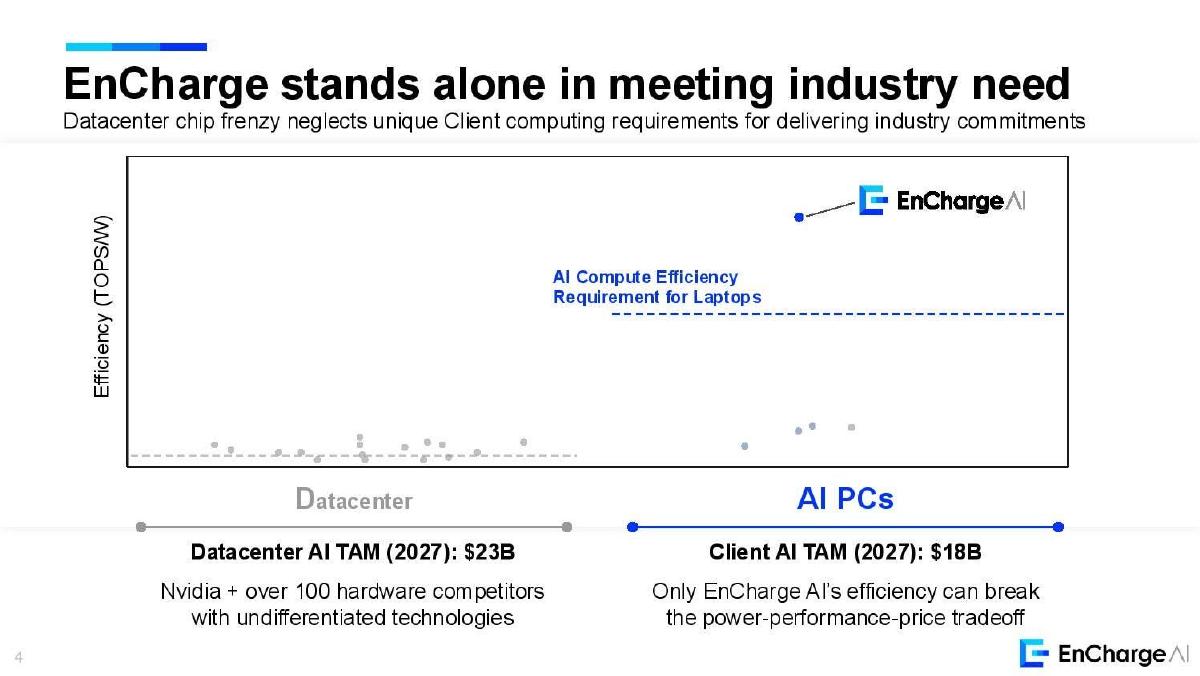
- The deck identifies a specific $18B TAM for Client Computing (NPUs for Inference) by 2027, distinct from the $23B Datacenter AI TAM (Slide 4).
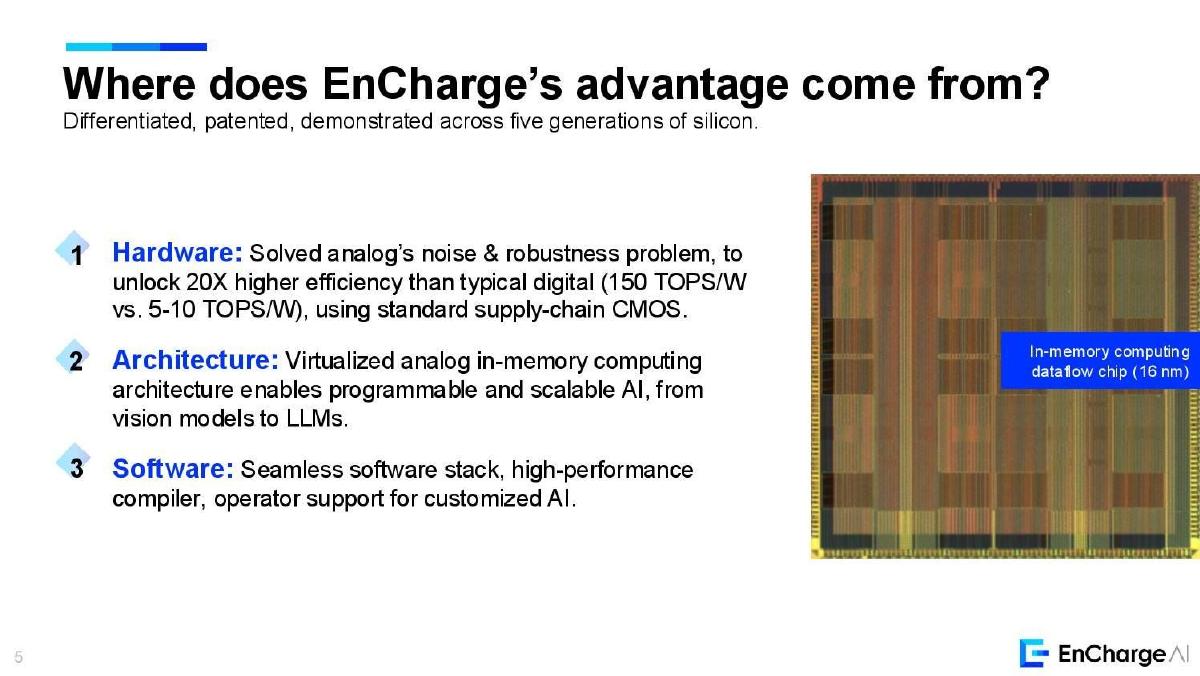
- EnCharge AI claims a 20X efficiency advantage over typical digital hardware, citing 150 TOPS/W compared to the industry standard of 5-10 TOPS/W (Slide 5).
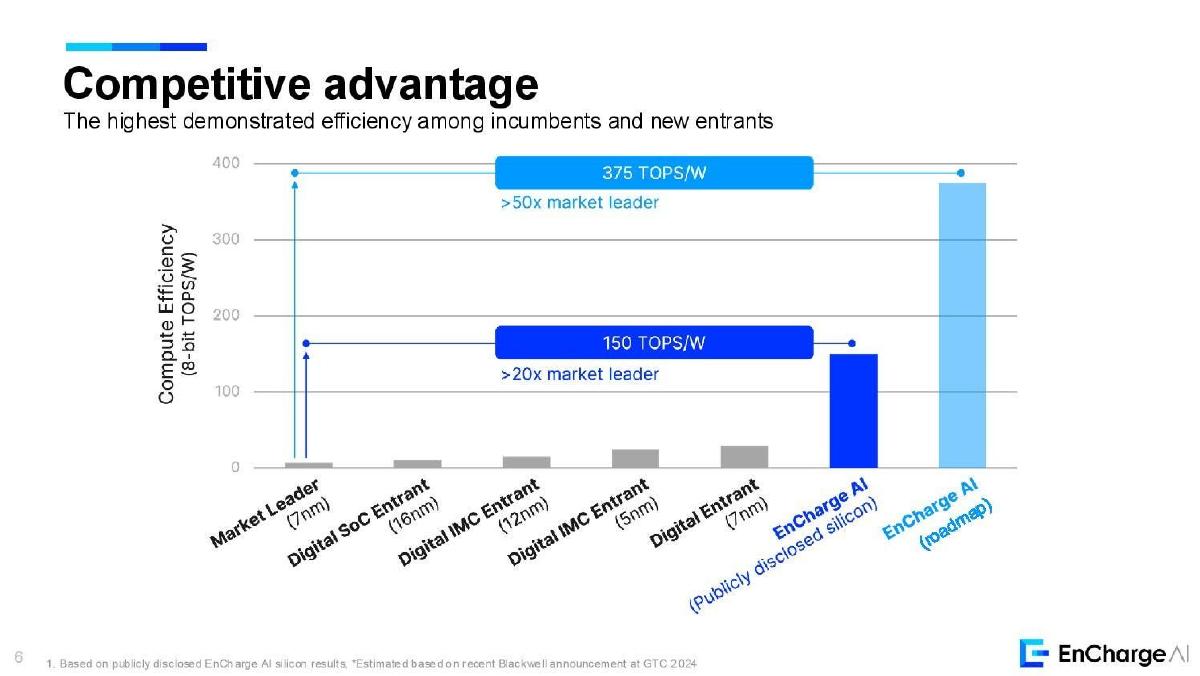
- The roadmap projects a future efficiency of 375 TOPS/W, which the company states is >50x the current market leader (Slide 6).
- The team slide highlights a combined total of over 85 patents among the three co-founders alone (Slide 7).
- The advisory board features three Deans of Engineering from top-tier universities (MIT, Princeton, Stanford) and former executives from Apple, Intel, and Qualcomm (Slide 8).
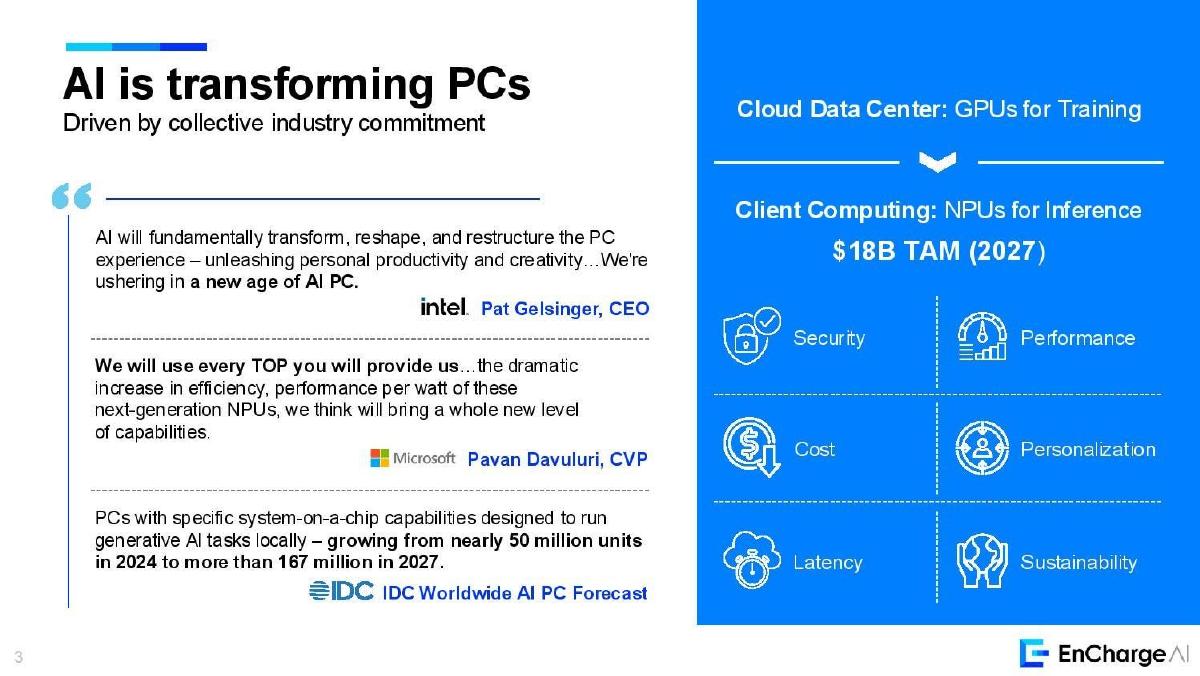
- Market validation is established through quotes from CEOs of Intel and Microsoft, framing the 'AI PC' as a fundamental industry shift (Slide 3).
- The deck omits a specific funding ask, use of proceeds, and detailed financial projections, focusing instead on technical superiority and market timing.
- The company positions its 'analog in-memory computing' as the solution to the noise and robustness problems that have historically plagued non-digital architectures (Slide 5).
The $100M Hardware Thesis: Efficiency as a Moat
EnCharge AI’s pitch deck is a masterclass in positioning a hardware startup against entrenched giants. In an era where Nvidia dominates the headlines, EnCharge AI successfully raised a reported $100M Series B in 2024 by arguing that the future of AI isn't just in the cloud, but on the 'Edge.' The deck is lean at only 9 slides, focusing almost exclusively on technical differentiation, market timing, and an unparalleled leadership team. It avoids the fluff of typical SaaS decks, opting instead for hard engineering metrics and institutional credibility.
Slide 1: Title Slide
The deck opens with a high-resolution image of a semiconductor die, immediately signaling that this is a hardware-first company. The tagline, 'Unlocking AI from Edge to Cloud,' sets the stage for a broad market play, though the subsequent slides narrow this focus significantly to the 'Client' side of the equation.
Slide 2: The Case for Decentralized AI
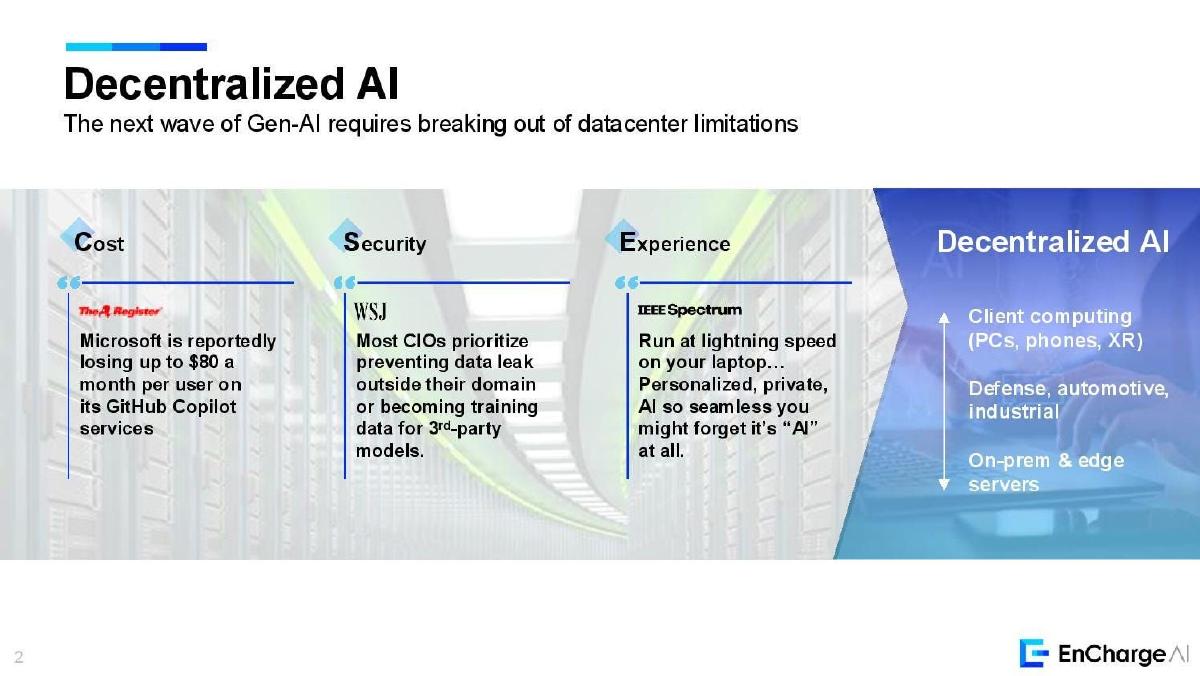
Slide 2 establishes the 'Why Now?' by identifying three pain points of centralized (cloud-based) AI: Cost, Security, and Experience. The slide uses third-party validation effectively, citing The Register regarding Microsoft losing up to '$80 a month per user' on GitHub Copilot services. This is a crucial point; it suggests that the current cloud-based AI model is economically unsustainable, creating a vacuum for local, efficient hardware. The slide also mentions WSJ and IEEE Spectrum to bolster the claims that CIOs prioritize data security and that users require 'lightning speed' on laptops.
Slide 3: The AI PC Revolution
This slide transitions from the general problem to the specific opportunity: the 'AI PC.' EnCharge AI uses quotes from Pat Gelsinger (CEO of Intel) and Pavan Davuluri (CVP at Microsoft) to prove that the biggest players in tech are committed to this shift. The most important figure here is the $18B TAM (2027) for Client Computing NPUs (Neural Processing Units). By citing IDC data that AI PC units will grow from 50 million in 2024 to over 167 million in 2027, the company demonstrates a clear, high-growth market window.
Slide 4: Standing Alone Against 100+ Competitors
Slide 4 is the 'Competition' slide, but it’s framed as a market map. It plots 'Efficiency (TOPS/W)' against two market segments: Datacenter and AI PCs. The slide claims there are 'Nvidia + over 100 hardware competitors' in the datacenter space, all with 'undifferentiated technologies.' EnCharge AI positions itself in the 'AI PCs' quadrant, above a dashed line representing the 'AI Compute Efficiency Requirement for Laptops.' This visual suggests that while many are trying, only EnCharge AI has the efficiency to break the power-performance-price tradeoff.
Slide 5: The Technical Advantage
This is the 'Secret Sauce' slide. EnCharge AI identifies three pillars of its advantage: Hardware, Architecture, and Software . The most striking claim is the 150 TOPS/W efficiency, which they state is 20X higher than typical digital hardware (5-10 TOPS/W). They explain that they have solved 'analog’s noise & robustness problem,' allowing them to use standard supply-chain CMOS. This is a vital detail for investors—it means they don't need a radical new manufacturing process to achieve their gains.
Slide 6: Competitive Advantage Benchmarking
Slide 6 provides a bar chart comparing 'Compute Efficiency' across various entrants. It shows 'Market Leader (7nm)' at a very low baseline, while 'EnCharge AI (Publicly disclosed silicon)' sits at 150 TOPS/W. The roadmap bar is even more aggressive, projecting 375 TOPS/W , which they claim is >50x the market leader . The footnote clarifies that these estimates are based on the recent Blackwell announcement at GTC 2024, showing the deck is extremely current and reactive to market leaders.
Slide 7: Leadership Team
In deep tech, the team is often the most important slide. EnCharge AI showcases a trio of PhD co-founders with massive IP portfolios. Naveen Verma (CEO) is a Princeton professor with 10k+ citations; Echere Iroaga (COO) has 25+ patents and experience at Qualcomm; Kailash Gopalakrishnan (CTO) is an IBM Fellow with 50+ patents. The supporting cast includes veterans from AMD, Intel, Broadcom, and Groq . This slide screams 'execution capability.'
Slide 8: The Advisory Board
If the team slide didn't close the deal, the advisory board slide likely did. It features the Deans of Engineering from MIT, Princeton, and Stanford . Having three of the most influential academic leaders in engineering on one board is a rare feat. Additionally, the presence of Donald Rosenberg (former General Counsel at Apple and Qualcomm) suggests the company is already thinking about the complex legal and government affairs landscape of the semiconductor industry.
Slide 9: Why EnCharge AI?
The final slide summarizes the five key pillars: Leading the AI PC Revolution, Large High-Growth Market, Proven IP-Protected Tech, Broad Industry Demand, and Expert Team. It serves as a summary of the previous eight slides, reiterating the 'unmatched performance' and 'track record' of the team.
What Works in This Deck
Specific TAM Segmentation: By splitting the AI market into Datacenter ($23B) and Client ($18B), EnCharge AI avoids the 'Nvidia-killer' trap. They aren't trying to beat Nvidia at training; they are trying to beat everyone at local inference. This makes the investment thesis much more digestible.
Hard Metrics: The use of TOPS/W as a primary KPI throughout the deck provides a clear 'north star' for the company’s value proposition. Investors in hardware need a single, measurable metric to track progress, and EnCharge AI delivers this on Slides 5 and 6.
Institutional Credibility: The advisory board and leadership slides are among the strongest seen in recent hardware raises. In a field where 'vaporware' is a constant risk, having the Deans of MIT and Stanford attached to the project provides immense technical validation.
What Is Missing from This Deck
Unit Economics and Pricing: While the deck mentions breaking the 'price tradeoff,' it does not explain how. There is no mention of the cost to manufacture these chips or the projected ASP (Average Selling Price) to OEMs (Original Equipment Manufacturers).
Go-To-Market (GTM) Strategy: The deck mentions 'Partnerships with Client platform and software leaders' on Slide 9, but it doesn't name them or explain the sales cycle. For a Series B, investors usually want to see a more detailed pipeline of which laptop or phone manufacturers are currently testing the silicon.
The Ask: As noted, there is no slide detailing how much money is being raised or how it will be spent. While common in high-profile rounds, it leaves the 'path to revenue' somewhat vague in the context of this specific presentation.
What Founders Should Copy
The 'Third-Party Validation' Strategy: Slide 2 and Slide 3 are excellent examples of using external quotes to build a narrative. Instead of the founders saying 'AI PCs are the future,' they let the CEOs of Intel and Microsoft say it for them. This shifts the burden of proof from the startup to the industry giants.
Visualizing the Moat: Slide 6’s bar chart is a perfect way to visualize a technical advantage. By showing their 'Publicly disclosed silicon' already outperforming the market and then showing a 'Roadmap' bar that dwarfs it, they create a sense of both current reality and future potential.
Focus on a Single Metric: If your product is better, you must be able to define 'better' with one number. EnCharge AI’s relentless focus on TOPS/W makes their value proposition incredibly easy to remember and communicate to an investment committee.
Frequently asked questions
- Why is there no 'Ask' slide in this deck?
- For a Series B round of $100M, the 'Ask' is often handled in private data rooms or verbal discussions with lead investors. At this stage, the deck serves more as a high-level strategic alignment tool to prove the technical moat and market opportunity rather than a request for a specific dollar amount, which may have already been soft-circled.
- What is 'TOPS/W' and why does it matter so much here?
- TOPS/W stands for Tera-Operations Per Second per Watt. It is the primary metric for energy efficiency in AI hardware. Because EnCharge AI is targeting 'Client Computing' (laptops, phones, XR), battery life and heat dissipation are the biggest constraints. Their claim of 150 TOPS/W (Slide 5) is their core competitive advantage against power-hungry GPUs.
- How does EnCharge AI differentiate itself from Nvidia?
- Slide 4 explicitly separates the market into 'Datacenter' (Nvidia's stronghold) and 'AI PCs.' EnCharge AI argues that while Nvidia dominates training in the cloud, the 'Client AI' market requires a different power-performance-price profile that current datacenter chips cannot meet due to their architecture.
- Is the advisory board really that important for a hardware startup?
- In semiconductor startups, credibility is everything because the capital requirements are massive. Having the Deans of Engineering from MIT and Stanford (Slide 8) acts as a 'technical insurance policy' for investors, signaling that the underlying science—specifically the difficult analog in-memory computing—is sound and peer-reviewed.
- What is the 'Decentralized AI' wave mentioned on Slide 2?
- It refers to moving AI inference away from centralized cloud data centers and onto local devices. The deck argues this is necessary due to cost (Microsoft reportedly losing $80/user on Copilot), security (preventing data leaks), and experience (latency and personalization).