Endeavor’s 9-slide deck is a surgical strike on the manufacturing sector's inefficiency. Rather than pitching a generic AI tool, the company focuses on the specific pain of unstructured data—PDFs, emails, and manual Excel entries—that plague legacy ERP systems like SAP and Oracle. The narrative is driven by Founder Sahitya Senapathy’s unique background, transitioning from a childhood in automotive manufacturing to engineering LLMs at AWS and Palantir. The deck successfully raised $7M by promising to turn weeks of manual order processing into seconds. It avoids the 'AI for everything' trap by…
Key takeaways
- The deck leads with a powerful personal narrative on Slide 2, establishing the founder's lifelong connection to manufacturing and technical elite status.
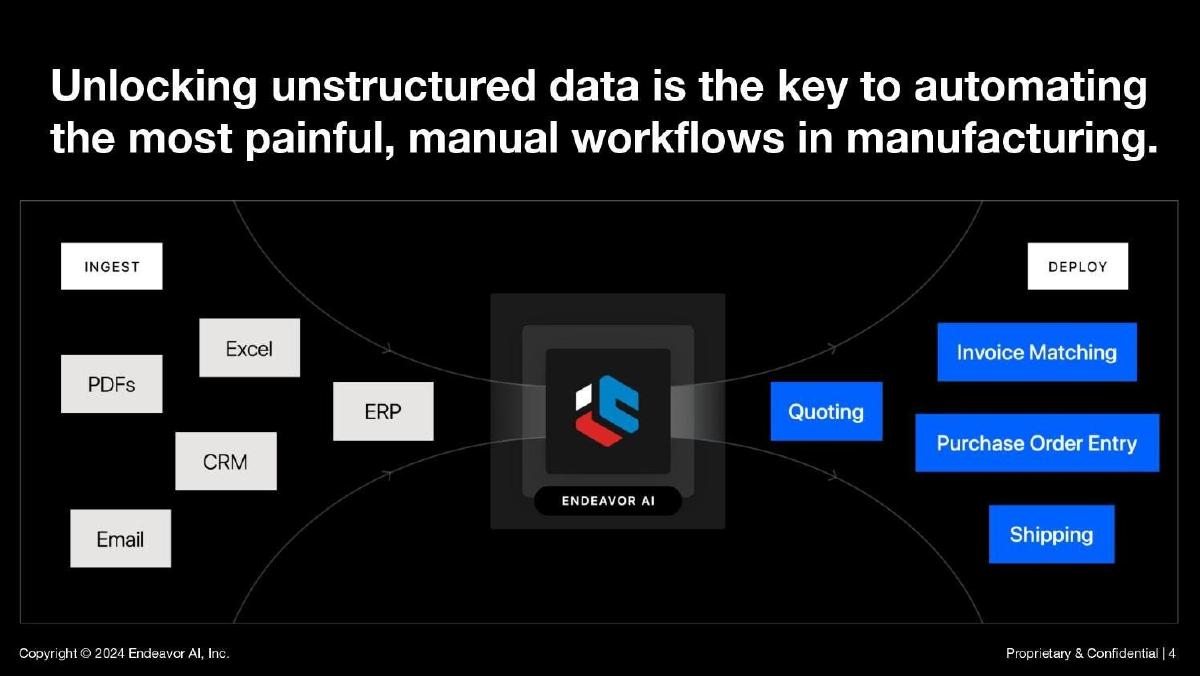
- It identifies 'unstructured data' as the primary bottleneck for industrial automation on Slide 4, rather than just 'lack of AI.'
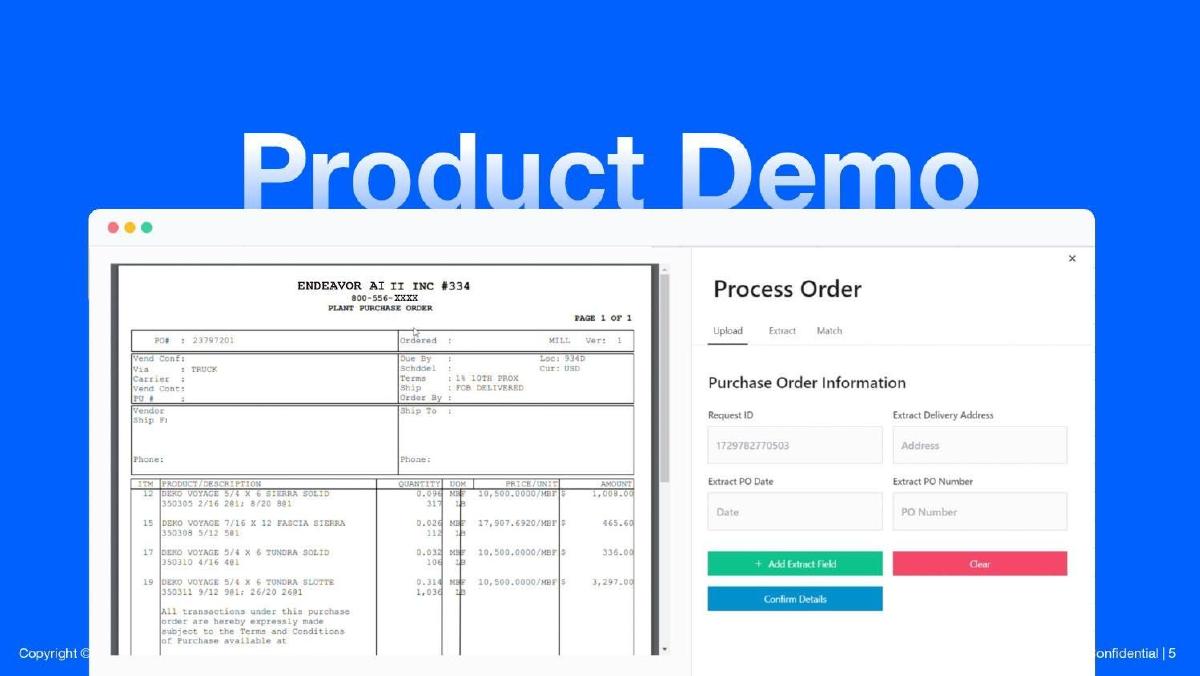
- The product demo on Slide 5 shows a clear, functional UI for processing purchase orders, moving the pitch from theoretical to tangible.
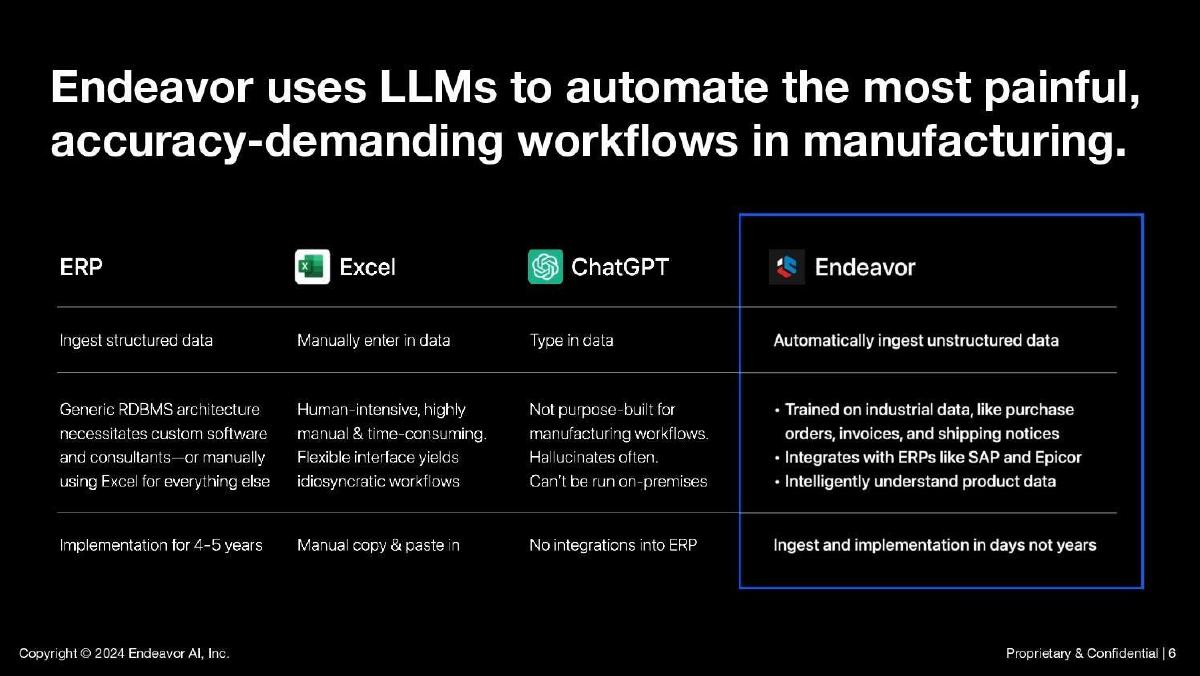
- Endeavor positions itself against legacy ERPs and generic AI like ChatGPT by highlighting its purpose-built industrial training on Slide 6.
- The deck claims to reduce implementation time from years (for traditional ERPs) to days on Slide 6.
- Early market validation is provided through specific quotes from a Steel Manufacturer CEO and a Flooring Manufacturer CTO on Slide 7.
- The team slide (Slide 9) showcases a high density of elite institutional pedigree, including Palantir, ByteDance, and Berkshire Hathaway.
- The $7M ask on Slide 10 is clearly mapped to three pillars: engineering, workflow expansion, and go-to-market scaling.
The Power of Specificity in Industrial AI
Endeavor’s pitch deck is a masterclass in narrative-driven fundraising. In an era where 'AI for manufacturing' is a crowded pitch, Endeavor stands out by being incredibly specific about the problem (unstructured data) and the pedigree of the team solving it. The deck, used to raise a $7M Seed round in 2024, is brief at only 9 slides, but every slide serves a distinct purpose in de-risking the investment.
Slide 1: Title and Positioning
The cover slide is minimalist, featuring the Endeavor logo and the tagline: "Workflow Automation for Industrial Enterprises." It immediately identifies the target customer (Industrial Enterprises) and the value proposition (Workflow Automation). The use of industrial textures in the logo graphic—marble, rusted metal, and blue corrugated siding—subtly reinforces the company's focus on the physical world.
Slide 2: The Founder-Market Fit Narrative
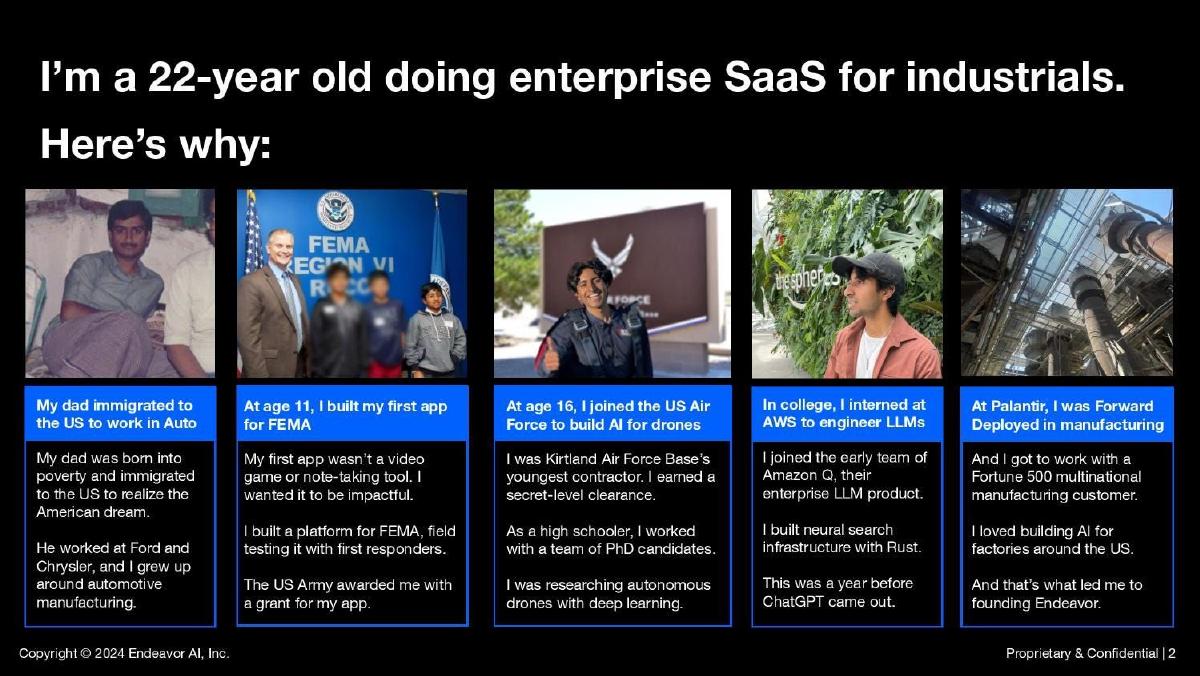
This is arguably the most important slide in the deck. Titled "I’m a 22-year old doing enterprise SaaS for industrials. Here’s why:" , it uses a timeline of five photos to establish Sahitya Senapathy’s credibility. It traces his journey from growing up around automotive manufacturing (his father worked at Ford and Chrysler) to building a FEMA app at age 11, joining the US Air Force at 16, interning at AWS to engineer LLMs, and finally working at Palantir for Fortune 500 manufacturing customers. This slide effectively silences any concerns about the founder's age by proving a decade of high-level technical and industry-specific experience.
Slide 3: The Problem – The Digital Transformation Lie
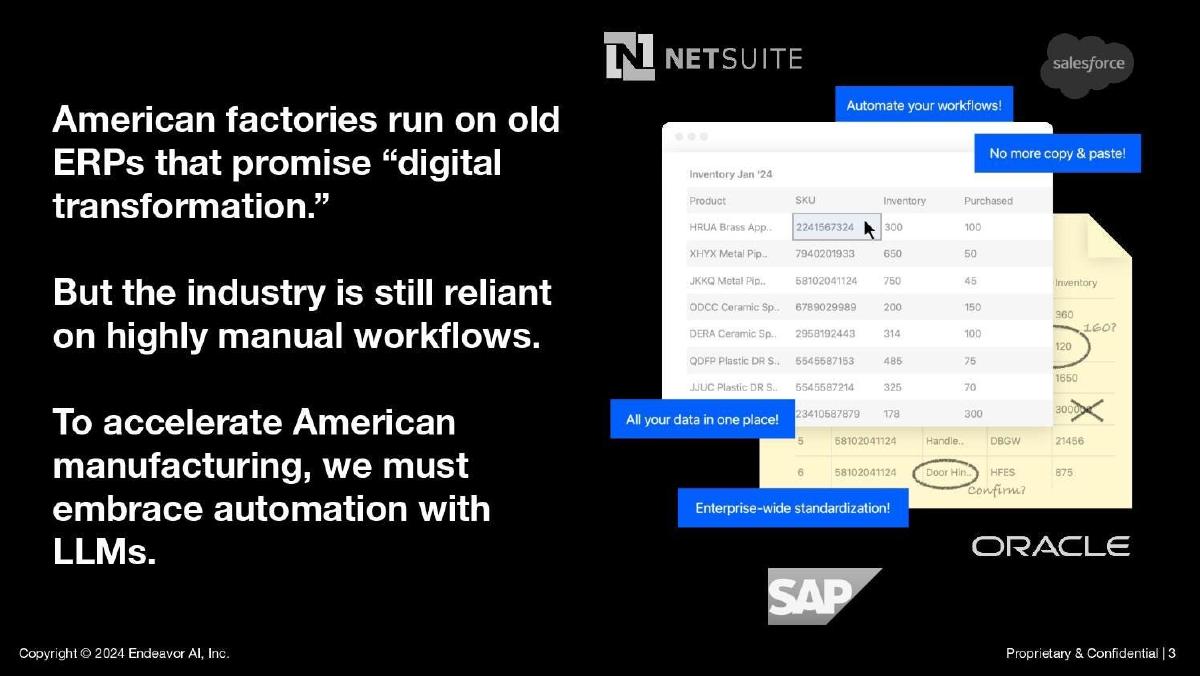
Slide 3 identifies the gap between promise and reality. It notes that while American factories run on ERPs (Enterprise Resource Planning) like NetSuite, Salesforce, Oracle, and SAP that promise "digital transformation," the industry is "still reliant on highly manual workflows." The visual shows a messy spreadsheet with hand-drawn circles and questions like "160?" and "Confirm?", illustrating the "copy & paste" nature of current operations. The solution offered: "To accelerate American manufacturing, we must embrace automation with LLMs."
Slide 4: The Technical Solution – Unlocking Unstructured Data
This slide gets into the mechanics. It identifies "unstructured data" as the key bottleneck. The diagram shows various inputs— PDFs, Excel, CRM, Email, and ERP —being ingested by Endeavor AI. The output is the automation of four specific, high-pain workflows: Invoice Matching, Quoting, Purchase Order Entry, and Shipping. By naming these specific tasks, Endeavor moves away from vague AI promises and toward concrete ROI for the customer.
Slide 5: The Product Demo
Instead of a complex architectural diagram, Slide 5 shows a clean UI. The "Process Order" screen demonstrates the platform extracting data from a "Plant Purchase Order" PDF. Fields like "Request ID," "Extract Delivery Address," and "PO Number" are shown being populated automatically. This slide proves that the product is real, functional, and designed for the specific needs of a factory floor manager.
Slide 6: The Competitive Landscape
Endeavor uses a comparison table to position itself against ERP, Excel, and ChatGPT. The key differentiators for Endeavor are:
Automatically ingest unstructured data (vs. manual entry in ERP/Excel). · Trained on industrial data like purchase orders and invoices. · Integrates with ERPs like SAP and Epicor. · Implementation in days, not years (contrasted with 4-5 years for traditional ERP implementations).
This slide addresses the two biggest threats: the status quo (Excel/ERP) and generic AI (ChatGPT).
Slide 7: Social Proof and Validation
The deck provides two powerful testimonials. A CEO of a Steel Manufacturer notes that even if the tool only works on 25-30% of quotes, it is a "tremendous value." A CTO of a Flooring Manufacturer claims the technology will "take five years off of our development process" and allow for "doing orders in seconds versus weeks." These quotes validate the demand and the specific time-saving benefits of the platform.
Slide 8: The Team
Slide 9 (labeled as 9 in the footer, though it is the 8th content slide) showcases the founding team's pedigree. It includes:
Sahitya Senapathy (CEO): Palantir, UPenn M&T. · Sanjeev Tara (Advisor): Former Group President at Berkshire Hathaway Automotive. · Josh Ludan (Eng): UPenn PhD, Farallon Capital. · Amil Naik (Eng): UT Austin, Y Combinator. · Yuanbo Chen (Eng): UC Berkeley, ByteDance Research.
The inclusion of a former Berkshire Hathaway executive as an advisor to the CEO is a massive signal of industry access and trust.
Slide 9: The Ask
The final slide states the goal: "We’re raising a $7M seed round to revitalize American manufacturing with AI." The funds are allocated to three areas: 1. Grow the engineering team , 2. Develop and deploy additional workflows (Sales, Inventory, Supply Chain, etc.), and 3. Expand the Go-to-Market motion by developing a direct sales workforce. It is a standard, logical close to a high-conviction pitch.
What Endeavor Does Exceptionally Well
The primary strength of this deck is Founder-Market Fit . In many AI pitches, the founders are technical experts looking for a problem. Endeavor flips this; the founder grew up in the problem space and then acquired the technical expertise at the highest levels (AWS, Palantir). This narrative makes the $7M seed round feel like a safe bet on a team that understands the nuances of a difficult, legacy industry.
Furthermore, the deck avoids "AI Hype." It doesn't talk about AGI or changing the world in abstract terms. It talks about "Invoice Matching" and "Purchase Order Entry." For an investor, these are tangible business processes with clear costs. Automating them has an immediate, calculable ROI, which makes the sales cycle feel more predictable than a generic productivity tool.
What is Missing from the Deck
Despite its success, the deck omits several traditional venture capital slides:
Market Size (TAM): There is no slide calculating the billions of dollars spent on manufacturing software. The founders likely assumed that the scale of the "American Manufacturing" sector is self-evident to sophisticated investors. · Business Model/Pricing: The deck doesn't explain how they charge. Is it per seat, per automated workflow, or a percentage of spend? This is a common omission in Seed decks where the focus is on product-market fit rather than optimized monetization. · Unit Economics: There is no mention of Customer Acquisition Cost (CAC) or Lifetime Value (LTV). Again, at the Seed stage, these metrics are often speculative. · Roadmap Timeline: While they mention expanding workflows, there is no specific timeline for when these features will launch.
Lessons for Founders
Founders in legacy industries should take note of how Endeavor handles legacy competition . Instead of saying they will "replace SAP," which is a terrifying and unlikely prospect for a manufacturer, they position themselves as an integration layer that makes the existing ERP more useful. This reduces the friction of adoption.
Additionally, the use of specific customer quotes that mention percentages (25-30%) and timeframes (seconds versus weeks) is far more effective than generic praise. It shows that the founders have had deep, technical conversations with their early users and understand exactly where the value is being created.
Frequently asked questions
- Why did Endeavor raise $7M with only 9 slides?
- The deck is extremely high-signal. It skips generic market data to focus on founder-market fit and a specific technical solution for a known, massive problem. When a founder has experience at Palantir and AWS, and an advisor from Berkshire Hathaway, investors often require less 'education' on the market opportunity and more proof of technical execution, which the demo and comparison slides provide.
- How does Endeavor differentiate itself from other AI startups?
- Slide 6 explicitly compares Endeavor to ChatGPT, noting that generic LLMs 'hallucinate often' and 'can't be run on-premises.' Endeavor differentiates by being 'trained on industrial data' and offering deep integration with legacy ERPs like SAP and Epicor, which are the gatekeepers of manufacturing data.
- What is the 'unstructured data' problem in manufacturing?
- As shown on Slide 4, manufacturing relies on a mess of PDFs, emails, and Excel sheets. Legacy ERPs are good at storing structured data but bad at ingesting these varied formats. Endeavor uses LLMs to 'unlock' this data, automatically turning a messy PDF purchase order into a structured entry in the system.
- Is the founder's age a risk or an asset in this deck?
- The deck turns age into an asset on Slide 2. By framing the founder as a '22-year old doing enterprise SaaS,' it highlights a decade of relevant experience (starting at age 11). It suggests a combination of 'Gen AI native' thinking with 'old school' industry exposure, which is a compelling narrative for modernizing legacy sectors.
- What are the specific use cases Endeavor targets?
- Slide 4 and Slide 10 list specific workflows: Invoice Matching, Quoting, Purchase Order Entry, Shipping, Sales, Inventory, Operations Planning, Supply Chain, Finance, and Procurement. By naming these, Endeavor proves they understand the actual day-to-day operations of a factory.