Transcarent’s 18-slide Series C deck is a highly polished example of a late-stage growth narrative. Rather than focusing on granular product features, the deck centers on category creation and the systemic inefficiency of the American healthcare experience. By leveraging a 'who's who' team of health-tech veterans—most notably CEO Glen Tullman of Livongo—the company successfully argued for a $200M infusion to capture a $226B 'immediately addressable' opportunity. The deck relies heavily on social proof, showcasing a client list that includes Delta and Target, and clinical outcomes like a 40% r…
Key takeaways
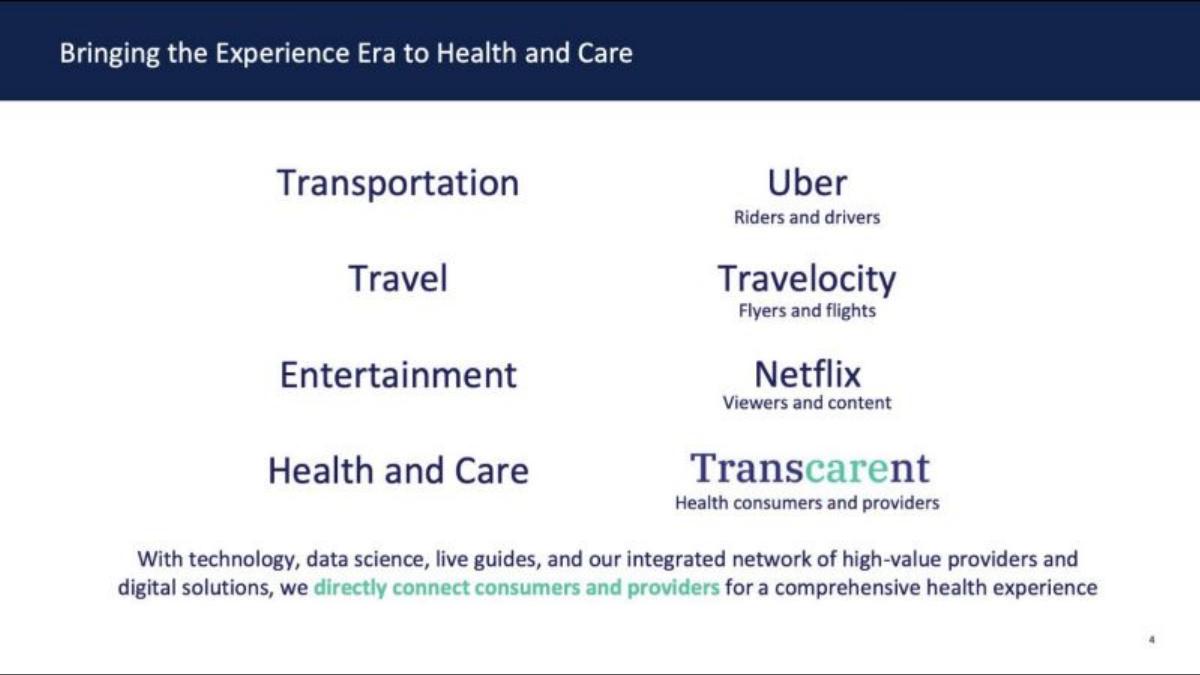
- The deck positions Transcarent as a new category leader by comparing it to industry disruptors like Uber, Netflix, and Travelocity on slide 4.
- Clinical and financial results are quantified with high-impact metrics, including an 80+ Net Promoter Score and a 40% reduction in ER visits on slide 7.
- The leadership team is a primary selling point, featuring executives with backgrounds from Livongo, Teladoc, Haven, and Optum on slide 8.
- The market opportunity is framed as a $1.1T annual employer health spend, with $226B identified as immediately addressable on slide 9.
- A clear expansion roadmap shows the company moving from 10% spend coverage in 2020 to a projected 90% by 2023 on slide 10.
- The business model is diversified across subscription (PEPM), utilization-based, and full-risk performance-based pricing on slide 15.
- Enterprise traction is validated through a logo cloud featuring major brands like Delta, Target, and Albertsons on slide 12.
- The deck omits specific revenue figures or detailed unit economics, focusing instead on 'covered lives' and 'addressable market' percentages.
The Series C Narrative: Scaling the 'Experience Era'
Transcarent’s Series C deck is a masterclass in late-stage storytelling. At this stage, investors aren't just looking for a product that works; they are looking for a platform that can dominate a category. The deck, dated December 2021, arrived at a time when digital health was seeing massive consolidation and growth. Transcarent’s strategy was to position itself not as another 'point solution' for diabetes or mental health, but as the connective tissue for the entire healthcare journey.
Slides 1-2: Vision and Category Creation
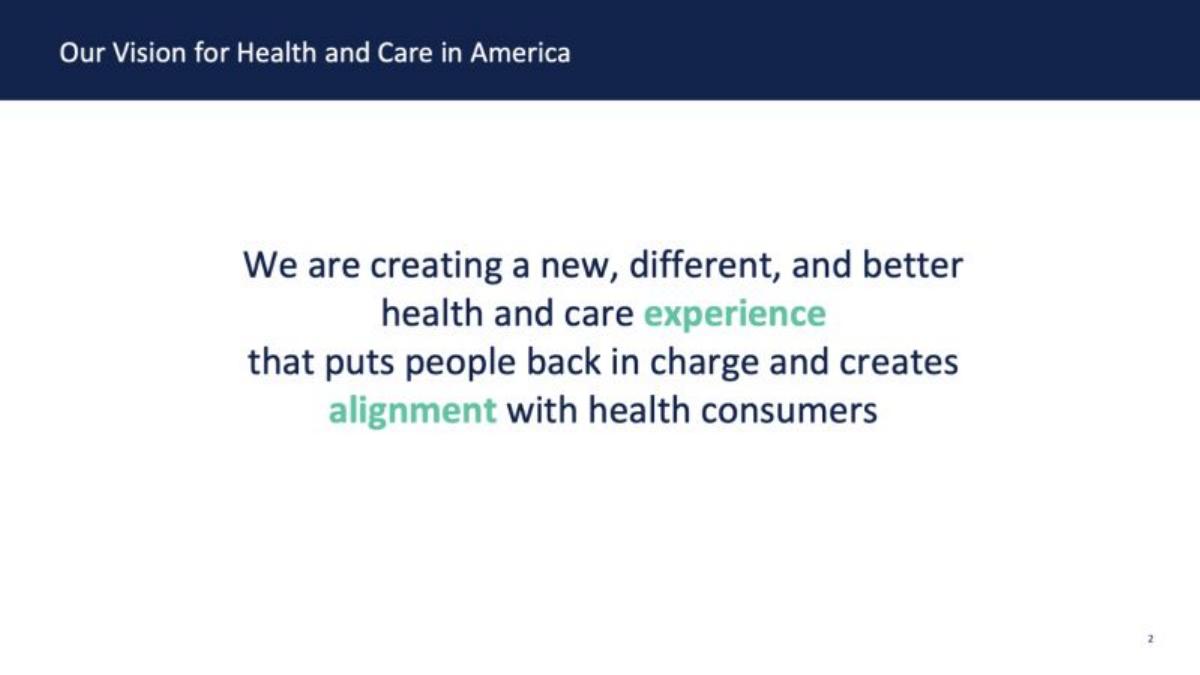
The presentation opens with a clean, professional cover and moves immediately into a vision statement on slide 2. The phrase "creating a new, different, and better health and care experience" sets the stage for a category-creation play. By emphasizing "alignment with health consumers," they signal a shift away from the traditional, often adversarial relationship between payers, providers, and patients.
Slides 3-4: The 'Uber' of Healthcare
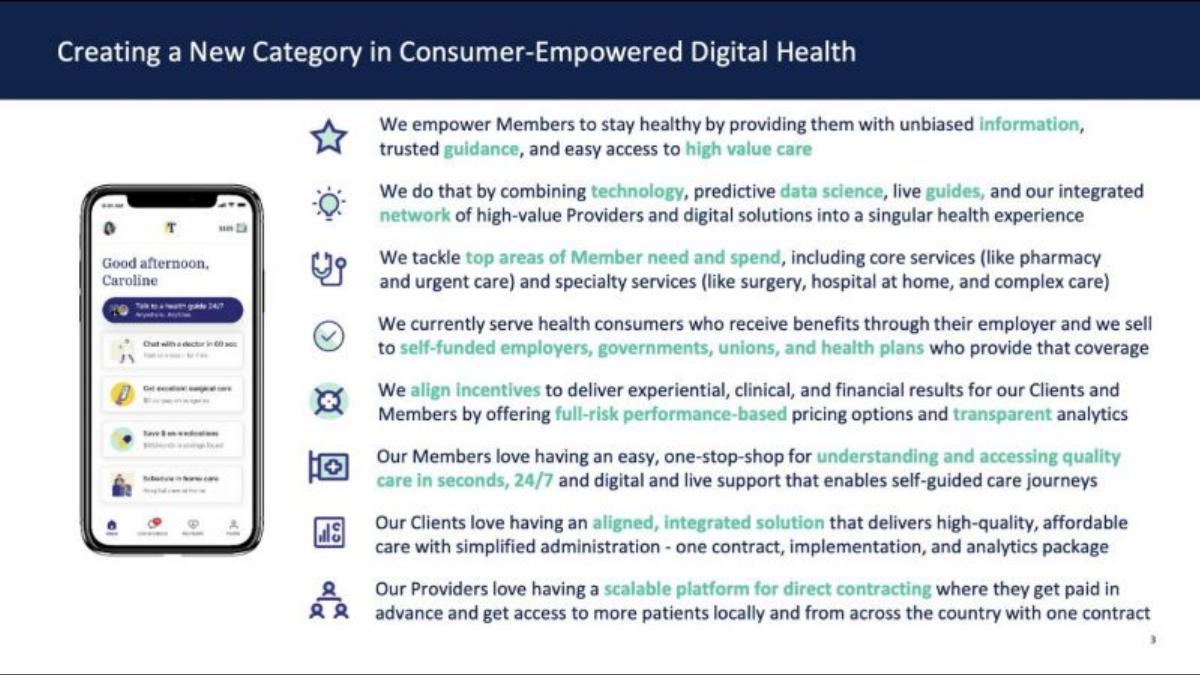
Slide 3 provides a high-level overview of the model, mentioning "predictive data science, live guides, and our integrated network." It explicitly states their target customers: self-funded employers, governments, unions, and health plans. Slide 4 is perhaps the most critical strategic slide in the deck. It uses a simple analogy to place Transcarent alongside Uber, Travelocity, and Netflix. This is a classic 'Experience Era' argument: just as Uber connected riders and drivers, Transcarent claims to "directly connect consumers and providers" for a comprehensive health experience. This framing justifies a high valuation by associating the company with legendary tech disruptors.
Slides 5-6: The Product as a 'One-Stop-Shop'
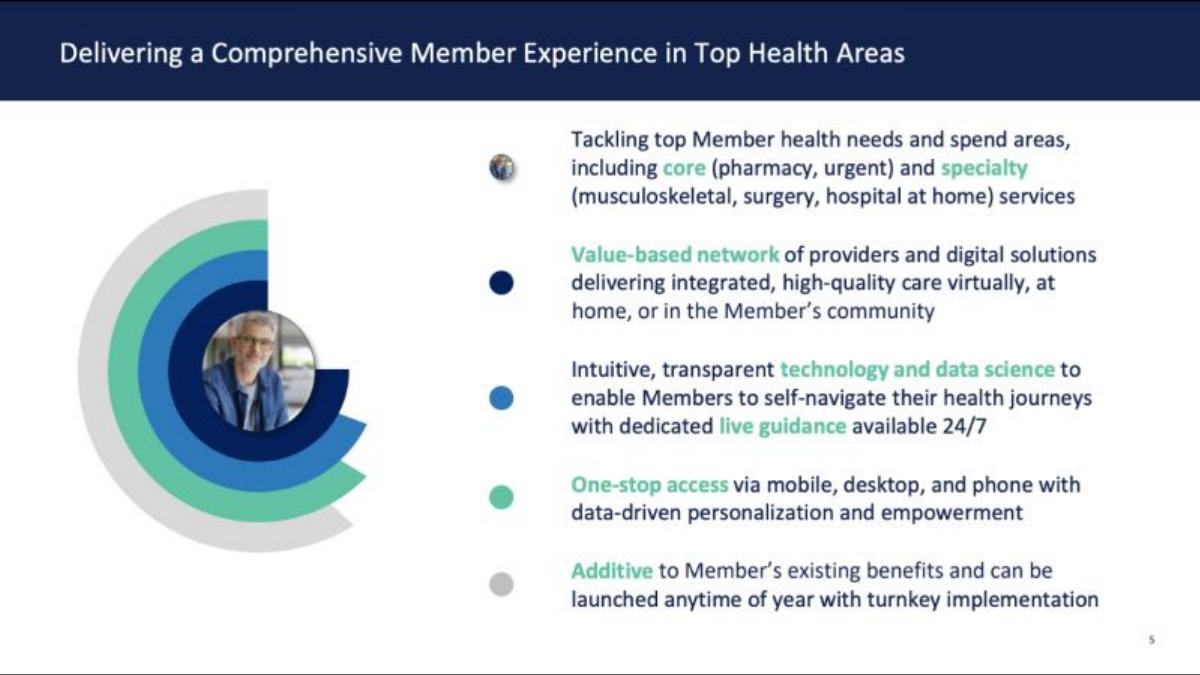
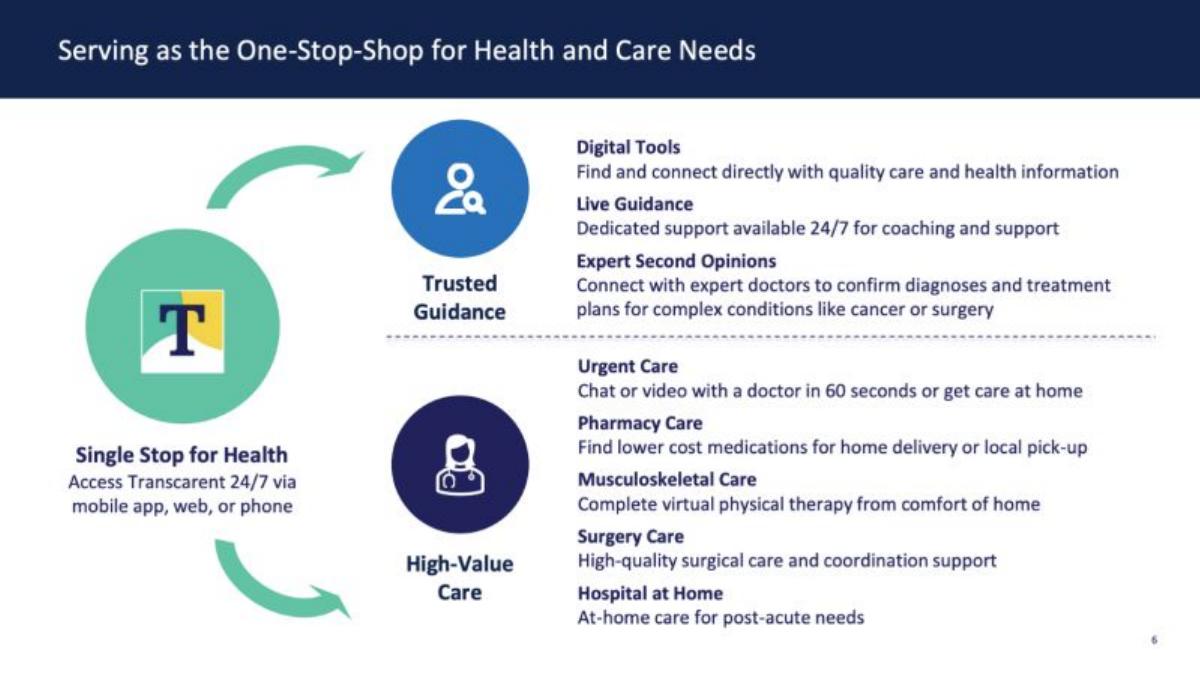
Slides 5 and 6 detail the breadth of the offering. They categorize their services into "Core" (pharmacy, urgent care) and "Specialty" (musculoskeletal, surgery, hospital at home). Slide 6 introduces the "Single Stop for Health" concept, accessible via mobile, web, or phone. The inclusion of "Expert Second Opinions" and "Post-acute needs" suggests they are attempting to capture the highest-cost segments of the healthcare continuum, which is where the real margin lies for self-insured employers.
Slide 7: Quantifying Success
For a Series C, metrics are non-negotiable. Slide 7 delivers these in a clean, five-circle layout. The figures are impressive: an "80+ Net Promoter Score," a "40% reduction in urgent and emergency room visits," and a "33% reduction in unnecessary surgeries." Crucially, they also claim an "80% reduction in readmissions and complications." These metrics address the primary pain points of their enterprise clients: cost and quality. By showing a "2-8% reduction in cost of care," they provide a clear ROI for the CFOs of their target clients.
Slide 8: The Power of the Pedigree
In healthcare, who you are often matters as much as what you build. Slide 8 showcases a team that is essentially a 'dream team' of health-tech exits. CEO Glen Tullman’s name carries significant weight following the $18.5B Teladoc-Livongo merger. The slide lists 12 executives with backgrounds from Livongo, Express Scripts, Teladoc, Haven, Optum, and Zocdoc. For an investor, this team reduces execution risk significantly; they have built and exited billion-dollar companies in this exact space before.
Slides 9-11: The Trillion-Dollar Market
Slide 9 breaks down the TAM (Total Addressable Market). It identifies 162M consumers and $1.1T in annual health spend by employers. They claim a "$226B Immediately Addressable Opportunity." Slides 10 and 11 (which appear to be duplicates or near-duplicates in this version of the deck) show a roadmap for expansion. They started with surgery (10% of spend) in 2020 and planned to cover 90% of member health spend by 2023 by adding pharmacy, cancer, behavioral health, and primary care. This 'land and expand' strategy is a key driver for Series C growth projections.
Slides 12-14: Traction and Sales Velocity
Slide 12 provides social proof with a logo cloud of 80+ clients , including Delta, Target, Albertsons, and UNFI. They claim 1M covered lives , a significant milestone for a relatively young company. Slide 13 discusses "Sales Velocity," showing how they are moving from large employers into mid-market, government, and labor unions. Slide 14 outlines their "Consumer Directed Approach," claiming 97% client retention and 85% member retention. The 90-day implementation window mentioned here is a competitive advantage in an industry known for multi-year rollouts.
Slide 15: The Business Model
Slide 15 explains how Transcarent makes money. They use a three-pronged approach: Subscription (PEPM), Utilization-Based (case rates), and Full-Risk Performance-Based. The latter is particularly aggressive, stating that "30% of actual savings" are paid to Transcarent. This 'at-risk' model aligns the company’s revenue directly with the client’s cost savings, a powerful selling point for large-scale enterprise contracts.
Slides 16-18: Conclusion
The deck concludes with a summary of the vision on slide 16 and a 'Thank You' on slide 17. Slide 18 is a promotional slide for the source library. Notably, the deck does not include a specific 'Ask' slide (though the catalogue listing confirms a $200M raise) or a detailed financial projection table. This is common in late-stage decks where the specifics of the round are often negotiated via a separate data room rather than the main pitch deck.
What Transcarent Does Well
Category Positioning: By comparing themselves to Uber and Netflix, they move the conversation away from 'health insurance' to 'consumer experience.' · Team Credibility: The team slide is one of the strongest in the industry, leveraging massive past successes to build trust. · Outcome-Driven: They lead with clinical and financial results (Slide 7) rather than just features. · Market Sizing: They don't just give a big number; they explain how they get to their 'immediately addressable' $226B figure.
What is Missing from the Deck
Detailed Financials: There is no mention of current ARR (Annual Recurring Revenue), burn rate, or specific revenue growth percentages. · Competitive Landscape: The deck assumes Transcarent is in a category of one. It does not address competitors like Accolade or Quantum Health. · Unit Economics: While they mention pricing models, they don't show the LTV (Lifetime Value) or CAC (Customer Acquisition Cost) for their 1M covered lives. · The Ask: The deck ends without a slide detailing how much they are raising or the specific use of funds.
Founder Takeaways
Use Analogies Wisely: If you are disrupting a legacy industry, use well-known tech giants (like Uber or Netflix) to help investors visualize your role in the ecosystem. · Focus on 'Covered Lives' and 'Retention': In enterprise health-tech, these are the two most important metrics for proving scale and product-market fit. · Build a 'Risk-Aligned' Model: Transcarent’s willingness to put fees 'at-risk' (Slide 15) is a powerful way to overcome enterprise sales friction. · Visual Simplicity: Despite the complexity of healthcare, the deck uses simple icons and clear charts. Avoid 'wall of text' slides when dealing with complex regulatory or clinical data.
Frequently asked questions
- What is Transcarent's core value proposition to employers?
- Transcarent offers a 'single stop for health' that integrates technology, data science, and live guides to manage employee health benefits. According to slide 3, they align incentives by offering full-risk performance-based pricing, which aims to deliver better clinical and financial results for self-funded employers, unions, and health plans.
- How does Transcarent justify its massive market size?
- On slide 9, the company cites 162 million consumers covered by employers, representing $1.1 trillion in annual spend. They calculate their 'immediately addressable opportunity' at $226 billion by applying their current service coverage (urgent care, musculoskeletal, and surgery) to that total spend.
- What specific health outcomes does the company claim?
- Slide 7 lists several key performance indicators: an 80+ Net Promoter Score, a 40% reduction in urgent and emergency room visits, a 33% reduction in unnecessary surgeries, and an 80% reduction in readmissions and complications. These figures are based on their book of business and partner results.
- Who are the key people behind Transcarent?
- The team, shown on slide 8, is led by CEO Glen Tullman (formerly of Livongo and Allscripts). Other notable leaders include COO Snezana Mahon (Express Scripts), CFO Stephanie Peng (Teladoc), and Chief of Staff Caitlin Fleming (Haven and Optum). This high-pedigree team is central to the Series C narrative.
- What is the company's pricing strategy?
- As detailed on slide 15, Transcarent uses a 'flexible and aligned' model. This includes a standard Per Employee Per Month (PEPM) subscription, utilization-based case rates for care delivered, and a full-risk performance model where subscription fees are at-risk or based on shared savings (30% of actual savings).