Transcend’s Series B deck is a masterclass in vertical SaaS positioning, targeting the massive but antiquated infrastructure sector. By framing 'poor planning' as the root cause of the climate crisis, the company elevates its generative design software from a mere productivity tool to a systemic necessity. The deck effectively utilizes a 'flywheel' model to explain how it serves three distinct customer segments—Asset Owners, EPCs, and OEMs—while showcasing a product history that spans over a decade. Despite several 'placeholder' slides and redacted financial figures typical of a late-stage co…
Key takeaways
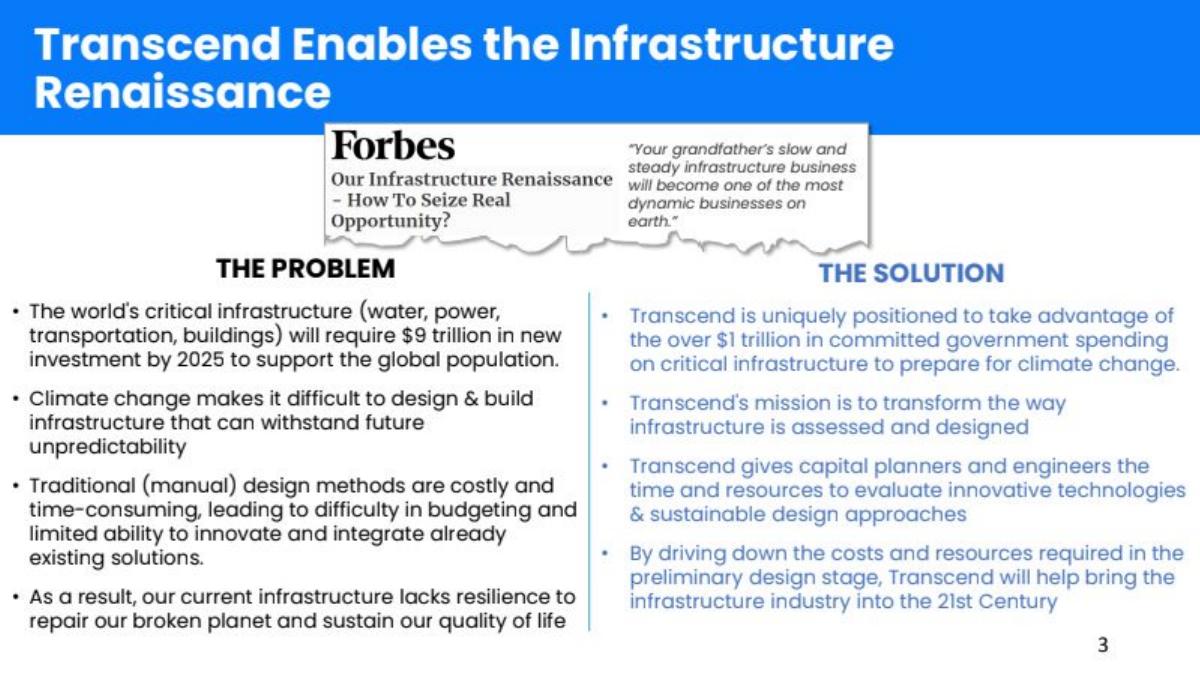
- The company identifies a $9 trillion investment requirement for global infrastructure by 2025 as a primary market driver (Slide 3).
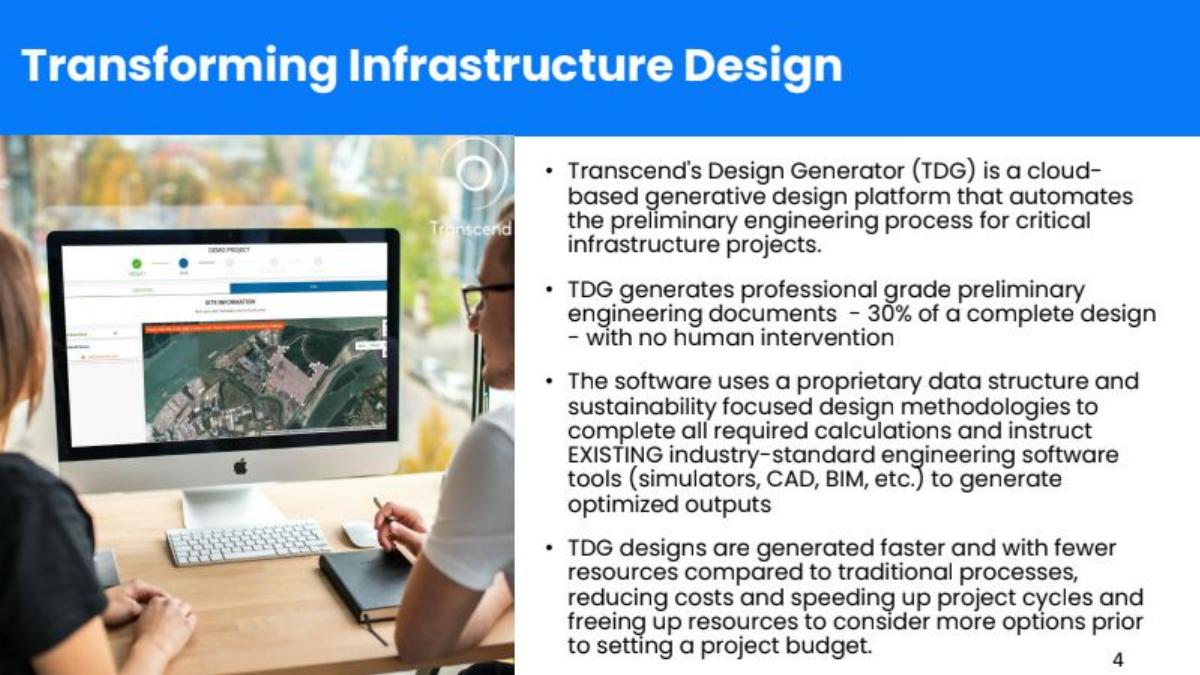
- Transcend’s Design Generator (TDG) automates the preliminary engineering process, completing 30% of a full design with no human intervention (Slide 4).
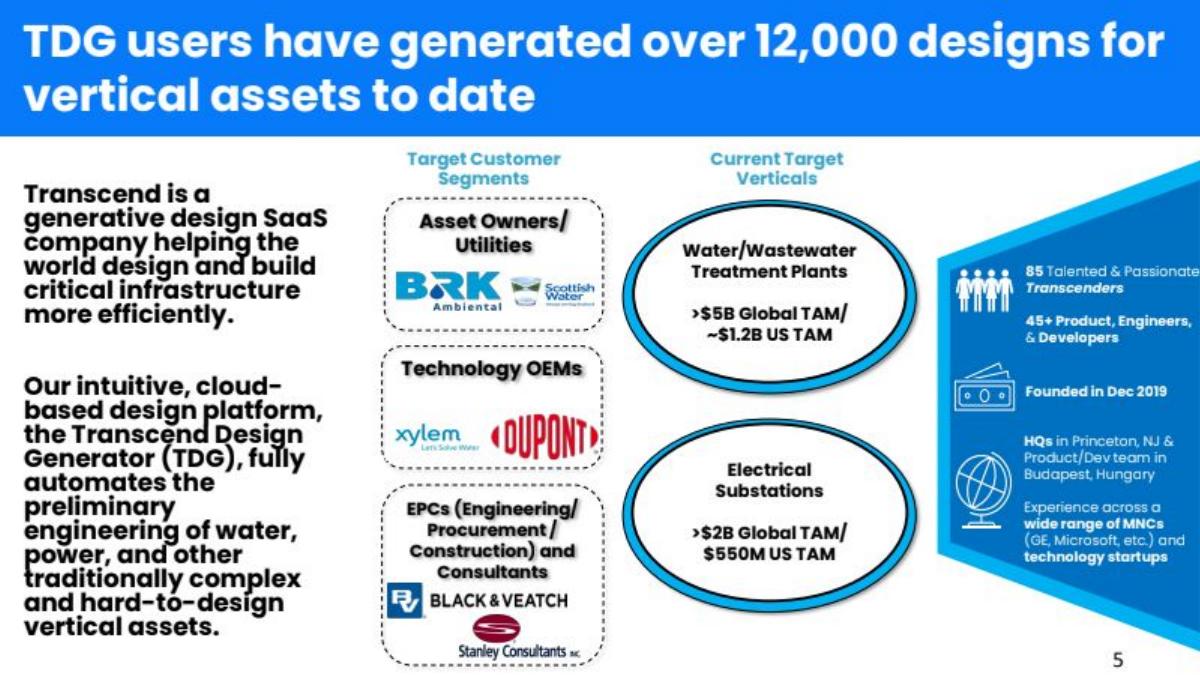
- The platform has already generated over 12,000 designs for vertical assets like water treatment plants and electrical substations (Slide 5).
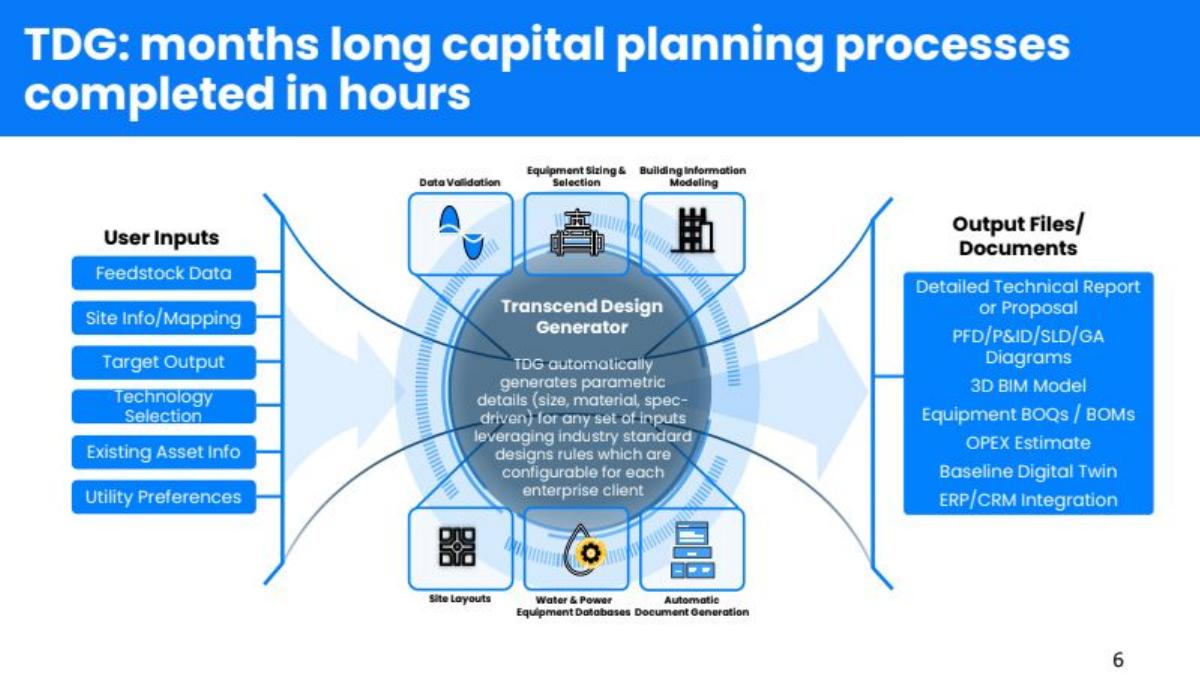
- Transcend claims to compress months-long capital planning processes into just a few hours (Slide 6).
- The product has a deep pedigree, originating as an internal tool in 2011 before spinning out as an independent company in 2019 (Slide 8).
- The business model targets three specific segments: Asset Owners, EPCs (Engineering/Procurement/Construction), and Technology OEMs (Slide 10).
- Market size is quantified by the $107B that asset owners spend on 3rd party design work in the US alone (Slide 12).
- The Series B round sought $20M in growth capital to accelerate team and product expansion (Slide 16).
The Macro Narrative: Infrastructure and Climate
Slides 1-3: Setting the Stage
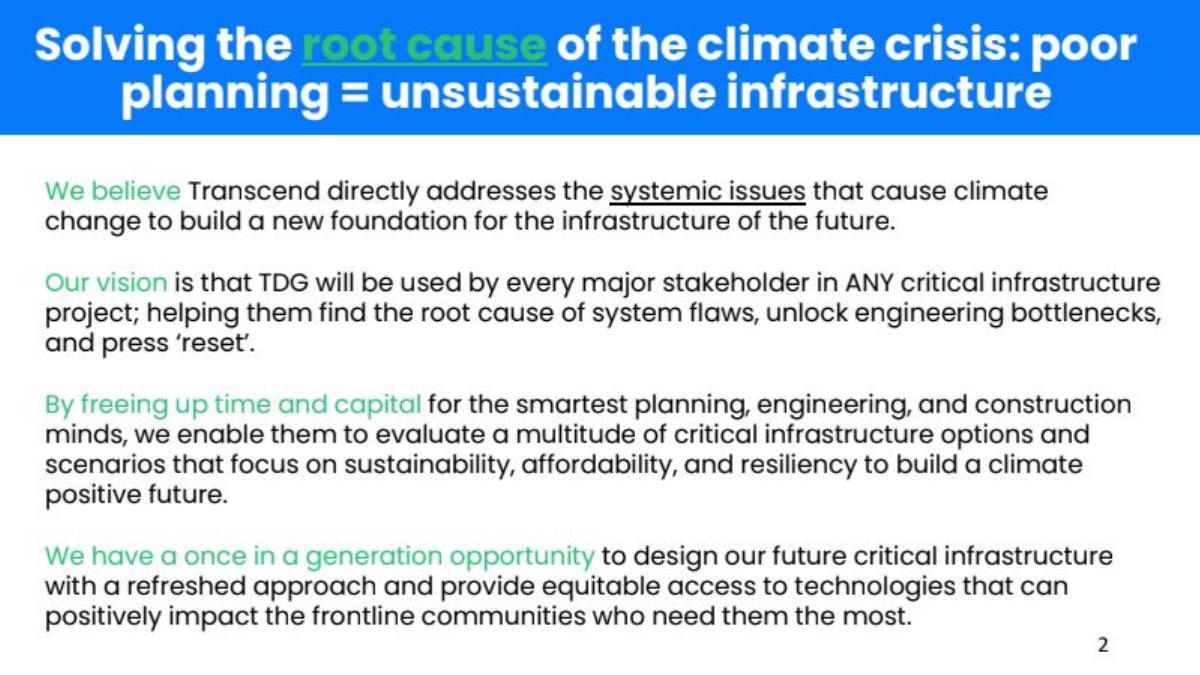
Transcend opens with a bold, high-level value proposition: Generative Design SaaS for Critical Infrastructure . The cover slide is clean, professional, and establishes the 2023 timeframe. Slide 2 immediately pivots to a mission-driven narrative, framing "poor planning" as the root cause of the climate crisis. This is a sophisticated positioning tactic; instead of selling a CAD plugin, they are selling a solution to "unsustainable infrastructure." They define their vision as becoming a tool used by "every major stakeholder in ANY critical infrastructure project."
Slide 3 introduces the "Infrastructure Renaissance." It cites a $9 trillion investment requirement by 2025 to support the global population. The slide sets up a classic problem/solution dichotomy. The problem is manual, costly, and time-consuming design methods that lack resilience. The solution is Transcend’s ability to drive down costs in the preliminary design stage, allowing engineers to evaluate more sustainable options that were previously cost-prohibitive to model.
Product Capabilities and Validation
Slides 4-7: The Transcend Design Generator (TDG)
Slide 4 gets into the technical weeds. It defines the Transcend Design Generator (TDG) as a cloud-based platform that automates the preliminary engineering process. A key metric here is that it completes 30% of a complete design with no human intervention . It doesn't replace existing tools; rather, it "instructs" them (simulators, CAD, BIM) to generate optimized outputs. This is a crucial distinction for B2B SaaS—it integrates with the user's existing workflow rather than forcing a total rip-and-replace.
Slide 5 provides impressive validation: over 12,000 designs generated to date . It also breaks down the current target verticals: Water/Wastewater (>$5B Global TAM) and Electrical Substations (>$2B Global TAM). The slide also mentions the company's footprint: 85 employees, founded in Dec 2019, with HQs in Princeton, NJ, and a dev team in Budapest, Hungary. Slide 6 illustrates the workflow, showing how user inputs (feedstock data, site info) are transformed into output files like 3D BIM models, OPEX estimates, and P&ID diagrams. Slide 7 is a simple placeholder for a demo video, promising a full facility design in 5 minutes.
Slide 8: A Decade of Development
One of the strongest slides in the deck is the Product History . It shows that TDG isn't a "v1" product. It started as an internal tool for Organica Water in 2011, achieved product-market fit validation through 2016, and underwent commercial validation with 4,000+ designs run by 2018 before spinning out in 2019. For a Series B investor, this history significantly de-risks the technology; it has been battle-tested in a real-world engineering environment for over ten years.
Go-To-Market and Business Model
Slides 9-11: Strategy and the Flywheel
Slide 9 outlines Five Core Differentiators , structured as pillars of the company's vision. These include Product-Led Growth, being the "Leading Voice" in the industry, clear ROI, a Land and Expand sales strategy, and a scalable tech stack. Slide 10 identifies the three target customer segments: Asset Owners/Utilities , EPCs/Consultants , and Technology OEMs . By listing logos like DuPont, Xylem, and Black & Veatch, Transcend demonstrates they are already playing at the highest levels of the industry.
Slide 11 introduces the "Transcend Flywheel." It explains how the product-led growth model works across these segments. For example, it notes that TDG saves hundreds of hours per design for EPCs, allowing them to offer more options to clients and achieve higher margins on fixed-bid work. This slide shows a deep understanding of the incentives for each player in the infrastructure value chain.
Market Size and Financials
Slides 12-14: The $107B Opportunity
Slide 12 quantifies the market using data from ENR 2021. It states that asset owners spend $107B on 3rd party design work in the US alone. Transcend highlights that their current verticals (Water, Power, Sewer/Waste) represent over $23B of that spend, leaving massive room for expansion into Transportation and Building (the two largest segments).
Slide 13 is a placeholder for product roadmap and financial projections , which is common in decks shared publicly after the round. Slide 14 provides an OEM Use Case for a redacted "XX Customer." This case study is highly specific, noting that the tool reduced the time to produce budgetary proposals by 50% (from 3 days to 1.5 days) and saved 300 days of engineering time across 200+ proposals. This is the kind of hard ROI data that Series B investors require.
Team and The Ask
Slides 15-16: Seasoned Leadership and $20M Raise
The team slide (Slide 15) features Ari Raivetz (CEO) , Adam Tank (CCO) , and Tony Rhine (COO) , along with VPs of Product, Delivery, and Customer Success. The backgrounds are impressive, citing experience at GE, Microsoft, and various VC-backed startups. They also list board members from Elemental Excelerator, PureTerra Ventures, and Aspen Capital Group, showing a strong support network of specialized investors.
Slide 16 is the Use of Proceeds . Transcend states they are raising $20M of growth capital . The goals for 2025 include being recognized as the market leader in automated design and generating CARR (Contracted Annual Recurring Revenue) from water and power verticals with "x%+" net revenue retention. The slide also mentions a goal of reaching ">$xM ARR in 2028." While the specific numbers are redacted, the structure shows a clear path toward a significant scale-up.
What Transcend Does Well
Vertical Expertise: The deck doesn't just talk about software; it talks about "P&ID diagrams," "BIM models," and "EPC billing cycles." This speaks the language of the industry. · De-risking through History: Highlighting the 10-year development history at Organica Water is a brilliant way to counter the "startup instability" objection common in the infrastructure world. · Segmented Value Prop: They don't have one generic pitch. They clearly articulate why an Asset Owner cares (ROI/Sustainability) versus why an OEM cares (Sales speed/Proposal volume). · Strategic Lead Investor: While not on a specific slide, the catalogue facts note that Autodesk led the round. Given that TDG "instructs" CAD and BIM software, having the industry giant as a lead investor is the ultimate validation.
What is Missing
Specific Financials: Due to the redacted nature of the deck, we don't see the actual ARR, CAC, or LTV. For a teardown, these omissions make it hard to judge the efficiency of the business. · Competitive Landscape: There is no slide addressing direct competitors or legacy software incumbents (other than the mention of manual processes). Investors would want to know how they stay ahead of potential generative design features from the very companies that invest in them (like Autodesk). · Implementation Friction: Infrastructure is notoriously slow to adopt new tech. The deck could benefit from a slide explaining how they overcome the "culture of manual design" beyond just saying they have a "Land and Expand" strategy.
What Other Founders Should Copy
The "Flywheel" Slide: Slide 11 is an excellent way to show how a single product serves multiple masters in a complex ecosystem. · The Use Case Specificity: Slide 14's breakdown of "3 days to 1.5 days" and "300 days saved" is much more compelling than saying "we improve efficiency." · Problem Scaling: Start with a global, undeniable problem (the $9T infrastructure gap) and then narrow down to your specific niche (preliminary design automation). This makes the startup feel like a necessary part of a global shift.
Frequently asked questions
- What exactly does Transcend's software do?
- Transcend’s Design Generator (TDG) is a cloud-based generative design platform. It automates the preliminary engineering phase for infrastructure projects like wastewater plants and power substations. According to slide 4, it generates professional-grade documents—representing about 30% of a total design—without human intervention, using proprietary data structures to instruct industry-standard tools like CAD and BIM.
- Who are the primary customers for this generative design tool?
- Transcend targets three distinct groups within each vertical: Asset Owners/Utilities (who control the budgets), EPCs/Consultants (who traditionally perform the manual design work), and Technology OEMs (who sell the equipment used in these facilities). Slide 10 details how each group benefits, such as OEMs using the tool to provide faster budgetary proposals to potential buyers.
- How does Transcend justify its market opportunity?
- The deck points to a massive $9 trillion global infrastructure need by 2025 (Slide 3). More specifically, it highlights that in the US alone, asset owners spend $107B on third-party design work. Transcend focuses on verticals like water, power, and industrial waste, which represent over $23B of that annual design spend (Slide 12).
- What is the history of the company?
- Unlike many early-stage startups, Transcend has a long technical history. As shown on slide 8, the software began as an internal tool for Organica Water between 2011 and 2013. It underwent a decade of validation and 'commercial registration' before spinning out as an independent brand in late 2019 with initial seed financing.
- What was the 'Ask' in this pitch deck?
- On slide 16, Transcend explicitly states they are raising $20M of growth capital. The intended use of proceeds is to accelerate the build-out of their team and product. The slide also notes that this funding is intended to provide 'ample runway' to reach their 2025 and 2028 financial objectives.