The Trailer Dynamics deck focuses on the 'Newton Electric Trailer,' an electrified semi-trailer designed to improve heavy-duty trucking efficiency. The core value proposition centers on a high-performance electric drivetrain featuring up to three e-axles, each capable of 550 HP (Slide 3). Beyond simple electrification, the company positions the trailer as a 'smart device' equipped with a comprehensive sensor array for safety, tracking, and freight monitoring (Slide 4). A unique secondary thesis suggests these trailers could act as a 'spinning reserve' to stabilize power grids, potentially off…
Key takeaways
- The Newton Electric Trailer utilizes an e-axle system where each axle can reach a peak power of 550 HP (Slide 3).
- The platform integrates a Main Control Unit managing battery, bogie, and motor systems (Slide 4).
- A sophisticated sensor suite includes gas chromatographs for CO2 monitoring and RFID sensors for cargo holds (Slide 4).
- The 'PDC' system calculates alternative routes and predicts traffic density to optimize energy resources (Slide 5).
- The company proposes using trailer batteries as a 'spinning reserve' to counteract grid deviations of ± 200 mHz (Slide 6).
- Trailer Dynamics was founded in 2018, following initial control module prototype development in 2017 (Slide 8).
- The control module reached 'Introduction to Series' status following functional safety standard compliance in 2019 (Slide 8).
- The business model includes an 'app store' concept for trailers to enable ongoing service offerings (Slide 7).
Introduction and Problem Statement
Slide 1: Title Slide
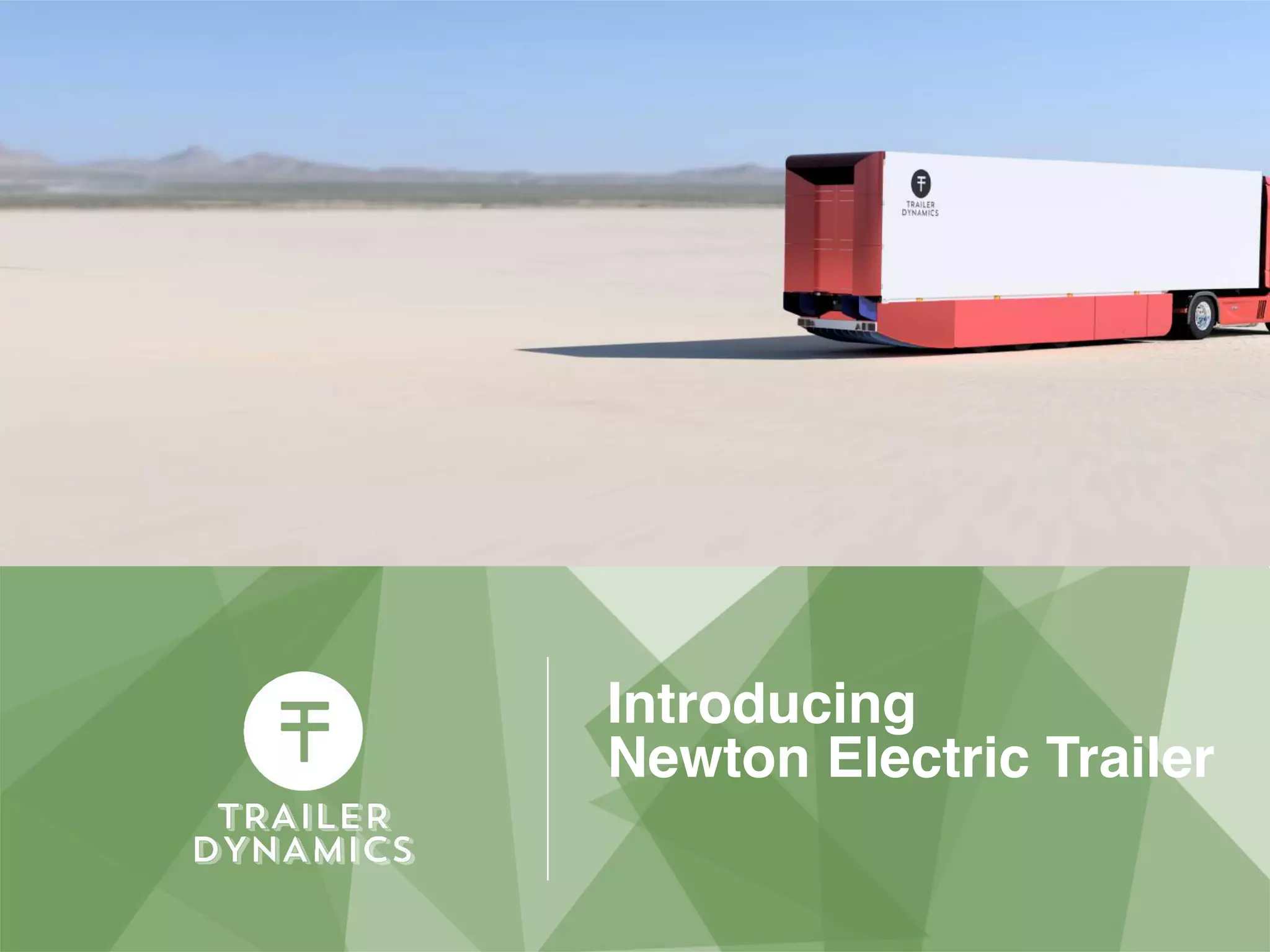
The deck opens with a clean, high-resolution image of a semi-trailer in a desert environment. The branding is minimal, featuring the Trailer Dynamics logo and the text 'Introducing Newton Electric Trailer.' The visual emphasizes the physical product, suggesting a hardware-centric focus.
Slide 2: The Efficiency Challenge
This slide presents a single figure: '40.000 € per Truck.' It asks the rhetorical question, 'How can we improve efficiency?' This establishes the economic pain point for fleet operators, though it does not specify if this figure represents annual fuel costs, maintenance, or total cost of ownership. It serves as the 'Problem' slide, framing the Newton trailer as the solution to this high operational cost.
Technical Specifications and Drivetrain
Slide 3: Newton’s Technological Highlights: Electric Drivetrain
This slide dives into the core hardware. It features a transparent 3D render of the trailer chassis, highlighting the 'E-Axle.' Key technical points include:
The E-Axle is the central element of the drivetrain. · Flexibility to install up to three e-axles depending on the forwarder's specific needs. · A peak power rating of 550 HP per axle.
This confirms that the product is not just a battery pack, but an active propulsion system.
Slide 4: Newton’s Technological Highlights: Sensors
Trailer Dynamics positions the trailer as a data-gathering hub. A complex block diagram shows the 'Main Control Unit' connected to a wide array of sensors. Notable inclusions are a gas chromatograph for CO2 monitoring, an optical overhead line tracker, and an 'Intelligent kingpin.' The slide categorizes these functions into vehicle safety, traffic safety, freight monitoring, tracking, and efficiency enhancement. This suggests a secondary value proposition in logistics software and safety data.
Software and Connectivity
Slide 5: PDC: Example Scenario 1
The 'PDC' (likely Predictive Drive Control) is illustrated through a city-scape visualization. The slide explains that the system detects disruptions on the route ahead. It claims the software calculates alternative routes, predicts traffic density, schedules energy resources, and calculates a new ETA. This indicates that the trailer's electric usage is managed dynamically based on external traffic conditions to maximize range and efficiency.
Slide 6: Stabilizing the Power Grid
This slide introduces a 'Possible technology' that could be added as an aftermarket feature. It defines three types of operating reserves: Spinning, Non-spinning, and Replacement. The company identifies 'Newton’s V.O.R' (Vehicle Operating Reserve) as a spinning reserve capable of counteracting grid deviations of ± 200 mHz within 15 seconds. This is a sophisticated pitch for a secondary revenue stream, turning a fleet of trailers into a virtual power plant.
Slide 7: Connected Trailer and App Store
The trailer is described as a 'smart device' that learns from road experience. The slide introduces the concept of an 'app store' for trailers, where new functions can be added via individual applications. This suggests a move toward a Software-as-a-Service (SaaS) model, where hardware capabilities can be unlocked or enhanced through software updates after the initial sale.
Timeline and Summary
Slide 8: Control Module Development Timeline
The timeline spans from 2017 to 2019. Key milestones include:
2017: First development of the next-generation control module prototype. · 2018: Founding of Trailer Dynamics and start of cooperation with TTC. · 2019: Control module ready for Newton Trailer, compliance with Class III IEC 61508 safety standards, and 'Introduction to Series.'
This slide provides credibility by showing a multi-year engineering effort and adherence to industrial safety standards.
Slide 9: Summary
The summary reinforces two main points. First, the grid stabilization feature (using one-tenth of the battery) could make the 'full charge of its batteries... nearly free.' Second, the 'smart asset' approach creates new business models and ongoing service offerings. The focus remains on the intersection of logistics efficiency and energy management.
What Trailer Dynamics Does Well
The deck is exceptionally strong on technical clarity. By providing specific horsepower figures (550 HP) and citing specific industrial safety standards (IEC 61508), the founders demonstrate a high level of engineering maturity. The visualization of the sensor suite and the drivetrain components helps demystify how an 'electric trailer' actually functions. Furthermore, the inclusion of a secondary revenue model—grid stabilization—shows forward-thinking regarding the total cost of ownership, which is the primary concern for their target B2B customers.
What is Missing from the Deck
Despite the technical depth, the deck has several significant omissions typical of early-stage engineering pitches: 1. The Team: There is no slide introducing the founders or the engineering team. In deep-tech and hardware, the pedigree of the team is often as important as the tech itself. 2. Market Size (TAM/SAM/SOM): While the deck mentions a 40,000 € cost per truck, it does not quantify the total addressable market. Investors need to know how many trailers are eligible for this technology globally or regionally. 3. Unit Economics and Pricing: The deck mentions the potential for 'free' charging via grid services, but it does not state the anticipated retail price of the Newton trailer or the cost to manufacture it. 4. Competition: There is no mention of other electric trailer startups or incumbent axle manufacturers (like SAF-Holland or BPW) who might be developing similar e-axle solutions. 5. The Ask: The provided slides do not include a funding request. It is unclear how much capital the company is seeking or what milestones that capital will fund.
Founder's Guide: What to Copy
Founders building complex hardware should look at Slide 8 (Timeline) as a model. It doesn't just list dates; it lists specific technical achievements and safety certifications. This builds much more trust than a timeline that only lists 'Product Launch' or 'Series A.' Additionally, Slide 4 (Sensors) is an excellent way to visualize a 'Smart' product. Rather than just saying the product is 'IoT-enabled,' the block diagram shows exactly what is being measured and how those data points roll up into the Main Control Unit. Finally, the Grid Stabilization (Slide 6) concept is a great example of how to pitch a 'Value-Add' that offsets the high entry cost of hardware, which is a common hurdle in the EV space.
Frequently asked questions
- What is the primary technical innovation of the Newton trailer?
- The primary innovation is the integration of an independent electric drivetrain into the trailer itself. According to Slide 3, the trailer can house up to three e-axles, each delivering 550 HP. This allows the trailer to actively assist the truck in propulsion, rather than being a passive load, which is intended to significantly improve overall fuel and energy efficiency.
- How does the trailer contribute to power grid stability?
- Trailer Dynamics suggests that parked trailers can function as a 'spinning reserve' for the electrical grid. Slide 6 explains that by providing just one-tenth of the battery resources for grid stabilization, the cost of charging the batteries could be significantly reduced. This turns a logistics asset into a distributed energy storage component.
- What kind of data does the trailer collect during transit?
- The deck outlines a massive sensor array on Slide 4. This includes environmental sensors like gas chromatographs for CO2, operational sensors like an intelligent kingpin and gyroscope, and safety features like blind spot assist and rear-view cameras. It also tracks freight via RFID and monitors load distribution using ultrasonic scanners.
- What is the development status of the technology?
- Based on the timeline on Slide 8, the company moved from a first prototype in 2017 to founding the company in 2018. By 2019, they had achieved Class III IEC 61508 functional safety standards and were moving toward 'Introduction to Series.' The deck reflects a company that has moved past the pure concept stage into hardware validation.
- What is missing from this pitch deck?
- The provided slides are heavily weighted toward technical specifications and engineering milestones. Missing elements include a clear Go-To-Market (GTM) strategy, a competitive landscape analysis, detailed unit economics (beyond the 40,000 € cost mention), and a specific funding 'Ask' detailing how much capital is needed and for what purpose.