Tracksuit’s Series B deck is a study in narrative-driven fundraising. By framing the 'Cookiepocalypse' and rising acquisition costs as a crisis for modern marketers, Tracksuit positions its 'beautiful, radically affordable' brand tracking as the essential new source of truth. The deck highlights a significant cost advantage—delivering measurement at 1/10th the price of traditional methods—and showcases 48 months of consistent growth across New Zealand, Australia, the UK, and the US. With over 75% of revenue coming from inbound leads and a clear 'counter-positioning' strategy against enterpris…
Key takeaways
- The problem is framed around the 'Cookiepocalypse' and the desperation of marketers to track non-clickable spend (Slide 2).
- Tracksuit claims a 90% cost reduction, offering services at 1/10th the cost of traditional tracking (Slide 4).
- The platform provides daily updates, contrasting with traditional 12-week reporting cycles (Slide 4).
- Growth is diversified across four major markets: NZ, AU, UK, and US, spanning 48 months (Slide 7).
- Inbound efficiency is high, with over 75% of revenue originating from referrals and inbound leads (Slide 10).
- The business model uses an entry-level $800/month price point to exploit the 'innovator's dilemma' against incumbents (Slide 10).
- Strategic priorities for 2025 include expanding use cases and validating new products (Slide 8).
- The deck leans heavily on social proof from investors and customers like Eucalyptus and Nature's Fynd (Slides 12, 13, 16).
The Narrative of Brand Measurement
Tracksuit’s Series B deck is a masterclass in identifying a macro-economic shift and positioning a product as the only logical solution. In a world where performance marketing is becoming more expensive and less measurable due to privacy changes, Tracksuit argues that brand tracking is no longer a luxury—it is a survival tool. The deck uses a clean, minimalist aesthetic that mirrors the product’s promise of 'beautifully designed' interfaces.
Slide 1: The Introduction
The deck opens with a simple, purple-themed title slide. It identifies the round as 'Series B' and is dated March 2025. The branding is understated, featuring the Tracksuit logo and a friendly 'Howdy' sticker. This sets a tone of approachable professionalism, moving away from the aggressive 'disruptor' tropes of early-stage decks toward something more established.
Slide 2: The Problem - The Cookiepocalypse
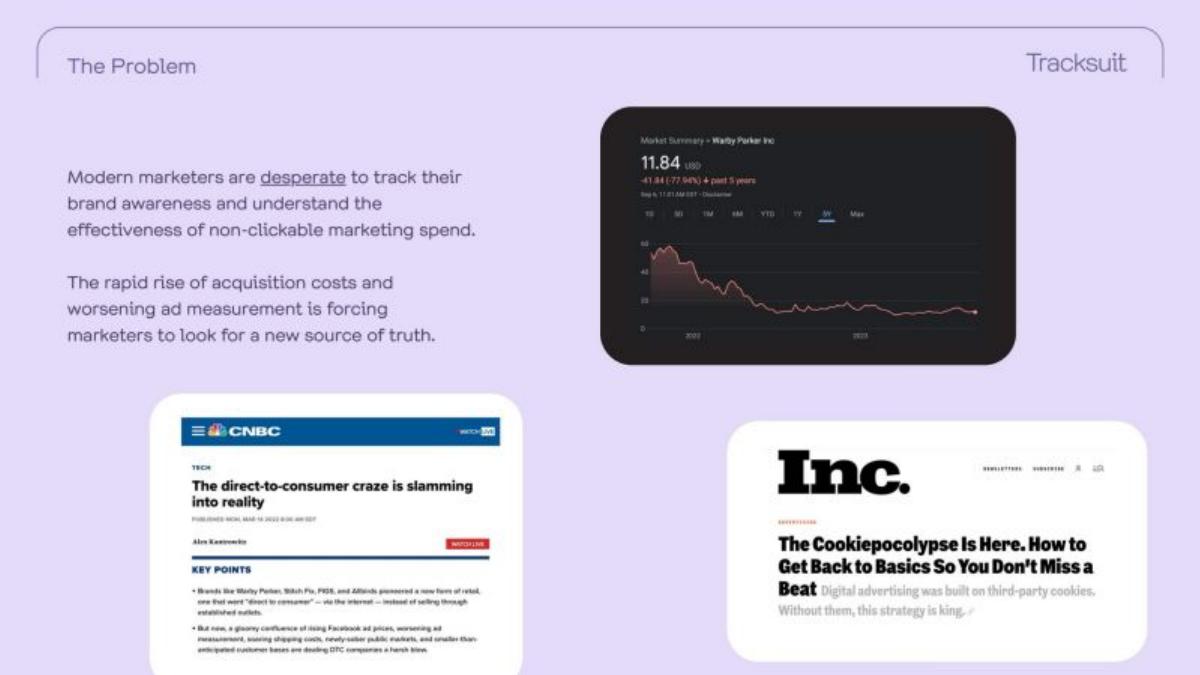
Slide 2 establishes the 'why now.' It uses three high-signal visual cues: a stock chart for Warby Parker showing a -77.94% decline over five years, a CNBC headline about the 'direct-to-consumer craze slamming into reality,' and an Inc. headline regarding the 'Cookiepocalypse.' The text explicitly states that modern marketers are 'desperate' to track brand awareness and non-clickable spend. By linking rising acquisition costs to the failure of traditional digital measurement, Tracksuit creates an immediate sense of urgency.
Slides 3-4: The Solution - Radically Affordable Tracking
After a transition slide ( Slide 3 ), Slide 4 delivers the core value proposition: 'Beautiful, radically affordable, always-on brand tracking.' The slide breaks this down into four pillars: 1) A UI that is easy to share, 2) Measurement at 1/10th the cost of traditional tracking, 3) Daily updates (vs. the industry standard of 12 weeks), and 4) Fundamental metrics like awareness and consideration measured against a competitive set. The '1/10th cost' claim is the most potent piece of data here, signaling a massive efficiency gain.
Slides 5-7: The Story and Traction
Slide 5 introduces 'The Story,' which is followed by a redacted growth chart on Slide 7 . Despite the redaction of specific dollar amounts, the chart provides critical information. It shows 48 months of history, with revenue split across four geographic regions: New Zealand (NZ), Australia (AU), United Kingdom (UK), and the United States (US). The chart indicates that growth accelerated significantly after the 'First capital raised' and 'Series A' milestones. The expansion into the US and UK markets is shown as a recent but rapidly growing portion of the total revenue mix.
Slide 8: What’s Next for 2025
Slide 8 outlines the strategic roadmap for the coming year. The four goals are: 1) Upgrading foundations for scale, 2) Expanding use cases, 3) Improving ease of use and 'next best action' features, and 4) Validating new products. This suggests that the Series B capital is intended not just for sales expansion, but for evolving the product from a data dashboard into an actionable insights platform.
Slides 9-10: Competitive Advantage and Counter-Positioning
Slide 10 is perhaps the most important slide for a Series B investor. It outlines three moats: Proprietary Data , Strong Brand & Community , and Counter-positioning . The data moat is built on owning the historical consumer data they collect. The community moat is evidenced by the fact that 'Over 75% of our revenue comes as inbound leads and referrals.' Finally, the counter-positioning argument uses the 'innovator’s dilemma'—Tracksuit offers an $800/month entry-level product that enterprise incumbents cannot match without destroying their own high-ticket business models.
Slides 11-13: Customer Social Proof
The 'Customers' section ( Slide 11 ) is supported by high-quality testimonials. Slide 12 features Matt Rossi, Head of Brand Marketing at Eucalyptus, who calls brand tracking the 'ultimate way of answering the question, "is what we’re doing working?"' Slide 13 features Brian Frances of Nature's Fynd, who explains how they use Tracksuit to set KPIs and track industry trends. These aren't just 'logo slides'; they are specific use cases that demonstrate how the product integrates into a marketer's workflow.
Slides 14-16: The People and Investor Validation
The 'Our People' section ( Slide 14 ) takes an unconventional approach. Instead of a standard grid of headshots and CVs, Slide 15 and Slide 16 feature photos of individuals (Mike Smith and Anthony Lee) in Tracksuit-branded apparel. Slide 16 includes a quote from Anthony Lee: 'I’m always impressed by how intentional you are with everything.' This emphasizes culture and 'intentionality' over raw credentials, which is a bold choice for a $25M round, likely relying on the fact that the investors already know the leadership team's pedigree.
What Works in This Deck
The Economic Disruption: The claim of being 1/10th the cost of traditional competitors is a powerful hook. It explains why Tracksuit can win the mid-market and DTC space where traditional firms like Kantar or Nielsen are too expensive.
The 'Why Now' Framing: By citing the 'Cookiepocalypse' and the death of third-party cookies, Tracksuit hitches its wagon to a massive, unavoidable industry trend. They aren't just a 'nice to have' tool; they are the replacement for a broken measurement ecosystem.
Geographic Diversification: Showing growth in NZ, AU, UK, and the US simultaneously proves that the brand measurement problem is global and that their go-to-market strategy is repeatable across different regions.
What Is Missing
Unit Economics: While the deck mentions an $800/month entry point, it lacks specific SaaS metrics like CAC, LTV, or Churn. For a Series B, investors usually want to see the 'machine' in detail.
Team Pedigree: The 'People' slides are high on culture but low on professional history. While this works if the round is already soft-circled, a cold investor would need to see the founders' previous exits or relevant industry experience.
Detailed Product Deep-Dive: The deck stays at a high level. There are no detailed screenshots showing how the 'competitive set' is configured or how the 'daily updates' are visualized in the dashboard.
What a Founder Should Copy
The Counter-Positioning Slide: Every founder should be able to explain why an incumbent cannot copy them. Tracksuit’s explanation of the 'innovator’s dilemma' regarding their $800/month price point is a perfect example of this.
The Inbound Stat: Claiming that 75% of revenue is inbound is a massive signal of product-market fit. If you have a high referral rate or low-burn customer acquisition, make it a centerpiece of your 'Advantage' slide.
The Use of External Headlines: Don't just say the market is changing; show the CNBC and Inc. headlines that prove it. It shifts the burden of proof from the founder to the world’s leading business publications.
Frequently asked questions
- What is Tracksuit's primary value proposition?
- Tracksuit provides 'always-on' brand tracking that is updated daily. Its primary disruption is economic; it claims to deliver robust measurement at 1/10th the cost of traditional brand tracking firms. This allows mid-market and DTC brands to access data that was previously reserved for massive enterprise budgets.
- How does Tracksuit defend its market position?
- The company cites three main advantages: proprietary data moats built over time, a strong community of brand marketers, and 'counter-positioning.' By offering an $800/month entry-level product, they make it difficult for traditional enterprise-focused competitors to compete without cannibalizing their own high-margin business models.
- What market tailwinds is the company riding?
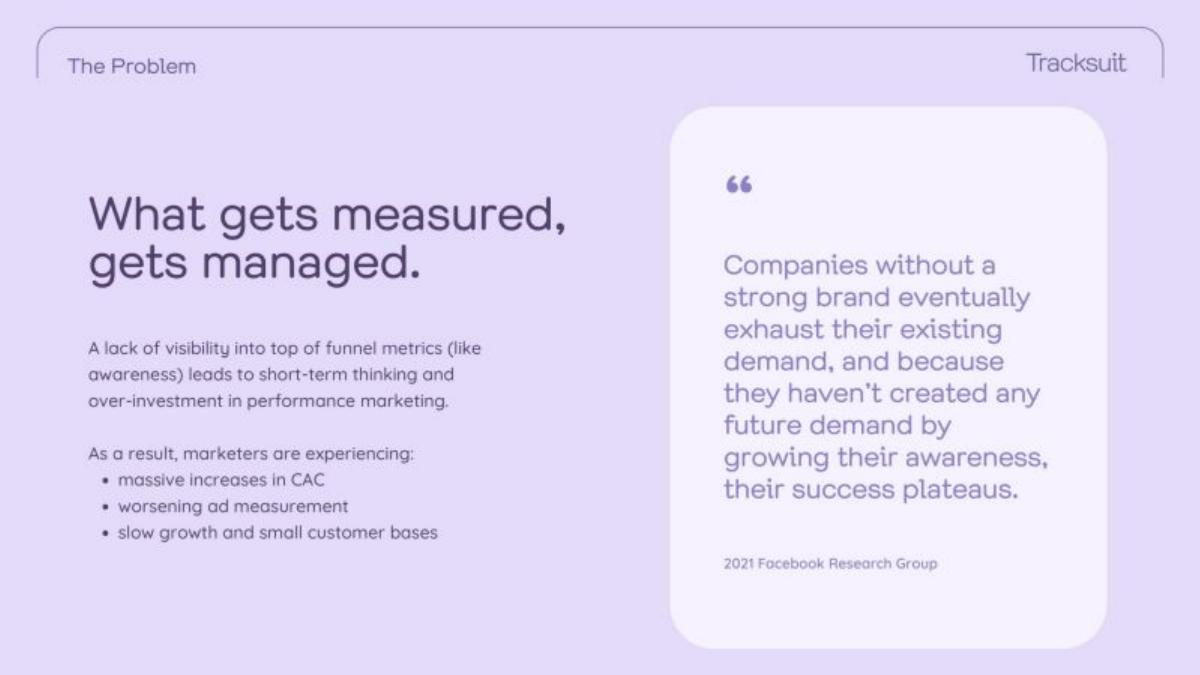
- Tracksuit highlights the 'Cookiepocalypse' and the decline of third-party tracking. As digital advertising measurement becomes less reliable and customer acquisition costs (CAC) rise, marketers are forced to look for new ways to justify 'non-clickable' brand spend, which Tracksuit provides.
- What does the growth trajectory look like?
- The deck shows 48 months of consistent revenue growth. While specific figures are redacted, the bar chart illustrates a clear acceleration after their first capital raise and Series A, with significant expansion into the UK and US markets alongside their home markets of NZ and Australia.
- Who are the key investors in this Series B round?
- The round was supported by a mix of international and regional venture firms, including VMG Partners, Altos Ventures, Footwork, Blackbird, and Icehouse Ventures. This cap table suggests a strong focus on consumer-facing brands and SaaS scaling expertise.