Why Won't a Big Company Just Copy You? How to Answer It
Investors always ask what stops the incumbent from copying you. Four real slides show how to answer with what copying would cost the incumbent.
Why Won't the Incumbent Copy You? Answer With What Copying Would Cost Them
Almost every investor meeting reaches the same question: if this works, why won't the big company in your market just do it too? Most decks answer with a word, such as moat, counter-positioning or innovator's dilemma. A word is not an answer. This guide uses four real pages to show the stronger version: name the incumbent, name what it would have to give up to copy you, and put a size on that loss where you can.
TL;DR
Answer the copying question by naming the specific incumbent and what copying you would cost it: revenue it would lose, customers or channels it would upset, or a promise it would have to break. Size that cost if you can, and say how long your opening lasts. Wasabi's competition slide does this in two sentences: Amazon earns more than $6 billion from storage and would have to give up nearly $5 billion of it to match Wasabi's price. Tracksuit and Cent Capital name the mechanism (a cheaper product the incumbents' business models can't easily offer) but give no figure for the cost. Mistral describes choices its rival is unlikely to make, which explains why it is different but not why the rival can't follow.
Four answers to the copying question, from sized to unsupported
Each page is read at full size. Quotes are exact; arithmetic is ours.
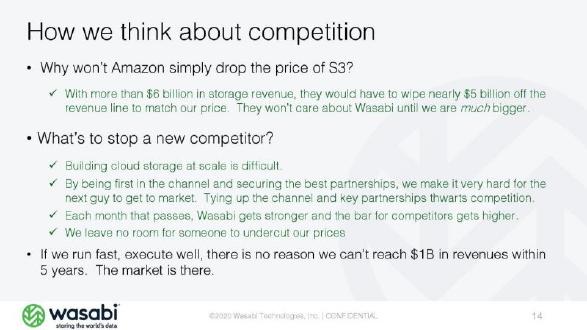
Wasabi competition slide — slide 15
Cloud storage. 'How we think about competition' page, 2020 deck.
Wasabi deck, slide 15. Exact stored slide matched to this analysis.
Our analysis: Names the incumbent, the cost and the time limit; the only sized answer in this set.
Evidence and limitation: Implied revenue given up: about $5B of about $6B, roughly 80%. The calculation behind $5B is not shown.
What a founder can adapt: Show the assumption behind the $5B and say what you will have built by the time the incumbent cares.
Supporting analysis
What the deck claims: "Why won't Amazon simply drop the price of S3?" "With more than $6 billion in storage revenue, they would have to wipe nearly $5 billion off the revenue line to match our price. They won't care about Wasabi until we are much bigger." Separate answer on new competitors: channel partnerships, difficulty of scale.
Presentation choice: Shows a copying answer an investor can check and argue with.
When it does not fit: Assuming the incumbent must reprice everything rather than launch a separate cheap tier.
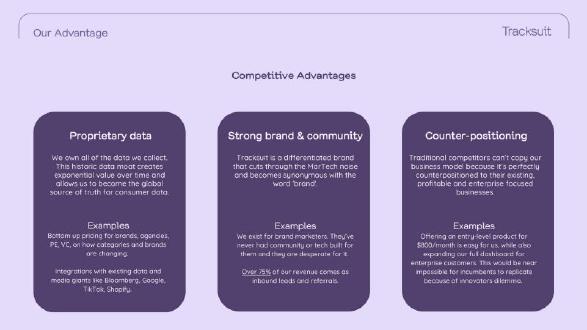
Brand tracking software. 'Our Advantage' page with three boxes.
Tracksuit deck, slide 17. Exact stored slide matched to this analysis.
Our analysis: A clear mechanism with an example, but the cost to the incumbent is not sized.
Evidence and limitation: Specific price point ($800 a month). No incumbent named; no incumbent price or revenue given.
What a founder can adapt: Name the incumbent and compare its typical contract price with $800 a month.
Supporting analysis
What the deck claims: "Traditional competitors can't copy our business model because it's perfectly counterpositioned to their existing, profitable and enterprise focused businesses." Example: "Offering an entry-level product for $800/month is easy for us, while also expanding our full dashboard for enterprise customers. This would be near impossible for incumbents to replicate because of innovators dilemma."
Presentation choice: Shows how an example makes a label concrete.
When it does not fit: 'Near impossible' where 'costly' is what the evidence supports.
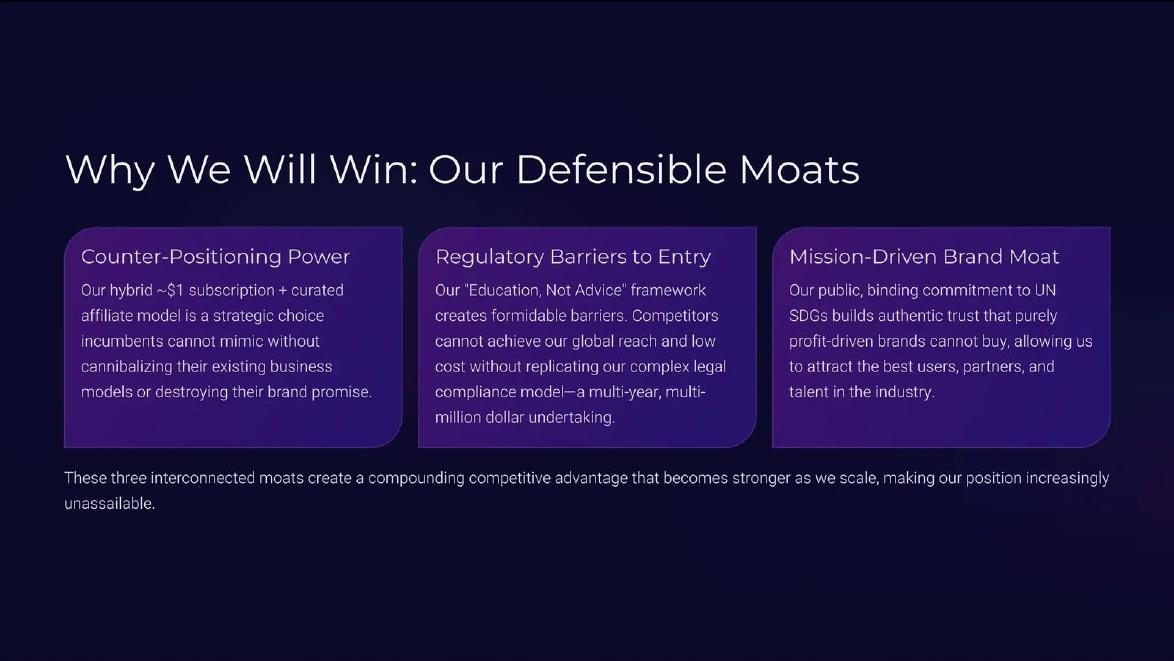
AI financial wellness app. 'Why We Will Win: Our Defensible Moats' page.
Cent Capital deck, slide 9. Exact stored slide matched to this analysis.
Our analysis: Plausible mechanism stated as fact without support.
Evidence and limitation: No incumbent named; no figure for what a $1 product would cost incumbents.
What a founder can adapt: Name one incumbent and estimate the revenue a $1 subscription would put at risk.
Supporting analysis
What the deck claims: "Our hybrid ~$1 subscription + curated affiliate model is a strategic choice incumbents cannot mimic without cannibalizing their existing business models or destroying their brand promise." Also: regulatory barriers ('multi-year, multi-million dollar undertaking'), mission-driven brand; "increasingly unassailable."
Presentation choice: Shows the common pattern of a label with no evidence behind it.
When it does not fit: Absolute closing claims such as 'unassailable' at an early stage.
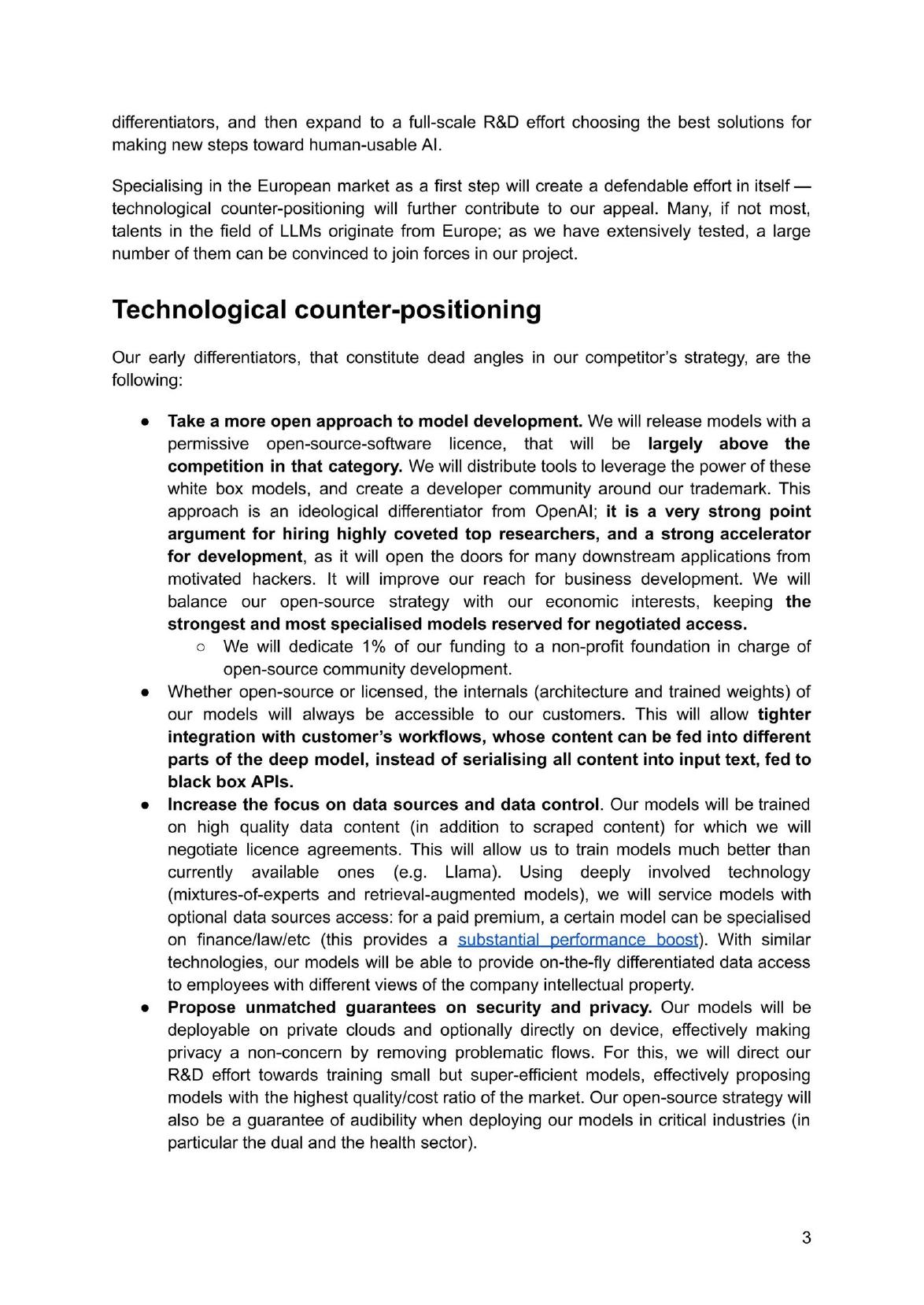
AI models. Page 3 of a 2023 written strategy memo, 'Technological counter-positioning'.
Mistral AI deck, slide 3. Exact stored slide matched to this analysis.
Our analysis: Explains the difference and the head start; leaves the cost of copying for the reader to infer.
Evidence and limitation: Names the rival and lists choices with benefits (hiring, developer adoption). Does not state what the rival would give up by copying.
What a founder can adapt: Add one line per difference saying what the rival would lose by matching it.
Supporting analysis
What the deck claims: "Our early differentiators, that constitute dead angles in our competitor's strategy": permissive open-source licence, access to model internals, licensed data sources, security and privacy guarantees with private-cloud and on-device deployment. Calls the open approach "an ideological differentiator from OpenAI".
Presentation choice: Shows how to tie each difference to a benefit collected while the rival hesitates.
When it does not fit: Calling something a blind spot without saying why the rival can't fix it.
The four parts: incumbent named, cost stated, cost sized, time limit.
Example
Incumbent named
Cost of copying
Sized
Time limit
Wasabi
Yes (Amazon)
Lost storage revenue
Yes (~$5B of $6B+)
Yes ('until we are much bigger')
Tracksuit
No
Undercutting enterprise business
No
No
Cent Capital
No
Cannibalization, brand promise
No
No
Mistral AI
Yes (OpenAI)
Implied, not stated
No
Partly (hiring, adoption)
Key Takeaways
Name the incumbent; 'traditional competitors' answers nothing.
Say what copying you would cost them: revenue, customers, channels or brand.
Put a number on that cost where your evidence allows.
Say how long the opening lasts and what you build meanwhile.
A label such as 'counter-positioning' is a heading, not the argument.
Write your copying answer
Fill this in before your competition slide is final.
Incumbent. Which one company would an investor most expect to copy you?
Cost. What would that company lose by offering what you offer?
Size. What public figures let you estimate that loss, and what is the estimate?
Time. What will you have built by the time copying is worth their while?
Newcomers. Why won't the next startup, which has nothing to lose, catch you?
Copyable framework: "Why won't [incumbent] copy this? Matching us would cost them about [amount or share] of [revenue line] ([source]). By the time we matter to them, we will have [asset]."
Illustrative example 1 — written by us
Before: "Traditional competitors can't copy our business model."
After: "Why won't [named incumbent] copy this? Our $800/month tier would undercut its [typical contract price] contracts. By the time we matter to them, we will have [asset]."
What improved: Our illustrative rewrite of Tracksuit's wording. The bracketed figures are left blank because the page doesn't give them.
The question this guide answers
This guide answers one founder question: what should a pitch deck say when an investor asks why a large, well-funded company won't simply copy the product once it starts working?
Our competition guides cover how to lay out alternatives, how to compare features and how to describe defensibility in general. The data moat guide covers one kind of defence. None of them makes this question its main point, and the answer is different from a feature comparison. A feature table shows that you are different today. The copying question asks why you will still be different in two years, when a bigger company has noticed you.
The useful answer is rarely 'they can't build it'. Large companies can usually build almost anything. The useful answer is that they won't, because doing so would hurt something they care about more: an existing revenue line, a pricing structure, a sales force paid on large contracts, a brand promise or a regulatory position. Investors call this counter-positioning, but the word only works when the slide shows the specific cost behind it.
How we chose and read the examples
We searched extracted text from the deck library for pages that address incumbents directly, using phrases such as 'why won't', 'incumbents cannot', 'cannibalize', 'counter-positioning' and 'innovator's dilemma'. Only a handful of pages across the library answer the question explicitly, which is itself a finding: most decks leave it to the meeting.
We kept four pages that show different levels of answer: Wasabi (a sized cost), Tracksuit (a named mechanism with an example), Cent Capital (a named mechanism without an example) and Mistral (a list of differences framed as the rival's blind spots). All four companies were private when these decks were made. We rendered each page from the source deck and read it at full size; Tracksuit's small text was enlarged at 300 dpi before quoting.
We did not check any company's claims against outside sources. When we say a claim is unsupported, we mean the page itself gives no support for it, not that it is false.
The four parts of a strong answer
A complete answer to the copying question has four parts, and each one can be a single line on the slide.
First, the incumbent by name. 'Traditional competitors' or 'big players' lets the reader fill in whoever they fear most, and you have not answered for that company. Naming Amazon, Salesforce or the three largest banks shows you have thought about the specific threat.
Second, the cost of copying. This is what the incumbent would lose by offering what you offer: revenue from a higher-priced product, margin, a channel partner relationship, a sales team's commission structure, or trust in a brand. The cost has to be specific to them. 'It is hard' applies to everyone, including the next startup.
Third, the size of the cost, where you can give one. A number turns an opinion into something an investor can check. You don't need precise figures from inside the incumbent; public revenue, list prices or customer counts often let you estimate the loss.
Fourth, the time limit. Few openings last for ever. Say what you will build while the incumbent hesitates, such as distribution, data, switching costs or brand, so that by the time copying becomes worth their while, it is no longer enough.
A sized cost: Wasabi
Wasabi's competition page, from a 2020 deck for its cloud storage service, asks the question in the investor's own words: 'Why won't Amazon simply drop the price of S3?' The answer gives Amazon's storage revenue as more than $6 billion and says Amazon 'would have to wipe nearly $5 billion off the revenue line to match our price.'
Those two figures imply that matching Wasabi's price would mean giving up roughly 80% of that revenue (about $5 billion of about $6 billion). The page does not show how the $5 billion was worked out, and it implicitly assumes Amazon would cut prices for all customers rather than offer a cheaper separate tier. Still, the reader can see the logic and argue with it, which is the point.
The page also handles the time limit honestly: 'They won't care about Wasabi until we are much bigger.' That concedes the protection is temporary. It then answers the second, different question, 'What's to stop a new competitor?', with channel partnerships and the difficulty of building storage at scale. Separating the incumbent from the next startup is useful, because the reasons are different.
What it lacks is a link between the two answers: what Wasabi will have built by the time it is big enough for Amazon to care. The channel partnerships line is the obvious candidate, and saying so directly would close the argument.
A named mechanism with an example: Tracksuit
Tracksuit's competitive-advantages page lists counter-positioning beside proprietary data and brand. The text says traditional competitors 'can't copy our business model because it's perfectly counterpositioned to their existing, profitable and enterprise focused businesses.' Its example: offering an entry-level product for $800 a month is easy for Tracksuit while it expands its full dashboard for enterprise customers, and this 'would be near impossible for incumbents to replicate because of innovators dilemma.'
This is better than the label alone. The price point is specific, and the mechanism is clear: a company built around large enterprise contracts would undercut itself by selling a cheap entry product. What's missing is the size of the cost and the name of the incumbent. The reader doesn't know whose enterprise business would be damaged, or by how much. One line, such as the typical price of an incumbent brand-tracking contract compared with $800 a month, would turn the claim into evidence.
The page also says 'near impossible', which is stronger than the example supports. Incumbents sometimes launch cheaper products under a separate brand. A more careful wording would be 'costly for incumbents', followed by the reason.
A named mechanism without support: Cent Capital
Cent Capital's 'Why We Will Win' page has a 'Counter-Positioning Power' box. It says its hybrid model of a roughly $1 subscription plus curated affiliate offers is 'a strategic choice incumbents cannot mimic without cannibalizing their existing business models or destroying their brand promise.'
The mechanism is plausible: a financial company that earns from higher fees or product sales might lose revenue by offering a $1 subscription. But the page doesn't say which incumbents it means, what their existing business model earns, or which part of it a $1 product would eat into. 'Destroying their brand promise' is asserted, not explained. The neighbouring boxes make similar unsized claims: a compliance model described as a 'multi-year, multi-million dollar undertaking', and a mission-driven brand that 'purely profit-driven brands cannot buy'.
The closing line says the three moats together make its position 'increasingly unassailable'. For an early company, that wording invites scepticism. The page would be stronger with one named incumbent and one figure in place of the final sentence.
Differences framed as blind spots: Mistral
Mistral's 2023 document is a written memo rather than slides, and its third page is headed 'Technological counter-positioning'. It lists 'early differentiators, that constitute dead angles in our competitor's strategy': releasing models under a permissive open-source licence, giving customers access to model internals, focusing on licensed data sources, and offering strong security and privacy guarantees, including private-cloud and on-device deployment. It names OpenAI as the rival and calls the open approach 'an ideological differentiator'.
This explains why Mistral is different and why that difference helps with hiring and adoption. What it does not fully argue is why the rival couldn't follow. The memo calls these 'dead angles' but doesn't say what OpenAI would give up by releasing open models; a reader has to infer that it might weaken a paid, closed product. Naming that cost would turn a list of choices into an answer to the copying question.
The memo is useful for a different reason: it ties each difference to a benefit Mistral can collect while the rival hesitates, namely researchers it can hire and developers it can attract. That is the time-limit part of the answer, done well.
What to put on your competition slide
Add one block, headed with the investor's question in plain words, such as 'Why won't [incumbent] copy this?' Asking it yourself shows confidence and saves time in the meeting.
Under it, write two or three lines: what the incumbent would have to give up, the size of that loss with its source, and what you will have built by the time the incumbent decides to respond. If you can't size the cost, say what you would measure. For example, the share of the incumbent's revenue that comes from customers paying more than your price.
Keep the incumbent question separate from the new-startup question. Incumbents are held back by what they would lose. New startups aren't, so your answer to them is speed, distribution, data or switching costs.
Avoid absolute words. 'Cannot', 'impossible' and 'unassailable' invite the investor to name the one time an incumbent did respond. 'Would cost them about $X' is harder to argue with.
How to size the cost when you lack inside data
You rarely know an incumbent's internal numbers, but a reasonable estimate is usually possible. Start with public figures: reported segment revenue, published list prices, customer counts from press releases or industry reports.
Then estimate the share at risk. If you charge 20% of the incumbent's price, ask what share of its revenue comes from customers who would switch to a matching product. Wasabi's page effectively assumes all of it. A more cautious version would give a range and say what the range depends on.
Show the source and the assumption in a footnote. An investor who disagrees with your assumption can still follow your logic, which is better than a claim with nothing to test.
What these examples can and cannot show
These four pages show how founders have answered the copying question in their own words. They cannot show whether any incumbent actually held back, or whether the answer persuaded investors. We did not check the figures or claims against outside sources.
Wasabi's $6 billion and $5 billion figures are the company's own. Tracksuit's and Cent Capital's claims about incumbents are untested on the page. Mistral's memo describes intended strategy, not results. Treat the examples as patterns of argument, not as proof that counter-positioning works.
Common mistakes
No incumbent named. Name the company the investor is thinking of.
Label as argument. 'Counter-positioning' needs the cost behind it.
Absolute claims. 'Impossible' invites a counter-example; size the cost instead.
One answer for everyone. Incumbents and new startups are held back by different things.
No time limit. Say what you build while the incumbent hesitates.
Diagnostic checklist
Incumbent named.
Cost of copying stated.
Cost sized, with source and assumption.
Time limit and what you build meanwhile.
Separate answer for new startups.
No absolute claims.
Frequently asked questions
Should I raise the copying question myself?
Yes. Investors will ask it anyway, and a short prepared answer on the slide shows you have thought about it.
What if a big company could easily copy us?
Say so, and focus on what you will build first: distribution, data, switching costs or brand. A credible plan beats a claim that copying is impossible.
How we chose these examples
Corpus: published pitch deck teardowns on StartupFundraising.com. Founder-uploaded private decks are excluded.
Selection (2026-10-01): we searched extracted page text for explicit answers about incumbents copying the company (phrases including 'why won't', 'incumbents cannot', 'cannibalize', 'counter-positioning', 'innovator's dilemma'), excluded listed-company presentations, and kept four pages with different levels of answer.
Review: the four pages were rendered from the source decks at full size on 2026-10-01 and read in full against company, deck and page number (editorial model review, with AI assistance in drafting; not human-reviewed). Tracksuit's text was enlarged at 300 dpi. No company claim was checked against outside sources.