One Lonely Outpost is a sci-fi life-simulation game that positions itself as a space-themed successor to Stardew Valley. The deck is notable for its transparency regarding internal investment, stating that team members have contributed over $50,000 in cash and $250,000 in sweat equity. The presentation focuses heavily on unique gameplay mechanics, such as gene splicing and robo-animal husbandry, while providing a tiered budget structure ranging from $145,000 to $295,000 per year. While the deck excels at showcasing art style and team pedigree—including a lead artist with experience at Valve—i…
Key takeaways
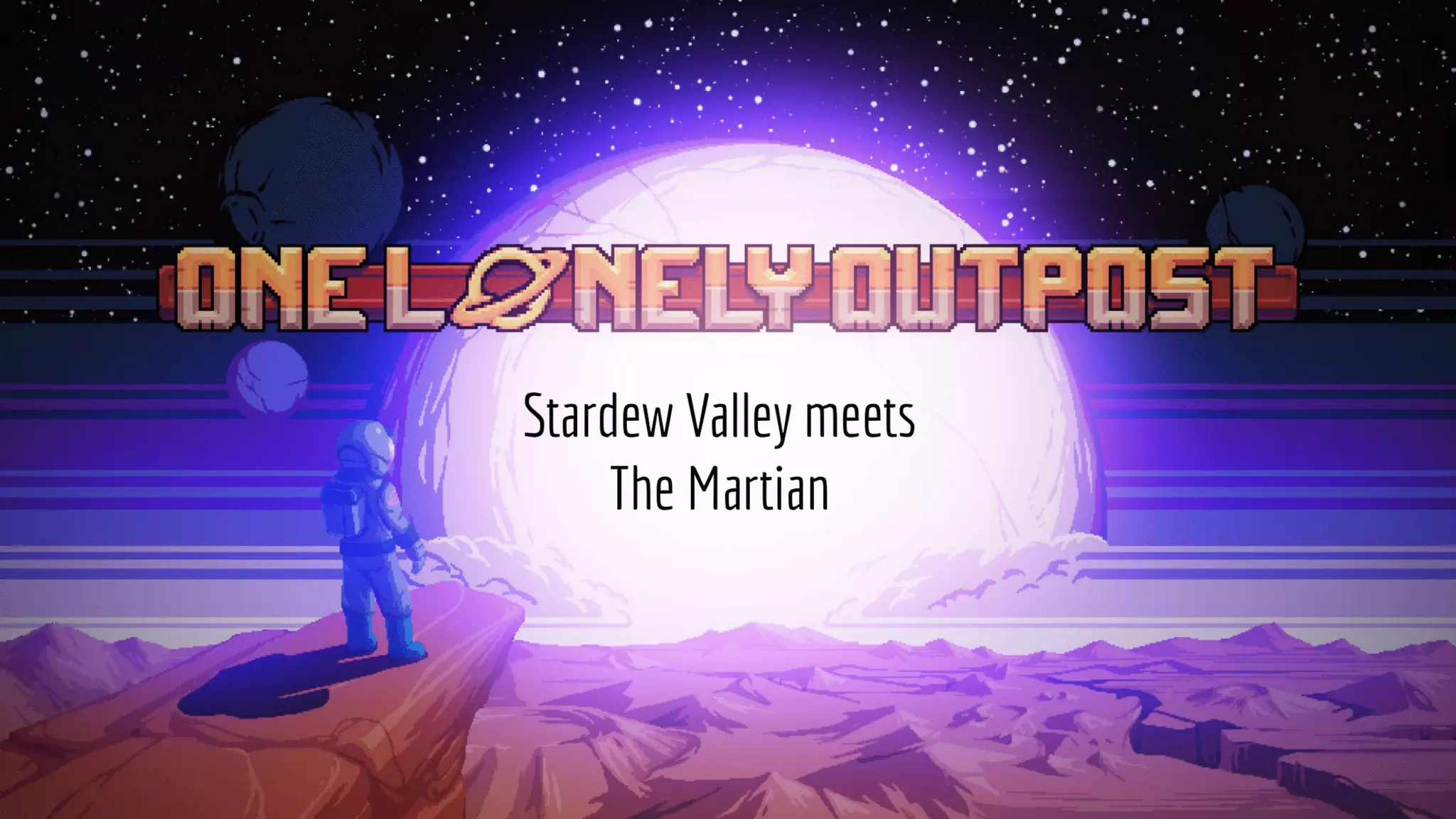
- The game uses a high-concept 'X meets Y' hook, describing itself as 'Stardew Valley meets The Martian' on slide 1.
- Founders have significant personal stakes, reporting $50,000 in monetary investment and $250,000 in sweat equity on slide 2.
- Early community traction is quantified by 3,500 Facebook likes, 3,500 Twitter follows, and a 1,200-person mailing list on slide 2.
- The deck provides a two-year development timeline with a 'Minimum' budget of $145k/year and an 'Optimal' budget of $295k/year on slide 3.
- Unique mechanics like 'Gene Splicing' for plant resilience and 'Robo Cows' are detailed as core differentiators on slide 4.
- The team slide (slide 6) highlights professional experience including work for DOTA 2, Valve, and Broadcom.
- Alpha screenshots on slide 7 demonstrate a functional UI, inventory system, and 'Spacebucks' currency.
- The deck omits a specific funding ask, exit strategy, or detailed competitor analysis beyond the mention of Stardew Valley.
Slide-by-Slide Teardown
Slide 1: Title and Hook
The deck opens with a high-contrast title slide featuring the game's logo and a central hook: 'Stardew Valley meets The Martian.' This is a classic 'X meets Y' pitch strategy designed to immediately categorize the game for investors. The background art establishes the 16-bit pixel aesthetic and the sci-fi setting, showing an astronaut looking out over a desolate, purple-hued alien landscape. It effectively communicates the tone and genre without requiring a single paragraph of text.
Slide 2: Why our game?
This slide addresses the market opportunity and the team's commitment. It notes that Stardew Valley captured 'tens of millions' of players and positions One Lonely Outpost as the next logical evolution by adding a space theme, which they claim is a 'first in the genre.' The slide lists 'Unique Selling Points' (USPs) such as gene splicing and in-depth plant tending. Crucially, it includes a 'skin in the game' section, stating that team members have invested over $50,000 in cash and $250,000 in sweat equity. It also lists early traction: 3,500 Facebook likes, 3,500 Twitter follows, and 1,200 mailing list subscribers.
Slide 3: Timeline & Budget
This is a highly transparent slide that breaks down the development roadmap and the capital required. The timeline spans nine quarters, from 'Project Kickoff' to 'Full Release' in Dev Y3-Q1. It allocates specific days for Feature Development (196 days), Bugfixing (60 days), Content Development (169 days), Polish (50 days), and Stabilization (35 days). The budget is presented in two tiers: a 'Minimum' of $145,000/year and an 'Optimal' of $295,000/year. The slide notes that the optimal budget is required for 'high-profile features' like Multiplayer and Terraforming.
Slide 4: Features - Synthetics
This slide dives into the specific mechanics that differentiate the game from standard farming sims. It explains 'Gene Splicing,' which allows players to modify plants for faster growth or resilience, though at the risk of 'adverse mutations.' It also introduces 'Robo Cows, Chickens, [and] Pigs' that produce synthetic meat and textiles. The slide mentions a 'neutral-stance environmental narrative,' suggesting a level of player agency and moral complexity regarding organic versus GMO paths, which adds depth to the standard life-sim loop.
Slide 5: Features - Ruins & Mini-games
To show that the game is more than just farming, this slide highlights exploration and secondary gameplay loops. It describes 'alien ruins' populated by robots that test the player's resolve, hinting at a narrative mystery regarding the planet's makers. It also mentions an 'Asteroid mining/racing mini-game' where players must place in the top three to keep their gathered resources. The inclusion of these features suggests a 'mid-core' complexity level designed to keep players engaged beyond the core farming mechanics.
Slide 6: Our Core Team
The team slide focuses on professional longevity and industry pedigree. Brad Petry (Project Manager) is credited with 12 released titles. Narongdej Teo (Lead Artist) is highlighted for his 10 years of experience and contract work for DOTA 2 and Valve. Christopher Bayliss (Programmer) is noted as being currently employed by Broadcom, and Richard Schmidbauer (Pixel Artist) brings 8 years of experience. The emphasis here is on the ability to actually ship a product, a common concern for investors in the indie game space.
Slide 7: Alpha Screenshots
The final slide provided shows four screenshots of the game in its Alpha state. These images confirm that the UI is functional, featuring an inventory hotbar, a date/time display ('2nd of Spring, 1st Year'), and a currency called 'Spacebucks.' The screenshots show character dialogue, crop farming, and exploration of crystal-laden caves. This serves as proof of concept, demonstrating that the project is well beyond the ideation phase and has a tangible, playable foundation.
What Works
The Hook: Comparing the game to 'Stardew Valley' and 'The Martian' is an excellent way to instantly communicate the gameplay loop and the setting. · Financial Transparency: Listing the exact amount of sweat equity ($250,000) and personal cash investment ($50,000) builds significant trust with potential investors. · Tiered Budgeting: Instead of asking for a single flat fee, the team shows what different levels of funding will actually buy in terms of features (e.g., Multiplayer). · Art Quality: The screenshots and slide backgrounds consistently demonstrate a high level of polish in the pixel art, which is the primary selling point for this genre.
What is Missing
A Clear Ask: While the budget is listed, there is no slide stating exactly how much equity is being offered or what the specific funding goal for this round is. · Revenue Projections: The deck mentions a '80%+ chance of positive ROI based on market research' on slide 3, but it does not provide the data or the projected sales figures to back this up. · Competitor Analysis: Beyond mentioning Stardew Valley as an inspiration, the deck doesn't address other sci-fi farming sims or explain how they will compete for player attention in a crowded Steam market. · Distribution Strategy: There is no mention of which platforms (PC, Switch, Console) are being targeted or how the team plans to handle marketing and publishing.
Founder's Guide: What to Copy
Quantify Your Passion: If you have spent years working for free or have put your own savings into a project, list the dollar value of that 'sweat equity.' It proves you won't walk away when things get difficult. · Use 'X meets Y': Don't over-explain your product on the first slide. Use two well-known references to anchor the investor's expectations. · Show the UI: Don't just show concept art. Show screenshots that include the inventory, the menus, and the dialogue boxes. It proves the 'game' part of the game actually works. · Professional Pedigree: If your team has worked for major players (like Valve or Broadcom), put those names in bold. In the risky world of indie games, a team that has successfully shipped products is a top-tier asset.
Frequently asked questions
- What is the primary value proposition of One Lonely Outpost?
- The game aims to be the first space-themed entry in the farming/life-sim genre. It differentiates itself from titles like Stardew Valley and Harvest Moon by introducing sci-fi elements such as gene splicing, terraforming, and robotic livestock, while maintaining the 'tactile pixel art style' that fans of the genre expect.
- How much funding is the team looking for?
- The deck does not state a specific 'Ask' amount. Instead, slide 3 presents two budget tiers: a 'Minimum' budget of $145,000 per year for two years ($290,000 total) and an 'Optimal' budget of $295,000 per year for two years ($590,000 total). The higher tier includes features like multiplayer and terraforming.
- What is the team's professional background?
- The core team consists of four members with significant industry experience. Project Manager Brad Petry has 7 years in game dev with 12 released titles; Lead Artist Narongdej Teo has 10 years of experience including work for Valve; and Programmer Christopher Bayliss has 9 years of experience and is employed by Broadcom.
- How does the game handle environmental themes?
- According to slide 4, the game features a 'neutral-stance environmental narrative.' Players can choose between 'organic and natural' or 'synthetic and GMO' paths for their colony. Both paths offer different benefits and risks, and non-player characters (NPCs) within the game will react based on their own opinions of these choices.
- What stage of development is the game currently in?
- Based on slide 7, the game is in the Alpha stage, featuring functional screenshots of farming, dialogue, and exploration. The timeline on slide 3 indicates that the project is moving through a two-year development cycle, with a Beta release planned for the start of the second year (Dev Y2-Q1).