Bitspawn is a blockchain-based esports infrastructure platform designed to solve the 'middleman' problem in competitive gaming. By automating tournament payouts and match reporting, the company aims to protect player rights and unlock revenue for the 97% of gamers who currently earn nothing from competition. The 2021 Seed deck successfully highlights a massive market opportunity—projecting a $1.6 billion global esports market by 2023—and showcases impressive early beta traction, growing from zero to nearly 10,000 users in just five months. While the deck relies heavily on aggressive projectio…
Key takeaways
- The deck identifies a significant gap in the market where only 3% of players are currently compensated for competing in esports (Slide 3).
- Bitspawn utilizes a native token, SPWN, to facilitate tournament entry fees and instant payouts to player wallets (Slide 6).
- Beta traction was a core selling point, showing cumulative signups growing from 671 in April 2020 to 9,821 by August 2020 (Slide 9).
- The platform targets a $2-4 average user acquisition cost to reach a goal of 4 million users by Q4 2023 (Slide 10).
- Revenue projections are highly aggressive, forecasting a climb from $15,000 in Q4 2020 to $16 million by Q4 2023 (Slide 13).
- The business model is diversified across four streams: transaction fees (10-50%), sponsorships, $5/month subscriptions, and white-label licensing (Slide 12).
- Strategic alliances include partnerships with talent agencies like MKM Group and payment platforms like Spend and Bitbuy (Slide 15).
- The leadership team features a mix of competitive gaming experience and technical background, including a former Amazon engineer (Slide 16).
Executive Summary: The Infrastructure of Competitive Gaming
Bitspawn entered the market during the 2021 blockchain and esports boom, positioning itself as the 'Esports Advancement Platform' (EAP). The deck focuses on the democratization of gaming revenue, moving away from the top-heavy model where only professional players earn a living. By integrating blockchain technology for automated payouts, Bitspawn aimed to capture the massive amateur market that existing platforms like FACEIT and Battlefy were allegedly underserving. The following teardown analyzes the 21-slide deck used to secure their Seed funding.
The Market Opportunity and Problem Statement
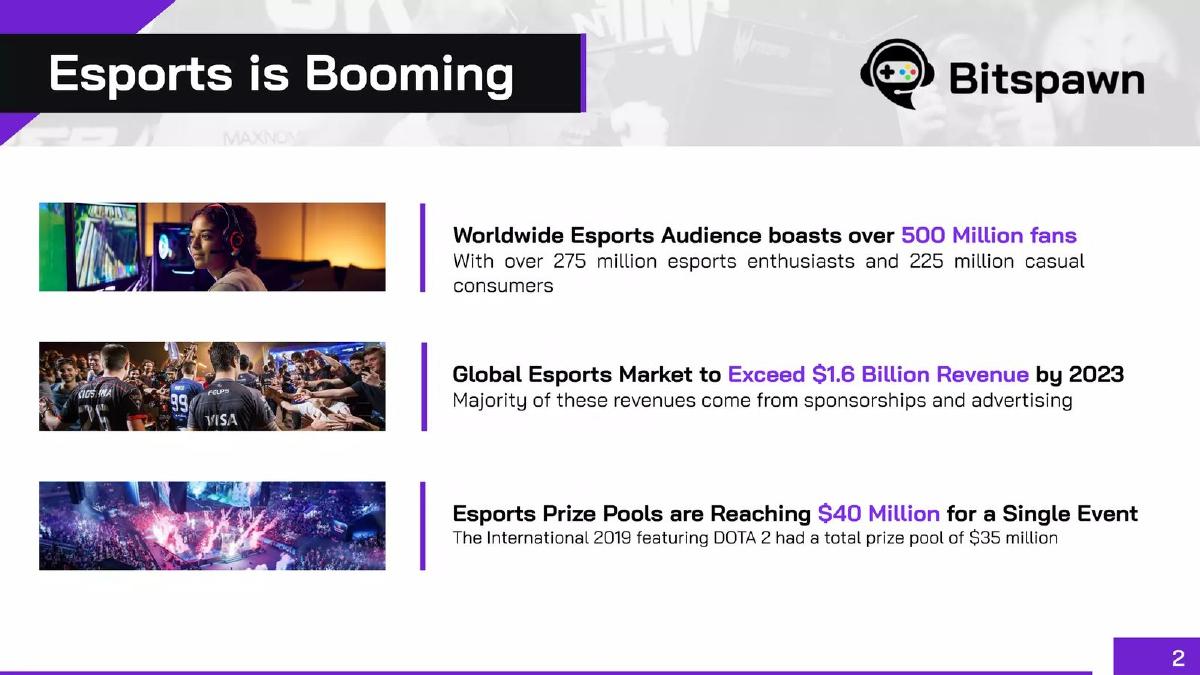
Slides 2-4 establish the macro environment. The deck leads with a 'booming' esports narrative, citing a worldwide audience of 500 million fans and a projected market revenue exceeding $1.6 billion by 2023 (Slide 2). This is a standard 'big market' opening, but Bitspawn quickly pivots to a specific, underserved niche.
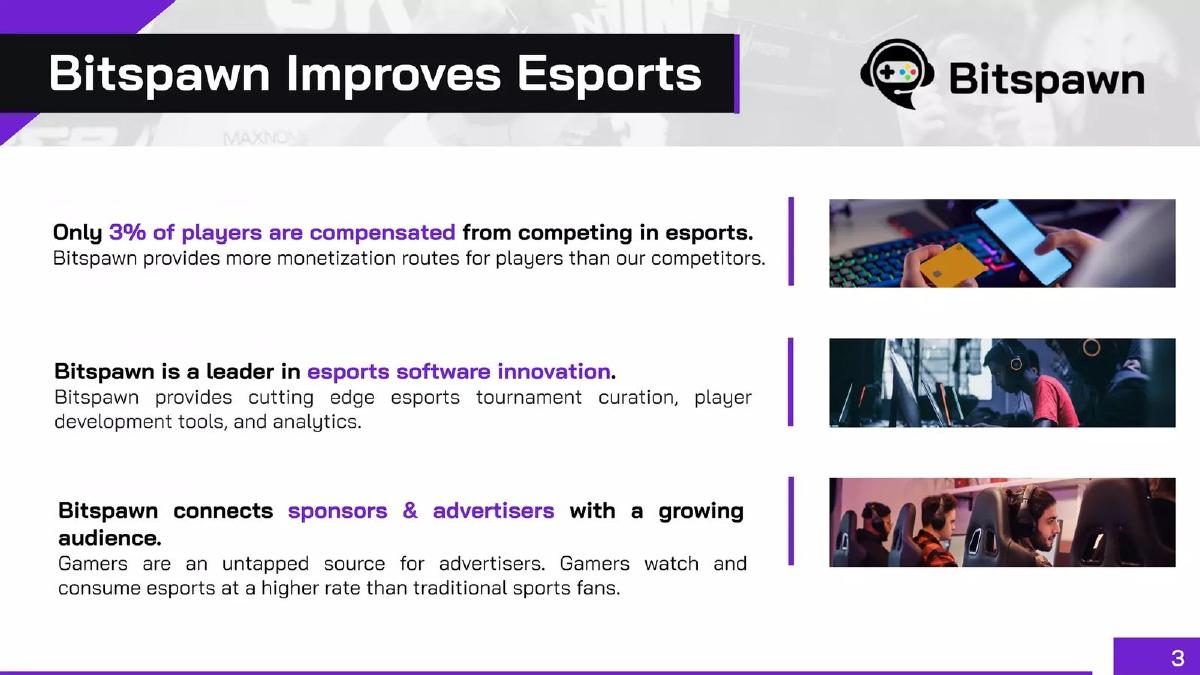
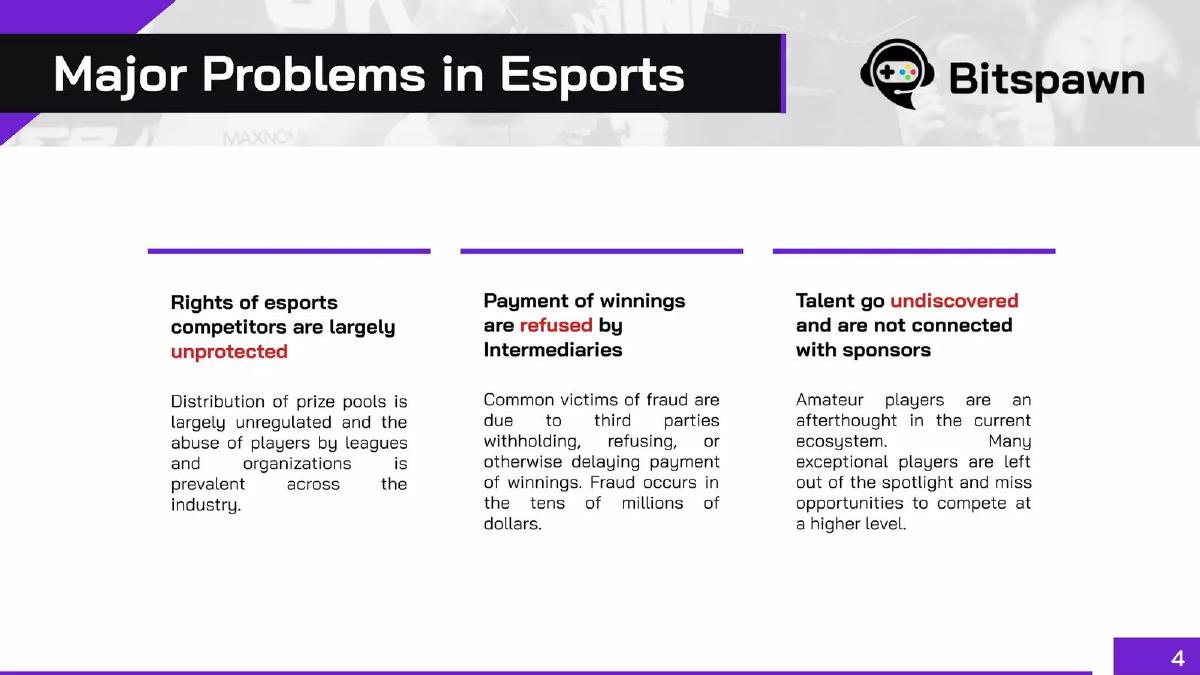
On Slide 3 , the company presents a striking statistic: 'Only 3% of players are compensated from competing in esports.' This sets up the 'why now'—the current ecosystem is built for the elite, leaving 97% of the audience unmonetized. Slide 4 defines the 'Major Problems' as unprotected competitor rights, refusal of prize payments by intermediaries, and undiscovered talent. By framing the problem as a lack of regulation and transparency, Bitspawn makes a logical case for a blockchain-based solution without overusing crypto jargon early in the deck.
The Solution: Automation and the SPWN Token
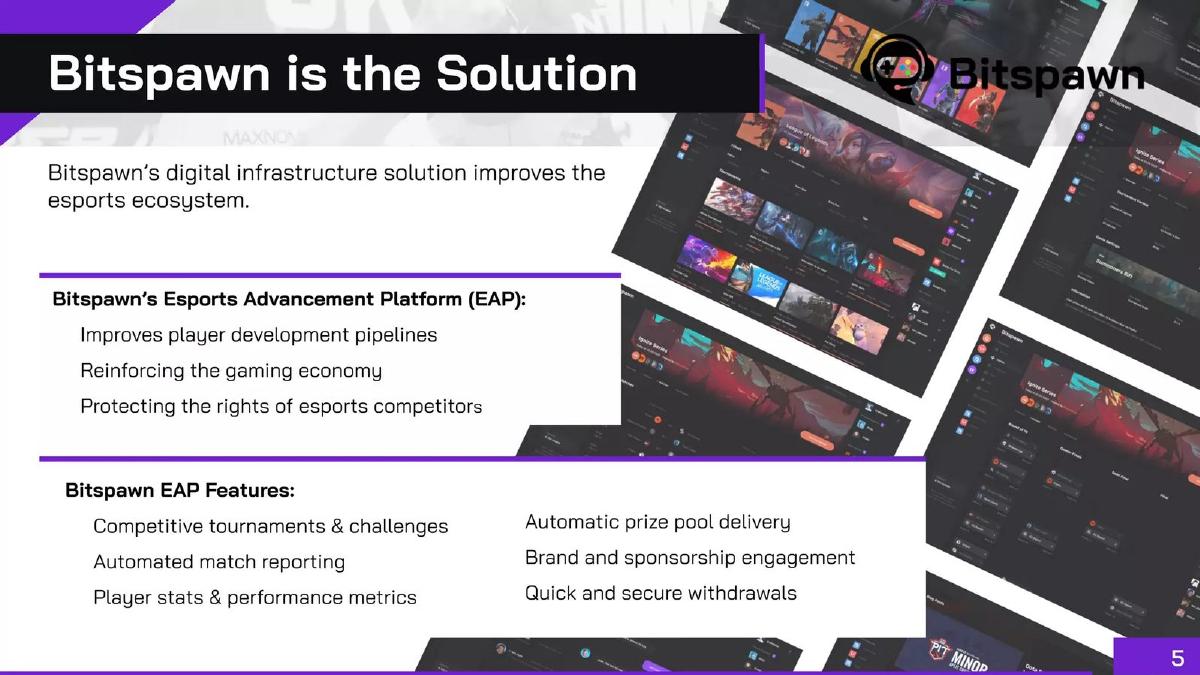
Slides 5-6 introduce the product. The 'Esports Advancement Platform' is described as a digital infrastructure that improves player development pipelines and protects rights. Slide 5 provides UI mockups of the platform, showing a clean, dark-themed dashboard for tournament management. Key features listed include automated match reporting and 'quick and secure withdrawals.'
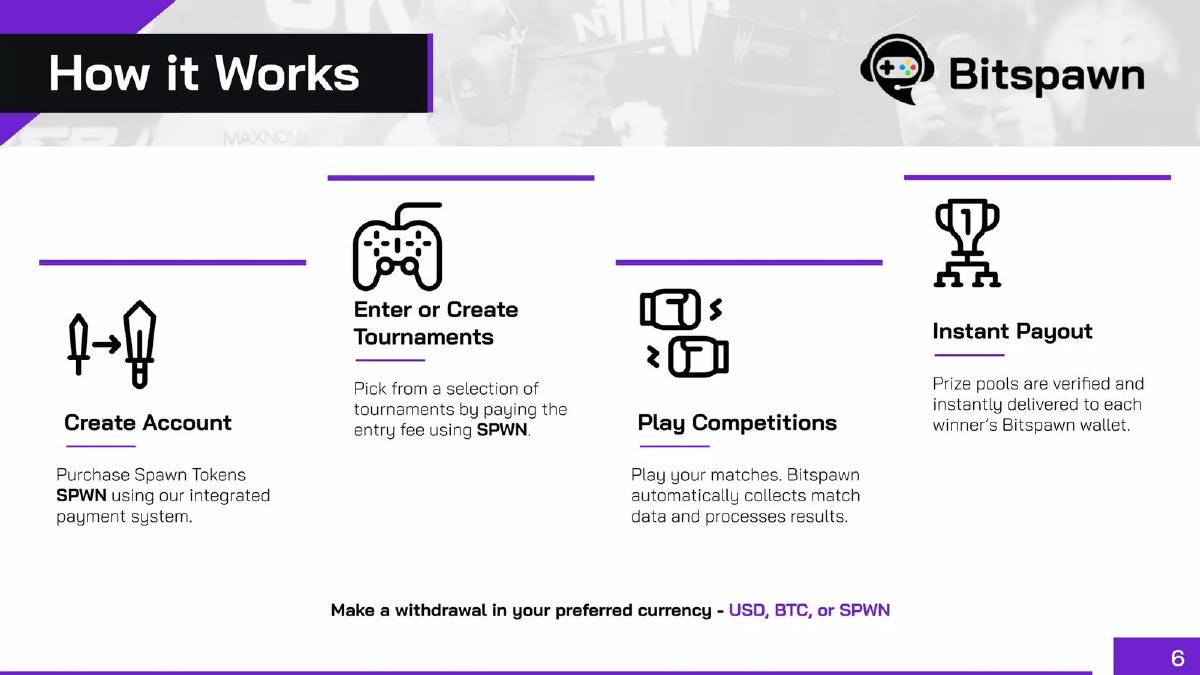
Slide 6 is the 'How it Works' slide, which is critical for any blockchain project. It outlines a four-step process: 1) Create Account/Purchase SPWN tokens, 2) Enter or Create Tournaments using SPWN, 3) Play Competitions with automated data collection, and 4) Instant Payout to the Bitspawn wallet. The slide notes that withdrawals can be made in USD, BTC, or SPWN, which is a vital detail for onboarding non-crypto native gamers who might be wary of token-only ecosystems.
Competitive Landscape and Strategic Positioning
Slide 7 provides a direct comparison with incumbents. Bitspawn lists FACEIT (15M users, $20M revenue) and Battlefy ($12.5M raised) but marks them with red 'X' icons for lacking automation and player progression. The deck argues that while these platforms have been around since 2011, there has been little innovation. This is a bold claim, but it serves to highlight Bitspawn's specific technological differentiator: the automated smart-contract payout system.
Slide 8 emphasizes the 'Importance of Impressions,' noting that sponsorships account for 70% of esports enterprise revenue. This slide serves as a bridge to the business model, explaining that by creating a 'positive feedback loop for engagement,' Bitspawn becomes an attractive vehicle for brands to reach the 'untapped source' of competitive gamers.
Traction and Growth Projections
Slides 9-10 present the company's early wins and future targets. Slide 9 shows a 'Beta Traction' graph that is the strongest part of the deck. Starting from zero signups in March 2020, the platform reached 9,821 cumulative signups by August 2020. They also list social media following (54K on Instagram, 10K on Facebook) as a proxy for brand awareness. While social followers are often considered a 'vanity metric,' in the esports world, they represent a direct marketing channel for user acquisition.
Slide 10 moves into projections, targeting 280,000 users by Q4 2021 based on a $1M CAD marketing budget. The long-term goal is 4 million users by Q4 2023. The deck cites an average User Acquisition Cost (CAC) of $2-4, which is a specific and useful figure for investors to model the efficiency of the capital injection.
The Financial Ask and Revenue Model
Slides 11-13 detail the investment opportunity and revenue streams. Slide 11 asks for $2 million (though the company eventually raised $6.8M, according to catalogue facts). The raise is structured in milestones, with valuations increasing from $5.5M to $13M as the company hits revenue and brand activation targets. The use of funds is split: 50% for marketing, 40% for development, and 10% for admin/legal.
Slide 12 breaks down the 'Revenue Sources' into four clear buckets: 1) Transaction fees (10% on withdrawals, 10-50% on tournament commissions), 2) Advertisements/Sponsorships (targeting five $50k engagements), 3) Monthly Subscriptions ($5/month for premium tiers), and 4) Licensing/White-labeling ($10k-$50k per integration). This diversification is a strength, as it shows the company isn't solely reliant on token appreciation or a single user-pay model.
Slide 13 shows a 'Projected Revenue' hockey stick, forecasting a jump from $600k in Q4 2021 to $16 million in Q4 2023. This assumes an average revenue per user (ARPU) of $4 USD per year. While the growth curve is aggressive, the ARPU figure is relatively conservative, which helps ground the projection.
Strategy, Team, and Outcomes
Slides 14-15 outline the growth strategy and alliances. The plan involves supporting six major titles at launch (DOTA 2, CS:GO, Fortnite, Call of Duty, League of Legends, and PUBG) and expanding to dozens more. Slide 15 lists 'Strategic Alliances' with organizations like Amuka Esports and technology platforms like Spend and Bitbuy, demonstrating that Bitspawn is not building in a vacuum.
Slide 16 introduces the leadership. The team includes Eric Godwin (CEO, 6 years in disruptive tech), Howard Goldman (Executive Director, serial entrepreneur), and Alex Lan (CTO, former Amazon engineer). The inclusion of a former Amazon engineer provides technical credibility, while the 'Growth' and 'Marketing' directors emphasize the company's focus on user acquisition. Slide 17 lists advisors from Wharton, Iterative Law, and MKM Group, further bolstering the professional image of the startup.
Slide 18 discusses 'Outcomes,' explicitly mentioning IPO/RTO, Acquisition/Merger, or remaining private. While founders are often told not to talk about exits too early, in the 2021 market, being clear about the intended liquidity path was often appreciated by Seed investors.
What Works in This Deck
Clear Problem/Solution Fit: The deck identifies a specific pain point (97% of gamers earn nothing) and offers a specific technological solution (blockchain automation). · Strong Beta Traction: Showing a 14x growth in signups over five months (Slide 9) provides the necessary proof of concept for a Seed round. · Diversified Revenue Model: Instead of just 'selling tokens,' the deck outlines four distinct ways the company makes money, including B2B licensing (Slide 12). · Specific Unit Economics: Citing a $2-4 CAC and a $4 ARPU (Slides 10 and 13) allows investors to understand the basic math of the business.
What Is Missing From This Deck
Unit Economics Detail: While they provide CAC and ARPU, there is no mention of Life Time Value (LTV) or churn rates from the beta period. · Tokenomics Deep Dive: For a blockchain-based platform, there is very little information on the total supply, inflation/deflation mechanics, or governance of the SPWN token. · Regulatory Strategy: Given that the platform involves 'prize pools' and 'withdrawals,' a slide addressing the legal complexities of online gaming and gambling laws in different jurisdictions would have been prudent. · Product Roadmap: The deck mentions expanding game support, but lacks a detailed feature roadmap (e.g., when mobile apps or specific social features would launch).
Founder's Playbook: What to Copy
The 'Current Offerings' Slide: Slide 7 is a masterclass in competitive analysis. It doesn't just list names; it lists their users, revenue, and specific weaknesses, making Bitspawn's entry seem inevitable. · Milestone-Based Funding: Slide 11's approach to raising capital in stages tied to valuation and milestones is a great way to manage dilution and show investors a clear path to value creation. · Visualizing the Process: The 'How it Works' icons on Slide 6 simplify a complex blockchain backend into a user-friendly four-step journey. · Market Context: Using Slide 2 to frame the 'Esports Audience' vs. 'Esports Enthusiasts' helps investors understand the difference between casual viewers and the platform's actual target users.
Frequently asked questions
- What is the primary problem Bitspawn aims to solve?
- Bitspawn targets the lack of protection and monetization for amateur gamers. According to Slide 4, prize pool distribution is largely unregulated, leading to fraud where intermediaries refuse or delay payments. Additionally, 97% of players earn nothing from their gameplay. Bitspawn uses blockchain to automate match reporting and prize delivery, ensuring players are paid instantly and transparently.
- How does the SPWN token function within the ecosystem?
- The SPWN token is the primary medium of exchange on the platform. As detailed on Slide 6, users purchase tokens through an integrated payment system to pay tournament entry fees. Once a competition concludes, the platform automatically verifies results and delivers prize pools directly to the winners' Bitspawn wallets in SPWN, which can then be withdrawn as USD, BTC, or kept as SPWN.
- What are the key revenue drivers for the company?
- Bitspawn employs a four-pillar revenue model (Slide 12). This includes transaction fees (10% on withdrawals, 10% on tournaments, and 50% on challenges), brand sponsorships (targeting $50,000 per engagement), monthly premium subscriptions at $5 per month (targeting a 5% conversion rate), and B2B white-labeling fees ranging from $10,000 to $50,000 per integration plus monthly management fees.
- How does Bitspawn compare itself to existing competitors?
- Slide 7 lists competitors like FACEIT, smash.gg, CMG, and Battlefy. Bitspawn claims these platforms suffer from a 'lack of innovation,' 'no money payouts,' or a lack of automation. Specifically, it notes that while FACEIT has 5-15 million users, it lacks the automated blockchain-based payout system that Bitspawn proposes to dominate the market.
- What was the specific funding ask in this deck?
- Slide 11 outlines a staged raise totaling $2 million over 6-12 months, though catalogue facts indicate they eventually raised $6.8M. The planned allocation was 40% for development and operations, 50% for marketing (including a $1M CAD budget for user acquisition), and 10% for administrative and legal costs. The raise was structured across four valuation tiers, starting at a $5.5 million pre-money valuation.