Bitspawn positions itself as a corrective force in the esports industry, specifically targeting the 'unprotected' nature of amateur competitors and the prevalence of payment fraud. The deck highlights a significant gap in the current market, where legacy platforms like FACEIT and Battlefy are criticized for lacking automation and slow prize payouts. Bitspawn’s financial model is built on an aggressive growth trajectory, projecting a leap from 20,000 users in 2020 to 4 million by 2023, fueled by a $2-4 average user acquisition cost. While the deck provides specific competitor revenue and user…
Key takeaways
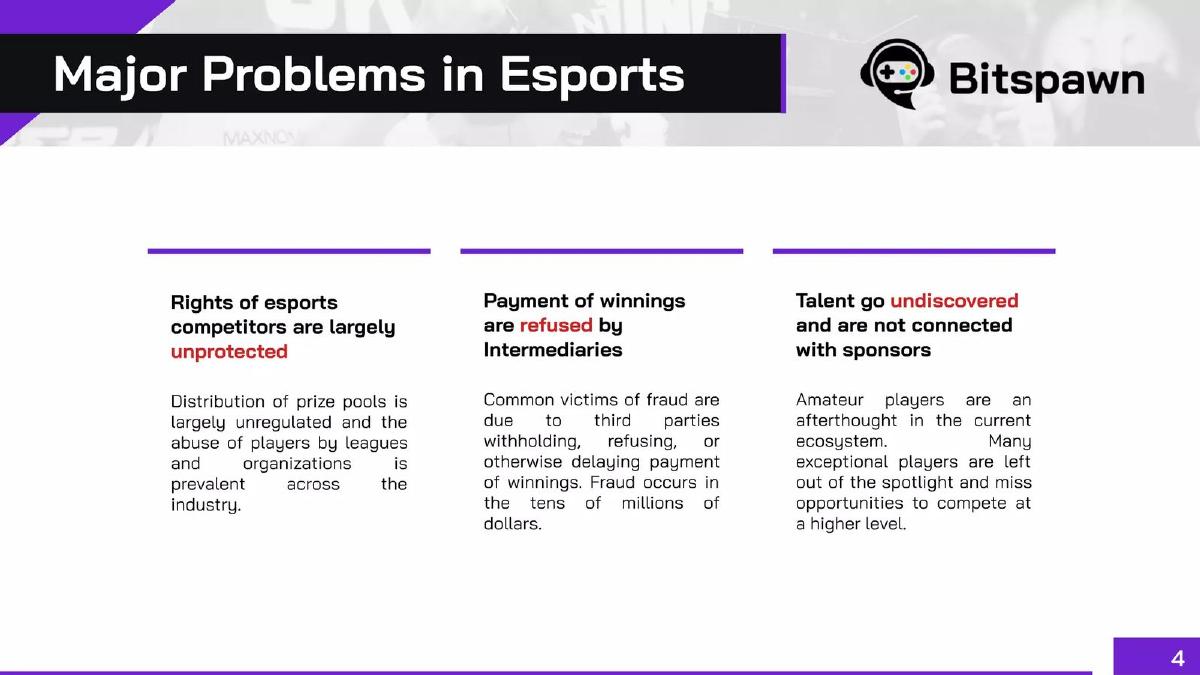
- The company identifies three core industry problems: unprotected player rights, refused winnings by intermediaries, and undiscovered amateur talent (Slide 4).
- Bitspawn claims that fraud in the esports winnings sector occurs in the 'tens of millions of dollars' (Slide 4).
- Competitor analysis benchmarks FACEIT at $15-20M USD revenue and Battlefy at $3-4M USD revenue as of 2019 (Slide 7).
- The growth strategy targets 280,000 users by Q4 2021, supported by a $1M CAD marketing budget (Slide 10).
- Revenue projections show a steep hockey-stick curve, moving from a $15K USD actual/target in Q4 2020 to $16M USD by Q4 2023 (Slide 13).
- The business model assumes an average revenue per user (ARPU) of $4 USD per year starting in 2021 (Slide 13).
- The leadership team includes a CTO who is a former Amazon Engineer and an Executive Director with experience in the cannabis and fintech sectors (Slide 16).
- The platform is headquartered in Toronto, Canada, at 240-55 St. Clair Ave W. (Slide 19).
Bitspawn Pitch Deck Analysis
Bitspawn presents a classic 'disruptor' narrative in the esports software space. The deck focuses heavily on the inefficiencies and perceived failures of the first generation of esports tournament platforms. By highlighting issues like payment fraud and manual result verification, Bitspawn positions its automated software as the necessary evolution for the industry. The deck is structured to move from industry pain points to competitive benchmarking, ending with a high-growth financial forecast.
Slide 1: Title Slide
The opening slide establishes the brand identity with a logo featuring a headset and a game controller. The tagline, 'Bitspawn is an innovative online esports software platform,' is functional but generic. The visual background uses cards representing popular titles like PUBG, Valorant, and Dota 2, signaling that the platform is game-agnostic and targets the most popular competitive ecosystems.
Slide 4: Major Problems in Esports
This slide identifies the 'Why Now' of the investment. It breaks the problem into three pillars: unprotected rights, refused payments, and undiscovered talent. Strongest Point: The mention that 'Fraud occurs in the tens of millions of dollars' regarding prize payouts. This quantifies the risk for players and suggests a clear market need for a trust-based software layer. Omission: The slide does not cite the source for the 'tens of millions' figure, which is a significant claim that investors would likely verify during due diligence.
Slide 7: Current Esports Offerings
Bitspawn uses this slide to benchmark itself against established players. It provides specific 2019 data for FACEIT ($29M raised, 5-15M users, $15-20M revenue) and Battlefy ($12.5M raised, 1-2M users, $3-4M revenue). The critique of these competitors is consistent: they 'lack automation.' By labeling FACEIT as having 'no money payouts' and CMG as having 'slow prize pool payouts,' Bitspawn sets up its own solution as the faster, more reliable alternative. This is a bold competitive slide because it provides hard numbers for the incumbents, giving investors a sense of the total addressable market size.
Slide 10: Projected User Growth
The growth chart shows a cumulative user target. The company aims for 20,000 users in Q4 2020, scaling to 4 million by Q4 2023. Key Metric: The deck explicitly states a '$2-4 Average User Acquisition Cost.' This is a vital figure for any B2C platform, as it allows investors to calculate the efficiency of the marketing spend. The target of 280,000 users by Q4 2021 is tied to a specific '$1M CAD Marketing Budget,' showing a clear link between capital and growth.
Slide 13: Projected Revenue
The revenue slide mirrors the user growth curve, showing a 'hockey stick' projection. The company expects to generate $16M USD by Q4 2023. Unit Economics: The model is based on '$4 USD Average Revenue per user starting 2021.' This is a relatively low bar for monetization, which can be seen as either conservative (easy to achieve) or risky (requires massive scale to be profitable). The slide also notes that the Q4 2021 target of $600,000 is contingent on a '$2M CAD Capital Injection,' which likely represents the 'Ask' for this round, though a formal 'Use of Funds' slide is missing from this selection.
Slide 16: Bitspawn Leadership
The team slide balances industry experience with technical pedigree. Eric Godwin (CEO) provides the 'founder-market fit' as a competitive gamer. The inclusion of Alex Lan (CTO), a former Amazon Engineer who helped grow the DOTA community in China, adds significant technical credibility. Howard Goldman (Executive Director) brings 'serial entrepreneur' experience from outside industries like cannabis and fintech, suggesting a focus on operational maturity and board governance.
Slide 19: Contact Information
The final slide includes a quote from the CEO that reiterates the mission: helping players who are 'getting burned by the platforms that they use.' It provides a physical office address in Toronto and social media handles. This slide serves as a final emotional appeal to the 'fairness' aspect of their business model.
What Bitspawn Does Well
The deck is exceptionally clear about the competitive landscape. Providing revenue and user counts for FACEIT and Battlefy (Slide 7) gives investors immediate context for what 'success' looks like in this niche. Furthermore, the deck does not shy away from unit economics; stating a $2-4 acquisition cost and a $4 annual revenue per user (Slides 10 and 13) allows for a quick back-of-the-envelope calculation of the business's potential margins.
What is Missing from the Deck
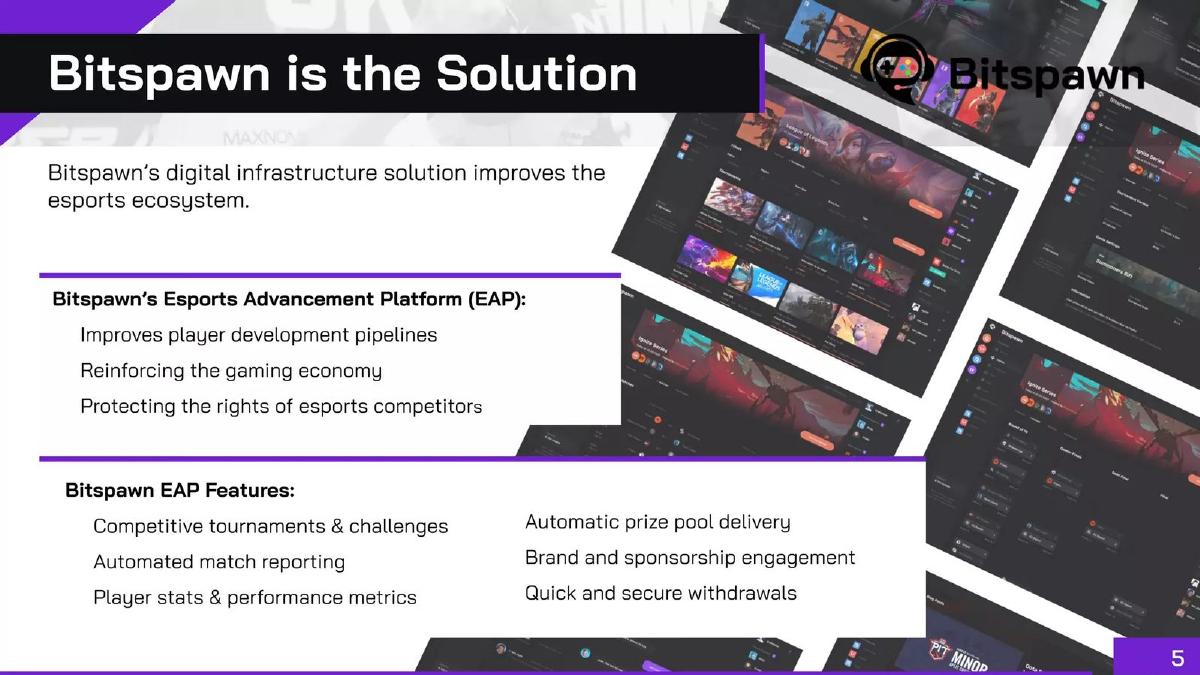
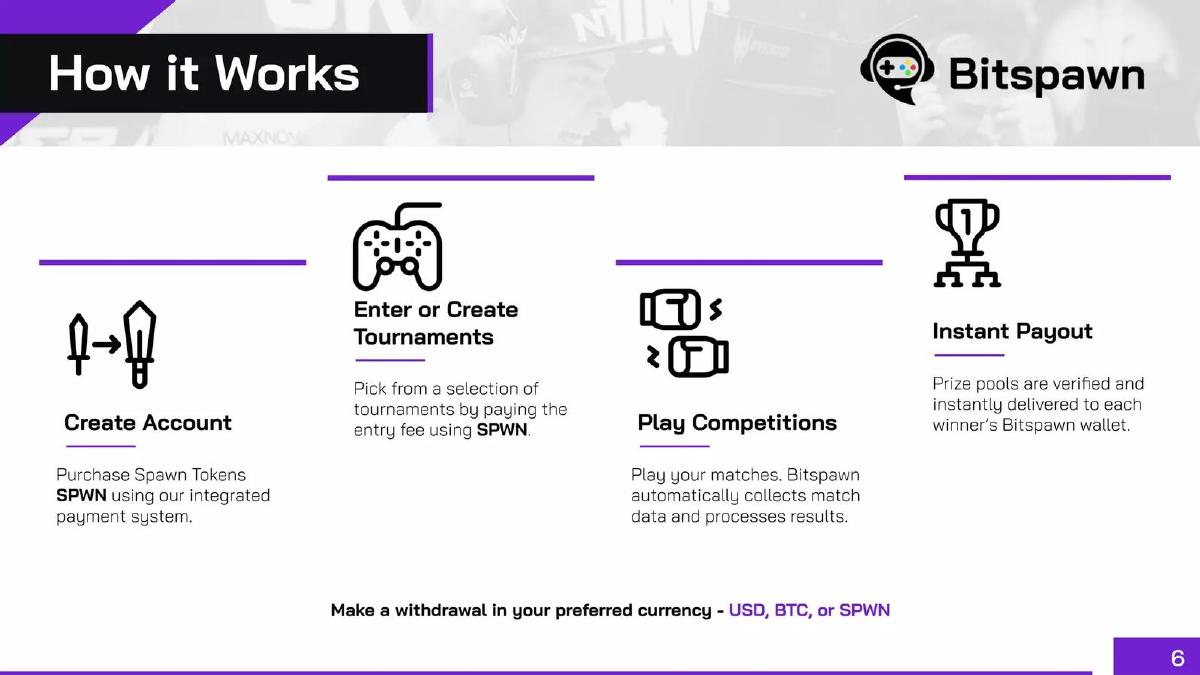
The most glaring omission in the provided slides is a detailed 'Product' or 'How it Works' section. While 'automation' is mentioned multiple times as a differentiator, the deck does not explain how that automation works—whether it is via API integrations with game publishers, OCR (Optical Character Recognition) of screenshots, or blockchain-based smart contracts for payouts. Additionally, there is no 'Use of Funds' slide or a clear 'Ask' beyond the implication of the $2M CAD capital injection mentioned on Slide 13. Finally, there is no mention of existing partnerships with game developers, which is often a major hurdle for third-party tournament platforms.
Founder's Takeaway: What to Copy
Quantify the Competitors: Don't just list logos; list their last round, their revenue, and their user base if available. It shows you have done your homework on the market (Slide 7). · Tie Growth to Spend: When showing a growth chart, state the marketing budget required to achieve those numbers. It makes the projections feel grounded in reality rather than just 'best-case scenario' guessing (Slide 10). · Identify a Moral Mission: Bitspawn isn't just building software; they are 'protecting' players from fraud. This creates a more compelling narrative than a purely technical pitch (Slide 4 and 19). · Specific ARPU: Stating a specific Average Revenue Per User (ARPU) helps investors understand your monetization strategy immediately (Slide 13).
Frequently asked questions
- What is Bitspawn's primary value proposition to players?
- Bitspawn focuses on security and automation. According to Slide 4 and Slide 19, the platform aims to prevent players from being 'ripped off' by event organizers. It addresses 'tedious game result submissions' and 'slow payouts' by using automated software solutions, contrasting itself against competitors that the deck claims lack these features.
- How does Bitspawn plan to acquire users and at what cost?
- The deck outlines a specific acquisition strategy on Slide 10. They target a $2-4 average User Acquisition Cost (UAC). To reach their Q4 2021 goal of 280,000 users, they have budgeted $1M CAD for marketing. They also track 'Monthly Impressions' (targeting 2 million) as a key metric for securing sponsorship engagements.
- Who are the main competitors and how does Bitspawn differentiate?
- Slide 7 identifies FACEIT, smash.gg, CMG, and Battlefy as the primary offerings. Bitspawn differentiates by claiming these platforms suffer from a 'lack of innovation,' 'no player progression,' and 'slow prize pool payouts.' Specifically, Bitspawn emphasizes its automation capabilities, which it claims competitors like Battlefy and CMG lack.
- What are the financial projections for the company?
- The projections are highly aggressive. Slide 13 shows revenue growing from $15,000 in Q4 2020 to $600,000 in Q4 2021 (based on a $2M CAD capital injection). By Q4 2023, the company projects $16M in annual revenue, driven by a user base of 4 million people paying an average of $4 USD per year.
- What is the background of the founding team?
- The team (Slide 16) is led by Eric Godwin, a competitive gamer with 6 years of experience in disruptive tech. The technical side is managed by Alex Lan (CTO), a former Amazon Engineer. The team also includes Howard Goldman (Executive Director) and specialists in social media and SEO, including a Growth Director who worked with TikTok.