BlackPepper’s Summer 16 deck pitches a social network for 'foodies' and restaurants, aiming to capitalize on the rise of the 'concept restaurant.' The deck relies heavily on a three-pronged revenue model involving ticketing, advertising, and premium restaurant services. While the 'Why Now' slide cites that 50% of millennials consider themselves foodies (Slide 3), the business model slide presents highly specific, yet seemingly hypothetical, calculations to reach a $7.7M annual revenue run rate (Slide 4). The deck lacks a team slide, a specific funding ask, and a clear competitive landscape, i…
Key takeaways
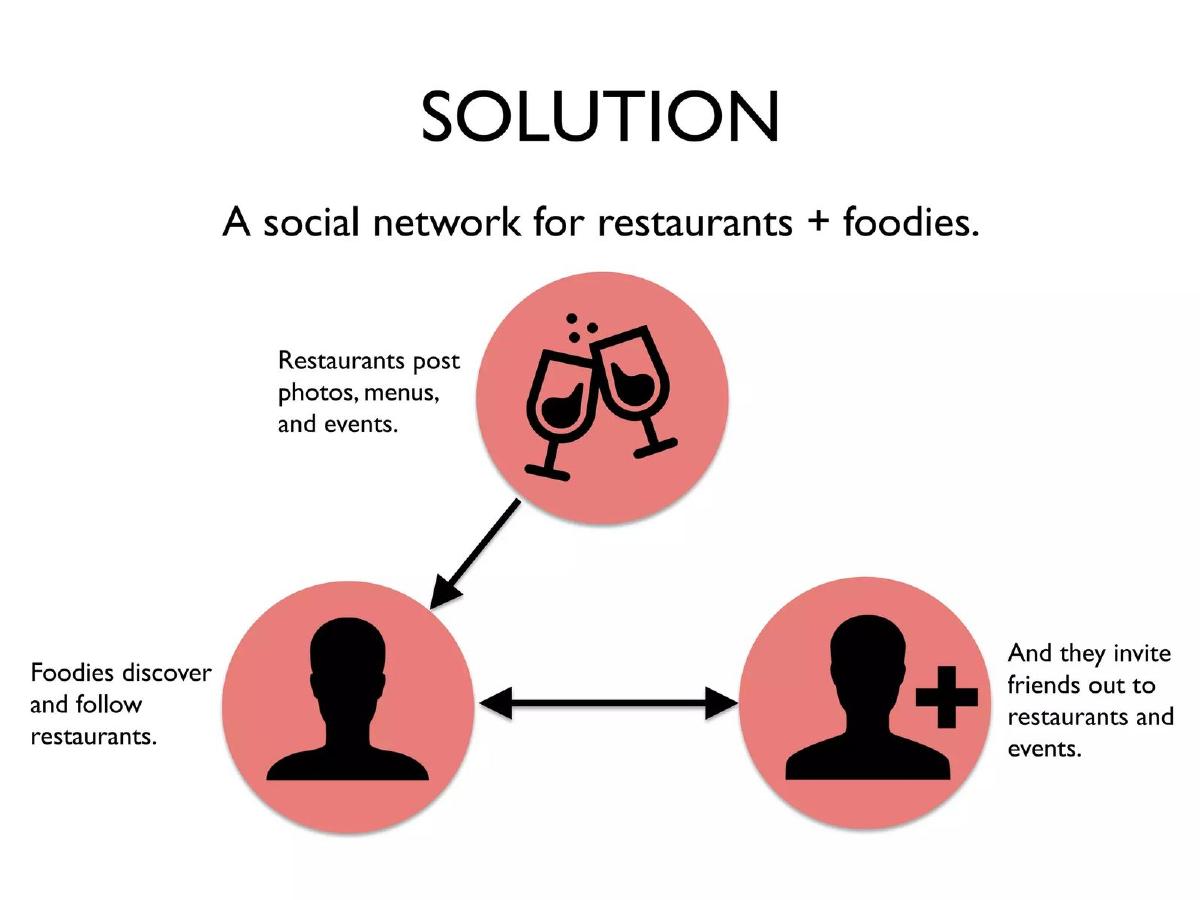
- The platform is defined as a social network where restaurants post content and foodies invite friends to events (Slide 2).
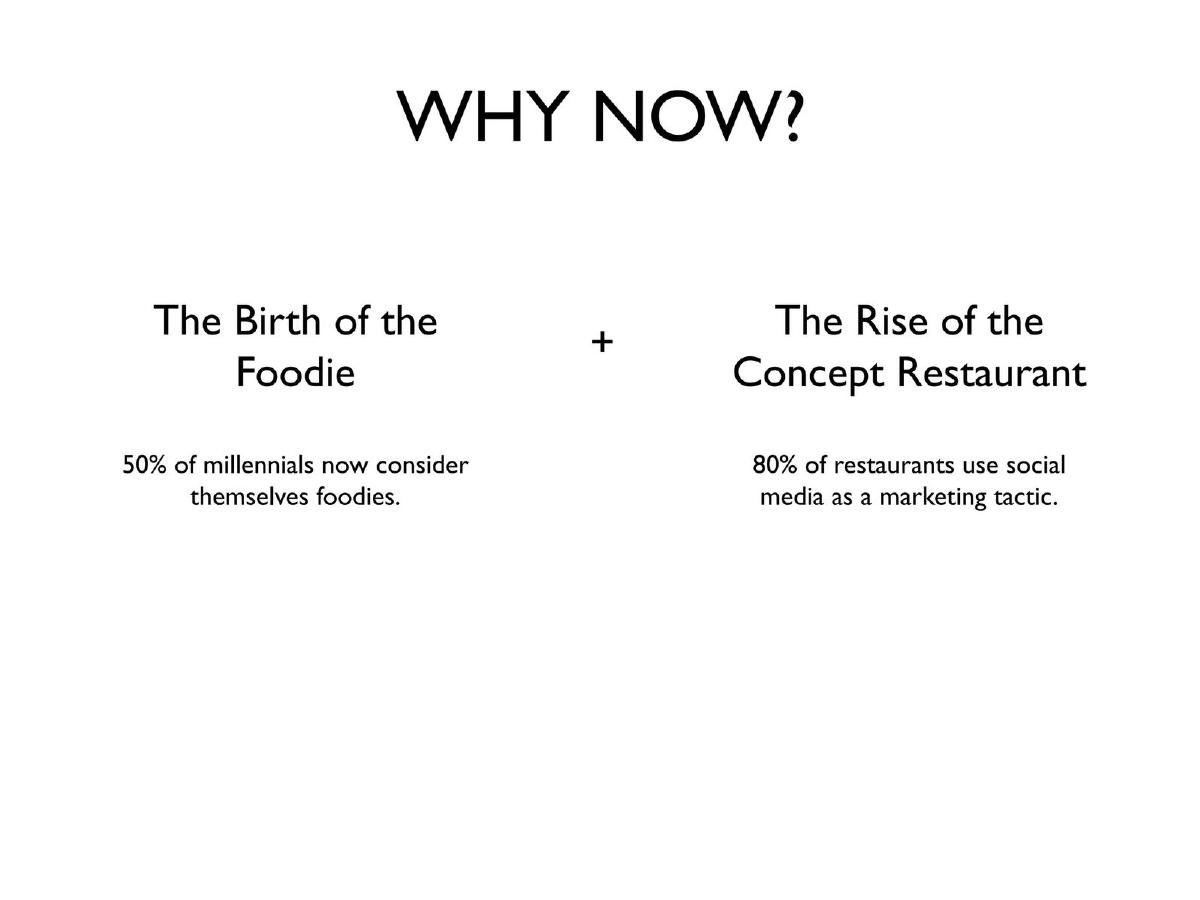
- Market validation is based on the claim that 50% of millennials identify as foodies and 80% of restaurants use social media for marketing (Slide 3).
- The business model projects $4M/year from ticketing based on a 3% charge on $30 tickets (Slide 4).
- Advertising revenue is calculated using a $10 CPM across 375k users visiting twice per week (Slide 4).
- Premium restaurant profiles are priced to include $1,000 for photography and $1,000 for social media management (Slide 4).
- Competitive advantages are largely qualitative, citing 'Aesthetic focus' and 'Reverence for food' (Slide 5).
- The deck mentions 'Taste preference IP' as a competitive advantage but does not explain the underlying technology (Slide 5).
- The progress roadmap uses a seasonal fishbone diagram to track milestones from MVP to 'Market, classifieds, analytics' (Slide 6).
Slide-by-Slide Teardown
Slide 1: Title Slide
The title slide is minimalist, featuring the brand name 'BLACKPEPPER' in a bold, sans-serif typeface. The logo to the left of the text appears to be a stylized representation of cracked peppercorns. The background is a high-quality, top-down photograph of various charcuterie boards, salads, and drinks. This sets a clear aesthetic tone for the company, signaling a focus on high-end dining and food presentation. No tagline or mission statement is present on this slide.
Slide 2: Solution
Slide 2 defines the product as 'A social network for restaurants + foodies.' The slide uses a simple diagram with three red circles and arrows to explain the ecosystem. The top circle represents restaurants, which 'post photos, menus, and events.' An arrow points to the bottom-left circle, representing foodies who 'discover and follow restaurants.' A double-sided arrow connects the foodie to a third circle (a foodie with a plus sign), indicating that they 'invite friends out to restaurants and events.' This slide effectively communicates the intended network effect but does not explain how the platform differs from existing social media like Instagram or Yelp.
Slide 3: Why Now?
This slide attempts to establish market urgency. It presents a simple equation: 'The Birth of the Foodie' + 'The Rise of the Concept Restaurant.' Two statistics are provided to support these claims. First, it states that '50% of millennials now consider themselves foodies.' Second, it claims that '80% of restaurants use social media as a marketing tactic.' While these figures suggest a large addressable market, they are broad industry trends rather than specific indicators of why a new, dedicated social network is required at this exact moment.
Slide 4: Business Model
Slide 4 is the most data-dense slide in the deck, outlining four revenue streams. Ticketing: The deck projects $4M/year based on 375k users buying one $30 ticket per month with a 3% charge. Third Party Advertising: It projects $2.3M/year based on 375k users visiting twice a week, viewing 6 pages per visit, at a $10 CPM. Premium Restaurant Profile: It projects $1.4M/year by converting 5% of 2,000 restaurants to a package that includes $1,000 for photography, $1,000 for social media management, and $75 job posting fees. Future Feature Suite: This section lists unquantified potential revenue from mobile offers, loyalty programs, coupons, shift management, delivery, reservations, and merchandise. The math is specific, but the slide does not clarify if these user and restaurant numbers are current reality or future goals.
Slide 5: Competitive Advantages
This slide lists six boxes containing qualitative advantages. These include 'Reverence for food,' 'Aesthetic focus,' 'Restaurant network,' 'First to market,' 'Unique foodie features,' and 'Taste preference IP.' The inclusion of 'First to market' is a bold claim for 2016, given the existence of numerous food-discovery apps. 'Reverence for food' and 'Aesthetic focus' are brand values rather than defensible competitive moats. The most intriguing point is 'Taste preference IP,' but the slide offers no explanation of what this intellectual property is or how it protects the business from competitors.
Slide 6: Progress
The final slide in the provided set is a 'Progress' roadmap designed as a fishbone diagram over a four-season background (Spring, Summer, Fall, Winter). The milestones are: Spring: Restaurant & user MVP and 100 restaurants onboard. Summer: User launch and 'Tickets, taste profile, dinner groups.' Fall: Mobile app and 'Editorials, dishes & ingredients, user posts.' Winter: 'Market, classifieds, analytics.' This slide provides a timeline for feature releases but lacks specific dates or years, and it does not show historical growth metrics to prove that the '100 restaurants onboard' milestone was actually achieved.
What Works
Visual Consistency: The deck maintains a clean, high-end aesthetic that aligns with the 'foodie' culture it targets. The use of simple iconography and plenty of white space makes the slides easy to read quickly.
Clear Ecosystem Definition: Slide 2 does a good job of explaining the three-way relationship between the restaurant, the user, and the user's social circle. It identifies the 'invite' function as a key driver of growth, which is essential for a social network.
Detailed Revenue Logic: While the numbers on Slide 4 are likely projections, the founders have at least thought through the specific levers of their business model (CPM, take rates, and service fees). This shows a level of granular planning often missing from early-stage social network pitches.
What is Missing
The Team: There is no team slide in the provided set. In a seed-stage social network, the background of the founders is often the most important factor for investors. Without knowing who is building the 'Taste preference IP,' the claim carries little weight.
Traction Data: The deck relies on hypothetical calculations. There are no charts showing month-over-month user growth, engagement rates, or actual revenue generated to date. Even the '100 restaurants onboard' is presented as a milestone rather than a verified achievement with logos.
Competitive Landscape: The deck ignores the 'elephant in the room'—existing giants like Instagram, Yelp, and OpenTable. Simply stating 'Aesthetic focus' as a competitive advantage does not explain how the company will win users away from platforms where they already spend their time.
The Ask: There is no slide detailing how much capital the company is looking to raise, what the valuation expectations are, or how the funds will be allocated across the roadmap shown on Slide 6.
What a Founder Should Copy
The Revenue Formula Approach: Founders should copy the way Slide 4 breaks down revenue into specific variables (Users x Frequency x Price x Margin). Even if the numbers are estimates, showing the logic behind the revenue helps investors understand the business's potential scale and the assumptions they need to believe in.
Simplified User Flow: The diagram on Slide 2 is an excellent example of how to explain a multi-sided marketplace without overcomplicating the visual. It focuses on the primary action each participant takes, which is the most important thing for an investor to grasp in the first 30 seconds.
Market Context: Using a 'Why Now' slide that combines a demographic shift (Millennials as foodies) with a business behavior shift (Restaurants using social media) is a strong way to frame a market opportunity. It moves the conversation from 'what is the product' to 'why is there a gap in the market.'
Frequently asked questions
- What is the core product of BlackPepper?
- According to Slide 2, BlackPepper is a social network for restaurants and foodies. The platform allows restaurants to post photos, menus, and events, while users (foodies) discover these restaurants, follow them, and invite friends to attend events. It functions as a three-way interaction loop between the business, the primary user, and the user's social circle.
- How does BlackPepper plan to make money?
- Slide 4 details a multi-stream revenue model: Ticketing (3% fee on $30 tickets), Third Party Advertising ($10 CPM), and Premium Restaurant Profiles. The premium tier includes services like professional photography, social media management, and job posting fees ($75 per employee). They also list future features like loyalty programs, delivery, and merchandise as potential revenue sources.
- What market trends is BlackPepper targeting?
- The 'Why Now' slide (Slide 3) identifies two primary drivers: 'The Birth of the Foodie' and 'The Rise of the Concept Restaurant.' It claims that half of the millennial generation considers themselves foodies and that 80% of restaurants already utilize social media as a marketing tactic, suggesting a gap for a specialized food-centric network.
- What are the biggest omissions in this pitch deck?
- The deck lacks several critical components for a professional fundraise. There is no team slide to establish founder credibility, no 'Ask' slide detailing how much money is being raised, and no slide showing actual traction or historical user growth. The competitive advantages listed on Slide 5 are also subjective rather than structural or technical.
- What is the 'Taste preference IP' mentioned in the deck?
- Slide 5 lists 'Taste preference IP' as a competitive advantage. However, the deck does not provide any further information on what this IP consists of, whether it is a proprietary algorithm, a patented data collection method, or simply a planned feature. Without technical detail, it remains a vague claim.