Bliss.ai targets the friction between engineering teams and management by quantifying code quality and technical debt. The deck outlines a clear problem: productivity metrics are fragmented, and non-technical leaders lack visibility into development health. By offering a dashboard that runs parallel code reviews, Bliss.ai claims to turn hundreds of hours of analysis into minutes. Their revenue model is bifurcated between a self-serve website tier ($29 to $249 per month) and an enterprise tier starting at $1,500 per month. The financing slide is particularly transparent, seeking a $750k seed r…
Key takeaways
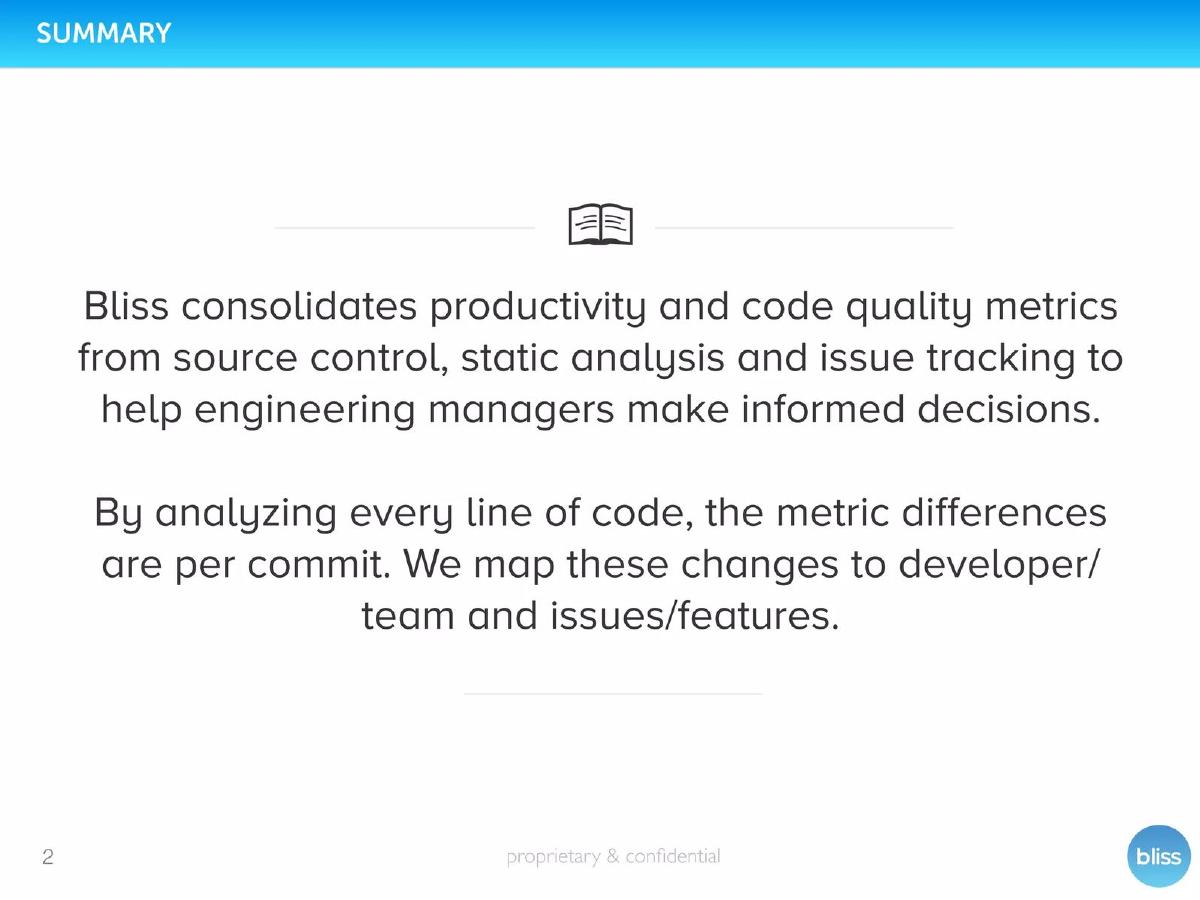
- The company defines its core value proposition as providing code quality metrics specifically for engineering managers (Slide 1).
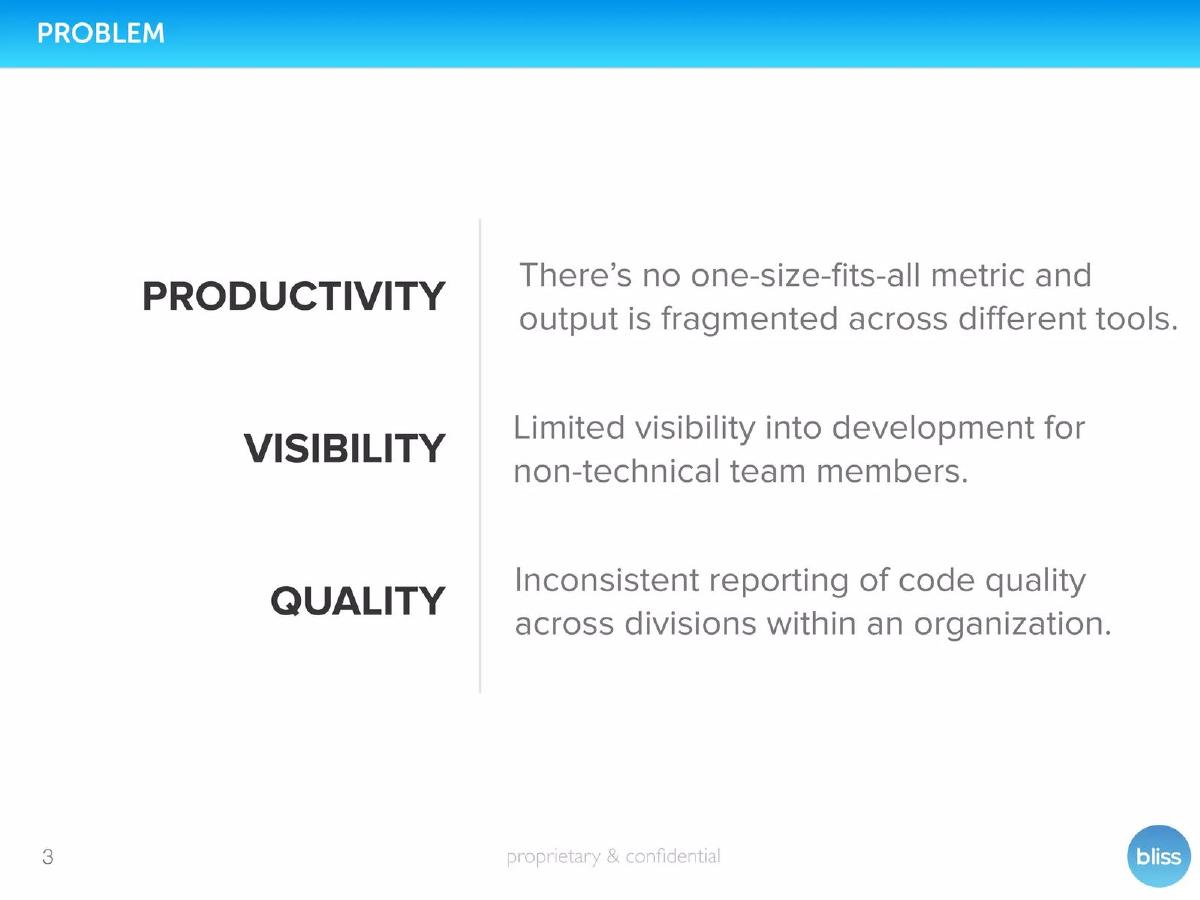
- Bliss.ai identifies three primary pain points: fragmented productivity metrics, limited visibility for non-technical members, and inconsistent reporting (Slide 3).
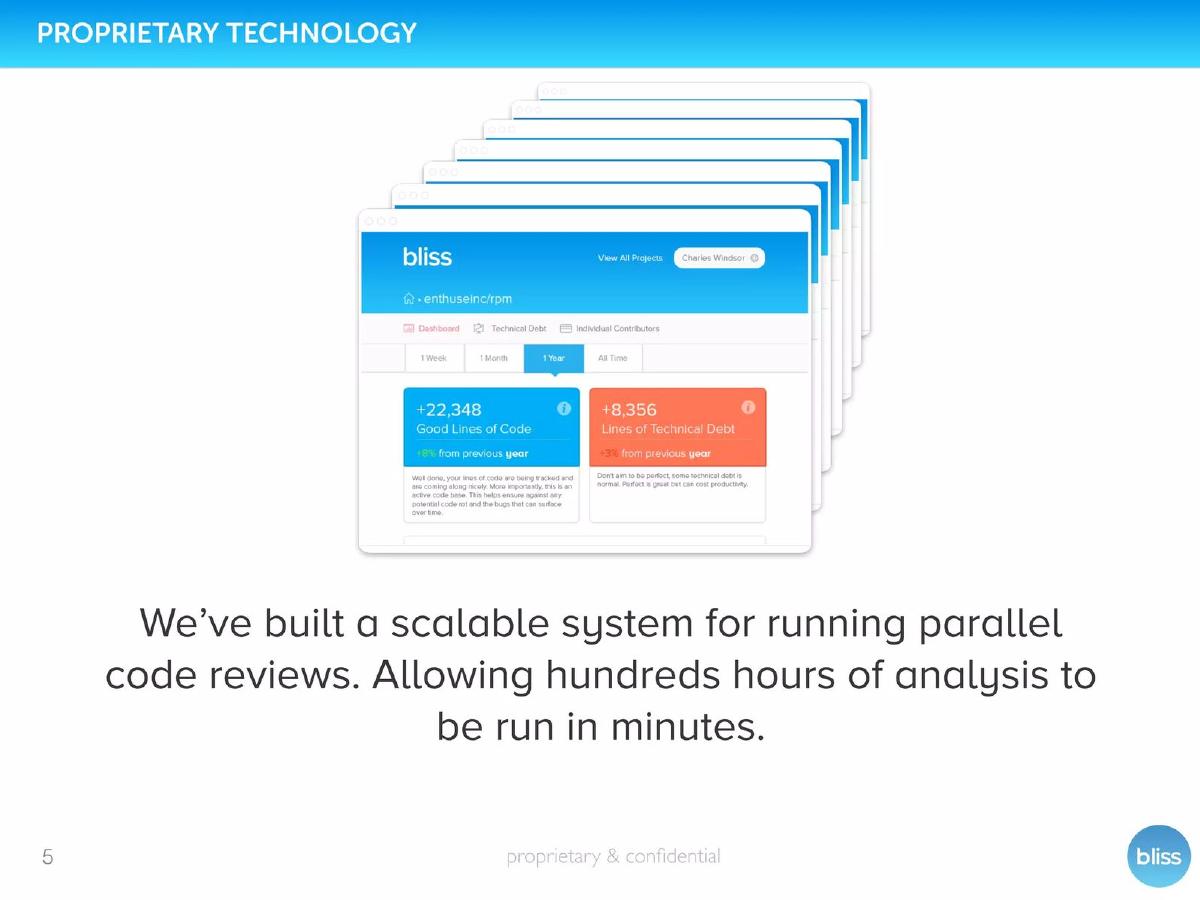
- The proprietary technology claims to run parallel code reviews, reducing hundreds of hours of analysis to minutes (Slide 5).
- Initial go-to-market strategy focused exclusively on startups from March 2015 through June 2015 to leverage homogeneous tech stacks (Slide 7).
- The revenue model includes an enterprise tier starting at $1,500/month for 50 repositories and a self-serve tier starting at $29/month (Slide 9).
- The startup is raising a $750k seed round via convertible equity with a 20% discount, noting that $500k is already committed (Slide 11).
- Use of proceeds includes hiring two engineers, one product person, and two sales development reps (Slide 11).
- Future milestones are clearly defined as reaching 1k paying customers, $1m ARR, and 50 enterprise customers (Slide 11).
Bliss.ai Pitch Deck Analysis
Bliss.ai enters the developer tools market with a specific focus on the management layer of engineering. The deck is structured to move from the high-level pain points of technical debt to the specific financial requirements of their seed round. By positioning themselves as a bridge between technical output and business visibility, Bliss.ai attempts to solve a perennial communication gap in software organizations.
Slide 1: Title Slide
The title slide is minimalist, featuring the Bliss logo and a clear sub-headline: "Code quality metrics for engineering managers." This immediately identifies the target persona. The presence of contact information for CEO Brian York and the "proprietary & confidential" footer sets a professional, standard tone for a VC-facing document.
Slide 3: The Problem
Bliss.ai categorizes the problem into three distinct buckets: Productivity, Visibility, and Quality. The slide notes that there is no "one-size-fits-all metric" and that output is currently fragmented across multiple tools. Crucially, it highlights the "limited visibility into development for non-technical team members," which serves as the primary hook for the business-side value proposition. The final point regarding inconsistent reporting across divisions suggests that the tool is intended to scale into larger organizations where standardization is a challenge.
Slide 5: Proprietary Technology
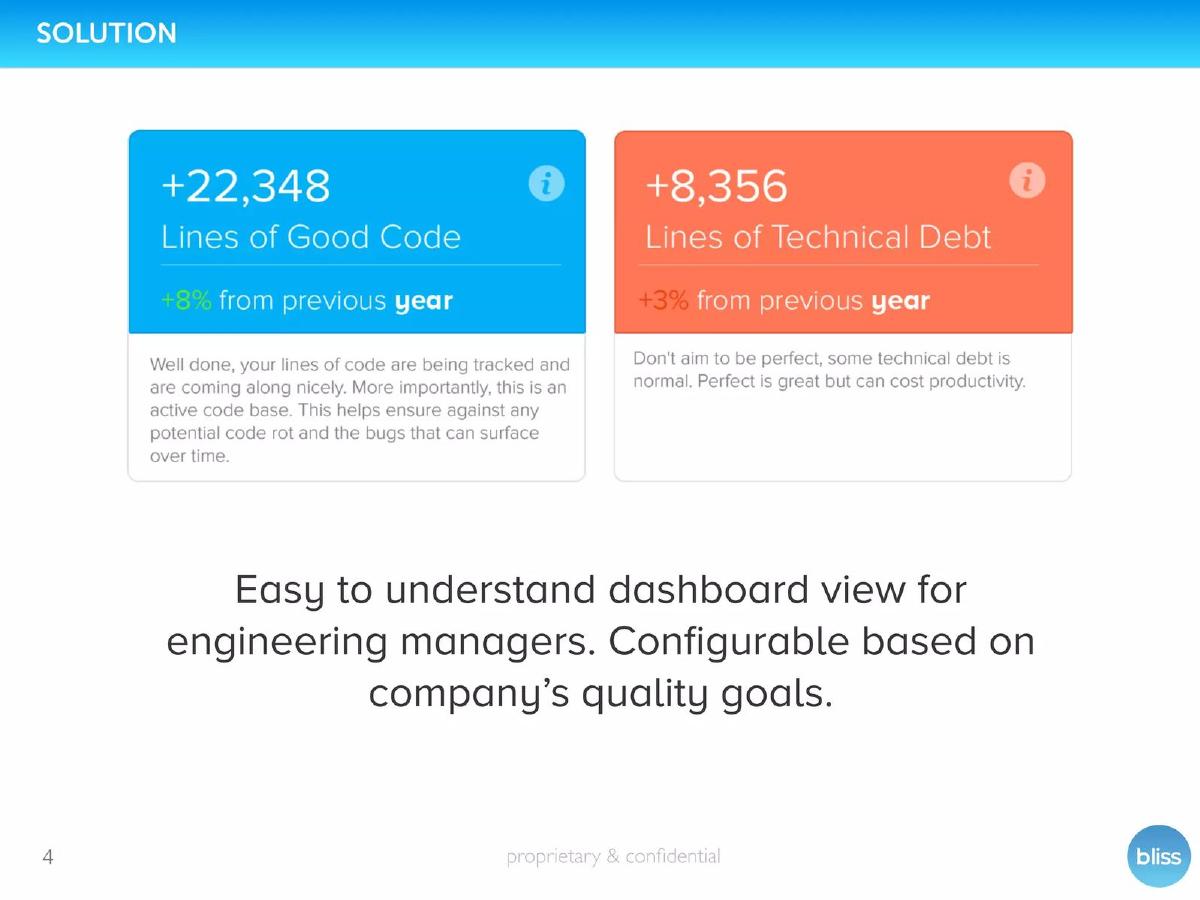
This slide introduces the solution through a visual representation of the dashboard. The core claim is the creation of a "scalable system for running parallel code reviews." The efficiency metric provided is significant: "Allowing hundreds hours of analysis to be run in minutes." The dashboard mockup shows metrics like "Good Lines of Code" (+22,348) and "Lines of Technical Debt" (+8,356), with percentage changes from the previous year. This indicates that the software is designed for long-term trend tracking rather than just snapshot analysis.
Slide 7: Go To Market and Social Proof
The go-to-market strategy is described as an initial focus on startups for "faster sales cycles and more homogeneous stacks." A small note indicates this focus was exclusive from March 2015 through June 2015. The slide relies heavily on testimonials from Roger Graves (CTO of Cloverpop) and Noah Abelson (CEO of ShareRoot) . Graves describes the tool as his "wing-man" for explaining technical debt to others, while Abelson notes that visibility into code helped him become a "better CEO." These quotes reinforce the idea that Bliss.ai is a communication tool as much as a technical one.
Slide 9: Revenue Model
The revenue model is split into two categories: Enterprise and Website . The Enterprise tier starts at $1,500/month for 50 active repositories. The Website tier is a self-serve model with two visible plans: Startups ($29/month for 1 project) and Team ($249/month for 10 projects) . The slide also includes a "Team Leaderboard" mockup, showing individual contributors ranked by a "Good/Debt Ratio." This feature suggests a gamification or performance management element to the software, allowing managers to see which developers (e.g., "Cliff Porter" or "Jane Sims") are producing the cleanest code.
Slide 11: Financing and Use of Proceeds
This is a highly tactical slide. Bliss.ai is seeking a $750k seed round via convertible equity. They disclose that $500k is already committed , leaving $250k available. The terms include a 20% discount . The use of proceeds is split between hiring (2 Engineers, 1 Product, 2 SDRs), enterprise deployment optimization, and validating marketing tactics. The milestones are ambitious: 1k paying customers, $1m ARR, and 50 enterprise customers. The inclusion of specific hiring counts and revenue targets provides investors with a clear roadmap for how the capital will be deployed.
Slide 13: Why Now?!
The final slide in this selection addresses the market timing. It uses the "Software eating the world" trope but adds a specific twist: engineering talent is not growing at the same pace, creating a "huge disparity." The second point focuses on the shift to remote working, citing a New York Times statistic that 3.2 million Americans worked remote in 2014 and an Elance oDesk projection that 40% of the U.S. workforce would be independent workers by 2020. The implication is that as teams become more distributed and talent becomes scarcer, automated oversight tools like Bliss.ai become essential.
What Bliss.ai Does Well
The deck is exceptionally clear about its target audience. By focusing on "Engineering Managers" on the very first slide, it avoids the common pitfall of trying to be everything to everyone. The distinction between the technical user (who benefits from parallel reviews) and the business user (who benefits from visibility) is well-maintained throughout the slides.
The financing slide is a standout for its transparency. Many seed-stage decks are vague about their current funding status. By stating exactly how much is committed ($500k) and the specific terms (20% discount), Bliss.ai creates a sense of momentum and urgency for the remaining $250k. The milestones are also quantifiable, which allows investors to hold the team accountable to a specific growth trajectory.
What is Missing from the Deck
The most notable omission in this selection is a dedicated Team Slide . While the CEO is mentioned on the title slide and testimonials are provided by customers, the internal expertise of the founding team is not detailed. For a technical product claiming to run "parallel code reviews," the pedigree of the engineering team is a critical factor for investor due diligence.
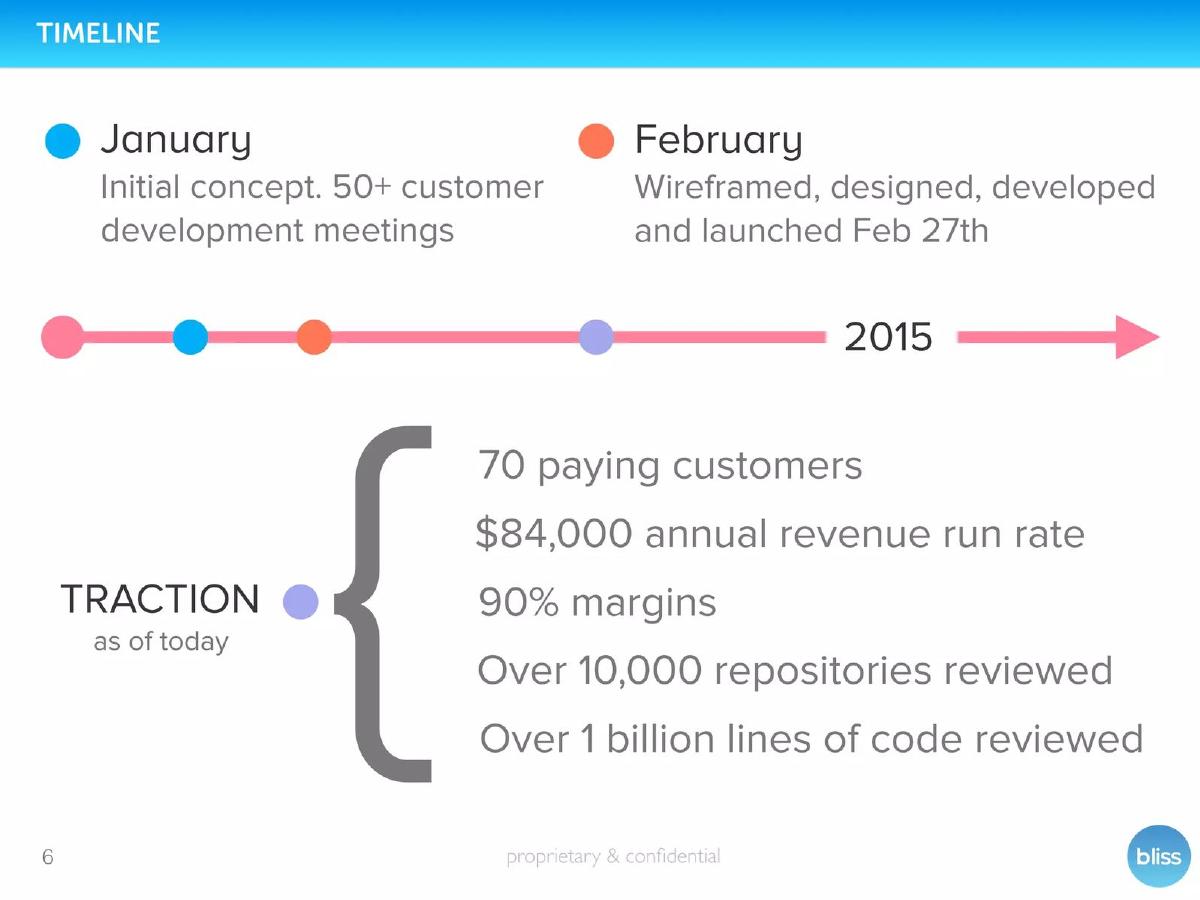
There is also a lack of Competitive Landscape analysis. The deck mentions that productivity metrics are "fragmented across different tools," but it does not name those tools or explain how Bliss.ai differentiates itself from established static analysis players or newer engineering intelligence platforms. Furthermore, the deck does not provide Unit Economics or current traction data beyond the testimonials. While the milestones are clear, the starting point (current ARR or current customer count) is not explicitly stated on these slides.
Founder Takeaways
Quantify the efficiency gain: Bliss.ai’s claim of turning "hundreds of hours of analysis into minutes" is a powerful value proposition. Founders should always look for a way to express their product's impact in terms of time or cost saved, as seen on Slide 5.
Use social proof to bridge the gap: If your product is technical but sold to (or used by) non-technical people, use testimonials from both sides. The CEO testimonial on Slide 7 is just as important as the CTO testimonial because it proves the tool solves the communication gap identified in the problem slide.
Be specific with your ask: Slide 11 is a model for seed-stage financing slides. Don't just ask for money; explain what the money buys (5 specific hires) and what those hires will achieve (1k customers, $1m ARR). This level of detail shows that the founder has a concrete operational plan rather than just a vision.
Focus on the 'Why Now': The use of external trends (remote work, talent scarcity) on Slide 13 helps contextualize the product within a larger macroeconomic shift. This helps investors see the product not just as a tool, but as an inevitable response to market changes.
Frequently asked questions
- What specific problem does Bliss.ai solve for non-technical managers?
- According to Slide 3, non-technical team members suffer from limited visibility into the development process. Bliss.ai addresses this by translating complex code quality and technical debt into metrics that can be understood by CEOs and other stakeholders, as evidenced by the testimonial from Noah Abelson on Slide 7.
- How does Bliss.ai structure its pricing for different market segments?
- Slide 9 details a two-pronged approach. The 'Website' tier targets startups and small teams with pricing ranging from $29/month for one project to $249/month for ten projects. The 'Enterprise' tier starts at $1,500/month, covering 50 active repositories and providing additional dashboard views.
- What are the specific hiring plans for the seed round capital?
- Slide 11 outlines the 'Use of proceeds' for the $750k raise. The company intends to hire five new employees: two engineers, one product specialist, and two sales development representatives (SDRs). This suggests a balanced focus on product development and sales outreach.
- What is the current funding status mentioned in the deck?
- On Slide 11, the company states they are raising a $750k seed round via convertible equity financing. They explicitly mention that $500k of this round is already committed, leaving a $250k gap for new investors, with a 20% discount offered on the convertible equity.
- What evidence of product-market fit is provided?
- Bliss.ai uses social proof rather than raw user growth numbers in this selection. Slide 7 features testimonials from Roger Graves (CTO of Cloverpop) and Noah Abelson (CEO of ShareRoot), both of whom lead venture-backed companies. These testimonials emphasize the tool's utility in managing technical debt and facilitating communication.