Bettery is a social betting platform that leverages blockchain technology to allow users to bet on social media content and personal opinions. The deck highlights a 'gamble-free' approach where users can bet 'pizzas' or free tokens, aiming to solve the trust and engagement issues found in traditional social media. With a dual-token model (BET and BTY) and a maximum supply of 2,000,000,000 tokens, the company seeks to incentivize hosts, players, and experts through a reputation system. The fundraising ask includes a $1.5M private sale and a $300K public sale to scale the user base and reach re…
Key takeaways
- The platform utilizes a dual-token system consisting of BET for rewards and BTY for business access and trading, with a total max supply of 2,000,000,000 tokens (Slide 9).
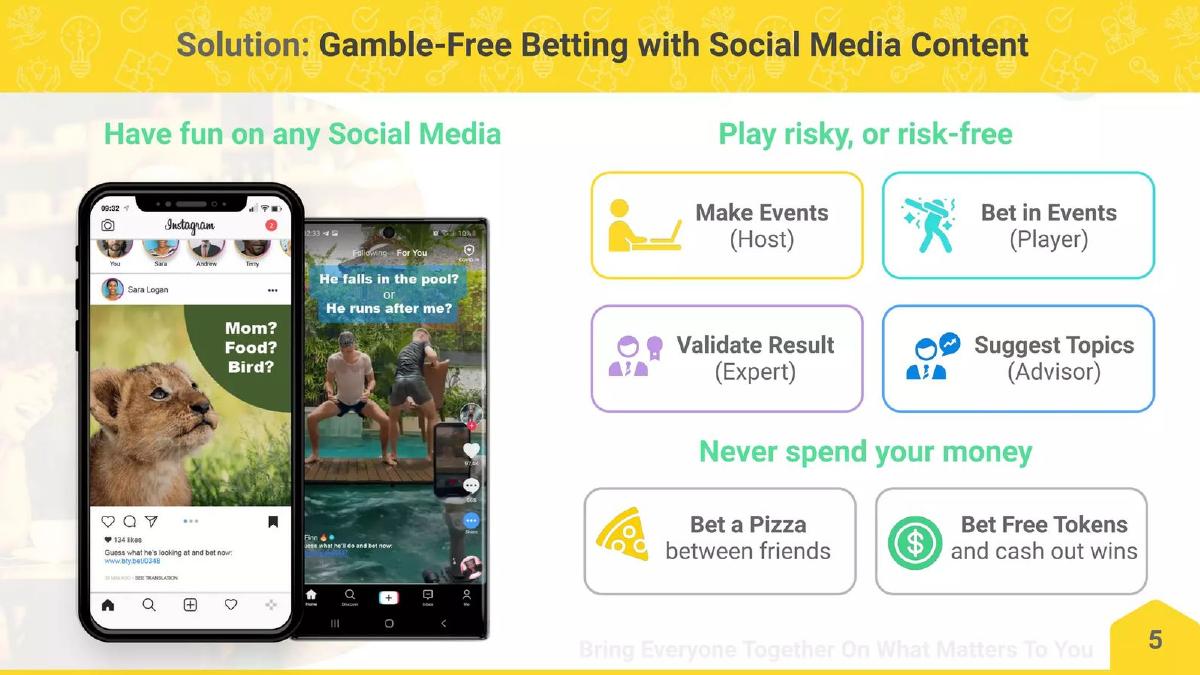
- Bettery positions itself as 'gamble-free' by allowing social bets like 'bet a pizza' alongside free token-based betting (Slide 5).
- The company is seeking a total of $1.8M through a $1.5M Private Token Sale and a $300K Public Token Sale (Slide 17).
- The roadmap targets revenue generation and full mobile application launches by Q3-Q4 of 2022 (Slide 15).
- A reputation system is central to the ecosystem, where users gain or lose points based on their accuracy as experts or success as hosts (Slide 13).
- The deck identifies Facebook Forecast, Polymarket, and Augur as primary competitors, claiming superiority through social media integration and non-betting user roles (Slide 11).
- Operational costs are detailed with a projected $50,000 monthly burn rate post-funding, including a $15,000 monthly spend on software engineering (Slide 17).
- The platform distinguishes between four event types: Regular, Premium, Pro, and Friends, each with different token requirements and reward structures (Slide 29).
Bettery Pitch Deck Teardown
Bettery is a blockchain-based social prediction platform that attempts to gamify social media interactions. By allowing users to host and participate in bets based on real-world social content, the company seeks to capture the intersection of the 'Play-to-Earn' movement and traditional social networking. This teardown examines the 17 slides provided from their 33-slide deck.
Slide 1: Title and Introduction
The cover slide establishes the brand identity with the tagline 'Bet with Friends on topics created by you and influencers.' It identifies Fedor Bushlanov as the Founder and provides a link to an intro video. The visual design uses a bright yellow and white palette, which is consistent throughout the deck. The inclusion of a direct contact email and a video link on the first slide is a standard practice for accessibility.
Slide 3: The Value Proposition
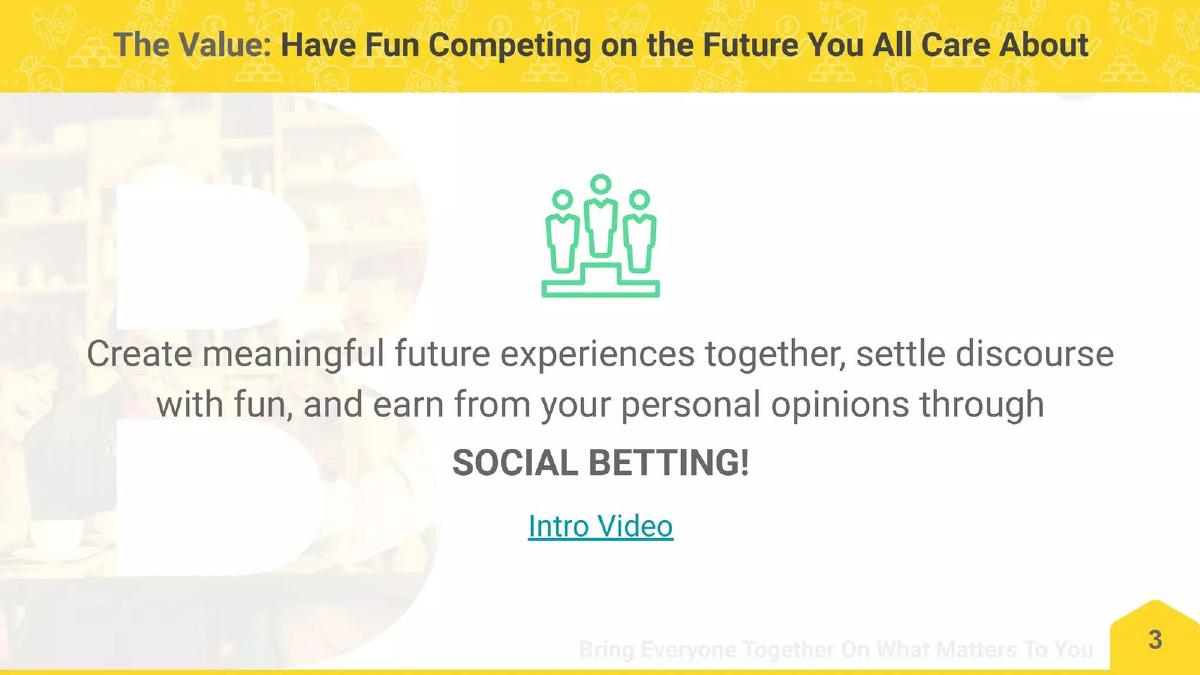
Slide 3 defines the 'Value' as having fun competing on the future. It uses the term 'SOCIAL BETTING' in bold to categorize the product. The slide claims the platform allows users to 'settle discourse with fun' and 'earn from your personal opinions.' This sets the stage for a product that is as much about social validation as it is about financial gain.
Slide 5: The Solution Mechanics
This slide introduces the 'Gamble-Free' concept. It shows mockups of the app integrated with Instagram and TikTok content. The solution is broken down into four user roles: Host (Make Events), Player (Bet in Events), Expert (Validate Result), and Advisor (Suggest Topics). Crucially, it mentions that users can 'Bet a Pizza between friends' or use 'Free Tokens,' which is a strategic move to distance the platform from the legal complexities of traditional online gambling.
Slide 7: Market Timing (Why Now?)
The 'Why Now?' slide cites three catalysts: the 'Blockchain is at all-time high' (noting increased trust), the 'Social Media crisis' (users migrating to open platforms like Telegram), and the 'Covid-19 pandemic' (increased online gaming). While these are broad macro trends, they provide the necessary context for why a decentralized social platform might find traction in the current market environment.
Slide 9: Business Model and Tokenomics
Slide 9 is the most technical, outlining the 'Token Mechanics.' It introduces a dual-token system: BET and BTY . The maximum supply for both combined is 2,000,000,000 tokens. BET is an internal reward token that cannot be bought or sold. BTY is the external, tradable token. The slide explains a one-way swap mechanism where 1 BET can be exchanged for 1 BTY. This structure is designed to prevent direct speculation on the reward token while providing a path to liquidity for active users.
Slide 11: Competitive Landscape
The competition slide uses a feature matrix to compare Bettery against Facebook Forecast, Polymarket, and Augur. Bettery claims to be the only one offering 'Non-Betting User Roles' and 'Free to Use' options simultaneously. Interestingly, it includes a post-mortem note on a failed competitor, Funrised, which raised $5.1M but failed because users 'ran out of topics to bet.' Bettery positions its social media integration as the solution to this specific content exhaustion problem.
Slide 13: Reputation and Fair Play
To solve the oracle problem (how a blockchain knows who won a real-world bet), Bettery uses a reputation system. Slide 13 explains that Hosts, Players, and Experts gain or lose reputation based on their actions. For example, an Expert loses points for validating incorrectly. High reputation unlocks 'high-paying' business events and allows hosts to manage more concurrent events. This gamified governance is a core part of their retention strategy.
Slide 15: Traction and Roadmap
The roadmap shows that in 2021, the company implemented a Desktop & Mobile MVP and established communities on Telegram and Twitter. The 'Coming next' section for 2021-2022 includes a Public MVP, a BTY Token Sale (Nov-Dec), and a 'Smart Contracts Audit' in Q2 2022. Revenue generation is slated for Q3-Q4 2022, indicating a long pre-revenue development phase typical of blockchain startups.
Slide 17: Investment Ask and Budget
The 'Investments' slide is highly specific. The company is looking for $1.5M from a Private Token Sale and $300K from a Public Token Sale. It lists a monthly burn rate of $50,000 . The budget breakdown is transparent: $60,000 for legal/compliance and licenses, and $40,000 in monthly expenses. The monthly spend includes $15,000 for seven software engineers and $15,000 for community building. It also notes they are currently bootstrapping at a burn of $8,000/month.
Slide 19: Closing
A simple 'Thank You' slide that repeats the founder's contact information and the company logo. It maintains the visual consistency of the deck.
Slide 21: Unique Sales Points
This slide reiterates the differentiation factors: 'No Crypto Knowledge Required' (social login, no wallets to install), 'Tamper-proof Outcomes' via smart contracts, and the ability for users to 'Monetize Their Data.' The mention of 'Extensive User Profiles' including 'psychological portraits' suggests an advertising-based secondary revenue stream.
Slide 23: Vision and Mission
The mission is 'To empower anyone to earn from creating collective knowledge through social discourse.' The vision is 'To bring value to people's opinions shaped by their unique life experiences.' These are standard high-level statements that align with the 'Social Betting' theme.
Slides 25 & 27: Design Mockups
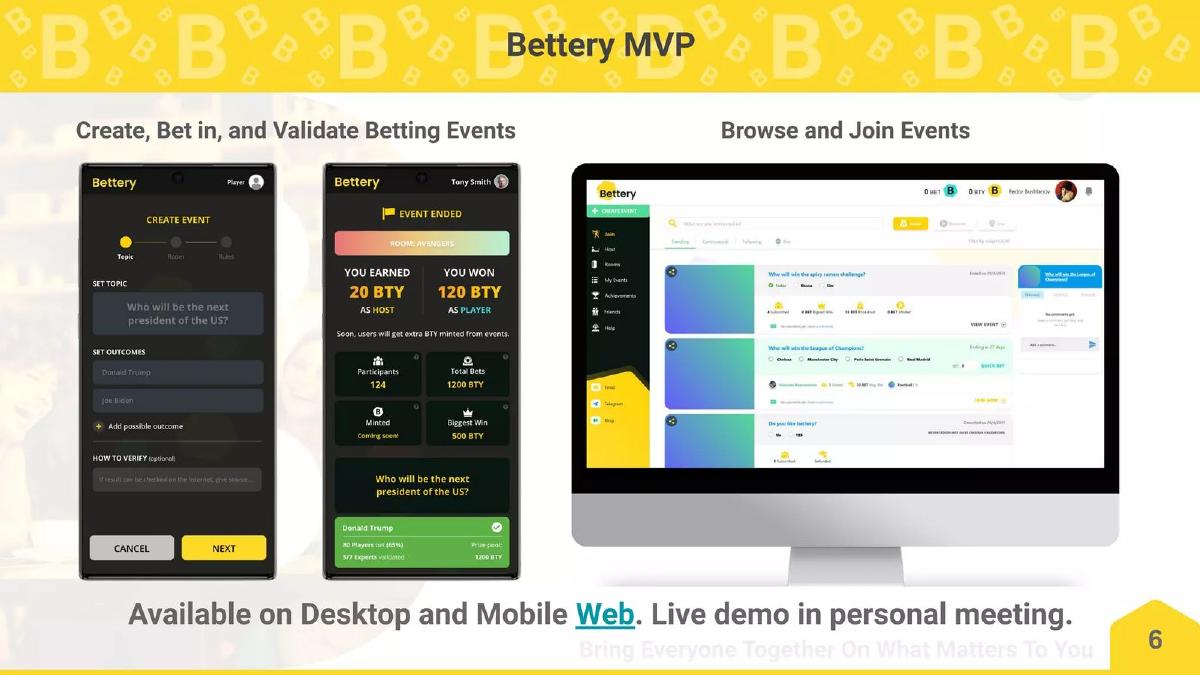
These slides provide high-fidelity mockups of the Desktop Web Design and Mobile App Design. Slide 25 shows an 'Event Timeline' with categories like 'Trending' and 'Controversial.' Slide 27 shows the mobile interface, including the 'Expert' validation screen. The UI looks modern and mimics social media feeds, which supports their claim of a low barrier to entry for non-crypto users.
Slides 29, 31, & 33: Deep Dive into Mechanics
The final three slides are detailed tables. Slide 29 breaks down the four event types (Regular, Premium, Pro, Friends). Slide 31 explains exactly when users earn or lose tokens based on their role and the event outcome. Slide 33 provides a granular look at the reputation point system, showing that a 'Cancelled Event' results in -1 Rep Point for a Host, while a 'Successful Event' adds +1 Rep Point. These slides are likely intended for a technical or deep-dive due diligence phase rather than a quick pitch.
What Works in This Deck
Granular Financials: Slide 17 provides a level of budgetary detail rarely seen in early-stage decks. Breaking down the cost per head for engineering and design shows a disciplined approach to capital allocation. · Clear Token Utility: The dual-token model on Slide 9 clearly distinguishes between internal gamification (BET) and external value (BTY), which is a common way to manage inflationary pressures in crypto ecosystems. · Role-Based Ecosystem: By defining roles like 'Expert' and 'Advisor,' the deck shows it has thought through the 'Oracle' problem—how to verify real-world events on-chain without a centralized authority. · Visual Mockups: The UI/UX slides (25 and 27) are polished and help the investor visualize the final product, which is essential for a 'social' app.
What is Missing or Weak
No Team Slide: In the 17 slides provided, there is no team slide. While the founder is named on the cover, the background and expertise of the '7 software engineers' or other co-founders are completely absent. In early-stage fundraising, the team is often more important than the product. · Lack of User Traction Metrics: While the roadmap mentions an MVP and community building, there are no hard numbers on current active users, retention rates, or community size. The deck relies heavily on 'what will happen' rather than 'what has happened.' · Regulatory Risk: Although the deck uses terms like 'Gamble-Free' and 'Social Betting,' the ability to 'cash out wins' (Slide 5) and trade tokens (Slide 9) often falls under gambling or securities regulations in many jurisdictions. The deck mentions $35,000 for 'Legal Opinions and Compliance,' but does not address the specific regulatory hurdles of social betting. · Market Size (TAM/SAM/SOM): There is no slide quantifying the total addressable market. While 'social media' and 'betting' are large, investors need to see the founder's specific estimation of the reachable market for this niche.
Founder Takeaways
Copy the Budget Transparency: If you are asking for a specific amount, follow the example on Slide 17. Showing exactly how many people you will hire and what their salaries will be builds significant trust with investors. · Address Past Failures: The competitive analysis on Slide 11 is excellent because it identifies why a previous company failed and explains how this new startup avoids that pitfall. This shows deep market research. · Use Role-Based Frameworks: If your platform relies on a community to function, clearly defining the roles (Host, Player, Expert) as Bettery did on Slide 5 helps explain complex interactions simply. · Ensure the Team is Present: Never omit a team slide. Even if you are a solo founder, highlight your advisors or key early hires to show you have the technical and operational capacity to execute the roadmap.
Frequently asked questions
- What is the core value proposition of Bettery?
- Bettery aims to turn social discourse into a competitive game. According to slide 3, the value lies in creating 'meaningful future experiences together' and earning from personal opinions through social betting. It attempts to bridge the gap between social media engagement and prediction markets by allowing users to bet on any content posted on platforms like Instagram or TikTok.
- How does the dual-token economy work?
- As detailed on slide 9, the economy uses BET and BTY tokens. BET is minted for user rewards and cannot be bought or sold directly. BTY is the tradable token used by businesses to access users and pay rewards. Users can perform a one-way swap of 1 BET for 1 BTY to cash out their earnings, creating a controlled flow from activity to liquidity.
- How does Bettery ensure fair play without traditional regulation?
- The platform relies on a multi-role reputation system shown on slides 13 and 33. Users act as Hosts, Players, Experts, or Advisors. Experts validate results; if they validate with the majority, they gain reputation. If they validate incorrectly, they lose points. High reputation is required to attend high-paying business events or to host multiple events simultaneously.
- What is the specific financial ask and use of funds?
- Slide 17 states a need for $1.8M total. $1.5M is sought via a Private Sale for scaling, and $300K via a Public Sale for revenue traction. The budget allocates $60,000 for single expenses (legal and licenses) and $40,000 for monthly operations, including a 7-person engineering team and community building efforts.
- Who are the competitors and how does Bettery differentiate?
- Slide 11 lists Facebook Forecast, Polymarket, and Augur. Bettery claims to differentiate by offering 'Non-Betting User Roles' (Experts/Advisors) and being 'Free to Use.' It also highlights a failure of a past competitor, Funrised, noting they failed because users 'ran out of topics to bet,' a problem Bettery intends to solve by using social media content as the betting source.