The Bliinx pre-seed deck is a lean, 14-slide presentation that successfully secured $863,400 in 2019. Its primary strength lies in its 'Traction' slide, which reports a jump from $0 to $40,000 in ARR in just 60 days, alongside a $200,000 pipeline. The deck avoids the common pre-seed trap of over-explaining technology, instead focusing on the 'siloed information' problem that costs professionals three hours per week. By identifying a specific initial market focus of $1.8 billion in professional and financial services, Bliinx demonstrated a clear go-to-market path. While the deck lacks a specif…
Key takeaways
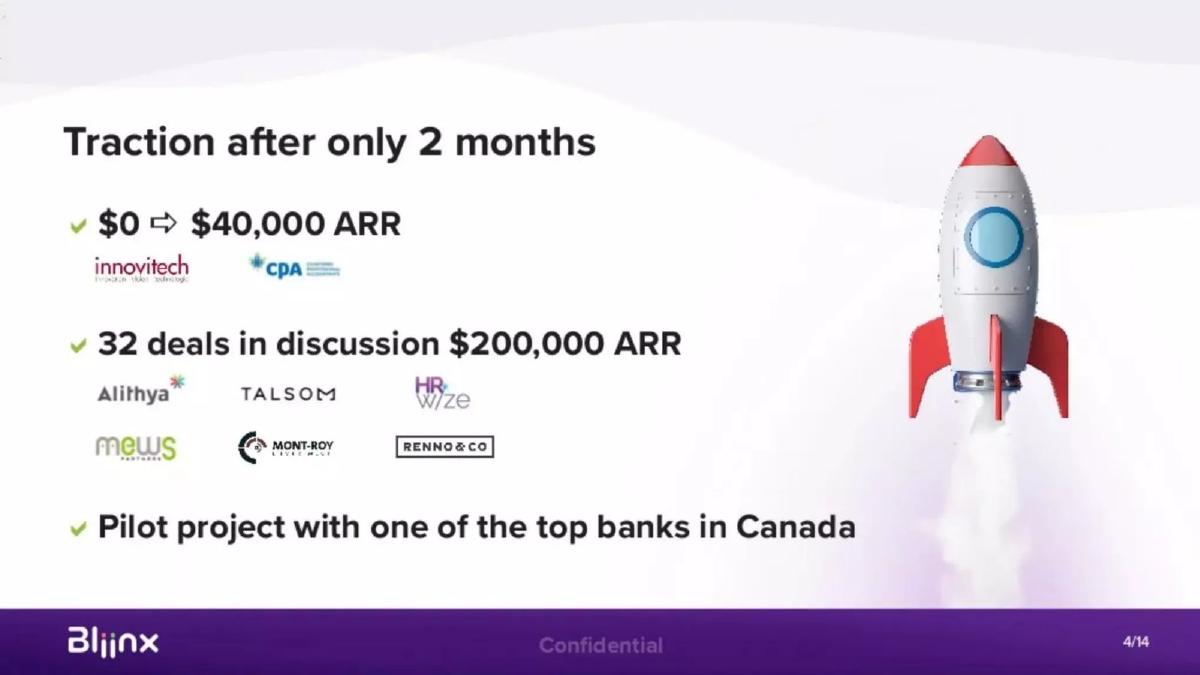
- The company achieved $40,000 in ARR within two months of operation, as stated on slide 4.
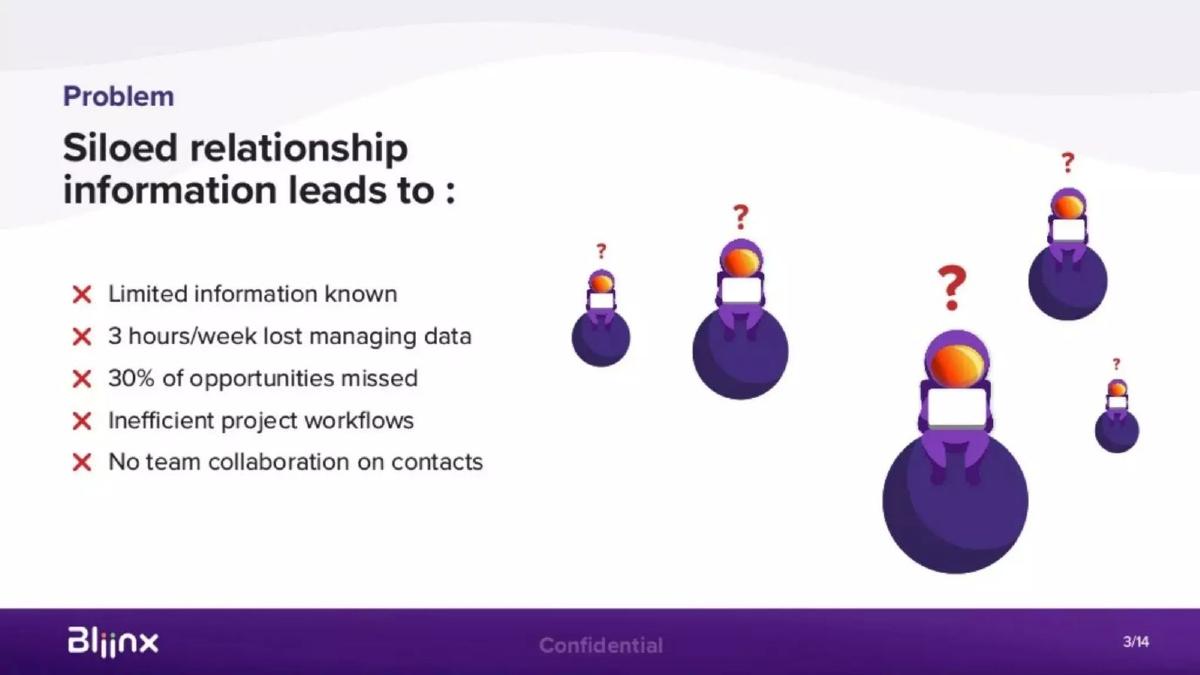
- Professionals lose an estimated 3 hours per week managing siloed data across various tools (slide 3).
- The initial market focus is a $1.8 billion segment within professional and financial services (slide 7).
- Bliinx positions itself against competitors like Affinity and Outreach by emphasizing workflow integration and ease of use (slide 8).
- Customer acquisition costs (CAC) are clearly segmented: $200 for direct sales versus $40 for bottom-up growth (slide 9).
- The business model is built on a $14 per user per month subscription fee (slide 10).
- The team includes a CTO who previously worked at Google and Ubisoft (slide 11).
- The deck outlines a roadmap to reach $500,000+ in ARR by Q4 2021 (slide 13).
The Bliinx Pre-Seed Teardown
Bliinx entered the market in 2019 with a specific value proposition: relationship productivity. While many startups in the CRM space try to replace existing systems, Bliinx focused on the layer of interaction that happens before the data ever reaches the CRM. Their pre-seed deck, which helped secure $863,400, is a study in how to use early traction to validate a crowded market. By focusing on the Office 365 ecosystem, they carved out a niche that felt both accessible and scalable.
Slides 1-3: The Problem of the Fragmented Workflow
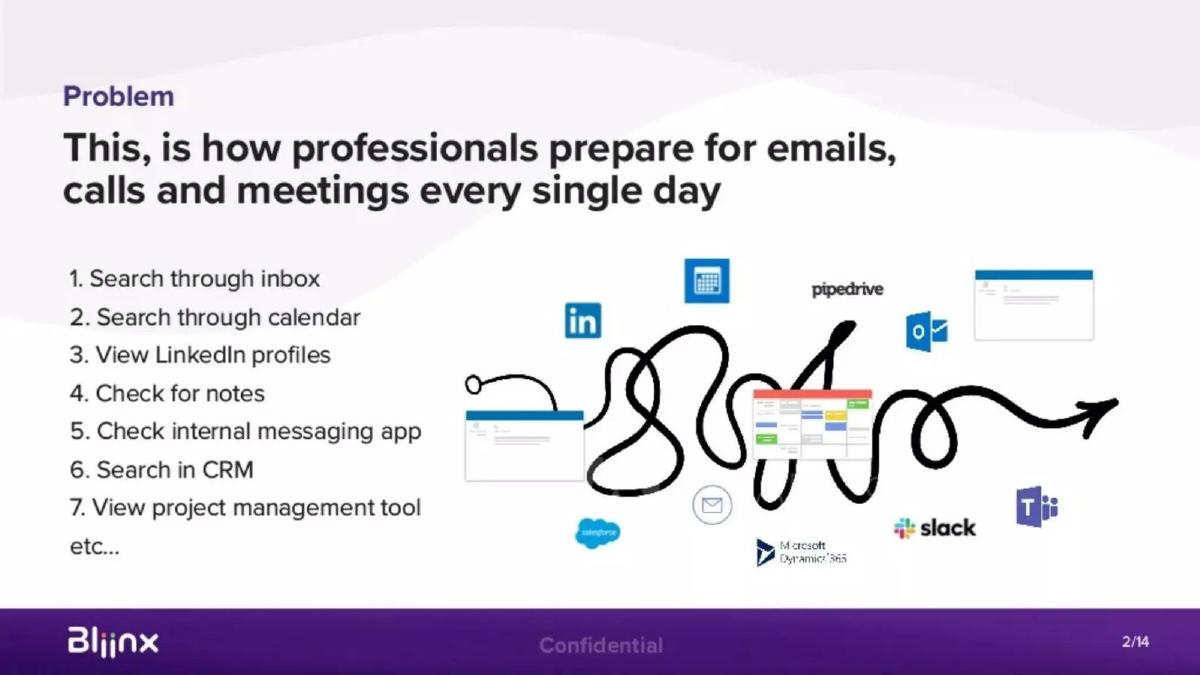
The deck opens with a title slide featuring a 'Relationship productivity' tagline and a series of astronaut characters. While the branding is playful, the deck immediately shifts to a serious pain point on Slide 2 . It lists the seven-step manual process professionals go through to prepare for a single meeting: searching inboxes, calendars, LinkedIn, notes, messaging apps, CRM, and project management tools. This is a highly relatable 'day-in-the-life' slide that sets the stage for the solution.
Slide 3 quantifies this pain. It claims that siloed information leads to 3 hours per week lost per person and, more importantly, 30% of opportunities being missed. For a pre-seed deck, these numbers are bold. They transform a 'nice-to-have' productivity tool into a 'must-have' revenue protection tool. The visual of astronauts on separate planets with question marks effectively mirrors the 'siloed' terminology used in the header.
Slide 4: The Traction Powerhouse
This is arguably the most important slide in the deck. Slide 4 shows that Bliinx went from $0 to $40,000 in ARR in only two months. It lists logos of paying customers like Innovitech and CPA. Furthermore, it highlights a pipeline of 32 deals in discussion worth $200,000 in ARR and a pilot project with a top Canadian bank. For a pre-seed investor, this slide mitigates almost all 'execution risk.' It proves that the founders can sell and that the market has an immediate appetite for the product.
Slides 5-6: The Solution and User Experience
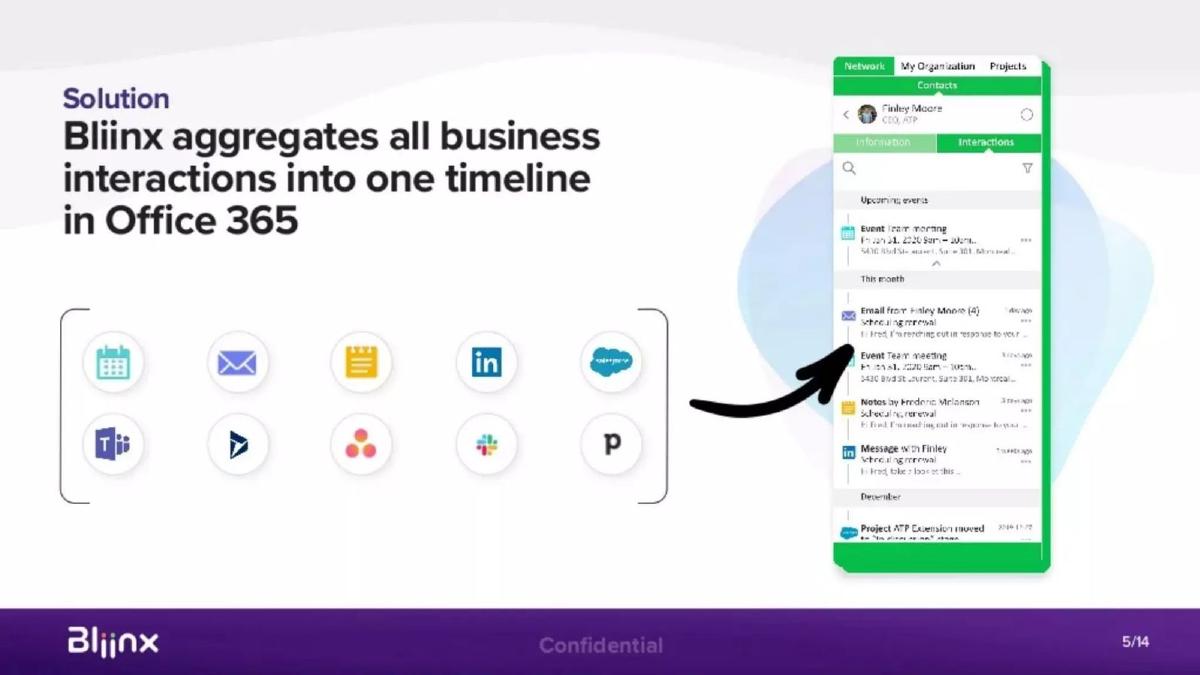
Slide 5 introduces the product as an aggregator that pulls interactions from Outlook, Teams, Slack, and LinkedIn into a single timeline. The visual shows a mobile interface with a chronological feed of emails, meetings, and notes. This is a clear 'show, don't tell' moment. It explains the product's utility without needing a technical deep dive.
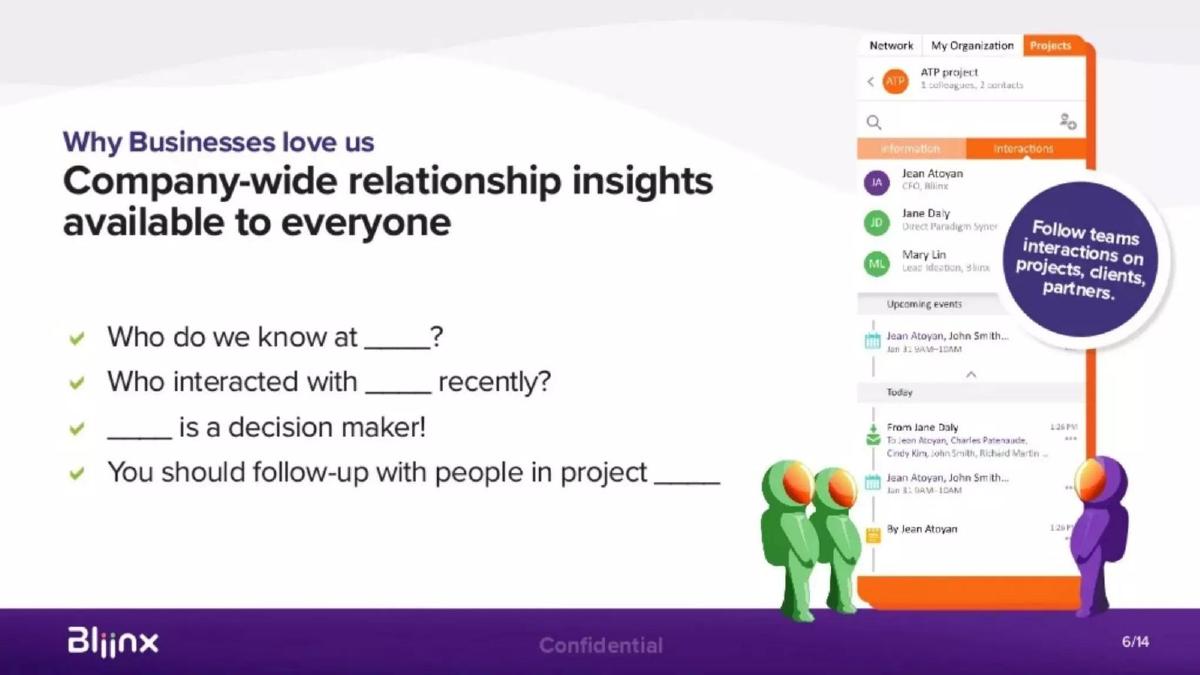
Slide 6 focuses on the collaborative aspect. It poses four questions that Bliinx answers for a team: 'Who do we know at [Company]?', 'Who interacted with [Person] recently?', 'Who is a decision maker?', and 'Who should you follow up with?'. By framing the solution as a series of answers to common business questions, Bliinx makes the software's value proposition concrete for non-technical stakeholders.
Slides 7-8: Market Size and Competitive Landscape
Slide 7 breaks down the North American market. It identifies 1 million businesses using Office 365. It segments the opportunity into Enterprise ($36B/year) and SMB ($4B/year), with an 'Initial Market Focus' on Professional & Financial services valued at $1.8B per year. This 'Initial Market Focus' is a critical detail; it shows the founders aren't just chasing a giant number, but have a specific entry point.
Slide 8 uses a three-circle Venn diagram to map the competitive landscape. Bliinx places itself at the center, claiming the intersection of 'Integrated in Workflow,' 'Easy to Use,' and 'Collaboration in Teams.' It explicitly calls out competitors like Affinity and Introhive for having 'Limited Data Sources' and 'Poor UX,' while Outreach and SalesLoft are labeled as 'For Sales Only' and 'Complex.' This positioning is smart because it frames Bliinx as the 'everyman' tool for the whole company, not just the sales department.
Slides 9-10: The Unit Economics and Business Model
Slide 9 provides a detailed look at customer acquisition. It breaks down three channels: Direct Sales ($200 CAC, $4,000 avg ARR), Channel Partners, and Bottom-up ($40 CAC, $120 avg ARR). Seeing CAC and ARR figures side-by-side at the pre-seed stage is rare and highly persuasive. It shows the founders are thinking about the math of the business, not just the features of the software.
Slide 10 is simple: the price is $14 per user per month. It mentions a 'Freemium with paywall' model and 'Direct sales with license purchases.' This clarity on pricing prevents any ambiguity about how the company intends to reach its revenue goals.
Slides 11-12: The Team and Investors
Slide 11 introduces the founders. Nathan, the CTO, is highlighted as a former Ubisoft and Google engineer who sold a 3D development project in 2016. Stephane, the CMO, brings 15 years of advertising experience. Fred, the CEO, is described as a leader in 'EQ, RQ and Business Dev.' The inclusion of advisors from companies like PasswordBox (acquired by Intel) and AdEspresso (acquired by Hootsuite) adds a layer of 'been there, done that' credibility to the young team.
Slide 12 showcases the existing investor base. Featuring 500 Startups and Panache Ventures prominently serves as a strong signal to new investors. It suggests that the company has already passed the rigorous due diligence of established accelerators and seed funds.
Slides 13-14: The Roadmap and Contact
Slide 13 provides a timeline. It notes a 'Runway: 18 months' and sets a goal for a Seed round in Q4 2021 with a target of $500,000+ in ARR. This gives investors a clear exit or 'next step' milestone to track. Slide 14 concludes with the CEO's contact information and a final astronaut graphic.
What Works in the Bliinx Deck
Traction Front-and-Center: Putting the $40k ARR achievement on slide 4 is a brilliant move. It changes the conversation from 'what if' to 'how fast can we grow.' · Specific Market Targeting: Instead of just saying 'CRM is a $50B market,' they identified the $1.8B professional services niche within the Office 365 ecosystem. · Unit Economic Transparency: Providing CAC and ARR estimates for different channels shows a level of financial maturity often missing in pre-seed decks. · Integration-First Strategy: By positioning themselves as a layer on top of Office 365 rather than a replacement for it, they lower the barrier to entry for new customers.
What is Missing from the Bliinx Deck
The Ask: The deck never explicitly states how much money they are raising in this specific round or what the valuation is. While this is sometimes left for the verbal pitch, having a slide dedicated to the 'Use of Funds' is standard practice. · Technical Architecture: For a product that claims to aggregate data from Slack, Teams, LinkedIn, and Outlook, there is very little information on how they handle data privacy, security, or the technical hurdles of these integrations. · Retention Metrics: While they show new revenue, they don't show churn or engagement rates (other than a mention of '50% DAU' on the future roadmap). For a productivity tool, showing that users actually stay active is vital.
What a Founder Should Copy
The 'Day in the Life' Problem Slide: Slide 2 is a perfect example of how to visualize a workflow problem. It uses logos and a simple 'tangle' graphic to show complexity. · The Traction Slide Layout: Use Slide 4 as a template. It combines current revenue, pipeline value, and marquee 'pilot' wins in a single, high-impact view. · The Question-Based Solution Slide: Slide 6 is excellent. If you can't explain your product in 3-4 simple questions that your customers ask every day, your value proposition isn't clear enough yet. · Segmented CAC: If you have multiple acquisition strategies, don't average them. Show the CAC for each, as Bliinx did on Slide 9, to prove you understand the different levers of your business.
Frequently asked questions
- How did Bliinx demonstrate product-market fit so early?
- Bliinx used slide 4 to show that they moved from $0 to $40,000 in ARR in just two months. They also listed 32 deals in discussion worth an additional $200,000 in ARR. This immediate revenue, combined with a pilot project at a top Canadian bank, provided concrete evidence that businesses were willing to pay for their solution before the pre-seed round was even closed.
- What is the core problem Bliinx solves for sales teams?
- According to slide 2 and 3, the problem is 'siloed relationship information.' Professionals currently have to search through inboxes, calendars, LinkedIn, CRM, and Slack to prepare for meetings. Bliinx claims this leads to 30% of opportunities being missed and three hours of lost productivity per week per employee.
- How does Bliinx differentiate itself from CRM giants like Salesforce?
- Slide 8 shows that Bliinx views itself as an 'integrated workflow' tool rather than a standalone database. They argue that competitors like Salesforce or Outreach are often 'For Sales Only' or 'Complex.' Bliinx positions itself as a collaboration tool for the entire team that aggregates interactions into a single timeline within Office 365.
- What are the primary customer acquisition channels for Bliinx?
- Slide 9 breaks acquisition into three pillars: Direct Sales (20% trial rate, $200 CAC), Channel Partners (leveraging existing clients like Alithya), and Bottom-up growth (using Facebook, Google, and LinkedIn ads with a $40 CAC). This multi-pronged approach shows a sophisticated understanding of unit economics for a pre-seed company.
- Who were the key investors in the Bliinx pre-seed round?
- As shown on slide 12, the round was backed by Panache Ventures (described as the most active seed fund in Canada) and 500 Startups in San Francisco. Individual angel investors included Armando Biondi (AdEspresso), Rémy Thérrien (Croesus), and Anthony Rjeily (EY). Having institutional and strategic individual investors on one slide adds significant credibility.