Blaize presents a mature, late-stage investor deck focused on the commercialization of its proprietary edge AI hardware and software stack. Having raised $335 million to date, the company positions itself as a high-performance alternative to traditional GPUs, specifically for video analytics and tactical security. The deck relies heavily on technical differentiation, showcasing a 3x advantage in TOPs efficiency and a 2x advantage in latency compared to standard GPUs. With a qualified pipeline exceeding $400 million and 56 patents, Blaize demonstrates significant market traction. However, the…
Key takeaways
- The company has raised a total of $335M to date as of the Q4 2024 presentation (Slide 4).
- Blaize claims a 3x advantage in TOPs efficiency and a 2x advantage in latency over traditional GPUs for video analytics (Slide 7).
- The sales pipeline is valued at over $400M in qualified opportunities with 10+ design wins (Slide 4).
- Their proprietary Graph Streaming Processor (GSP) architecture reduces memory bandwidth requirements by sending data to the next node immediately rather than batching (Slide 16).
- The company maintains a global footprint with offices in the US, UK, India, and UAE, supported by ~220 employees (Slide 4).
- The software stack includes three distinct products: a Software Development Kit, Picasso for video analytics, and AI Studio for no-code ML-Ops (Slide 19).
- Key strategic investors and partners include Samsung, Denso, Mercedes-Benz, and Franklin Templeton (Slide 4).
- The deck identifies a $71B Serviceable Addressable Market (SAM) by 2028 (Slide 4).
Executive Summary and High-Level Traction
Slide 1: Title Slide
The presentation opens with a standard corporate title slide for the Fourth Quarter of 2024. The branding is professional, utilizing a dark blue city-scape background with data-stream overlays to emphasize the 'Edge' connectivity theme. The tagline 'Life on the Edge' establishes the company's focus on edge computing immediately.
Slide 4: Key Metrics and Market Stats
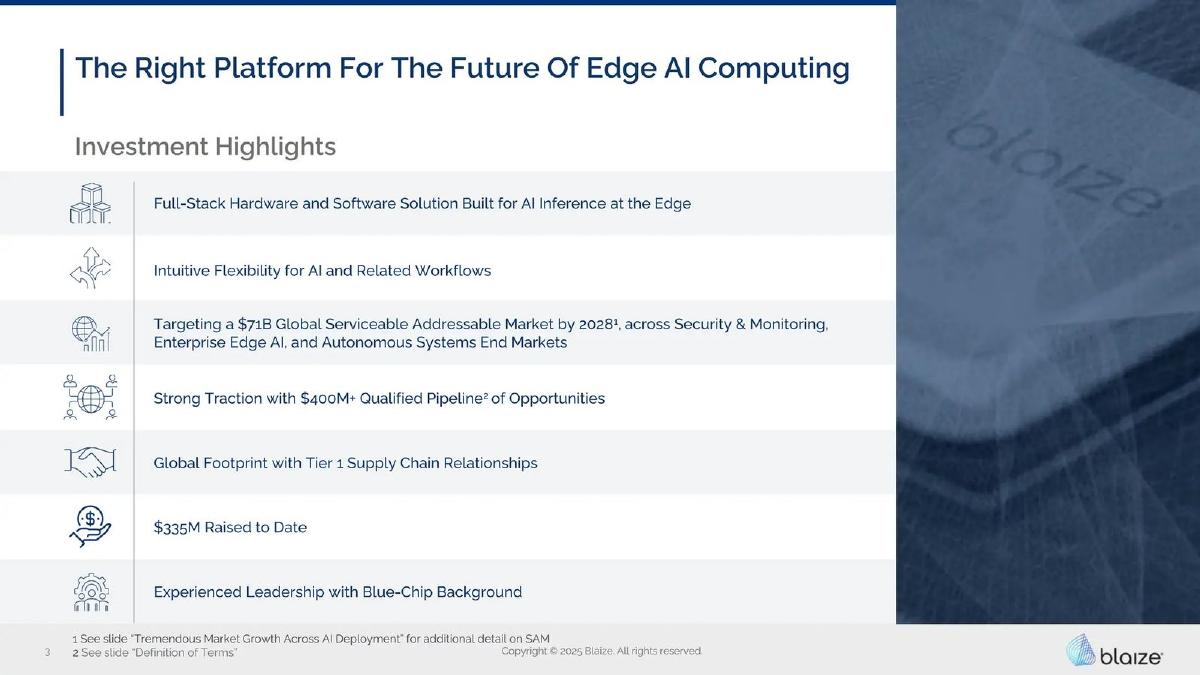
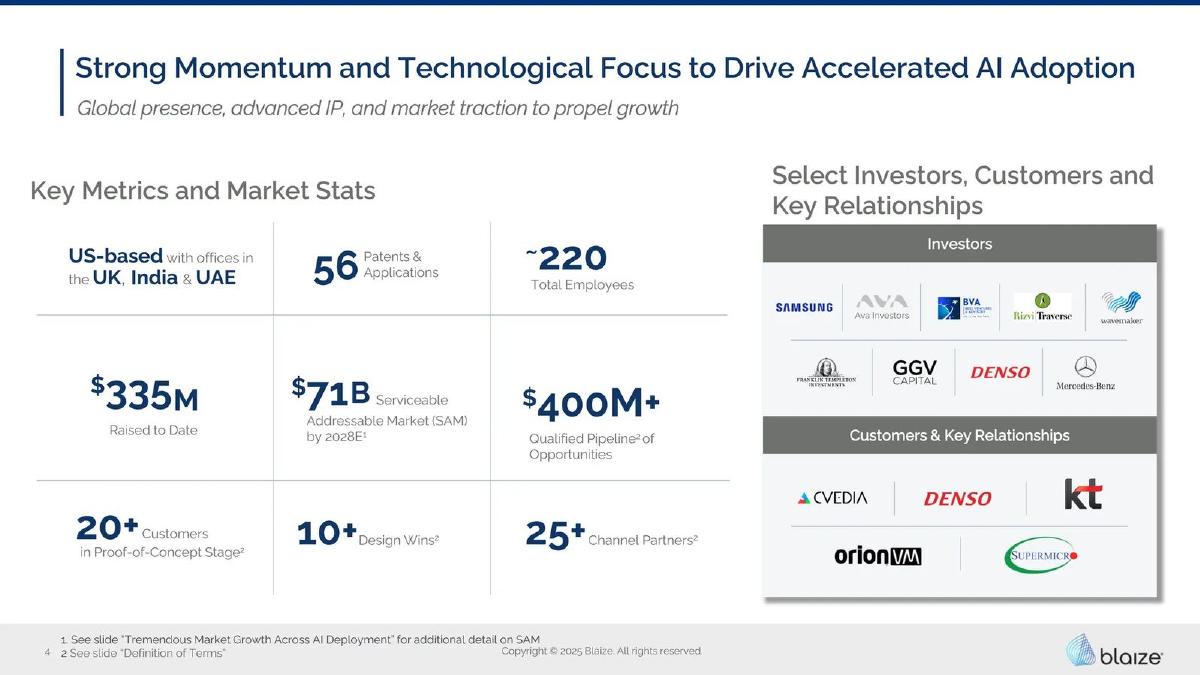
This is a high-density traction slide that establishes Blaize as a mature player. The company reports $335M Raised to Date and a $71B Serviceable Addressable Market (SAM) by 2028 . The slide lists 56 Patents & Applications and a workforce of approximately 220 total employees. Crucially, it quantifies the commercial pipeline at $400M+ in Qualified Opportunities , supported by 10+ Design Wins and 20+ customers in the Proof-of-Concept stage. The right side of the slide displays a 'who's who' of industrial and tech giants, including Samsung, Denso, Mercedes-Benz, and GGV Capital as investors, and Supermicro and KT as key relationships.
Performance Benchmarking and Technical Differentiation
Slide 7: Performance vs. GPU
Blaize uses this slide to directly challenge the industry-standard GPU. Using Blaize-performed benchmarking tests with YOLOv8, the company claims significant leads in four categories. Specifically, they cite a 2x improvement in Latency (measured in ms), a 3x improvement in TOPs Efficiency (FPS/TOP), a 2x improvement in Cost Efficiency (FPS/$1000), and a 2x improvement in Scalability (number of cameras per server). The visual representation uses simple bar charts to contrast a generic 'GPU' against the 'Blaize X1600P-Q'.
Slide 10: Solution Overview
This slide maps out the full-stack nature of the Blaize offering. It divides the business into four quadrants: Semiconductor Architecture (the BLZP1600-ENS chip), Accelerators and Platforms (Xplorer and Pathfinder modules), Software (SDK, AI Studio, and Picasso), and the Partner Ecosystem. The slide notes that this was 'Built Through over a Decade of R&D,' signaling that the company is past the experimental phase and into the commercialization phase.
Slide 13: Illustrative Case Study – Security and Monitoring
To ground the technical specs in reality, Blaize provides a case study for 'Full Field Asset Tracking.' The slide shows how the Pathfinder P1600 and Xplorer X600M integrate with cameras, radar, and drones to feed a centralized 'Command Center.' The benefits listed are specific: equipment health monitoring, anomaly optimization, safety compliance, and enhanced security. This slide is effective because it moves the conversation from 'chips' to 'solutions.'
Architecture and Software Ecosystem
Slide 16: Graph Streaming Processor Architecture
This is the most technical slide in the deck, explaining the 'New Breed of Architecture.' It contrasts 'Legacy Sequential Processing' (CPU/GPU) with the 'Blaize Graph Streaming Processor.' The diagram illustrates that while traditional architectures require high memory bandwidth to store data between tasks, the Blaize architecture allows data to stream directly to the next node. The slide claims this results in task-level parallelism and reduced power consumption , which is critical for edge use cases where power and cooling are limited.
Slide 19: Software Deployment Workflow
Blaize addresses the 'software wall' that often hinders hardware adoption. They segment their software into three tiers: the SDK for low-level engineers, Picasso for video analytics product owners, and AI Studio for 'non-coding users.' By targeting CXOs and data scientists with a no-code ML-Ops solution, Blaize attempts to broaden its user base beyond hardware specialists.
Global Footprint and Market Context
Slide 22: World Class Suppliers and Engineering Footprint
This slide emphasizes the company's operational maturity. It maps out a global presence with HQ in the US, core engineering in India, and a Middle East division. The 'Key Supplier Relationships' section is particularly strong, listing TSMC, Samsung, Synopsys, Plexus, and Cadence . A footnote specifies that USA silicon manufacturing is planned, likely a nod to recent geopolitical trends and the CHIPS Act.
Slide 25: Technology Inflection Point
This slide contextualizes Blaize within the current AI boom, specifically mentioning Qwen 2.5-Max and DeepSeek R1 . It argues that the industry is moving toward 'Mixture of Experts' (MoE) models and 'Low-Precision Datatypes'—trends that favor the efficiency and memory-handling capabilities of the Blaize architecture. This slide serves to prove that the company's decade-old R&D is perfectly timed for the current shift in AI model architecture.
Slide 28: Closing Slide
The deck concludes with the company logo and website. There is no specific 'Ask' slide or 'Use of Funds' slide included in this 10-slide sample, though the source listing indicates the full deck is 28 slides long.
What Works and What is Missing
What Works
Clear Technical Differentiation: The comparison between sequential processing and graph streaming (Slide 16) is a masterclass in explaining a complex hardware advantage simply. · Strong Social Proof: Mentioning Samsung, Denso, and Mercedes-Benz on the same slide as a $335M funding total (Slide 4) immediately establishes credibility. · Solution-Oriented Approach: By including case studies (Slide 13) and a tiered software stack (Slide 19), Blaize shows they understand that silicon alone doesn't solve customer problems.
What is Missing
Financial Performance: While the pipeline is mentioned, there is no mention of actual trailing revenue, gross margins, or burn rate in these slides. · The Ask: This sample does not include a slide detailing how much capital is being raised in this Q4 2024 round or what the specific milestones for that capital are. · Competitive Landscape: While they compare themselves to a generic 'GPU,' there is no mention of other edge-specific competitors like Hailo, Groq, or Tenstorrent. · Unit Economics: For a hardware company, the cost to manufacture vs. the sale price is a critical metric that is absent here.
Founder Takeaways
Founders in the deep-tech or semiconductor space should study how Blaize handles the 'Hardware vs. Software' narrative. Many hardware startups fail because they don't provide the tools for developers to actually use their chips. Blaize's Slide 19, which segments software by user type (Engineer vs. Product Owner vs. Data Scientist), is a strong model for showing how a company plans to achieve mass adoption. Additionally, the use of a 'Qualified Pipeline' metric (Slide 4) is a smart way for pre-revenue or early-revenue companies to signal commercial demand to late-stage investors.
Frequently asked questions
- What is the core technological advantage Blaize claims over competitors?
- Blaize relies on its proprietary Graph Streaming Processor (GSP) architecture. Unlike traditional CPUs or GPUs that use sequential processing and require high memory bandwidth to store data while tasks complete, the GSP allows data to stream through the device, sending it to the next node as soon as it is ready. According to slide 16, this task-level parallelism results in higher efficiency, lower power consumption, and reduced memory requirements.
- Who are Blaize's primary customers and partners?
- The deck lists several high-profile investors and partners on slide 4, including Samsung, Denso, Mercedes-Benz, and Franklin Templeton. Their customer base includes 20+ companies in the proof-of-concept stage and 10+ design wins. Slide 22 also highlights key supplier relationships with major semiconductor industry players like TSMC, Samsung, Synopsys, and Cadence.
- What specific hardware products does Blaize offer?
- Slide 10 and slide 13 detail the hardware lineup, which includes the Blaize Pathfinder P1600 Embedded System on Module and the Blaize Xplorer X600M M.2 SFF Accelerator Platform. These are designed for edge systems, ranging from small-form-factor modules for drones and cameras to larger accelerator platforms for command center servers.
- How does Blaize address the software side of AI deployment?
- Blaize offers a full-stack solution. As shown on slide 19, their software suite consists of a traditional SDK for hardware/software engineers, 'Picasso' for product owners focused on video analytics optimization, and 'AI Studio,' which provides end-to-end ML-Ops for data scientists and non-coding users. This tiered approach aims to lower the barrier to entry for deploying AI on their silicon.
- What is the current scale and reach of the company?
- As of late 2024, Blaize employs approximately 220 people across a global footprint. Slide 22 shows their HQ and architecture teams are based in the US, while core engineering is located in India, and a dedicated AI Middle East division operates in the UAE. They also have a presence in the UK for auto and systems engineering.