BitRush positions itself as a diversified player in the 2015-era digital economy, moving beyond simple Bitcoin transactions into what it calls 'CryptoBusiness.' The deck outlines a three-tier strategy: a consumer-facing portal (BitRush.Land), a core technology framework (BitCore), and an incubator (Start-it). A significant portion of the presentation is dedicated to 'Project JokerTimes,' a gaming site that reportedly reached nearly 400,000 unique users and 5.7 million pageviews between March and June 2015. The fundraising ask is specific, seeking CAD 1 million through a private placement of 1…
Key takeaways
- The company defines its mission as inventing 'CryptoBusiness,' targeting a transition from fiat to distributed digital economies (Slide 2).
- Bitcoin market data from March 2015 shows a 78x year-over-year increase in merchant annual revenue to $180 billion (Slide 3).
- The core team includes a former CEO of the Vienna Stock Exchange and a former partner at Ernst & Young (Slide 4).
- The business model is explicitly compared to Amazon, with BitRush.Land serving as the 'Retail' arm and Start-it as the 'AWS' equivalent (Slide 5).
- Project JokerTimes achieved a bounce rate of 17.12% and an average session duration of 2:34 over a three-month period in 2015 (Slide 6).
- Revenue projections shift from advertising in 2014-2015 to service fees in 2016 and investment revenues by 2018 (Slide 7).
- The private placement offer seeks up to CAD 1 million, representing 8% of fully diluted capital (Slide 8).
- Post-acquisition of MezzaCap, the cap table shows MezzaCap holding 68% of shares before the new placement (Slide 8).
Executive Summary: The CryptoBusiness Vision
BitRush Corporation presents a deck that is very much a product of the 2015 cryptocurrency landscape. At a time when Bitcoin was primarily viewed through the lens of currency replacement, BitRush attempted to broaden the scope to 'CryptoBusiness.' The deck moves from high-level macroeconomic theory to specific website analytics and finally to a detailed private placement offer. It is a dense presentation that attempts to justify a CAD 1 million raise by showcasing a diversified ecosystem of technology, entertainment, and venture incubation.
Slide 1: Title and Identity
The cover slide establishes the brand with a large 'B' logo and the tagline 'We invent CryptoBusiness.' It lists two corporate addresses: one in Toronto, Canada, and one in Vienna, Austria. This dual-location presence aligns with the team's background, which is heavily rooted in European finance. The URL www.bitrush.co is prominently displayed, signaling a digital-first approach.
Slide 2: Macro Thesis - The Digital Economy
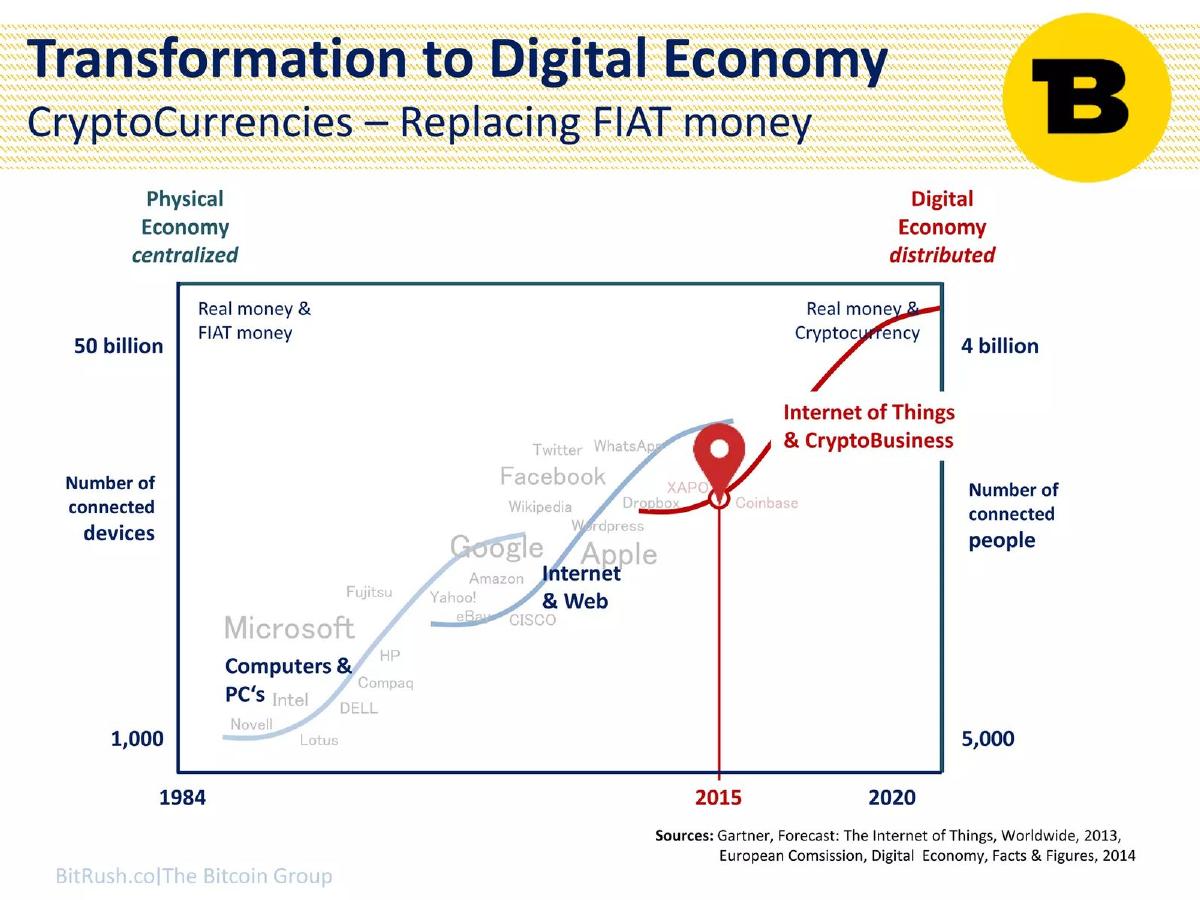
Slide 2 provides the 'Why Now' justification. It charts the 'Transformation to Digital Economy,' contrasting the centralized physical economy with a distributed digital one. The slide uses a timeline starting in 1984, moving through the PC era (Microsoft, Intel), the Internet era (Google, Amazon, Facebook), and landing on 2015 as the tipping point for the 'Internet of Things & CryptoBusiness.' It cites Gartner and the European Commission to support its claim that connected devices will reach 50 billion by 2020, while connected people will reach 4 billion. The red pin on the chart marks 2015 as the start of the 'Real money & Cryptocurrency' era.
Slide 3: The Bitcoin Market Landscape
This slide serves as a market validation tool, providing a snapshot of the Bitcoin ecosystem as of March 2015. Key metrics include:
Wallets: 8,457,207 (a 2x increase over 12 months). · Merchants: 100,000 (a 2x increase over 12 months). · Merchants' Annual Revenue: $180 billion (a 78x increase from $2 billion in March 2014). · VC Investment: $676 million all-time, representing a 4x increase over the previous year.
The inclusion of 'Github no. of updated repositories' (27,857) is a notable addition, signaling that the founders are paying attention to developer activity as a leading indicator of market health.
Slide 4: The Core Team
The team slide is a strong point for BitRush, emphasizing 'experienced and passionate people.' The biographies highlight institutional credibility:
Peter Lukesch (CEO): Former metals trader and public company board member. · Elfriede Sixt (Corporate Adviser): Former Ernst & Young partner and founder of the FinTech Austria Association. · Stefan Zapotocky (Corporate Finance): 34 years in finance, including 6 years as CEO of the Vienna Stock Exchange. · Joachim Kalcher (CTO): PhD in informatics and experienced tech entrepreneur.
The presence of Werner Boehm and Fred Dobias, both described as serial entrepreneurs and early Bitcoin investors, rounds out a team that looks more like a private equity firm than a typical 2015 crypto startup.
Slide 5: The Business Model Architecture
Slide 5 attempts to explain the company's structure using an Amazon analogy. The model is built on three layers:
Start-it (Incubator Platform): Described as the 'Amazon Web Services' equivalent, this layer houses entertainment and payment startups. · BitCore Technology Framework: The middle layer facilitating payments and gaming. · BitRush.Land (Portal): The 'Amazon Retail' equivalent, delivering entertainment and payment services to the end user.
This 'proven business model' slide is ambitious, suggesting that BitRush is simultaneously a platform, a service provider, and a venture studio.
Slide 6: Traction - Project JokerTimes
This is the 'meat' of the deck, providing Google Analytics data for their primary project, JokerTimes, from March to June 2015. The stats are impressive for a three-month window:
Unique Users: 394,210. · Pageviews: 5,717,217. · Average Session Duration: 02:34. · Bounce Rate: 17.12%.
The slide also includes a real-time user count of 206 and a geographic breakdown showing heavy usage in Italy (36%) and Russia (17%). The company estimates the valuation of this single project at USD 3-5 million based on a metric of $30-$50 per registered user.
Slide 7: Revenue Evolution
The revenue roadmap is a standard 'up and to the right' chart, but it breaks down the sources of income by year:
2014-2015: Advertising revenues from traffic-generating websites. · 2016-2017: Service and fee revenues from a growing user base and the Start-it platform. · 2018-2019: Investment revenues from successful exits or dividends from incubated startups.
This indicates a shift from a high-volume traffic model to a high-value financial services and investment model.
Slide 8: The Ask - Private Placement Offer
The final slide in this set is the most technical. It details the capitalization before the private placement, noting that 83.3 million shares were issued for the acquisition of MezzaCap. The new offer seeks to raise CAD 1 million by issuing 10 million shares at CAD 0.10. The cap table pie chart shows that post-acquisition but pre-placement, MezzaCap holds 68% of the company, while 'Old Shareholders' hold 20%. The new placement represents an 8% dilution of the fully diluted capital.
What BitRush Does Well
The deck excels at establishing institutional credibility . By listing a former Stock Exchange CEO and an EY partner, BitRush separates itself from the 'hobbyist' reputation that plagued many early crypto projects. The use of specific, third-party verified data (Google Analytics, Alexa rankings, and Gartner reports) provides a level of transparency that investors appreciate. Furthermore, the Amazon analogy on Slide 5 is a clever way to explain a complex, multi-faceted business model to investors who might not understand the nuances of blockchain technology but do understand the value of infrastructure versus retail.
What is Missing from the Deck
Despite the detailed traffic stats, the deck is missing unit economics . We see how many users they have, but not how much it costs to acquire them (CAC) or what the lifetime value (LTV) of a Bitcoin gamer is. There is also a lack of competitive analysis . In 2015, the Bitcoin gaming and payment space was becoming crowded, yet BitRush presents its model in a vacuum. Finally, the technical architecture of 'BitCore' is left as a black box; for a company claiming to 'invent CryptoBusiness,' more detail on the underlying technology would have been beneficial for technical due diligence.
Founder's Playbook: Lessons to Copy
Founders should take note of Slide 6's transparency with analytics . Instead of just saying 'we have a lot of traffic,' BitRush included screenshots of Google Analytics, including session duration and bounce rates. This builds immediate trust. Additionally, the phased revenue roadmap on Slide 7 is a great way to show a long-term vision that starts with a realistic, immediate income stream (advertising) before moving into more speculative areas (investment returns). Finally, the clear capitalization breakdown on Slide 8 is a best practice; being upfront about share counts and finders' fees prevents surprises during the closing process.
Frequently asked questions
- What is the primary product BitRush is pitching?
- BitRush pitches a multi-layered ecosystem rather than a single product. This includes 'BitCore,' a technology framework for payments and gaming; 'BitRush.Land,' a portal for entertainment services; and 'Start-it,' an incubator for other startups. The most tangible asset shown is 'JokerTimes,' a Bitcoin-based gaming and entertainment website that serves as their initial traffic generator.
- How does BitRush plan to generate revenue?
- The revenue strategy is phased over five years. Initially, the company relies on advertising revenue from traffic-generating websites. By 2016, they plan to introduce fee-based web offers and merchandising. The long-term goal (2018-2019) is to generate service fees from their incubator platform and eventually realize investment returns from the startups they nurture.
- What are the specific terms of the investment round?
- The deck outlines a 'Private Placement Offer' for 10 million shares at a price of CAD 0.10 per share. This includes full warrants also priced at CAD 0.10. The total proceeds sought are up to CAD 1 million, which would represent approximately 8% of the company's fully diluted capital at the time of the presentation.
- What traction does the company demonstrate?
- Traction is centered on 'Project JokerTimes.' Between March and June 2015, the site recorded 2,246,208 sessions and 394,210 unique users. The deck also highlights a low bounce rate of 17.12% and a global reach, with 36% of real-time users coming from Italy and 17% from Russia at the time of the screenshot.
- Who is behind BitRush?
- The team is composed of seasoned professionals from finance and technology. Key members include CEO Peter Lukesch (former metals trader and public company board member), Stefan Zapotocky (former CEO of the Vienna Stock Exchange), and Elfriede Sixt (former EY partner). This suggests a 'gray-haired' management approach to the volatile crypto sector.