Simpolium’s 10-slide deck focuses on Cityscape Pro, a plug-in for Autodesk 3ds Max designed to automate the time-consuming process of 3D urban modeling. The deck excels at identifying a specific pain point—the manual labor involved in architectural visualization—and claims a 40% reduction in production time. While the product utility is clear and supported by a list of international customers and a 500 Startups Georgia background, the deck lacks critical financial data. There is no mention of current revenue, specific funding requirements, or detailed unit economics. It functions more as a pr…
Key takeaways
- The product, Cityscape Pro, claims to save 40% of production time in the archviz and 3D animation industry (Slide 3).
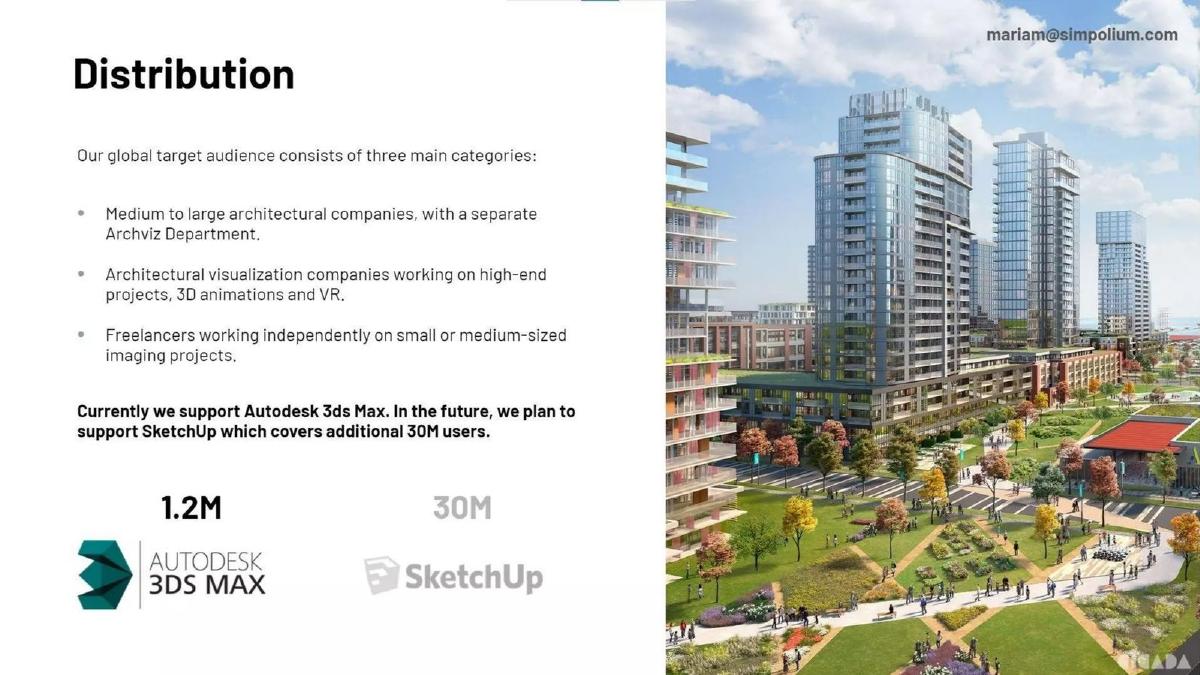
- The distribution strategy targets 1.2 million Autodesk 3ds Max users with plans to expand to 30 million SketchUp users (Slide 5).
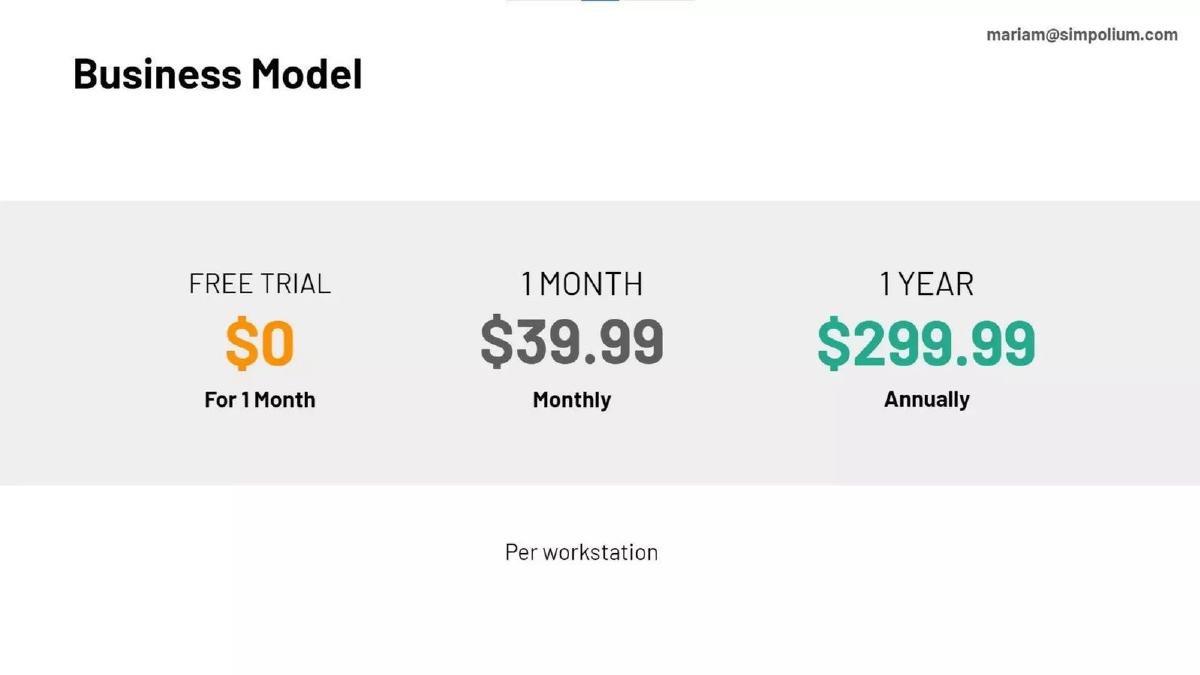
- The business model is a per-workstation subscription priced at $39.99 monthly or $299.99 annually (Slide 6).
- Simpolium was a Top 10 startup in the 500 Startups Georgia program between 2020 and 2021 (Slide 7).
- The company secured pre-seed funding from two Georgian investors and a grant from Georgia’s Innovation and Technology Agency in 2021 (Slide 7).
- The deck lists 14 customer logos, including SmartCentres REIT, Diamond Schmitt, and DLR Group (Slide 8).
- The founding team consists of a Software Engineer and a 3D Artist, providing a balanced technical and domain-expert perspective (Slide 9).
- The deck completely omits a specific 'Ask' slide, leaving the desired funding amount and use of proceeds unknown.
The Simpolium Pitch Deck: A Product-First Approach to ArchViz
Simpolium’s pitch deck is a concise, 10-slide presentation focused on Cityscape Pro, a parametric modeling tool for urban environments. The deck is visually clean and leans heavily on the product's ability to solve a very specific, high-friction problem for 3D artists and architects. While it succeeds in demonstrating product-market fit within a niche, it falls short of providing the financial depth typically required for a late-seed or Series A round.
The Hook: Problem and Solution
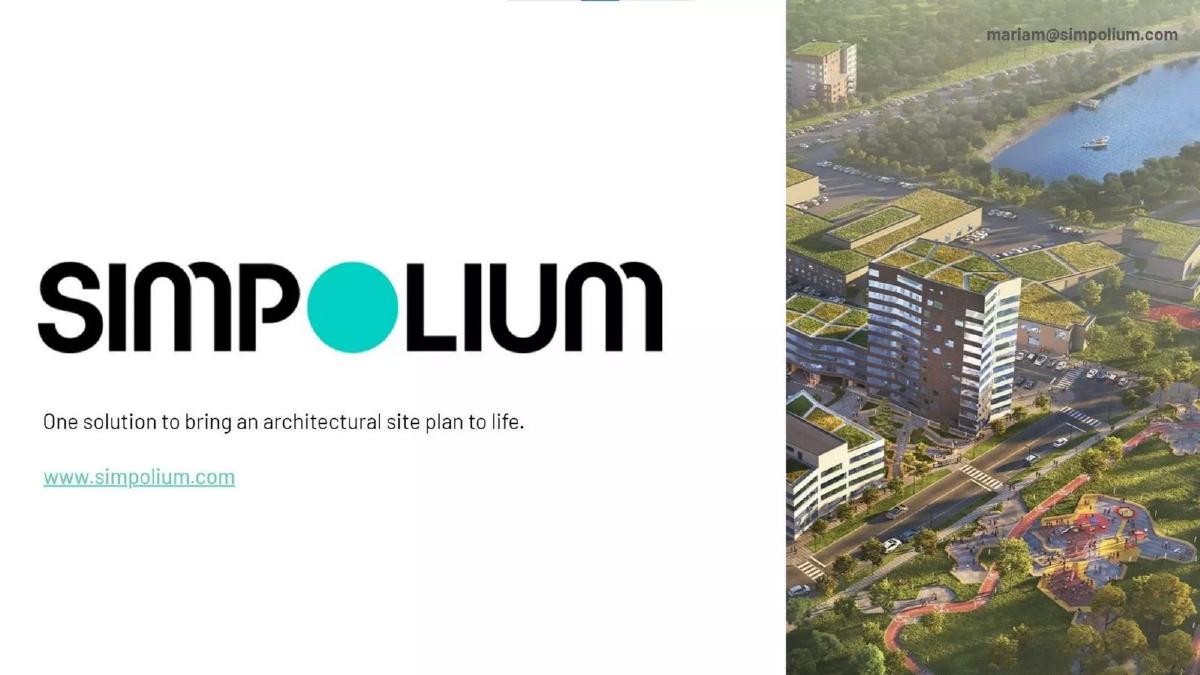
Slide 1: Title Slide The deck opens with the Simpolium logo and the tagline: "One solution to bring an architectural site plan to life." The inclusion of a high-quality architectural render on the right side immediately establishes the industry context. A contact email for 'mariam@simpolium.com' is present in the top right corner, a detail maintained throughout the deck.
Slide 2: Problem The problem is broken down into three pillars: the time-consuming nature of 3D modeling, the high level of expertise required, and the complication caused by frequent project changes. This is a standard but effective way to frame the 'pain' for architectural visualization (ArchViz) professionals.
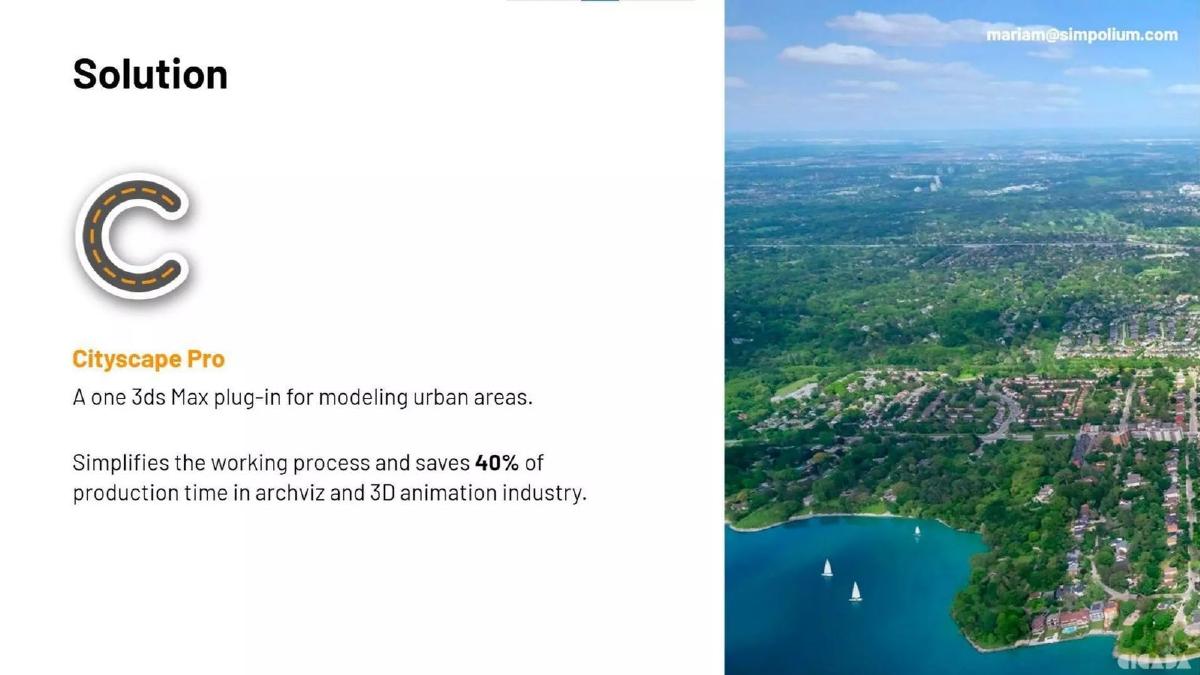
Slide 3: Solution The solution is introduced as Cityscape Pro, a plug-in for Autodesk 3ds Max. The key metric here is the claim that it "saves 40% of production time in archviz and 3D animation industry." For a software tool, a 40% efficiency gain is a compelling value proposition, though the deck does not provide the data or case study to back up this specific percentage on this slide.
Product Mechanics and Market Reach
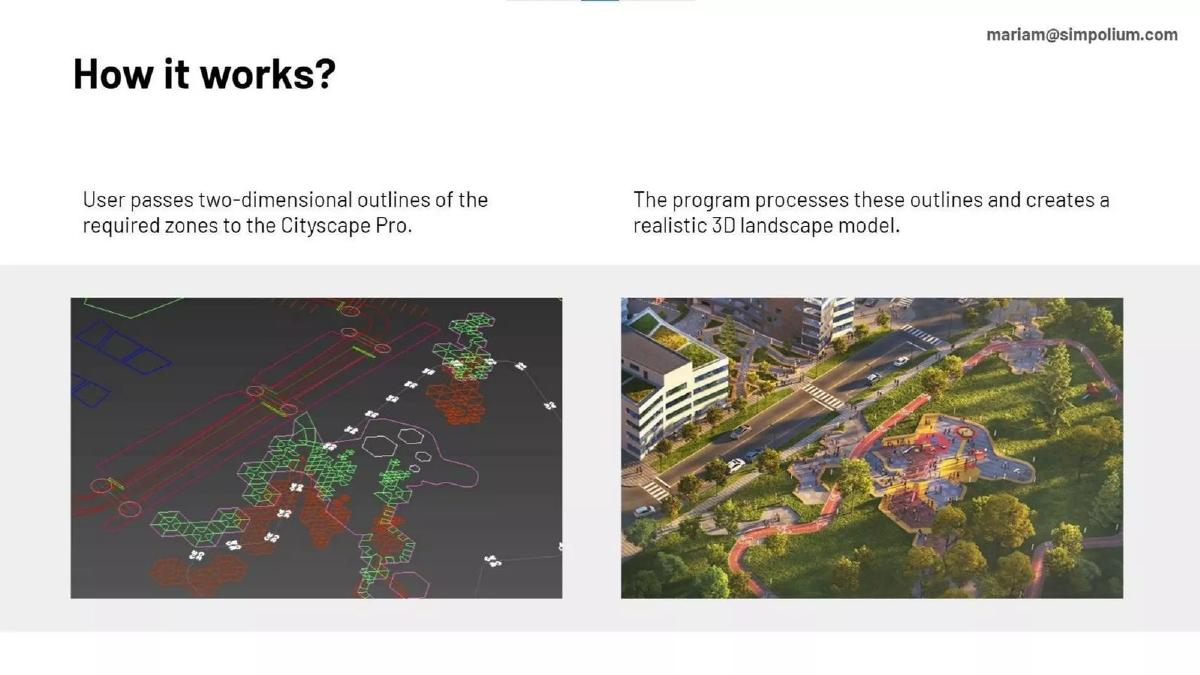
Slide 4: How it works? This slide provides a visual comparison between 2D outlines and the resulting 3D landscape model. It explains that the program processes 2D outlines to create realistic models. This is crucial for technical investors to understand that the software is an automation layer rather than a standalone modeling suite.
Slide 5: Distribution Simpolium identifies three target categories: large architectural companies with ArchViz departments, specialized visualization companies, and independent freelancers. The slide highlights a current market of 1.2 million Autodesk 3ds Max users and a future target of 30 million SketchUp users. This 25x expansion opportunity is the deck's primary indicator of scale.
Business Model and Traction
Slide 6: Business Model The pricing is straightforward: a 1-month free trial, followed by $39.99 monthly or $299.99 annually per workstation. This SaaS model is standard for the industry, though the deck does not specify if these are current prices or projected ones. The absence of a 'Pro' or 'Enterprise' tier for the large architectural companies mentioned in the previous slide is a notable omission.
Slide 7: Timeline This slide provides the company's pedigree. Key milestones include the June 2020 launch, being featured on the Autodesk App Store in November 2020, and participating in 500 Startups Georgia (Top 10) through 2021. It also mentions pre-seed funding from two Georgian investors and a government grant. This establishes that the company has already passed through initial professional vetting.
Slide 8: Customers A logo wall features 14 companies from the US, Canada, Australia, and Europe. Notable names include SmartCentres REIT and DLR Group. This slide serves as the primary evidence of global demand and product utility across different scales of firms.
The Team and Closing
Slide 9: Team The team slide features two co-founders: Mariam Japaridze (Software Engineer) and Sandro Japaridze (3D Artist). This duo represents the classic 'builder and user' pairing, which is highly regarded in early-stage investing. However, the slide lacks any professional history, previous companies, or educational background for either founder.
Slide 10: Closing The final slide repeats the logo and contact information with the phrase "Unlock the full creative potential." It is a standard exit slide that offers no new information.
What Works in the Simpolium Deck
The deck is exceptionally clear about what the product does and who it is for. By focusing on a specific plug-in for a specific piece of software (3ds Max), the founders avoid the trap of being too broad. The 40% time-saving claim (Slide 3) is a powerful anchor for the entire pitch. Furthermore, the inclusion of the 500 Startups logo and the list of international customers (Slide 8) provides immediate credibility that the software is functional and market-ready.
What is Missing from the Simpolium Deck
The most glaring omission is the Ask . There is no slide indicating how much money the company is looking to raise, the valuation they are seeking, or how they intend to spend the capital. Additionally, the deck lacks any financial performance data . While they show a pricing model, they do not show how many paying users they currently have or what their growth trajectory looks like. The Team slide is also thin on details; investors generally want to see the specific pedigree (e.g., "10 years at Autodesk" or "CS degree from X") that qualifies the founders to build this specific tool. Finally, there is no Competitive Landscape slide. While Cityscape Pro is a plug-in, it competes with manual labor and potentially other automation scripts or built-in software features, none of which are addressed.
What a Founder Should Copy
Founders building technical tools should copy the "How it works" visualization on Slide 4. It clearly shows the input (2D lines) and the output (3D render), making the value of the automation instantly recognizable even to a non-technical investor. The Distribution slide (Slide 5) is also a good example of how to show a "Land and Expand" strategy—starting with a smaller, highly professional user base (3ds Max) before moving into a much larger, more general market (SketchUp). This shows a logical progression for growth rather than just claiming a massive Total Addressable Market (TAM) from day one.
Final Analysis
Simpolium has built a deck that functions well as a product overview but lacks the 'business' components of a fundraising deck. It proves the product works and people buy it, but it fails to explain why an investor should put money in now and what that money will achieve. For a seed-stage company, this deck would likely serve as a 'teaser' to get a meeting, but a much more robust financial and strategic supplement would be required to close a round.
Frequently asked questions
- What is the core problem Simpolium addresses?
- According to slide 2, 3D modeling of complex urban areas is a time-consuming process that requires high expertise. The workflow is further complicated by the frequent changes inherent in architectural projects, which usually necessitate manual rework.
- How does the Cityscape Pro software actually function?
- Slide 4 explains that the user passes two-dimensional outlines of required zones into the software. The program then processes these outlines to automatically generate a realistic 3D landscape model, effectively turning 2D site plans into 3D environments.
- What is the current market reach and future expansion plan?
- Slide 5 notes that they currently support Autodesk 3ds Max, which has 1.2 million users. Their primary growth strategy involves expanding support to SketchUp, which they claim covers an additional 30 million users.
- What evidence of market validation does the deck provide?
- Validation is shown through three channels: participation in 500 Startups Georgia, being a 'Featured Paid Plugin' on the Autodesk App Store, and a customer list featuring firms from the US, Canada, Australia, and Europe (Slides 7 and 8).
- What financial information is missing from the deck?
- The deck is missing almost all standard financial metrics. There is no mention of Monthly Recurring Revenue (MRR), Customer Acquisition Cost (CAC), Lifetime Value (LTV), or historical growth rates. Most importantly, it lacks a slide detailing how much capital they are raising.