SI Pay presents a vision for a 'cutting edge' UPI application that addresses the credit gap in India's digital payment ecosystem. The deck outlines a strategy to capture 50% of a 400 million user Serviceable Obtainable Market (SOM) by 2030, specifically targeting college students and residents of Tier 2 and 3 cities. The core value proposition centers on a 'Borrow to Pay' feature that provides instant micro-loans for transactions, allegedly secured by blockchain technology. While the deck provides ambitious market projections—including a $2.5 trillion market value for UPI by 2030—it lacks cri…
Key takeaways
- The company projects the Total Addressable Market (TAM) for UPI payments to reach 1.1 billion downloads by 2030 (Slide 03).
- SI Pay aims to secure 200 million users by 2030, representing 50% of their identified SAM (Slide 03).
- The primary product innovation is a 'Borrow to Pay' feature providing instant micro-loans for UPI transactions (Slide 07).
- Geographic focus is strictly on Tier 2 and Tier 3 cities in India to boost financial inclusion (Slide 09).
- Market size data estimates 2 billion transactions per day and 800 million users in the Indian market by 2030 (Slide 11).
- The deck claims blockchain technology will provide transparency and security not available in current UPI applications (Slide 13).
- The roadmap targets 10 million users by April 2025 and 50 million users by July 2025 (Slide 15).
- The deck omits a team slide, financial projections, and a specific funding amount requested from investors.
Slide-by-Slide Analysis
Slide 1: Title and Vision
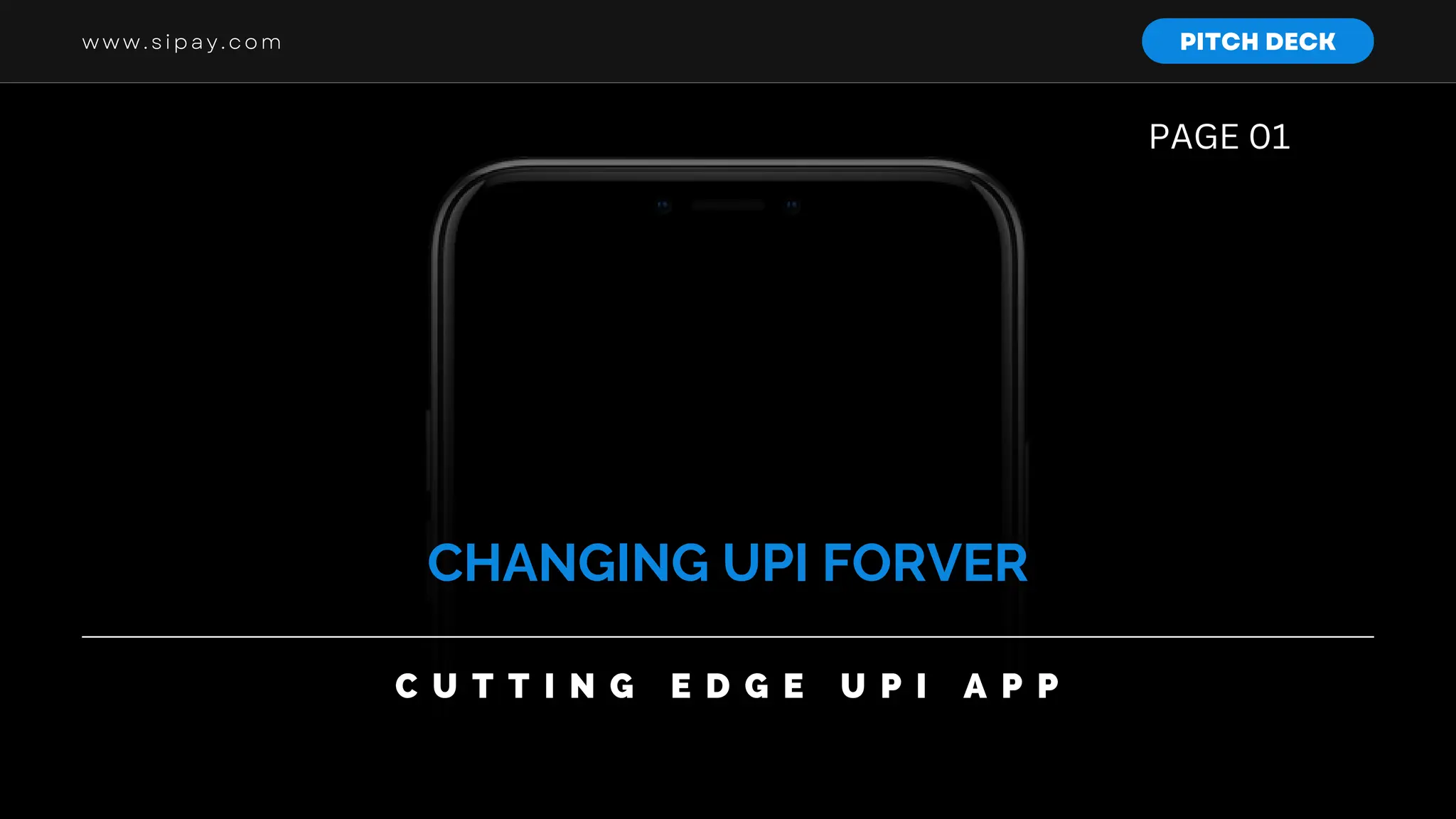
The deck opens with a high-contrast black and blue design featuring a smartphone silhouette. The headline 'CHANGING UPI FORVER' (note the misspelling of 'forever') is paired with the sub-headline 'CUTTING EDGE UPI APP.' The slide includes the company URL (www.sipay.com) and identifies itself as 'Page 01.' It establishes the sector immediately: Indian fintech via the Unified Payments Interface (UPI).
Slide 3: Market Opportunity (TAM/SOM/SON)
This slide uses a bar chart and concentric circles to define the market scale. It projects that by 2030, the Total Addressable Market (TAM) for UPI payments could reach 1.1 billion downloads. The Serviceable Obtainable Market (SOM) is defined as 400 million smartphone users in 2024, expected to grow to 1.1 billion by 2030. The 'SON' (likely a typo for SOM or SAM) targets 200 million users by 2030, which the slide notes is roughly 50% of the current SAM. The current user base is visually represented as 400 million against a 'remaining' potential of over 1 billion.
Slide 5: Problem Statement
SI Pay identifies four core problems in the current market: Problem 1: Urgent Financial Needs, specifically for lower-income categories unable to borrow. Problem 2: Security, noting the rise of 'FRAUD & SCAM' alongside transaction growth. Problem 3: Financial Literacy, stating that since India is 'not being a fully educated country,' literacy is a vital form of education. Problem 4: Payback, highlighting that informal loans from friends and colleagues often go unattended. The slide uses 3D character assets common in modern template designs.
Slide 7: Services and Micro-Merchant Integration
This slide details the 'Thynk Unlimited' service suite. It highlights two primary services: 'Borrow to Pay' for immediate financial needs and 'Recharge' for mobile and utility bills. The right side of the slide lists 'Micro Merchant' categories the app intends to serve, including Doctor Appointment, Electrician, Personal Tutor, Labour, Chef Booking, Maid Booking, Plumber, Marketing Agent, and Library Seat Booking. It also mentions a 'Normal UPI App' function and 'Trading.'
Slide 9: Target Market
Presented by Rushiraj Korde, this slide narrows the focus to Tier 2 and Tier 3 cities in India. The text emphasizes 'digital payment accessibility and financial inclusion.' It reiterates the 'Borrow to Pay' feature and introduces 'blockchain-powered security' as a key differentiator. The two primary personas identified are 'Target TIER 2 & 3' and 'College student.'
Slide 11: Market Size Projections
This slide provides specific macro-economic targets for the year 2030. It projects 800 million users, 2 billion transactions per day, and a total market value of $2.5 trillion. The text attributes this growth to increased smartphone usage, government initiatives, and the shift toward a digital economy.
Slide 13: Competitive Advantage
Under the heading 'WHY WE ARE BETTER?', the company lists three pillars: Opportunity: Using blockchain to appeal to tech-savvy young adults and SMEs. Market Size: Citing the explosive growth of UPI. Unique Then Competitor: (likely 'Unique Than Competitors') Specifically naming the 'Borrow to Pay' feature integrated with blockchain as a unique proposition not available in current UPI applications like PhonePe or Google Pay (though those competitors are not named explicitly).
Slide 15: Future Roadmap
The roadmap outlines a four-step execution plan. Step 1 (July to October 2024) focuses on app development and launching with a third-party partner. Step 2 (December 2024-25) involves marketing and the process for obtaining an independent license. Step 3 (April 2025) sets a target of 10 million users. Step 4 (Q4 2025/July) aims for 50 million users and having their 'own licence in hand.'
Slide 17: Contact Information
The final slide invites investors to join the 'fintech revolution.' It provides a contact email (rushirajkorde33@gmail.com) and a phone number. The text emphasizes the 'transformative movement' of redefining digital payments in India.
What SI Pay Does Well
The deck identifies a very specific and massive pain point in the Indian market: the lack of formal credit for the 'next billion' users in Tier 2 and 3 cities. By anchoring the product to UPI—a system that already has massive consumer trust and adoption—the friction for user acquisition is theoretically lowered. The focus on micro-merchants (plumbers, maids, tutors) suggests a strategy to capture the informal economy, which is a significant portion of India's GDP. The market data provided on Slide 11 is grounded in widely accepted industry projections for the growth of digital payments in the region.
What is Missing from the Deck
The most glaring omission is the Team Slide . In early-stage fintech, especially one involving blockchain and lending licenses, the pedigree of the founders is the most important factor for investors. There is no mention of previous experience in banking, compliance, or software engineering. Furthermore, the deck lacks a Financial Ask . It does not state how much money is being raised or how that capital will be allocated. Unit Economics are also absent; there is no explanation of how the 'Borrow to Pay' feature makes money (interest rates vs. transaction fees) or how the company will manage credit risk and defaults. Finally, the Blockchain Implementation is mentioned as a buzzword but never explained technically, which is a red flag for sophisticated investors.
Founder Takeaways
Focus on the 'Why Now': SI Pay successfully argues that the explosion of UPI creates a secondary need for credit. Founders should always link their product to a massive, existing behavioral shift. Define Your Geography: By explicitly targeting Tier 2 and 3 cities, SI Pay avoids a direct 'head-to-head' comparison with urban-focused giants in the initial pitch phase. Professionalism Matters: Typos like 'FORVER' (Slide 01), 'eduation' (Slide 05), and 'Transcations' (Slide 11) significantly undermine the credibility of a company asking to handle financial transactions and blockchain security. Roadmap Clarity: The roadmap on Slide 15 is a good example of how to show a transition from a 'lean' start (using a third-party partner) to a 'full-stack' finish (obtaining their own license). This shows a realistic understanding of regulatory hurdles in fintech.
Frequently asked questions
- What is SI Pay's core product?
- SI Pay is a UPI-based mobile application that integrates a 'Borrow to Pay' feature. This allows users to access instant micro-loans directly within the payment flow to cover immediate financial needs. The company also lists services for micro-merchants, such as booking systems for doctors, electricians, and tutors, alongside standard utility recharges.
- Who is the target audience for this fintech solution?
- The deck identifies two primary target segments: residents of Tier 2 and Tier 3 cities in India and college students. The goal is to provide digital payment accessibility and credit to lower-income categories who are currently unable to borrow through traditional channels.
- How does SI Pay plan to use blockchain technology?
- According to the slides, blockchain is used to power the 'Borrow to Pay' model. The company claims this technology enhances security, transparency, and efficiency for micro-loans. However, the deck does not specify which blockchain protocol is used or how it interacts with the centralized UPI switch.
- What are the major milestones on the company's roadmap?
- The roadmap is divided into four steps: Step 1 (July-Oct 2024) involves app development and a third-party launch; Step 2 (Dec 2024-25) focuses on marketing and applying for an independent license; Step 3 (April 2025) targets 10 million users; and Step 4 (July 2025) aims for 50 million users with their own license in hand.
- What critical information is missing from the SI Pay deck?
- The deck is missing several standard venture capital requirements. There is no slide detailing the founding team's background, no breakdown of the business model or unit economics (interest rates, take rates), no competitive landscape analysis beyond a general mention of 'current UPI applications,' and no specific funding 'ask' or use of funds.