Tesla's early investor deck was not selling a garage dream. With the Roadster already on the road, its job was to de-risk the far more ambitious Model S and justify the capital needed to scale.
Key takeaways
- De-risk through validation, not just vision. Tesla dedicates three full slides to its paying partnerships with automotive giants Toyota, Panasonic, and Daimler, turning potential competitors into investors and customers.
- Show, don't just tell, your team's strength. The team slide explicitly merges 'Silicon Valley' and 'Auto' talent, showcasing a roster of executives that directly address the dual challenges of software/hardware innovation and industrial manufacturing.
- Traction is multi-faceted. Tesla presents revenue from OEM contracts, strategic investment from partners, pre-order deposits for a future product, and team growth metrics, creating a comprehensive picture of momentum.
- Lead with a tangible vision for the next step. The deck centers on the Model S—a specific, ambitious, and well-defined product—rather than a vague promise of an electric future.
- Turn operational hurdles into strategic assets. The acquisition of the Fremont factory is framed not as a cost center, but as a massive, undervalued strategic asset that enables their production roadmap.
- The narrative is about execution. The deck is heavily weighted toward progress updates, milestones hit, and the physical build-out of teams and facilities, assuring investors that this complex plan is already in motion.
- Even great decks have gaps. This presentation lacks explicit financial projections, a competitive analysis, and a clear 'Ask' slide, suggesting it was likely part of a broader roadshow or accompanied by significant verbal context.
Introduction
This early Tesla Motors investor presentation is a fascinating document. Likely created around late 2010 or early 2011, it sits at a pivotal moment in the company’s history. The initial proof-of-concept, the Roadster, is on the road, but the company’s survival and future hinge on its ability to execute the far more ambitious Model S. This is not a deck selling a dream from a garage; it’s a deck from a company in the trenches, trying to raise capital to scale from a niche manufacturer to a major automotive player.
The deck’s primary function is to de-risk what is, on its face, a spectacularly risky venture: building a new car company from scratch. Every slide is a brick in a wall of evidence designed to convince investors that Tesla has the team, the technology, the partners, the initial demand, and the manufacturing plan to pull it off. It is operationally dense, focusing more on tangible progress than on grand, abstract market slides. For founders in capital-intensive, hard-tech industries, this deck is a lesson in building credibility one metric at a time.
The Team: A Strategic Fusion
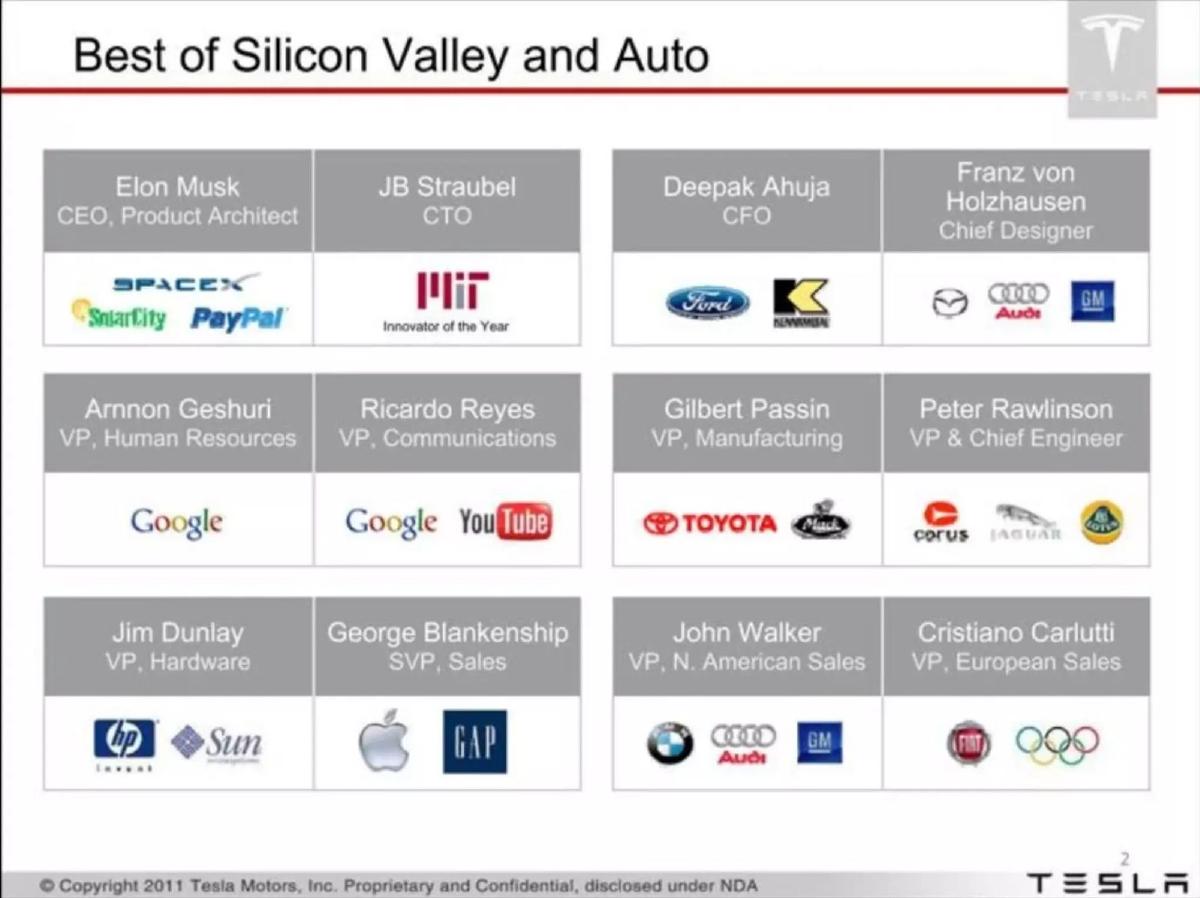
The presentation opens immediately after the cover with a slide titled “Best of Silicon Valley & Auto.” This is not just a team slide; it's a mission statement. Tesla’s core hypothesis was that an electric car company needed to be a masterful blend of software/hardware engineering and industrial manufacturing. This slide is the proof.
It presents two rows of senior executives, a veritable murderer's row of talent. The top row features names that would become legendary: Elon Musk (CEO - Product Architect), JB Straubel (CTO), and Deepak Ahuja (CFO). These leaders represent the core pillars: product vision, technology, and finance. The second row reinforces the first, bringing in specialists like Franz Von Holzhausen (Chief Designer, ex-Mazda), Gilbert Passin (VP - Manufacturing, ex-Toyota), and Peter Rawlinson (VP & Chief Engineer, ex-Lotus/Jaguar).
What an investor sees here is a purpose-built team. They didn’t just hire smart engineers; they hired a chief designer from a respected automaker, a VP of Manufacturing from the company that literally wrote the book on efficient production (Toyota), and a Chief Engineer with deep experience in high-performance vehicles. Every major risk category an investor could imagine—Can they design a beautiful car? Can they build it at scale? Can they make it perform well?—has a world-class name assigned to it. This approach preemptively answers dozens of diligence questions.
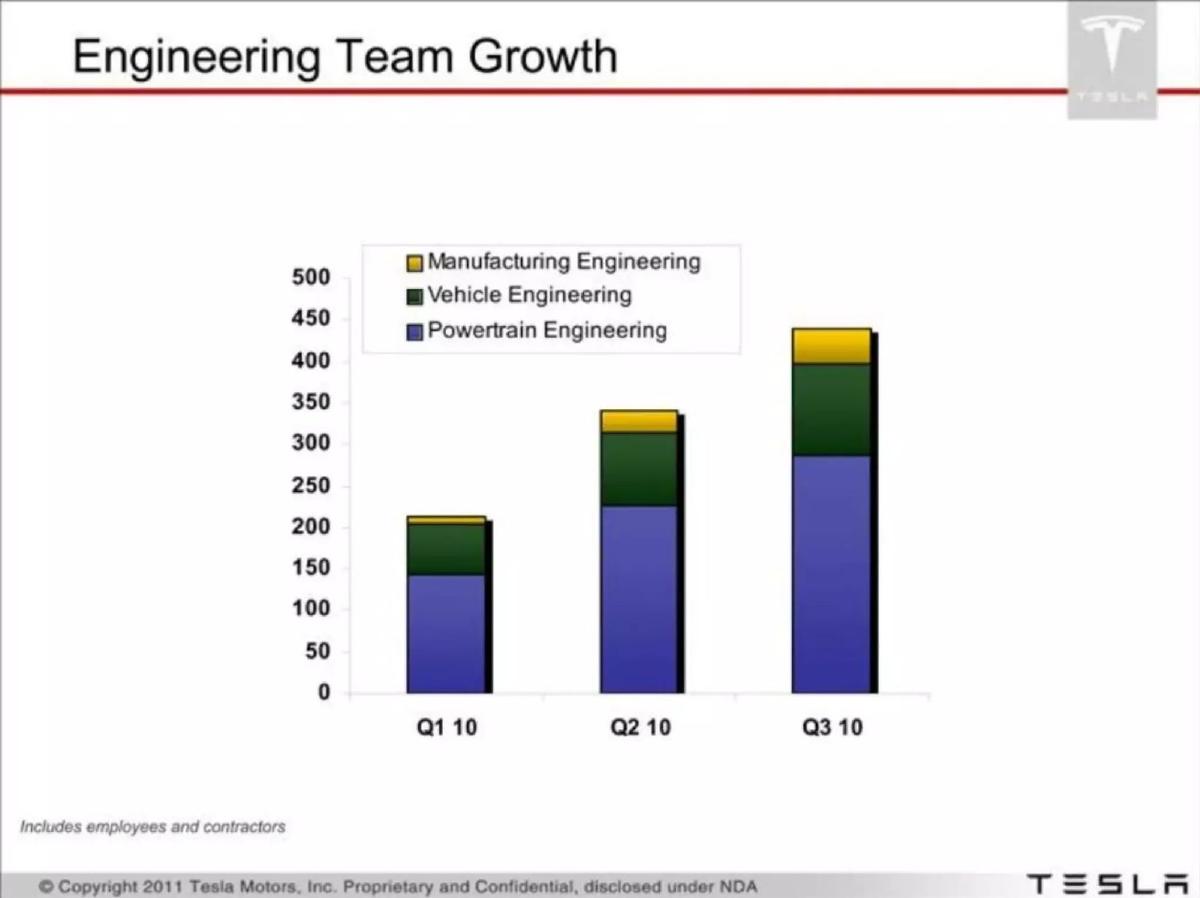
Following this is a simple bar chart titled “Engineering Team Growth.” It shows the headcount increase across Powertrain, Vehicle, and Manufacturing engineering from Q1-10 to Q3-10. While simple, it's a powerful signal of execution. They are not just a collection of impressive resumes; they are actively building the army required to go to war.
Validation Through Partnership: The Core of the Deck
The next three slides are arguably the most powerful in the entire presentation. In an industry where startups are often crushed by incumbents, Tesla flips the script, presenting those same incumbents as partners, customers, and investors. This section is a masterclass in de-risking a business.
Toyota
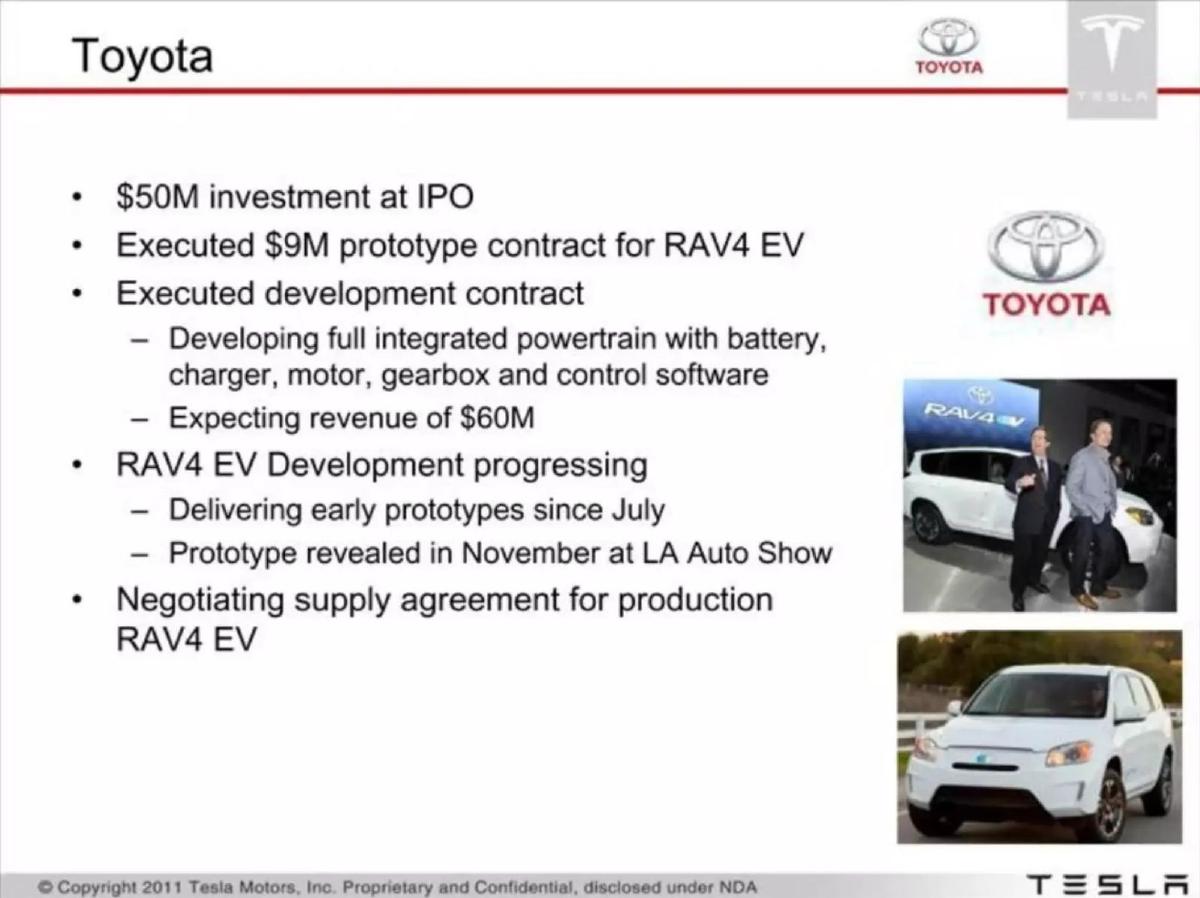
The Toyota slide is a blockbuster. It announces a $50M investment at IPO from one of the world's largest and most respected automakers. This is the ultimate third-party validation. It continues by detailing a contract to develop a full powertrain for the RAV4 EV, with expected revenue of $60M . They are not just getting an investment; they are getting paid to do what they do best. The slide notes that development is progressing, with prototypes delivered. This isn't a press-release partnership; it's a working, revenue-generating relationship.
Panasonic
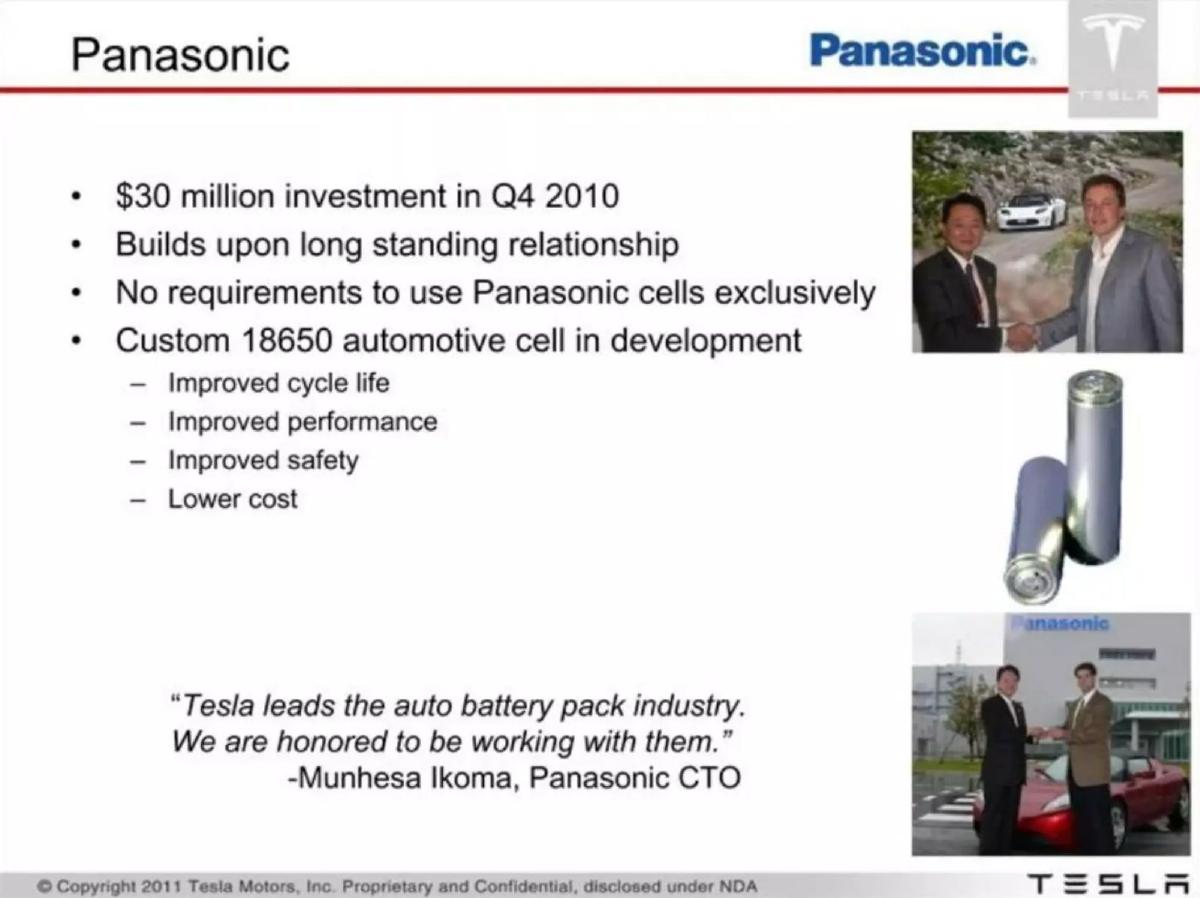
The next slide details the relationship with Panasonic, the battery cell supplier. It highlights a $30M investment and frames it as building upon a long-standing relationship. Crucially, it clarifies that Tesla is not locked into using Panasonic cells exclusively, preserving strategic flexibility. The most important detail is the joint development of a “custom 18650 automotive cell” with improved performance, safety, and cost. This demonstrates that Tesla isn't just buying off-the-shelf components; they are co-developing core technology with a world leader. The quote from Panasonic's CTO—"Tesla leads the auto battery pack industry. We are honored to be working with them"—is an investor-grade endorsement.
Daimler
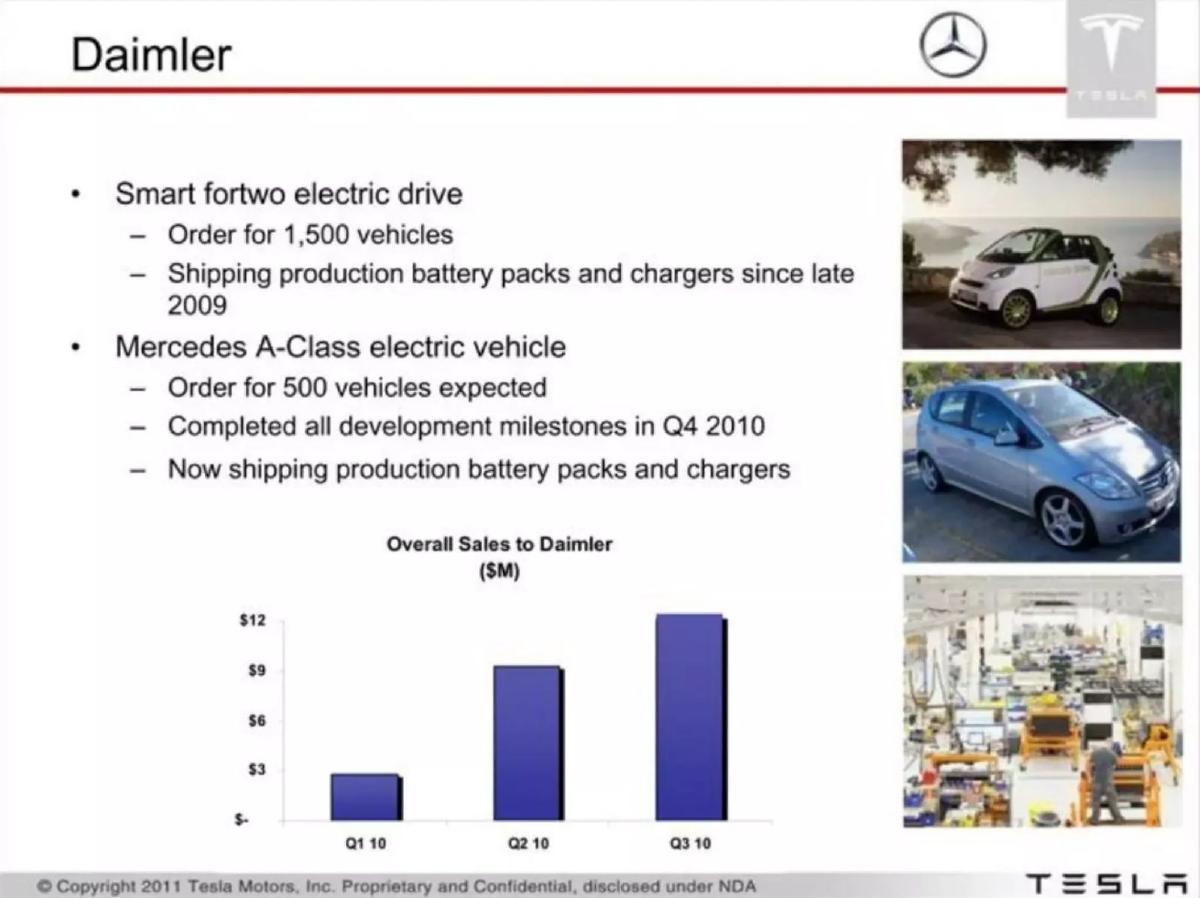
The Daimler slide provides concrete revenue traction. It details orders for battery packs and chargers for two separate vehicle programs: the Smart for two (1500 vehicles) and the Mercedes A Class (500 vehicles expected). A bar chart shows “Overall Sales to Daimler” growing through Q3. While the exact numbers are hard to read, the trend is clear: this is a real, revenue-producing business line. For an investor looking at the massive capex required for the Model S, seeing this non-trivial B2B revenue provides a crucial financial cushion and further proof of technological leadership.
Taken together, these three slides tell an investor: “The world’s leading automotive and electronics companies have vetted our technology, invested millions of dollars into our company, and are paying us millions more to put our powertrain in their cars. The technology risk is significantly lower than you think.”
Product: From Halo to Mainstream
Having established its technical and operational credibility, the deck pivots to the product that this fundraise is presumably all about: the Model S.
Roadster: The Proof of Concept
A single, visually-driven slide titled “Roadster Leading the Way” serves as a bridge. No metrics are given. The purpose of this slide is to remind investors that Tesla has already built and delivered a groundbreaking EV. The Roadster is the halo, the proof that the core technology works and can deliver incredible performance. It’s the foundation upon which the entire Model S plan is built.
Model S: A New Category
The deck introduces the Model S with an image and a clear, focused goal: “20K Units Annually - 1% Share of Premium Global Market.” This is a smart way to define the market. Instead of a giant, unbelievable TAM slide, they present a specific, attainable beachhead. They are targeting a tiny slice of a large, existing market, which feels both ambitious and credible.
The next slide, “In a class of its own,” details why the Model S isn't just another electric car. It’s a list of features and performance specs that were, at the time, revolutionary. The features highlighted are not just car features; they are tech features: “17 inch 3DFX touch screen computer,” “4G Wireless connectivity,” “Applications Platform.” This frames the car as a piece of consumer electronics as much as a vehicle. Simultaneously, it highlights superior automotive specs: “More cargo than any other sedan,” “5 star crash rating,” and performance numbers like “Up to 300 miles per charge” and “0-60 mph under 6 seconds” that demolish the existing stereotype of EVs as slow, compromised golf carts. This slide effectively creates a new category for the Model S to dominate.
Traction and Vision: Demand and Scalability
With the product defined, the deck provides evidence of market demand and a vision for the future.
Model S Reservations
A bar chart shows “Cumulative Model S Reservations” growing steadily to around 3,500 by Q3 2010. While not a massive number, the slide adds two crucial pieces of context: the sales team is “not actively focused on getting” them, and the reservation price is a “minimum $5000.” This is not a flimsy, $99 waitlist. Raising over $17.5M ($5,000 x 3,500) in deposits for a car that doesn't exist yet, without a major marketing push, is a powerful signal of genuine product-market fit with early adopters.
The Technology Platform
The slide titled “Platform for Broader Market Opportunity” is a simple but profound diagram. It shows a common powertrain and adaptable platform as the base for future vehicles. This is Tesla’s rebuttal to the question, “How are you more than a one-hit wonder?” It tells investors they are not just building a car; they are building a scalable architecture. The explicit mention of “Gen III EV” on the Fremont Facility slide reinforces this. The vision is clear: use the high-margin Model S to perfect the technology and manufacturing, then leverage that common platform to build a more affordable, mass-market car. This is the secret master plan in a single slide.
Execution: Building the Machine
The final section of the deck is dedicated to proving that Tesla can actually build the Model S at scale. For a car company, this is everything.
The deck dedicates multiple slides to the Fremont Facility . The first presents the acquisition as a massive strategic win. For a purchase price of just $42MM , Tesla acquired a facility with a historical capacity of over 400,000 units. The deck calls it a “proven facility used until recently to produce high quality cars.” This is a brilliant move that sidesteps the immense cost and time of a greenfield factory build. It presents the factory not as a liability or a cost, but as a deeply discounted strategic asset that de-risks the entire production plan.
A subsequent slide provides a bullet-point update on the factory’s progress: ownership transfer is complete, equipment is being installed, and they are preparing for prototype builds. This isn’t a plan; it’s a status report. It shows methodical execution against a complex operational timeline. For investors worried about “production hell,” this slide is a dose of calming reality. It says, “We have the factory, we have the plan, and we are on schedule.”
What's Missing: The Glaring Gaps
Despite its many strengths, this presentation is notably incomplete by modern standards. There are several critical components of a standard pitch deck that are entirely absent from the provided text.
The Problem: The deck never explicitly states the problem it is solving. The evils of gasoline, the poor performance of previous EVs, and the dependence on foreign oil are all implied, but never articulated. The presentation assumes the audience already understands the ‘why’. · Financial Projections: There are no financial models, no P&L projections, no cash flow analysis, and no balance sheet data. The Daimler revenue chart is the only piece of quantitative financial information. In a business this capital-intensive, the absence of a detailed financial plan is a major red flag in a vacuum. · Competitive Landscape: The deck claims the Model S is “in a class of its own” but does not provide a competitive matrix or analysis. It doesn't show how it stacks up against other EVs (like the Nissan Leaf) or incumbent premium sedans (like the BMW 5-Series). · The Ask & Use of Funds: The deck is titled “Investor Presentation,” yet it never states how much money it is trying to raise or how those funds will be allocated. There is no ‘Ask’ slide.
The absence of these slides strongly suggests one of two things: either this is a partial deck, or it was designed specifically for a context (like a pre-IPO roadshow) where detailed financials and deal terms were provided in a separate prospectus or discussed verbally. A founder today should not interpret these omissions as a new standard. For almost any fundraising conversation, financials and the ask are non-negotiable.
Conclusion
The early Tesla investor presentation is a masterwork of strategic communication. It sells a high-risk, capital-intensive vision by relentlessly focusing on de-risking. The narrative is clear and compelling: We have assembled a world-class team from both tech and auto. We have validated our core technology with paying customers and strategic investors who are industry giants. We have a halo product on the road (Roadster) and a category-defining successor ready for production (Model S). We have tangible, costly demand signals for that successor. And we have secured the manufacturing facility to build it at scale for a fraction of the expected cost. Every slide provides another piece of evidence that the team is executing on its audacious plan. It is a deck built on proof, not promises.
Frequently asked questions
- Why does this deck dedicate so much space to OEM partnerships with Toyota, Daimler, and Panasonic?
- Because in a capital-intensive business like automotive manufacturing, third-party validation from established, respected leaders is the single most powerful way to de-risk the venture for new investors. These partnerships demonstrated that Tesla's technology was not just a science project; it was robust enough for major automakers to invest in and pay for. It moved the conversation from 'Can they build it?' to 'They're already getting paid by the industry's best.'
- Tesla doesn't have a 'Problem' slide. Can I leave that out of my deck too?
- Unlikely. Tesla was operating in a context where the problem—dependency on oil, climate change, and the poor quality of existing EVs—was widely understood by the sophisticated investors they were targeting. For most startups, you cannot assume the audience shares your unique insight into the problem. You must articulate the pain point clearly and compellingly to establish the need for your solution. Tesla is the exception, not the rule.
- The team slide is just a list of names and titles. Why is it considered so effective?
- Its effectiveness comes from its strategic composition and headline. The title 'Best of Silicon Valley & Auto' is a thesis statement. The names below it are the evidence. It lists specific, high-profile leaders whose past experience at iconic companies (Toyota, Mazda, Jaguar) directly maps to the primary risks of the business (manufacturing, design, engineering). It showed investors they had assembled a 'dream team' specifically recruited to solve the unique dual-challenge of being a tech and auto company.
- Tesla used Model S reservations as a traction metric. Is this a good idea for my hardware startup?
- It can be, but context is critical. Tesla's approach worked because the deposits were substantial ($5,000 minimum), indicating high intent from customers. This made it a meaningful financial and demand signal. If you use pre-orders or reservations as a metric, be prepared to defend their quality. A large number of $1, no-commitment 'reservations' is far less impressive than a smaller number of significant, non-refundable deposits.
- This deck is missing financials, an 'Ask', and a 'Use of Funds' slide. Does that mean they're not important?
- Absolutely not. This is a critical point. This deck was almost certainly presented in a context, like a formal IPO roadshow, where a separate, detailed prospectus contained all the financial data and deal terms. For 99% of founders raising capital, omitting these slides would be a fatal error. Investors need to know your financial plan, how much you're raising, and how you'll spend their money to hit your next milestones. This Tesla deck should be seen as an incomplete document in that regard.